On Saturday morning Cabul and I set as out as tourists. ADRA had made driver Charles and an ADRA car available to us in exchange for expenses, a very generous deal. We drove to Fort St. George at the end of the bumpy road into El Mina.
The Portuguese arrived here in 1482 attracted by vision of gold. They built a fort with a church inside it, as they did in many other places along the West African coast. The Dutch, their arch-rivals at the time, showed up in 1637 and kicked them out. They enlarged the fort with two moats and a drawbridge 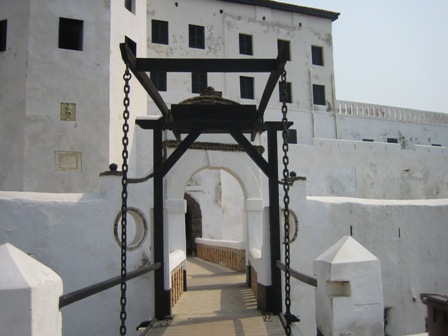 that has a distinct Dutch flavor. They turned the Portuguese church into storage space and made a more austere church in the main building of the fort, right above the female slave quarters, dark and filthy places where the women and men were held, separately, waiting for the ships to take them across the Atlantic.
The old church now holds an exhibit about culture, kings and the customs of the land. The list of kings goes back to 1300; the first 350 years seem more stable with kings chosen along the maternal line; the second 300 years favor the paternal line but there is much interference from the Portuguese, then the Dutch, and then the British. Kings sit on stools rather than thrones, and thus kings are stooled or destooled as the case may be.
As the guide told us delicately, the Dutch men, and the Portuguese before them, were without wives in these dangerous tropical lands and so they needed ladies. Thus, from time to time the miserable group of women was let out of their dank and dark dungeons into the courtyard. Standing in that very place I could picture how the governor, leaning out over a balcony two stories higher, would scan the crowd for his enjoyment. While he was doing this the blinds on the church windows across from him would be ordered closed. Clearly he did not want God to see him as he was preoccupied with his baser instincts.
If the governor could not make up his mind the guards used a Dutch rhyme that I learned when I was little (iene, miene, mutte). Our guide Richard recited it with the right intonation; the words were a little off, but may be it is because it was old Dutch, a language I never learned.
The ‘lucky lady’ was cleaned up by soldiers and given some food and sent up through a set of backstairs and a trapdoor to the governor’s private quarters, to be used as he wished. After he was done she’d go back down the trapdoor and held for a while on the floor below to entertain the officers who lived there before being discarded back into the mass of misery down below. Her only hope was that she conceived. Pregnant women were released. They could go home, a walk of some 1000 miles, or stay in town and become the mothers of a new group of notables. Their children had Portuguese or Dutch last names and were of light skin, which meant better in the social pecking order. They became the new elite. They are still very visible to this day al along the Southern coasts of West Africa. The Maternity Home has been restored and stands as a symbol of new life, in more than one sense.
The Dutch were driven out by the British in 1872. With the abolishment of slavery the place started to decline as a commercial center. Now, with the help of the EU and the Dutch government an ambitious restoration project is underway. Pictures of Dutch Crown Prince and his Maxima show the launch of the project.
After the fort we visited a similar imposing building but there the restoration and ‘touristification’ had not yet taken place. We were the only people there and had to wake up the ticket seller, sleeping on a bench in a stark naked room with only a transistor radio for company. We paid 2 dollars for a self guided tour as per the fee schedule posted on the wall but there was nothing to guide us; the place was in disarray with debris and construction material strewn along, bats and birds nesting in the turrets. They did not like our intrusion. It was a very short tour.
After lunch at the restored Bridge House, now a hotel and restaurant, we left for Kakum National Park. The park is about 35 kilometers inland, and has the only canopy walk in Africa, according to our forest ranger guide. We started our walk with buses full of Ghanaian adolescents, mostly church groups, and a sprinkling of foreigners. The walk up was tricky for me, uneven rocks and quite steep at first. But even I was in better shape than many of the young Ghanaians, so I understand the health minister’s preoccupation with ‘Mens Sana in Corpore Sana.’ Cabul and I were number 2 and 3 on the walk which consisted of 7 spans of 40 to 60 meters long that were constructed from aluminum ladders laying flat on the bottom of nets tied to ropes and with a plank over the ladder to facilitate the walking. 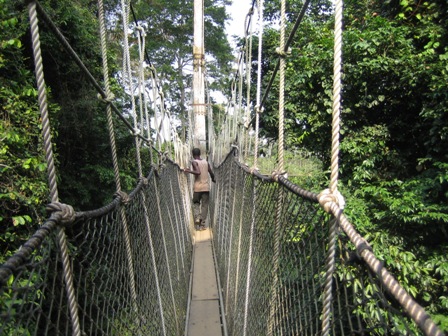 The walks were between 11 and 40 meters above the ground. It was breathtaking to be so high up with the sounds of the forest canopy, mostly insects and birds. We were sufficiently ahead of the teenagers to not hear their shrieks of laughter and terror. We watched them later as they stepped on the first walk, the boys teasing the girls, the girls playing their damsel in distress role to the hilt.
Back at the park entrance I visited the exhibit which was nicely done. It was the first time I saw the Adinkra symbols used in ways I like to use them. Many are stylized representations from nature and it is graphic design at its best: the fern stands for endurance and defiance; the snake climbing up a palm tree stands for doing the impossible and 4 crocodiles pulling outward stands for unity. It gave me some more ideas for next week.

 Sylvia's Journal
Recent Comments