The workshop started with about 75% of the participants. Maybe some people were disappointed about this b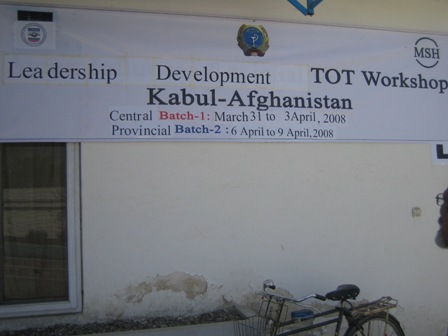 ut I was happy as it made the room a little less crowded. The reduced number allowed me to re-arrange the program to accommodate for the opening delays and the fact that everything takes much longer than I guessed because of translation. Oh how I wish I could speak the language of Darius!
We are doing the training in the MSH office This means we are completely self-sufficient: above us is the secretariat, all around us are MSH support and technical staff, down the hall is the kitchen that provides us with food and drink, and next door the prayer room so no one has to leave the place. Next week is going to be quite a show, we will have the biggest of MSH’s conference rooms set up in theater style to seat about 50 people and on each side of it a workshop room seating about 25 provincial health authorities, NGO representatives and technical advisers around smaller tables.
After watching a video of an inspiring leadership program in Egypt that Joan and Morsi launched some 6 years ago we engaged the group in a visioning session that had to break through rigid mental models steeped in current reality problems, abstract language and a focus on action rather than results. This is the contradiction: people are urged to act but then all they can think of is action verbs without any of them being anchored in the end result that the action is supposed to produce. It took some effort to get them down to thinking in pictures and it was a bit of a stretch for my co-facilitators. We switched back and forth between Dari and English and ended up facilitating as a trio. It feels OK, my gut tells me; it is the only honest source of feedback I have because I am unlikely to be criticized. This is a problem I share with top leaders when I am out in the field: severed feedback loops. I have cultivated my gut to compensate for this paucity of information through more direct channels.
Lunch was served in boxes from Kabul’s fast food chain called Chief Burger. It contained a hamburger, fries and a coke. What gives it away as Afghan fast food is the flat bread. It was only halfway through my hamburger that I discovered that the Afghan flat bread was wrapped around kebabs. The first bite brought back memories of the trip Axel and I took around Afghanistan in the fall of 1978. We traveled on a budget of just dollars a day and this is what we ate, pretty much all the time. The only thing missing is the small tray with the three spices: powder made of ground grapes, chili pepper and salt. Taste and smell evoke instant memories of this magical trip along the hippy trail that bonded us together for the rest of our life.
In the afternoon we had strayed so much from the program that it was no use trying to catch up. Instead I used the dynamics in the room to illustrate some facilitation do’s and dont’s; like how to recognize and then deal with energy dips; how to respond to the incessant requests for explanations about how scanning is different from monitoring and evaluation (it turned out the Dari translators used the same word) and the most engaging ways to handle the reporting out by small groups.
The first day ended on a high note and was closed by the DG of Provincial Public Health exhorting everyone to write down every word I say. I’ll try not to make that happen. Here too I am amazed again how new and novel adult education methodology is. Everyone knows the theory but translating it into action does not happen. It is no wonder training has gotten such a bad rap; and it is no wonder that people believe training workshops are not complete without ice-breakers; of course, something’s got to break the ice, since powerpoint slides don’t.


 Sylvia's Journal
0 Responses to “Afghan Chiefburger”