Archive for May, 2008


Shoesaver

The party of Reinout is over in more than one way. A swift train ride took us to the airport and I am now in a place that is beginning to feel like my second home, Schiphol airport. The train ride on the second floor of the train allowed us to see the Dutch landscape, on another 10+ day, slide by in all its glory. It does make me a bit nostalgic. When I lived here I did not appreciate the beauty of my own country. I found it boring because it was flat. Bicyclists got onto the train with their bicycles. I wished we could join them, although going back home has its own appeal.

All 150 people invited to Reinout’s party showed up; there were few I knew other than direct family and one person who I had last seen about 45 years ago.

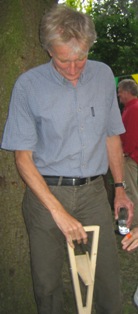
There were a few songs, a long, rambling and wonderful speech by my Irish twin brother Willem who gave Reinout a contraption made by one of his patients in the far east corner of Holland. It is called a shoe-saver and is constructed to help older gentlemen avoid the post-pee dribble that can mess up nice shoes. Axel and I see a business opportunity that would start with advertisements in the retired persons magazine. When not peeing, the gentleman can use the contraption as a walking stick. We also see an application for women.

Longevity

It is summer in Holland; a premature summer that dresses people in shorts, tanktops and flipflops. Who cares that is still early May. The tulips have accelerated their blooms and some people who travelled long distances to come to the famous Keukenhof tulip park will be disappointed in missing these blooms if they don’t get there soon. We made the trip yesterday; Axel for the second time in 2 weeks. The tulips in the shaded areas were still in the prime of their bloom and the park has been expanded with many other varieties of flowers, among them a lily pavillion with more lillies than you could throw a stick at in enormous vases in a thousand shades of red, yellow and white.

We bought fresh asparagus, just picked from a field next to the small store. They are white and fleshy and taste nothing like the thin green ones we know. We served them, traditional style, with eggs, collected that day from under Sietke’s own chicken, ham (not from her pigs) and new potatoes; for a final touch, melted butter, also from the farm, was dribbled over everything. Dinner was preceded by cocktails: raw herring and white beer and ended hours later at dusk, which starts here about 10 PM.

Loaded with heavy suitcases and bags full of licorice and other Dutch delicacies that have to make the trip back with us tomorrow, we dropped off the car at our friends house in Hilversum and then took the train via Utrecht to Tilburg. This was no small feat because we were carrying what feels like 100s of pounds and no elevators or escalators, only stairs, everywhere. We have come a long way since July 2007.

My nephew Pieter, last seen swimming in the fridgid waters of Lobster Cove in the middle of March picked us, and our heavy luggage, up and drove us to his dad’s home, my baby brother Reinout, where the preparation for his 50th birthday party were in full swing.

Reinout had organized an outing for the early arrivals to visit the local modern art museum. It reminded us of MassMoca. It is built in an old textile factory. I learned today that the not so nice name for people from Tilburg is crockpissers (kruikenzeikers). Reinout explained that, in the olden days, the woolfactory workers had to bring their pispots to the factory because the urine was used in the processing of the wool. It gives a whole new meaning to human resources.

When we came back a giant inflatable Abraham decorated the yard. In Holland, when you turn fifty, you ‘see’ Abraham (women ‘see’ Sarah). It has something to do with longevity.

Aspagras

Yesterday was a long day that included a change in continent during the night. It is only when I got to the airport that I realized how tired I was. The prospect of two days vacation in Holland was appealing, especially since it included Axel who was waiting for me upon arrival at Schiphol at 6 this morning.

Yesterday I ended my assignment with a brief stand up meeting with the MSH team during which we discussed the operational plan that needs to be implemented between now and August, to launch the leadership program.

I checked out of my hotel early and thereby missed my last chance at breakfast at Don Vito’s, the Italian restaurant on the ground floor of my small hotel, wedged in between the London Café and the Fitness Centre. Breakfast at Don Vito’s sounds more interesting than it is, although it’s worth it just for the coffee which comes out of a giant espresso machine; the kind you’d find all over Italy but rarely in the US.

Laika the MSH driver took me to the Hilton where I arrived just in time for the morning break of the meeting which brought my colleague Karen to Addis. Among the 30 or so participants I recognized two, one from Ghana and one from Tanzania whom I remembered from previous assignments, one 4 months ago and the other 9 years ago. The conference consisted of PowerPoint presentations followed by group discussion around a case study. I had a hard time getting into it and stayed in the background.

At lunch Karen and I sat with the Ethiopian delegation which consisted of an older doctor with his young and timid staff. It was hard to get them to talk about management and leadershp. They used vague language and I suspected they really didn’t understand what management and leadership really meant. Maybe someone had convinced them that they needed management and leadership training. My quick and dirty needs assessment gave me no clues at all. Nevertheless, now that we are establishing a local leadership development team, we can offer them something of value. It would be a less complicated and costly arrangement than having to fly people like me in from afar.

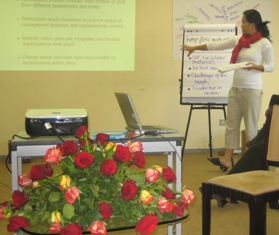
Karen was on after lunch and executed a flawless presentation, the one she had practiced on me on Sunday and refined after that. The group discussion afterwards around a case study started haltingly; once again it appeared that people were not sure what they were supposed to say. The discussion heated up when one person asked whether leadership could actually be taught. With that we were off on a more engaged conversation with people debating that question rather than the four questions that the case study posed. The whole thing remained somewhat unfocused which was predictable since the desired outcome of the discussions was not entirely clear to anyone.

The organizers of the conference were happy with how things were going; but it was not my kind of conference. Having seen other modalities for people to learn and engage together, I find myself quickly bored with the more traditional style that marked this and a thousand other meetings and workshops that take place throughout Africa and the world.

I arrived at the airport with many ecstatic couples with tiny or not so tiny adopted Ethiopian children on their way to a new homeland and family. I have never seen so many adopters and adoptees together in one place. One wide-eyed little boy navigated the escalator with a huge grin on his face while holding on for dear life to his new dad’s big hands, new mom hovering lovingly behind him. He was on a big adventure; everything was new.

A nice KLM steward seated me in an empty row, far away from crying babies, which allowed me to sleep throughout the flight to Amsterdam. When I woke up we were getting ready to land. A sign, mowed in a field in gigantic letters, welcomed me home in Dutch. The message was signed by Holland’s largest producer of sausages and canned soups and stews, flooding me with memories about winter meals on dark afternoons and camping dinners with my brother in Vogelenzang.

It is a gorgeous day in Holland with everything in bloom and birds chirping. We are off to buy fresh asparagus from the field. They are white and fleshy here and worth a trip to Holland, just for that.
Names

Yesterday we met at the Ethiopian Management Institute where our new lead facilitator had sufficiently intrigued several of her colleagues with stories about the inception workshop of last week that seven of them showed up for our meeting. They did enter the meeting room with large question marks on their forehead.

Without much input, since everyone had been busy, I had proposed an agenda that was about the right things but much longer than anyone expected. It is, once again, part of these awkward steps with a new dance partner, when expectations and aspirations are still not known. It was also not entirely clear who was leading and who was following. But somehow our intuitions and commitment carried the day and we ended up dancing beautifully together, producing the outputs that I had hoped we would.

While waiting for the meeting to start I asked everyone what their name meant. In most of the world people’s names are meaningful. They are in a way the very personal visions of parents (or families) for their newborn child. In our case, the meaning of the names of the people around the table also made a nice backdrop for our future work together and it broke the ice, there was much laughing. Imagine a group with names like Hope, Diamond, Strong-and-Mighty, Forget-the-Past-and-Start-Anew, Pillar-of-Light, Never-Run-Away, Beautiful-Greens and Like-My-Mother! How could we possibly go wrong?

Our brandnew team leader from EMI led us through an exercise that took us from a shared purpose, shared vision, to a measurable short term result and a better understanding of what we are collectively up against. In the middle of her facilitation she was served a macchiato and we were asked if we wanted one too. At first I did not think I heard the word well and assumed I must be mistaken; Macchiato? In Africa ? In a government institution? But I was not mistaken and we were all served the best macchiato I ever had in small glass cups. This is after all Ethiopia and a place where Italians left their footprints all over the place.

At lunchtime everyone was in high spirits and the collective visioning and planning had created a team spirit that no teambuilding exercise could have created. We also had completed, in half of the envisioned time, enough for the MSH team to turn into a plan with a budget; the boss would be satisfied. We were treated to a delicious lunch in the bright and airy restaurant at the institute’s top floor.

I completed the details of the ‘what’s next’ piece in my hotel, mindmapping all the steps that will take us from here to a successful launch of this new program in early August. There is much work to do, but we have done it before and I have a good sense of what it takes.

Tae and I went out for dinner in the Zebra Grill restaurant where no zebra is served. We reflected on the week and on life in general. It has been wonderful to work with her so intensely this week. Whoever offers her a job next is lucky. Her Ethiopian name is Almaz which means diamond. It is an apt name; she is truly a gem.

Today is departure day. After checking out of the hotel, one last visit to the office to transfer the planning tasks to my colleagues here in Addis. Then I will head out to the Hilton to support Karen for her presentation and meet a new cast of characters who are here to study private-public partnership. Karen will enlighten them on how to strengthen managerial and leadership capacities that will make these partnerships work.

On time

When I arrived at the office yesterday morning I had expected to have ample time to prepare for a meeting later that day with the core team that is supposed to lead the leadership work here in Ethiopia. I thought we had agreed on a meeting at 3 PM but everyone showed up at 9 AM. This was the second time that something like this happened during my short stay here. I assumed that somehow I had not communicated the time clearly.

I am amazed that it took me an entire week to discover that there is such a thing as Ethiopian time which is 6 hours behind the time I took to be universal. It was a humbling experience of my Western (US/European)-centricity.

And so I learned yesterday that Ethiopian time starts with 1 o’clock at what I consider 7 AM. When 7 PM arrives it is back to 1 o’clock. Thus, when I convened the meeting at 3, it was assumed I meant 3 o’clock Ethiopian time, which is why people arrived at 9 AM. It took me most of the day to get my head around this.

There was more. I had been puzzled all week by the surprisingly clean and freshly painted signs celebrating the Millenium. In my calendar, this happened 8 years ago. Yesterday I learned that Ethiopians are currently in the year 2000, not 2008. The Ethiopian calendar is 8 years behind the one I know (‘we are 8 years younger,’ said my 60-ish counterpart Hailu with a grin). There were more suprises. Because here, all the months have 30 days there is a need for a 13th month (‘Ethiopia, 13 months of sunshine’ advertises a poster on the side of the road). The 13th month is a very short one, 5 or 6 days. And thus I found out that something I did not consider possible is possible after all: May 6 and April 29, 2008 and 2000, and 9 AM and 3 PM all happen at the same time. Talk about living with ambiguity! The lesson from all this is to remember to add an adjective to the word time, either ‘Ethiopian’ or ‘ferang’ (foreign) and not to make any assumptions, or at the very least, check them.

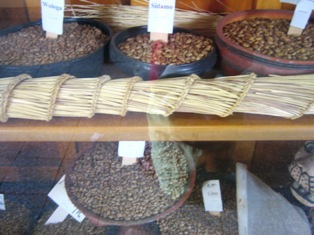
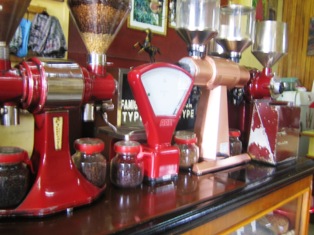
After the hastily improvised meeting I went to get the coffee beans I had promised to bring home. Tomoca is a place that is all about coffee: regional varieties, roasting techniques, taste and smell. I bought green and roasted Yirga Chaffe beans, and two other regional varieties of roasted beans. I was a bit overwhelmed by the number of choices, green, unwashed, washed, powder and several different kinds of roasts (Famiglia, Turco, USA, Bar and Swedish type). I also bought a children’s book about Kaldi and the dancing goats who discover coffee beans (explaining why the Starbucks wannabee is called Kaldi). I had heard the same story 30 years ago in (North) Yemen. Ethiopians and Yemenis are both claiming to be the birthplace of the coffee bean (from Kaffa or from Mocha) and the Queen of Sheba.

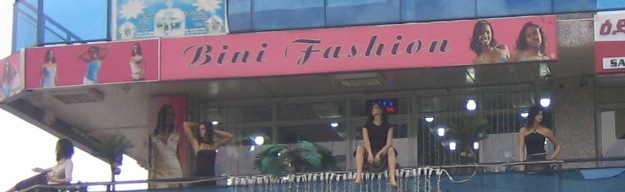
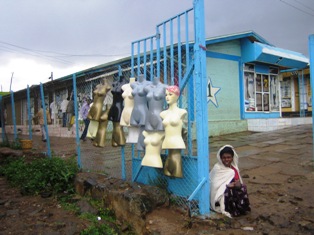
On the way I finally got to take a picture of a fashion boutique a few floors above the road where pale mannequins perch seductively on gallery railings.

Back at the hotel I had lunch with my friend Tom from New Hampshire who happened to be in town as well. We had not seen each other for several months and had much catching up to do. The rest of the day was spent writing my report, cleaning out my inbox and preparing for tomorrow’s planning meeting which, hopefully will start at the time I expect it to start

Ants in our pants

Yesterday we visited Mount Entoto which looks out over Addis. Emperor Menelik II, claimed to be a direct descendant from King Solomon and the Queen of Sheba, built his palace there and founded Addis Ababa. It is considered a sacred location with several simple and rusty tin-roofed monasteries surrounding the church and palace. The church was not accessible to us. The palace consists of three simple structures where king Menelik II and his wife Taitu slept, ate and received guests, each category of guests required to enter and leave through a separate entrance. Compared to the quarters of their royal and imperial contemporaries in Europe, the buildings were striking in their simplicity. They also contrasted with the heavy embroidered and bejewelled gowns worn by the imperials and clergy which we saw earlier in the adjacent museum.

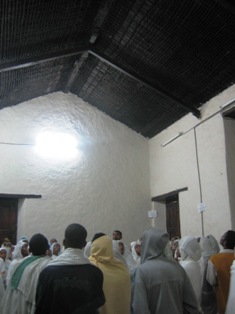
A nearby church, named after archangel Raguel, was open. Like the other structures it was simple on the outside but awesome on the inside. Around the central room, only accessible to men, so not us, the biblical stories were painted in the typical bright-colored Ethiopian style. I recognized most of the imagery although there were some stories (like St. George slaying the dragon) that did not come out of the bible that Tae and I know.

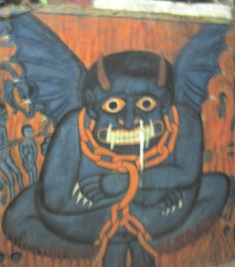
I learned that the bad people are portrayed with one eye only while the good people are shown with both eyes. In most of the pictures the one-eyed people do terrible thing to the two-eyed people; a true horror show with severed heads, limbs, drownings, quartering and finally, the devil himself in dark and menacing colors.

Outside the church Karen noticed a monkey but our guide, for reason we could not figure out, told her it was a rabbit, even though it was so not a rabbit and we were all totally sober. Maybe the guide was not.

In the car on the way back we discovered we had biting ants in our pants. It took awhile to squash them all; they were big. By the time we stopped for a lilttle shopping expedition the ants were all dead and the sting of their bites gone. There were hundreds of little shops selling endless variations of woven fabrics, from simple unbleached cotton dresses and shirts to colorful shimmering shawls and a few tourist trinkets that play on the Rastafarian theme. I bought a few shawls that look best when they are displayed together.

Mendi meat

Yesterday was an entire day without obligations because today Ethiopia celebrates Patriots Day. Offices are closed. I did not have to prepare anything.

I read, and finally finished, the hefty library tome that I have schlept to Kabul and now to Addis, about the Peabody Sisters. It is a book about the first four decades in the life of three extraordinary gifted women who lived about 200 years ago in New England in the shadow of famous men like Ralph Waldo Emerson, Nathaniel Hawthorne and Horace Mann. They lived in a time where women’s lives were too circumscribed to acquire lasting fame and recognition on their own. We have come a long way since then.

Karen showed up in the afternoon and we rehearsed her presentation at a conference later this week. Tae, although not able to join us, had recommended we have dinner at a Middle Eastern restaurant (Ali Baba) but we never found it. Our Amharic is limited to hello, thank you and goodbye which was not sufficient to find the place. In the end the taxi driver drove us to a place that he thought sounded similar enough, Al Mendi. We were enthusiastically received by several wait staff and were seated in a small, simple and very empty restaurant. We remained the only guests for the duration of our meal. We had been assured the food was ‘arabic’ but what we got was probably closer to an Ethiopian version of such food.

The explanations of the menu made our choices a little adventuresome, since everything on the menu was translated into English as ‘meat.’ It was good that Karen had become a flexible vegetarian as she calls herself now. We both got a bowl of lamb broth with a spicy sauce, followed by a mountain of orange and white rice, accompanied by small bowls with chunks of various meats in thick and spicy sauces. My dish had a giant drumstick on top that was too big for a chicken and too small for a turkey. What was I eating? Asking made no sense since the English of our wait staff was very rudimentary. In the background the Ethiopian TV channel was showing something about the big athletic event going on, so loud, that we could hardly hear each other. On our request they toned it down. Now they could watch us instead of the TV. A trip to the rest room was an adventure by itself, over a muddy path with scattered stones of various sizes, in the dark. The ankle hinge is still not functioning properly but the trip had to be made and was completed successfully. Karen and I parted ways in different taxis to our respective hotels.

In the evening I clicked through the available TV channels and found nothing but programs about people who were about to die a violent death: Elite US soldiers in the mountains of Afghanistan ambushed by bearded men with big guns, hapless holiday makers in a plane about to crash into the Red Sea and a young couple stranded in the open ocean after their diving boat took off without them; they both ended up being eaten by sharks; nothing light. I did not recognize how depressed I was getting until I opened my email and found another distress message from Tessa from Canada. The closing pages of the Peabody Sisters lifted my spirits before I fell asleep; a sleep full of dreams which evaporated while I took a shower.

Rest

We ended yesterday’s workshop a little earlier than planned because the participants used up so much of their energy in the morning that there was little left after lunch.

We were done about 3 PM and once again I found myself in that sweet spot which is called ‘goods delivered;’ a place that is both empty and full at the same time. Free to relax and do whatever I want, it always takes awhile to recover from the adrenaline surge that accompanies such an event. For the first time I felt how bad my foot ached. I had not paid much attention to the pains because I was focused on other things. With that need for attention gone I suddenly became a cripple. I had, after all, been standing and walking non stop for two long days. A bath helped. A foot massage would have been better. I remembered the 90-minute foot massage I had in China; something like that.

Cell phones are on big part of my professional life; less so my own and more so those of participants which always ring in workshops no matter what agreements you make about it. I get exposed to an amazing array of ring tones. This week I heard some interesting new ones. One cellphone rang like a marching band was coming around the corner; another was a laughing baby. It was hard to keep a straight face when it rang. Click here to hear it.

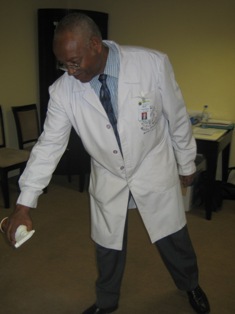
In the middle of the conference room was a large bouquet of roses; compliments of the hotel. The roses were still in good a shape when the room was disassembled. I pulled out the best looking ones which are now gracing my room in a beer glass. The arrangement was sprayed with a gold glitter spray for a special glittery effect. The floor of our room was also sprayed, each morning, to make it smell ‘orangy.’ The person in charge of the conference rooms, who I first mistook for a doctor because of his white coat, proudly showed me the the spray; made in America, he pointed out. The resulting scent was one of waxed floors treated with chemicals that smell like they ought to be outlawed rather than the intended orange blossoms.

My new found facilitator friend from the local management institute, Eneye, invited me out for an evening of culture. While I was waiting in the dark hotel lobby, the lights do go out from time to time and sometimes the generator overheats, she arrived with her driver who I mistook for a husband, and her little sister. They took me to a cultural restaurant that was already full with Ethiopians and only a few foreigners. Guests are seated on uncomfortable low stools or chairs that look like the obelisk of Aksum and tables that look like woven laundry baskets with a platter on top. There appeared to be always room for a few more people. Soon we were packed like sardines.

Stunningly beautiful waitresses served the traditional food, goat and lamb stew served with sauces that ranged from very hot to inedibly hot, on top of what Axel considers a dishrag (injera), a large spongy pancake, with more rolled up injera, dark and light colored, on the side. Musicians playing traditional instruments formed the backdrop of a tiny stage. More stunningly beautiful young men and women danced a variety of traditional dances in an odd assortment of outfits that seemed decidedly unafrican. I loved the music and the dances. There were dances that were simply happy and peppy and those that were more of the possessed kind with much shaking of body parts. In one dance the woman rolled her head so fast that her face looked like an early Picasso, where the eyes, nose, mouth and ears are all in the wrong place. At times I feared her head may simply come off. Eneye, her sister and I touched our necks in sympathetic pains.

This morning I was woken up at 4:30 by warm fresh bread smells coming in from below. The smells were accompanied by the throbbing sounds of music and dancing that came from the night life that was apparently still in full swing in the neighborhood.

This morning the rain is coming down in sheets. It is the kind of rain that washes away roads. It is considered a good thing. Rain is about food and thus life and survival. My colleague Karen has arrived last night. She, too, brought rain, a good omen for her, a good thing for Ethiopia.

Seeds

I never set foot outside the hotel yesterday. This is what happens when I am in the middle of a workshop. It is the downside of such short events – there is no time off. The day starts early and ends late.

Of the 30 people invited about 20 showed up with a lot of coming and going. This seems the trend in such intitial (‘inception’) events. I can understand this. There are many demands on people’s time and why go to this inception workshop when there is much else to do. I consider myself somewhat of a gardener: preparing the soil, planting some seeds. If I am lucky I see some of them sprout right in front of my eyes. I think I did see some green coming out of the soil.

The gamble of working through facilitators whose skills I don’t know paid off, if not in the quality of their sessions than at least in the modeling we do of how people learn skills and how to coach and mentor. It was noted and appreciated I believe. These first team experiences are like awkward dances with a new date. We are polite, careful not to step on toes and the conversation carefully monitored, at least by some of us. I am looking for reactions, openness, sensibilities, etc. I am encouraged by the commitment I have seen so far: they arrived early, were well prepared and stayed late for a debriefing and feedback session after 5 PM. This meeting was punctuated by a very loud but short aerobics class taking places a few floors below us in the hotel.

For this group the notion that management and leadership are important for producing better health services is beyond doubt. What to do about it is less clear. This is why we are demonstrating some of the processes, models and tools our project can make available. I showed once again the video of the Aswan leadership program (Seeds of Success).

I think I have now seen it a hundred times and it remains moving. It is also compelling because it so clearly links leadership development with tangible results that represent lives saved and family tragedies averted. I could tell that the Ethiopians were intrigued and some appeared to be ready to take up the challenge. I hope that what we are doing now is simply planting the ‘Seeds of Success’ in Ethiopia.

Final touches

A large billboard on the main drag advertises for ‘the best Ethiopian restaurant in North America.’ For this you have to travel to either Washington D.C. or to Baltimore. It seems a bit far when you are in Addis and hungry.

May 1 is a holiday. Nevertheless Tae, Hailu and I worked hard on putting the final pieces together for our ‘inception’ workshop tomorrow. The intent is to make a good case of why managing and leading is a skill that people who manage health programs ought to have. It seems so obvious but it is not.

I spent an hour each with the various members of our just-in-time facilitator team to rehearse their part in the workshop. Everyone will get to be the lead facilitator on one activity. Some people are a bit worried about this but how else to pass the baton to a local team?

I also tested out the Ethiopian music I donwloaded from the internet on my new colleagues. It turned out I stumbled upon the Ethiopian Cliff Richard and other musicians who had their peak in the 60s and 70s but are still well loved, especially by people with grey hair like me.

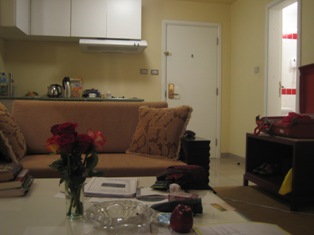
Tae and I went to see the workshop room in the Yoly hotel. The hotel felt more down to earth, more connected to Ethiopia than my Luxury Collection La-La Land Hotel that could have been anywhere in the world. So I changed hotels. Now I have a very large room that includes a kitchen, a balcony, and comes with permanent access to the internet, all for a much lower price. I can look into houses and yards that tell me I am in Ethiopia. My colleague Bannet, who is our project’s director, warned me that I am on the edge of the red light district. I reassured him that I usually don’t wander around at night in cities I don’t know. Nightlife, as seen from my balcony was active but did not interfere with my sleep.

Tae and I had lunch in a small café and I learned from her about the traditional coffee ceremony where, while the beans are roasted, a basket of popcorn is passed around. Then the aromatic beans are passed around like a smudge stick, the coffee brewed and served, sweet and strong, to be drunk in three small cup servings. Axel would like this place. Of course he expects I bring back some beans.

On the eve of the workshop I relaxed and ordered room service from the Italian restaurant below, wild mushroom ravioli and Tiramisu (the Italian influence is noticeable). I watched the National Geographic Channel which airs, every hour, an advertisement for a special next week with the words ‘Fasten your seatbelts for Air Crash Investigation.’ It shows images of terror-stricken passengers in airplanes that are crashing or exploding; my kind of documentary! Minutes later another advertisement says that donkeys and mules cause more accidents than airplane crashes. That ad was illustrated with a donkey kicking a pile of watermelons which rolled down a cobbled street and killed an old lady doing her marketing. Should I be relieved?

There was more good stuff on TV. A program about Dubai’s artifical island group (The World) showed how white-clad oil cheiks and Dutch engineers combine resources and ingenuity to do the impossible at unimaginable costs for the world’s richest people. It makes you wonder about our priorities. We could do a lot of other things with that kind of ingenuity and those resources in my line of work. At least it shows that, if we put our minds to it, everything is possible after all.


Categories

Blog Stats

  • 137,070 hits

Enter your email address to follow this blog and receive notifications of new posts by email.

Join 76 other subscribers