Archive for July, 2008


Spending

Every morning I wake up about the same time, 5 AM. This gives me plenty of time to write, get dressed and turn my rough ideas about what will happen during the day into something a little less improvised.

I dreamed about government contracts and small print, rules and regulations; this was probably triggered by learning last evening why we are responsible for several activities that appear to have little to do with each other. Alison played an active role in my dream because she was confronting our government reps with things that did not add up, were forgotten or made our lives miserable. She did this with great charm and respect, as she does in real life.

There was also a bride in the dream who I helped get out of a car, which required many hands. She was wearing a family heirloom bridal gown with several of the women who had worn it before in attendance, including those whose marriages had fallen apart. I was wondering whether seeing their dress in action again was difficult. Some of those women were relatives. They were all very skinny. And finally there was something about Haiti and lots of money. This is actually true. There is much money here, asides from the very wealthy private citizens, the US government also has access to enormous reservoirs of funds, which is why we are here. Spending it in ways that show compelling results to Congress is a different story altogether. This is also why we are here and why there is much work to be done.

Yesterday afternoon we closed the second of the three events I am here to (co)facilitate. The last one starts today, a teambuilding session with our Haiti team that is still very new and not even complete. They are not new to each other as many of them have been transfered wholesale from one organization to another after their contract ended. I have gotten to know many over the last three days but today all the staff, including the drivers, will be part of the session. This requires a design that does not depend on reading and writing skills. Antoine and I have discussed this and we have a very (very) loose design that involves a tree, with Antoine being the trunk. I get to apply the fertilizer.

The two facilitator teams practiced their sessions yesterday and critiqued themselves and then listened to feedback from their peers. Neither was easy. The level of disappointment is deep and the sense of futility is palpable; there have been too many well-meaning attempts to bring about positive change. Here I am part of yet another. Why would it be different this time? It is easy for me to say they have to become more leaderly in their behavior. This can cost you your head in Haiti as many people have learned. It’s a lesson that is not very useful and certainly not a behavior worth emulating.

A representative of our funder, the person who has a lot to say about how we spent the US tax dollars, swung by the hotel after everyone had gone home. We chatted while we had a local Prestige beer, and she listened intently to my explanation about our program. I am always a bit surprised when people like her get enthusiastic and want to know more. I assume they get to hear stories like that all the time. I expect such people to be jaded, but she was not. She confides that Haiti has been one of the most difficult places she has worked in, mostly because of the pervasive sense of pessimism and despair. She grew up as a missionary kid in the Ivory Coast and is an anthropologist by profession; she knows a thing or two about development and cultural change. Her French is impeccable. Our enjoyable informal conversation counted as my formal debriefing, to be checked off my to do list.

A band made dinner more festive last night. I had an overpriced vegetarian pizza that tasted like catsup and washed it away with superb pistachio ice cream. The two items together cost about 25 US dollars, probably because everything is imported. I wonder how Haitians who dine here can afford it.

Next to my table were four twangy-talking Americans, senior citizens, from the southern half of the US. In some respect they looked like missionaries (pale), in others they did not (Hawaiian shirts and dyed hair). I tried to listen to their conversation to alleviate my boredom during the long pizza wait. My interest was first tweaked by a story about an out-of-wedlock child of a mother who is now in her eighties and can still not talk about it; somewhere there is a half sister with kids and grandchildren who cannot be acknowledged as part of the family. It was all very sad and juicy. And then the conversation turned to colonialism and the various colonial rulers. The Dutch were also mentioned and I tried to move closer to the table without being too conspicuous. I wanted to know what they were saying and thinking about my people and debated whether I should simply join them and say, hey I am Dutch but I am also one of your people know (and don’t you love our president!). I would have loved to know who they would vote for and why. But then the long awaited (and tasteless) pizza arrived.

I brought out my computer and turned my attention to recording the band. I had hoped to link to the file here so you could listen in, but I cannot figure out how to do that (yet).

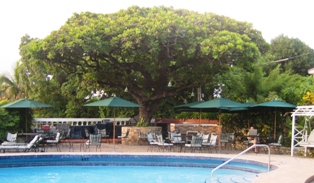
Heaven?

The number of participants has shrunk to 14. This was intentional. The people who are left are supposed to be the facilitators of the two leadership programs that will be launched in October. One group is going to realize one part of the vision that they created on the first day (medicine and supplies always in stock in the 200+ facilities) while the other is trying to get several groups of mothers and youth to take matters in their own hand in Cite Soleil, Haiti’s infamous capital slum. But before either of those things will happen, much needs to be done.

It is hard to shift from a training paradigm that consists of experts telling you what to do, who then hope you implement what they told you to. It is called the ‘spray and pray’ method. I sprayed a little yesterday but today several small groups will actually teach short pieces from the program by way of practice. It will also give me a better idea about the facilitator skill level of the people I will be coaching from a distance. It will also make the whole adventure more real for them.

When I handed out the assignments there was a visible shiver in the room. If some people had been hoping that this was going to be something that would not require much efforts (and was rewarded with abundant food at break and lunch time), then this was the rude awaking. It will be interesting to see if everyone shows up today. The whole event was labeled as a TOT (training of trainers), so it makes you wonder what people were thinking, but I also know that we human being are very good at fooling ourselves.

At the end of the day Antoine invited me to his home where, since one week, his family is also installed after a separation of 3 months. They are from Senegal, a place where two major life events occurred for our family: our marriage and Sita’s birth. Antoine has a young family with two adorable daughters, a very precocious 5 year old and an 11-month old baby. It was nice to escape the very limited hotel menu for a night and be fed Senegalese food which is one type of food I could eat for days in a row. After dinner I taught the five-year old Dutch children’s songs while she was trying to remember and English one. They had lived in Ghana until only a few months ago and I knew she could speak English (and Wolof) but she told me she could not remember. I predict that the Ndiayes are going to have a strong-willed teenager on their hands in about 10 years.

They live in a house that is glued to the mountain and overlooks the harbor and the airport. It looks tiny when you drive in from the street, where a heavily-armed guard greets you; but behind the entrance gate Escherian steps go up and down and reveal several stories and sections that make it more like a palace. The place is beautiful beyond belief and everything about its location, the flora and the climate in which it sits is gorgeous, except for that armed guard and the misery that exists too close for comfort. It reminds me of a joke the Libanese used to make when we lived there: God created Libanon first and poured all his love and beauty into the place. When it was finished he realized it was as perfect as heaven and people living in such a place would be spoiled (this is a very Calvinistic God) and so he put the Lebanese in it. It could have been a story about Haiti.

Seamless

I woke up with a brilliant title for today’s entry, at about 5:00 AM, but I wasn’t fast enough with my pen and it popped like a soap bubble. It had something to do with Liga, a vitamin-packed baby biscuit that was popular in my childhood and a school bus that wasn’t moving.

The night was interrupted several times when I woke up in a sweat. I could not tell whether this was caused by the old airco that wasn’t working as well or my body. The crash, now nearly a year ago, stopped the hot flashes. It was as if my body put that physiological transition on hold while it was busy with repairs. Breaking out in a cold sweat is actually not that surprising given how unprepared I feel for the assignment here because everything is turning out so very different from what I expected.

Last night at 8 PM I was ready to go to bed. I had not quite realized how tired I still was from the trip. But I could not, as the planned program for today had to be changed because of all sorts of last minute surprises, people not being where I thought they would be; a message from the DG of the health ministry for an appointment today. The appointment had been proposed for a more convenient time but then confirmed for a time that required missing most of the morning session which is where everything gets introduced. Not something I can give to newbies. A dilemma; does one take what one gets? And then, after having scrambled to re-arrange the program and instruct others to replace me I am told the visit can be made without me. That was good news but still, some key people will be missing. Improvisation is still the order of the day.

My room number is not a number. It is, quite appropriately, labeled ‘D.’ In the French-African world the capital letter D stands for ‘debrouillage’ as in ‘système D’ which is how citizens of countries like the Congo and Haiti survive; they manage (somehow) in a place that is entirely not managed. Yesterday was all about ‘système D’. It feels like laying the tracks in front of a moving train.

Most of the 20 or so participants (out of 40 invited) who showed up were from our project and a few from partner organizations and the ministry of health. We don’t have the senior folks from the ministry here but the three lower level chiefs who did show up get to be part of the facilitation team. I had not expected the two people from WHO and I don’t think they had expected what I put in front of them, being part of the creation of a project vision. As they left I discovered that one of them was Flemish and I quickly ran to my room and handed her the 650 page Dutch book I had just finished. This means I have about 4 pounds less to carry back in my defective suitcase. The Ghana chocolates I am leaving behind are good for another 2 pounds less. Six pounds makes a difference. Of course I risk putting on 6 pounds myself with the abundant foods offered several times a day. They have the best French toast here for breakfast which is called ‘pain perdu’ or lost bread. I am also catching up on the fruits and vegetables I craved so much during my 48 hour airport ordeal; and then there is Haiti’s famous rum.

I was last in Haiti one week after reverend Tutu managed to calm down an upset crowd on the grounds of the Montana hotel. That was about two and a half years ago I believe. Things have erupted occasionally since then, as they tend to do in Haiti. Some things have changed and some have not. The hotel I am staying in, the Villa Creole, has not changed much; this includes the menu. The fish is still imported, even though we are on a Caribbean island. Happy and healthy fish swimming in a clean ocean was part of the vision imagery that the group developed yesterday morning. One might say it has little to do with the focus of this project (HIV/AIDS) but because it has everything to do with good nutrition and economic progress it is, in the end, about management and leadership. As the current rector of GIMPA, Stephen Adei, says in his Ofori Atta Memorial Lectures on leadership and nation building, “Leadership is cause, everything else is effect.” Our project is about getting people to get that basic principle.

Villa Creole was founded in the 1940s by Haiti’s first radiologist and his wife, and art collector, by the name of Assad; maybe distant relatives of the Syrian presidential dynasty. The art collection is impressive and displayed all over the hotel; some of it wonderful and some of it not to my taste. I love the metal work, something Haiti is famous for. A magnificent piece adorns the dining area. It depicts a mermaid riding a rooster – I suspect some local legend – and is about 5 feet tall. The oddest piece of art is a painting of an owl with a measuring tape in its talons: wisdom and measurable results; it could have been the logo of our leadership program.

The indoors of this hotel is seamlessly connected to the outdoors; you just walk out, there are no walls. It is that kind of climate. Similarly, there are no walls between my bathroom and my sleeping area, the shower is right in the corner behind some curly metalwork and a shower curtain; not the kind of place where you could have visitors and use the bathroom. Having visitors in one’s room is actually not allowed, for security reasons. This notion of a seamless transition is appealing to me because it seems like such a great metaphor for what I am doing here – creating seamless transitions in a team, between teams, and from me being so very organized and prepared to someone who’s just winging it.

Grand entrance

At my arrival at Port au Prince I found that my trip was not over. I was out of the plane and through customs very fast. Even my suitcase showed up in the first batch, a rare occurrence that, this time, turned out not to be a good thing. It had acquired a big crack in its hardcover case since it left Accra and so this may well have been its final journey, if it makes it back in one piece. But that is a worry for later.

I did not find a driver waiting for me at the exit ramp as promised and demanded by MSH’s security rules. I was confronted, once again, with this awful dilemma where a seemingly (or may be sincerely) kind gentleman says he will help you and make sure you get to the hotel safely, especially if your driver has not shown up. This is where my trusting attitude bumps into paranoia. It gets worse when the gentleman confronts you when you act mistrusting and accuses you of racism or arrogance, expressed at first in milder terms but eventually getting there, if you don’t hire him in the end; honey before ire. Another taxi driver approached and they started to argue about whose charge I was going to be. I hate situations like this. We are very explicitly told to not take taxis or trust anyone other than a uniformed MSH driver but, after about 15 minutes in the hot sun (which is very long after two full days in transit) there was still no driver in sight. The kind gentleman offered to call any of the numbers on my staff list but, as I had learned in New York, most were incorrect or missed digits. Beside, in the bright sun I could not see what numbers he was actually punching in. He could have been dialing a co-conspirator for all I knew. Paranoia is an awful thing.

I thanked my kind helper and told him I was going to get back inside and sort things out in the cool air-conditioned arrival hall where he was not allowed to enter; luckily I was allowed back in. Of the three cell phone companies with kiosks only one was willing to sell me a simcard without a phone. I was able to reach Carmen, who I had talked with from JFK and who knew about my trials and tribulations and she told me the driver was there. I exited again and this time found him right away at a place he had not been standing before. At such moments one does feel like getting down on one’s knees and thank The One Who Listened.

Without any time to waste I was taken to the MSH office, then to my hotel (room not yet ready) and then to our project’s temporary quarters where we had a short meeting with the chief, Antoine. As there was no time to spare I sat down with my co-facilitator and we went over the program that starts today. She is an experienced trainer and facilitator but as far as the leadership program is concerned she is starting from scratch. We worked for a little over an hour until my eyelids started to close and my stomach started to talk. I handed out the Ghana chocolate bars I had brought and ate one myself to silence my stomach. I finally gave up and requested to be taken to the hotel and left my new colleague to digest all the stuff I had introduced her to.

I barely made it through lunch; the waitress had to wake me up as I had slumped over my plate, to put my onion tart in front of me. I vaguely remember eating it, taking a shower and then a good long nap.

That was my first day; four left to go and two events: an alignment meeting with all the partners today and a facilitator teambuilding and TOT to get them ready to run the first workshop later this month on their own. It is another just-in-time kind of intervention and I get tired simply reading my own words. It is 6 AM in the morning and I have to start to prepare for the grand entrance of the leadership development program here in Haiti, where expectations are high.

Fight or flight

American Airlines also paid for the MIA hotel which, luckily, did not require me to leave the airport and deal with baggage carts that always have to be left behind, and stand in fuel-saturated areas to wait for the one shuttle bus that is not in the line up. After I picked up my bags I simply took the elevator two floors up and wheeled my bagage cart right into my room. The stranded LAC passengers were less lucky (“our late arirval was caused by traffic control at JFK! – write to the government!”) and probably were not going to pay the overpriced hotel room that had a seller’s market advantage.

The day did not start auspiciously: another long wait in between towering baggage carts with people trying to jump the line. I think most people were still too sleepy to protest. Then came the bad coffee (I should have taken the Cubano) and the reactionary radio talk show blabbering overhead in the waiting area by the gate. My breakfast consisted of an almond croissant (plus bad coffee) compliments of American Airlines, that left my brown travel dress flecked with powdered sugar and me with sticky hands. I have now been eating bad and overpriced airport/airline foods for over 24 hours and am craving fresh vegetables and fresh fruit.

At boarding time the noise level started to rise again. I was dreading this last part of the trip and hoped, even prayed, that it would be, indeed, the last part of this trip. I have come to believe there is a shouting and yelling bell curve (which does, by the way, not apply to kids). When people are not quite awake in the early hours of the day or overtired and worn out at the end of the day there is very little yelling. In the middle of the day after just enough abuse and frustration, the shouting gets to its shrill peak, creating more abuse in its wake. So that is how the cycle gets maintained. I am imagining the flight attendants and ground crew coming home at the end of the day, worn out and tired and then act it out on their spouses, children or pets. I also wonder if being put on the Haiti flight for duty is considered punishment among the staff, like the vodka-soaked Delta flight from Moscou to New York, as I have been told.

This endless trip is only palatable because I write. It forces me to look at and for amusing situations and things, which takes my mind off obsessing about things that go wrong. For this purpose I carry with me a tiny little notebook and a pencil. Here are some of the things I scribbled into this note-booklet while most of my fellow travelers were nervous, angry, yawning or simply asleep.

A cashier at the airport wore a Direct Merchants Land’s End shirt. The logo was embroidered where the restaurant or hotel’s logo should be. I could tell it was not the real thing because the comma was in the wrong place. Later I stood in line behind a guy with fascinating Chinglish written on the back of his shirt: December XVIII: Abuse of greatness is when join remore from power. To complete the outfit he wore a baseball hat of the brand ‘Caffeine’ according to the little metal plate glued to the back.

On the plane to Miami yesterday I was sitting in front of a young Christian man and a young Orthodox Jew (curly side locks, black hat and all). They were talking about Jesus. The Christian kid say, incredulously, “you mean Jesus was just a regular guy?” “Yes,” said the other kid, softly, “just a regular guy.” He said it in a very compassionate way, like you would break bad news to someone. There was more conversation but the fire seemed to have gone out of it after the devastating news about Jesus. The young Jewish gentleman did not say much after that and kept stroking his prayer book. I tried to imagine what his life would be like. Of course I cannot, but I have just finished the 650 page book, translated from German into Dutch, which traces one Swiss Jewish family from the mid 1800s until 1945 and was deeply immersed in the life and rituals of his people back in the old days. My two full days of being in transit was good for several hundred pages.

At JFK airport yesterday there were many young and old orthodox men, all dressed in the same uniform, same hats, same locks. One carried two small black boxes attached to long leather straps and some form of headgear. He was looking for travelers willing to undergo a ritual he was willing to provide. I wondered whether he was doing some sort of practicum, as I did not think this was about winning souls. Two teenage boys agreed and I watched intently how one of them had his arm encircled by the black straps, one square on his head, covered by the headgear and another on his arm. After that there were prayers said and the boys closed their eyes. It was all done in about 5 minutes. The young boys walked away excitedly and the young Jewish man wrapped all his religious paraphernalia up and, unsuccessfully, approached others before joining his people in a far off corner. I felt like an antropologist observing an old tribe. There was so much I had wanted to ask them but I did not dare, afraid I would also be strapped up and prayed over. In hindsight it might have been a good thing.

There was more. Once in the plane (another very ancient Airbus that had known better times) a man with an entire multi-story sound system the size of a good size suitcase worked his way against the traffic from the back of the plane to the front. He was accompanied by a number of big mamas, all with handbags that could give you a head injury if you did not duck in time. It seemed they were on the wrong side of the plane. Chaos. After a while they returned; more chaos, more ducking. They were on the right side of the plane after all. They disappeared towards the back, with much commotion. The flight attendants simply ignored the whole thing and did not raise an eyebrow.

Sitting in the A seat next to me was a young woman who must have eaten tons of garlic on the eve of her departure (I got used to the smell within fifteen minutes). More entertaining was the gentleman on the far end of our row. He wore a brand new baseball cap. I could tell it was brand new because the large sales ticket was still attached, dangling from the top. Nobody seemed to think this was something one should remove, and I was not going to tell him. 

By the time we landed (more intense praying and hallelujas) I had stopped caring or finding anything odd or worth writing about. Even the young woman (on last night’s flight) who, seconds before landing got up and went to the bathroom. The flight attendant just shrugged her shoulders, rolled her eyes and then advised her to stay seated on the toilet during landing. No big deal, after a long day of work it seemed the rules are quite bendable. Everyone was tired, why fight?

I don’t love New York

Or to be more precise, AA and JFK. It feels like it was today but it’s past midnight, so it is yesterday. I am now in Miami. Not quite where I had intended to be but about halfway. I spent the entire day at JFK airport. Actually, that is not entirely correct; between 9:30 and 12:30 I was in a plane, some of that time on the tarmac, which I know really well by now, and some of that time in the air. About one hour into our very delayed flight to Port au Prince, we returned with a leaking fuel tank. I was happy that the captain decided not to risk running out of fuel before we reached our destination because there’s no place to land before you get to Haiti after you leave the North American coast.

The flight was full, noisy on the way out; very quiet on the way back – lots of praying going on all around me. But once on the ground the intense prayer turned into yelling and screaming to anyone who dared to disagree that this was unfair, a plot against Haitians (why would American Airlines put a faulty plane on the Haiti route?). One does not argue with a person whose emotional buttons have been pushed. The rationality of some people only put oil on the emotional flames. At times I had to put my fingers in my ears to hear myself think.

This is the second time on this double feature trip that I am arriving a day later than planned. In Ghana, in the end, it did not matter. It better not matter again. Maybe the universe is signaling me that such tight schedules are just invitations for delayed arrivals. It meant that, once again, I will have to make a running start, just like last week in Ghana. I can do that.

Yesterday’s travel day from hell also stood in sharp contrast to my pleasant flight to and from Accra in business class. As Axel remarked during one of my frequent phone calls to him (to vent), “you are out of your traditional corridor.” Indeed I was, and I’m afraid I still am.

Once back at JFK there were long lines populated with angry people and ground staff who acted as if this has happened before. They did their best but were very stingy with handing out anything that could make our life easier, such as dinner coupons or lounge passes (we couldn’t give lounge passes to everyone, imagine!). I have no frequent traveler standing with American Airlines so no special treatment for me; no special lines, no lounges. I had forgotten how bad it is to be part of the crowd of low status travelers.

I did not want to relive the experience of the early morning check-in for a flight to Haiti at JFK, which bad in itself, would also require getting up at about 3 AM. I wanted to get out of the NY airspace as quick as possible and try my luck in another airspace. Miami seemed like a good waypoint that would give me at least some sense of progress for an entire day of ‘travel.’ Retrieving the luggage took several hours which meant I missed the 4:30 PM flight to Miami. It was just as well that I missed that flight which arrived at the same time as my later flight, around 11 PM; all flights were delayed but some more than others.

Leaving JFK was once again slow going. It was my fourth long wait on the tarmac at JFK in less than a week. As a result we arrived so late in Miami that most flights to Latin America had left so there were more angry people, but less shouting. I suspect most people had been worn out by all the waiting. That included me.

Just say no

When you arrive in Ghana a big sign with the words ‘Akwaba’ welcomes you. Right below it is another sign “Peadophiles and other sexual deviants are not welcome here.” There was a gentleman sitting behind me on the plane who was reading a help-yourself-type book with the title, “The Hardness Factor.” I did not have to read the subtitle to know what that was about. I don’t’ think he fits the category the Ghanaians are afraid of, at least not yet. The lady sitting next to me on the way back was reading a much tamer book that contained 105 prayers. Of course I don’t know what the prayers were for.

When you leave the country you are reminded every 10 meters that drug traffickers eventually get behind bars. Someone designed this campaign, hired an ad agency and now it is considered implemented. Will any of these campaigns make a difference, I wonder?

On my last night in Accra I saw another campaign at work as I was watching a local TV network: a compelling ad shows people trying to slip money into the hands of officials for work they are not supposed to be paid for. In the first part of the ad you see various officials happily pocketing the bills and providing the payer (briber) with whatever it is he wants. Interestingly, none of the bribers are women. Then, the movie is rewound and the same scenes played over again but this time each of the officials portrayed (women among them) shouts ‘NO’ with the sound missing but you can read their lips. They bravely and selflessly put the common good before self interest. It looks so simple. It is a strategy out of the behavior change school that believes that exhortations to “just say no!” actually work.

That it is not as simple I witnessed at Accra’s airport yesterday morning. In order to get checked in and cleared to leave Ghana, with all your stuff intact, you have to follow a very convoluted and circuitous process with many stops where officials go through the same documents, open and close (or not) your suitcase and rifle through your carry-on baggage. A gentleman in front of me, flying business class to some UN meeting in New York pressed a 5 Ghana Cedi bill (about 5 dollars, a considerable amount of money for ordinary people and low level officials) into the hands of the lady who was checking his hand luggage. This is the weak chain in the security link. I watched her lips and she did not say ‘No.’ Instead she quickly zipped up the bags and the UN delegate was cleared. They saw me watching. I saw no signs of shame, secrecy or anything that indicated they considered what they just did wrong. I wondered whether they had seen the ad and if they did, whether they considered it had anything to do with their own behavior.

It may be a common practice and hard to stamp out, but in my line of work, the places I travel to, I have never needed money to get through a barrier. This includes a checkpoint with drunken teenagers carrying Kalashnikovs in northern Rwanda a few years before the genocide, a Kenyan security agent who found cash on me and told me I was not supposed to export any Kenyan Shilling (nice try) and a Guinean customs agent who wanted money but instead got a pack of condoms which I had been given after touring a PSI project in Kankan. May be the latter does count as a bribe but it has a nice side effect from a public health point of view.

I was thinking about the ad that urged me to contact an official whenever I witnessed bribing. I tried to imagine actually doing that right there in the airport and realized that the exhortation to ordinary citizens to act on (rather than only denounce) corruption is a nice idea but quite naive. I looked at officials in the area and wondered who I would go to. Who would be the righteous one who would take my complaint serious? Who would thank me because I had helped him (or her) stamp out the practice? More likely, I suspected, would be a polite nod from the official who would then turn around and make the rest of my departure miserable or encourage other to do so.

Corruption is so tightly woven into the fabric of life that I don’t think you can tackle it through exhortations on TV. And so I justified not sticking my nose into the UN delegate’s business. My Quaker consciousness rebelled a bit against this decision but my Dutch sense of realism and practicality won out in the end.

I am still not sure I did the right thing but I did get upgraded again to business class. Reward for what?

Westwards

Yesterday I was up early, did my exercises and took my regular seat in the internet café behind one of the big clunky machines. I finally got the hang of posting my blog from a pen drive. It takes some organization and it takes time. But at about 3 dollars an hour one can be patient.

My first morning here breakfast consisted of cold pre-fried eggs on equally cold and very thick toasted white bread, sliced to the thickness of about one inch thick. Toast is therefore merely an idea as it is hard to penetrate to the center of the slice without burning the outside. Yesterday’s breakfast consisted of hard boiled eggs with the same toast and a tiny dish with miniscule amounts of butter and jam. At least nothing would be wasted.

There is a choice of a Lipton teabag, ingenuously constructed with two strings looped inside the teabag so that when you pull the label the strings magically lengthen, or Nescafe, now packed nearly everywhere in the slender stick package that was, when it first appeared, so very European. Hot water is kept hot for hours in a Chinese made thermos, ubiquitous in Africa. ‘The Perfect Choice’ it says on the label of this particular thermos that comes from the ‘Envy ™ serie.’

I was the only guest in the breakfast room as the participants had all gone home. I sat on a small balcony looking out over the ocean and the wavy palms. The words ‘Oh what a beautiful morning’ popped into my head and I had to contain myself not to break out into song. It was that kind of morning.

The rest of the morning I met for the last time with the facilitation team and we retraced our steps from the just-in-time start in January to the results presentation this week. The experience had been overwhelmingly good except for the continuing sticky issue of money requested for things that were not in our budget or we are not allowed to pay for as per US government regulations. These things tend to create a very negative field that can completely obscure whatever good feelings there were before.

When we were done there was a long wait before lunch. We killed time by talking about yesterday’s late start and how this was yet another example of espoused theories about leadership that bump into ingrained reflexes to leadership anchored in the institution of the traditional chieftaincy. Talk is cheap; acting on those words is dangerous and can cost you your job, as some have personally experienced. Most people cannot afford the luxury of speaking their mind. This is when I discovered that Brian (Brain) is not afraid. He has put his eggs in the basket of one of the presidential candidates who appears to have a good shot at the throne. If he wins Brian hopes to get a position in the presidential entourage. Then I will have a friend in a high place. Later in my hotel room in Accra I watched a video portrait of his candidate. I think I have to talk with Brian about that portrayal. His man came across as someone who hires young men out of work to dance and sing around him and look excited. I was not impressed and was struck by the general absence of women in the video montage.

The hotel in Accra hosted a fashion show to which all guests were invited. The most intriguing outfit was from an up and coming young designer who had attached a gold-sprayed calabash to the model’s derriere. It bumped around as she did her catwalk. It did not look like she could ever sit down with the thing dangling behind her. The ingenuous headdress, very African, very Ghanaian, also required at least one hand to keep it from flopping over. It was a nice outfit to look at but so totally impractical.
All models had faces like masks. I suspect that is how they were instructed. They posed where I stood (the photographers corner) and so I had a good up close look at their faces. Theirs was a kind of vacuous gaze. I had fun staring back; my gaze was met with a stare that only babies could trump.

And now back to JFK, about 10 hours away, westwards.

Smooth operation

You can’t say no to royalty. Today’s royalty in Africa are the chiefs of administrative ‘tribes,’ of government ministries and departments. When they arrive late you feed them breakfast, even if 30 people have been waiting in a conference room for over an hour. Maybe they did not even ask for breakfast but you treat them like royalty, nevertheless. That’s the tradition.

So all of us were way off with our bets on how long after the official starting time of 9 AM we would actually begin the formal show and tell. It turned out to be one hour and a half. It never ceases to amaze me that this keeps on happening despite all the rhetoric (and much complaining) about punctuality. I watched people’s reaction intently and was glad that I was not in charge. Some people openly rolled their eyes presumably because they saw the contradictions; others are so used to it they don’t even notice; and finally there are the facilitators who appear to be, as a universal subspecies, in perpetual denial about when people will actually arrive. I stopped proposing to include the expected delays in the day’s programming by padding all the activities with extra time. We never caught up in the morning. Everything got simply moved up. People are used to this. I did not see anyone look at their watch but the participants did decline the afternoon break until the program was officially closed, and the bright yellow ADRA polo shirts and per diem handed out, late in the afternoon.

While the important people ate breakfast the teams used the extra time to get their final presentations in even more final shape. I could not help myself and dragged inserted photos back in shape here and there. People liked it when I helped them look thin again instead of the squashed creatures they had become. Pen drives were exchanged accompanied by queries of ‘how clean is your’s?” or “Are you free of viruses?” With all of us working in public health we have fun with these allusions to safe sex and infections. We, or rather our viruscan software, did ‘catch’ some nasty viruses in the process; Brian, who was first introduced to us as Brain – a name that stuck – lost some files. They were suddenly gone. If ever there was a good reason to back up, this is the place. I travelled with my two laptops, 2 pen drives and 2 multi-gigabyte hard drives. Between the two computers I juggle two versions of MS Office, one readable on one computer but not on the other. It gets rather complicated and it is a challenge and a half to backup the right new versions over the right old versions in such a way that the files (doc or docx) are on the right computer, hard disk or stick and can be opened properly.

During the morning I managed to sit through all 7 PowerPoint presentations without yawning. Listening to the presentations was actually quite enjoyable because they were sharp, tight and short. The facilitators had sprinkled the really good ones in between the less impressive ones but in the end they all came out quite compelling. Yeah for PowerPoint!

And once we started it was one smooth operation from start to finish. The presenting teams were confident and completely owned their challenges, showing results people had not expected possible in only 6 short months. And they promised more results and more impact by the end of the year.

I watched the facilitators guide the show with equal confidence. I was happy. Maybe this is what grandmotherhood feels like, watching the grandchild walk with confidence and seeing the parents enjoy the miracle; that’s how we were all together yesterday morning.

After the presentation a flurry of excited conversations took us through lunch. We discussed a senior leadership program for teams from the central level. The top is usually left out from the sort of practical training district officials often receive. They are occasionally sent to overseas courses but most are theoretical and very cerebral. The senior leaders are very thirsty for having the experiences that their subordinates have, and so the doors are wide open and we started to explore how and what to do. I am thinking about using juggling as a metaphor for learning. I did this many years ago in Turkey and produced some twenty fine jugglers in the process, all wearing suits; they were also to have become better trainers but of that I don’t have first hand experience.

In the evening Naomi and I accompanied the facilitators for a walk on the beach followed by a meal that was slow in coming, and pricy for Ghanaian standards; the worst was my five slice pineapple desert that cost the equivalent of 5 dollars; this in a country where pineapples practically grow by the side of the road as a weed. Everyone agreed I paid ten times too much, so I left the precious pineapple fibers stuck between my teeth for awhile prolonging the delightful taste of Ghanaian pineapple.

On the balcony

Yesterday I arrived in Cape Coast quite rested. Somehow I managed to take a few catnaps on the way down there even those the car rattled and vibrated like a truck. I already knew that, if there is no choice, our bodies are quite adaptable and the mind can simply shut off.

I arrived at the Sanaa Lodge hotel about noon time, expecting to see the entire group at lunch. I was wrong. I was welcomed with applause as I entered the conference room in the middle of the 4th of 7 dress rehearsal presentations. It is then that I realized, once again, that the visa/passport hiccup that had postponed my trip by a day had, after all, been a good thing. I have a hard time sitting through many slide presentations and seven in one morning would have been a bit much; three and a half was just right.

 Some teams had done well, others less so. I noticed that the tendency to call absences (lack of this or that) ‘obstacles’ was still alive and well.  It was good to sit in the back and listen and see where our notes or instructions have not quite had the desired effect. But it was also nice to sit in the back and be an observer for a change. The facilitation team, brand new to each other and the material in January, had nicely come together and was entirely and confidently in charge.

Naomi is here from our partner organization ADRA. She flew in from the Southern Sudan via Kenya and is here to be proud of her organization, especially the team leader William who is the exemplar of a leader and exactly the right person to lead this program.

We walked around the reception area with our laptops trying to ‘catch’ the wireless  signal which the hotel claims to have and we failed to find. The hotel’s IT guy is looking into this but since we are leaving tomorrow we are not holding our breath. The five clothes hangers I asked for have not arrived either and will probably never do.

Susan and her colleague from USAID/Ghana arrived in the afternoon and we sat side by side in the hotel’s internet café having plenty of time to catch up during the innumerable pauses created by slow machines and slow connections.

For dinner we drove into town and had shrimp curry and jollof rice in a little shack on the beach. When we came back I had planned to head straight for bed but was told that a gentleman was waiting in the conference room for me. That was of course William, abandoned by his crew and acting very much like I would have as lead facilitator: taking care of details for tomorrow, getting all the handouts right and working late into the night. I ended up working with him, ‘drawing’ the vision that was created in January on a giant flipchart and reviewing all of the improved PowerPoint slides until it was past midnight.

Today we have been told that a ‘high-powered’ team is arriving from Ghana’s health headquarters to listen to the results of 6 months of intense leadership development work. This we have been promised by the top chief who cannot be with us, unfortunately. I was able to catch him on the phone in between meetings but that is all the contact we’ll have on this trip.

It is a risky thing to invite people for morning attendance at a site that is several hours and many traffic jams away from their usual place of work. We guessed how late some would arrive and when we could actually start. As usual, I am the more pessimistic one on that; all but one of my Ghanaian colleagues think that this time, here, now, things will be different. I have heard that said before and am doubtful but won’t make it my problem. I am, after all, an observer, or, as one of the facilitators said, “you are standing up on the fourth balcony above the dance floor, watching.” Ron Heifetz would be thrilled to know his metaphor is used so fluently in Ghana.


Categories

Blog Stats

  • 135,917 hits

Enter your email address to follow this blog and receive notifications of new posts by email.

Join 76 other subscribers