 For our session yesterday Ali had mobilized eleven facilitators, most were his own colleagues from our project, a few from the ministry and some from another donor. Their job was to help the small group conversations stay focused on the end result: clarity on issues that they could resolve themselves and those that had to be tackled by higher level authorities in the ministry or even beyond.
After a set of predictable but unpredicted delays our session got started rather late. As planned it did get the system connected to itself with provincial, central and NGO participants talking with each other about things that held them back. It unfolded more or less as we had hoped until the previously mentioned international organization ran interference again. A two person delegation showed up to present something that was not on the program but deemed important (everything here is deemed important). Everyone argued their case (of why or why not this presentation should be inserted in the middle of our group process that was in full swing). We were like lawyers of opposing parties walk up to the bench and whisper something to the judge while the audience waits for the process to continue. In the end we prevailed and our carefully designed and agreed upon process continued; the invading delegation left with a vague promise that they would be on the program later. I know they came back in the afternoon but I don’t think their presentation ever happened.
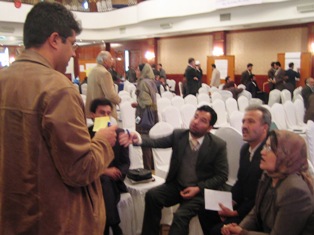 The small groups went through a filtering process that produced a summary of the major bottlenecks (or issues, or recommendations – the language was a little unclear and I suspect stuff was lost in translation). It’s not my favorite approach, to start with problems rather than a vision, but that had been a given. Post-It notes with issues that did not fit in the current health and nutrition strategy, that did not need to be tackled right now or that could not be tackled by the people in the room were put in envelopes labeled ‘not strategic,’ ‘not now,’ and ‘further up.’ The latter was handed over to two of the 6 DGs for putting on the agenda of minister and his deputies. At least that was the plan. That too did not quite happen in the way we had designed it.
Just when we were ready for the lunch break and the system looked engaged and connected to its self, the said international organization showed up once more, this time its top leadership and a delegation from their regional and world headquarters. They took place at the high table and were invited to address the participants. Then came a goodbye ceremony of one of their staff members, presents, certificates, more speeches. It felt as if we had tumbled into a parallel universe. The impromptu event overpowered what was left of the design of the day and from then on everything defaulted back to familiar patterns of large public events. The energy that had filled the large ballroom only hours earlier had all but dissipated and everyone went back to telling (top) and asking (bottom).
There were some feeble attempts made to refocus the event but it was out of our hands. At 5 PM Steve and I quietly walked out and headed into another dust-filled traffic jam across town. We did not get home till 6 PM. One of our colleagues called at 9 PM that he was just home. The event he had put so much effort in to organize had droned on hours past its formal ending time. May be it was a big success, or good enough but I don’t think it did much for encouraging leadership in the provinces, despite the exhortations to lead.


 Sylvia's Journal
Parallel universe, more like Alice in Wonderland. How did they – the outside delegation – come to feel that it was ok to come into an ongoing process? Were they totally not noticing the context? Any organizational proprioception here? Your irritation and disappointment comes through so clearly. And what did Ali and the others of this so painfully assembled group think of the hijacking of the opportunity to design and carry out their event?
But is there a moment for all of you to debrief this scene? To ask what might have been done to mitigate the effects of this destabilization of the design, of any design?
And something positive seems to have happened, despite the course-altering invasion. I sense that there was some feeling of accomplishment on the part of the facilitation team in having set up this novel structure for clarifying issues that could be solved by the group itself. Is that right?