Archive for November, 2008


Out and about

We spent three and a half hours in a strategy and teambuilding meeting with the entire team minus one. He had to deal with passport and visa issues, something I have great sympathy for as I am still not sure how to get my Bangladesh visa in time for takeoff, just over a week from now over Thanksgiving week.

We reviewed the last two weeks and all the events that happened. They appeared disparate and unconnected from one another but not to those of us who were involved in all four; we moved from central level NGOs, to provincial level mixed teams, to the DG team and finally the entire collection in one room. It was a perfect assignment for me – two weeks of nothing but designing and watching the design come to life.

We ended the team meeting with an exercise around learning styles that resonated much with everyone as they guessed, mostly right, who had what kind of learning style; there were many aha’s and much laughing but also, I think, some recognition that all styles produce important contributions to the team’s task. I am not sure that the idea that they have a team task has taken root yet – last time I was fooled they had but now I am more realistic. It’s a novel concept and there are few role models.

I was sent out of the room at the end because they were collecting contributions for a present which was bought by the secretary and Ali and offered with much photo taking, after work hours in an empty office. One of the gifts was a porcelain ring box with Egyptian motif made in China, bought in Afghanistan which will be transported to Holland and then the US. The world is indeed flat.kabulnov2008_gifts
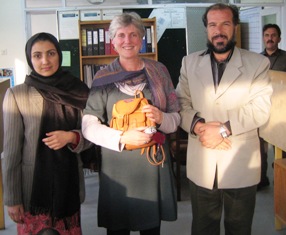
Pia, who used to work at MSH and set up our office some 5 or 6 years ago, came to say hello to old friends. She has her own company now and spends much time in Jalalabad and other places that are much less secure than Kabul. Like me (and Axel and Joan) she is an unlikely survivor of a horrendous (car)crash and bears a long scar on her head, horizontal, as opposed to Axel’s vertical one. We went to the guesthouse and had a real social event in our salon, which looks like an antechamber to a carpet store with all those rugs from Steve. For food and drink we did not have much to offer other than toot and tea (or water, diet coke or fanta). This did not matter because the company was entertaining enough, with Steve, Maria, then Brad and Maureen joining us later.

Pia and I took off for my first night out (which she found unbelievable so it was a rescue mission of sorts). I finally had my long awaited coronas and two tacos thrown in for good measure but not until after a wild ride all over Kabul searching first for Pia’s hotel and then the restaurant. It was a little unnerving because the driver kept saying he knew where these two places were when he did not but could not say so and of course our Dari and his English were no good for serious talk about such matters. At night the streets are fairly empty except for a few trucks and cars and of course the ubiquitous large SUVs scurrying foreigners around who have to escape their confining quarters. Being lost was particularly nerve wrecking when the driver stopped in front of a heavily guarded building with floodlights and suspicious guards coming out of the dark with large guns. After that the coronas were especially wonderful.

We met John and SueAnn from another NGO who are used to go out at night and manage to get their daily rations of alcohol, so unlike us in hotel zero. John worked for Hillary’s campaign but is nevertheless happy with our new president. John is a temporary visitor like me (TDYers we are called); his colleague works in Kabul. For Pia Kabul was a haven of peace even though she was busy on her cell phone arranging for armored cars for their staff doing reconstruction in the East and South. The freedom and normalcy of Kabul made her giddy. Everything is a matter of perspective. I was reminded of Beirut again. John had lived in Beirut and studied at AUB. I rarely meet anyone who has lived in Beirut. Of course neither one of us knew the Beirut the other described, given there was about 30 years in between.

At 10 PM the driver arrived and this time, unlike 7 months ago, I immediately recognized the car and got in without a hitch because I knew the license plate, color and make. Last time I had no idea which car to pick from the line up of large SUVs with turbaned and bearded drivers and security guards. How was I to tell the difference between those with good and bad intentions?

kabulnov2008_last_nightAnd then it was time to pack. I took the decorations down – the pictures from the Khulm bazar that I bought on my second day in Kabul which seems ages ago. I rolled up the new Maliki rug and put it in the canvas bag that brought the rolls of paper and posters on my way in, a perfect fit.

My sleep was restless and full of dreams about plane and orthopedic disasters, two things that are on my plate now and that fill me with considerable anxiety: getting out of Kabul by air and having appointments to figure out what to do with my ankle next week.

Interference

kabulnov2008facsFor our session yesterday Ali had mobilized eleven facilitators, most were his own colleagues from our project, a few from the ministry and some from another donor. Their job was to help the small group conversations stay focused on the end result: clarity on issues that they could resolve themselves and those that had to be tackled by higher level authorities in the ministry or even beyond.

After a set of predictable but unpredicted delays our session got started rather late. As planned it did get the system connected to itself with provincial, central and NGO participants talking with each other about things that held them back. It unfolded more or less as we had hoped until the previously mentioned international organization ran interference again. A two person delegation showed up to present something that was not on the program but deemed important (everything here is deemed important). Everyone argued their case (of why or why not this presentation should be inserted in the middle of our group process that was in full swing). We were like lawyers of opposing parties walk up to the bench and whisper something to the judge while the audience waits for the process to continue. In the end we prevailed and our carefully designed and agreed upon process continued; the invading delegation left with a vague promise that they would be on the program later. I know they came back in the afternoon but I don’t think their presentation ever happened.

kabulnov2008smgrpThe small groups went through a filtering process that produced a summary of the major bottlenecks (or issues, or recommendations – the language was a little unclear and I suspect stuff was lost in translation). It’s not my favorite approach, to start with problems rather than a vision, but that had been a given. Post-It notes with issues that did not fit in the current health and nutrition strategy, that did not need to be tackled right now or that could not be tackled by the people in the room were put in envelopes labeled ‘not strategic,’ ‘not now,’ and ‘further up.’ The latter was handed over to two of the 6 DGs for putting on the agenda of minister and his deputies. At least that was the plan. That too did not quite happen in the way we had designed it.

Just when we were ready for the lunch break and the system looked engaged and connected to its self, the said international organization showed up once more, this time its top leadership and a delegation from their regional and world headquarters. They took place at the high table and were invited to address the participants. Then came a goodbye ceremony of one of their staff members, presents, certificates, more speeches. It felt as if we had tumbled into a parallel universe. The impromptu event overpowered what was left of the design of the day and from then on everything defaulted back to familiar patterns of large public events. The energy that had filled the large ballroom only hours earlier had all but dissipated and everyone went back to telling (top) and asking (bottom).

There were some feeble attempts made to refocus the event but it was out of our hands. At 5 PM Steve and I quietly walked out and headed into another dust-filled traffic jam across town. We did not get home till 6 PM. One of our colleagues called at 9 PM that he was just home. The event he had put so much effort in to organize had droned on hours past its formal ending time. May be it was a big success, or good enough but I don’t think it did much for encouraging leadership in the provinces, despite the exhortations to lead.

Vaccination dress

I dreamed of a simple dress that contained vaccine. Somehow, it was able to slowly pass from the fabric into your body and deliver sufficient protection to save you from one or another vaccine-preventable illness. I heard enough the last few days about unnecessary deaths that could be prevented through vaccinations that my mind set to work during the night and came up with this idea. If I had an iota of entrepreneurial gutsiness in me I would further explore this farfetched idea. But I don’t. I am in a different business which is the one of thinking and talking together in productive ways. That will be our challenge this morning. It was originally on yesterday’s program but various forces conspired against it.

Yesterday had some activities inserted that were not on the program. A high powered UN team from outside the country arrived just in time for lunch – funny how so many people show up just before lunch. The delegation shamelessly hijacked the morning program under the guise of ‘a nice opportunity to exchange views with you.’ I could see the organizers biting their tongue. But the interference is sanctioned by the highest levels, so what can you do?

Although I agree that it was an opportunity, the ‘exchange’ part did not work. The exchanges were nothing more than a series of requests for help from the audience, reducing participants to the role of victims, or worse, beggars for this or that, rather than agents of change. It is a role many are familiar with when in the presence of higher authority and, like a well worn coat, they wear that role with ease. While some of us try to strengthen leadership and management, much of the design of public discourse produces behavior and attitudes that are antithetical to leadership and instead reinforce helplessness and dependency.

I have entirely transferred responsibility for our interactive session to my counterpart, and he has successfully delegated subtasks to his peers. He organized a just-in-time orientation of facilitators from our project’s team, the EU team and some from the ministry of health. Organizing this was a challenge and a half. I admired how he pulled it off over lunch. This required not only rounding everyone up but also chasing higher level officials away from our reserved table, something no one felt comfortable to do. I offered myself as the naive foreigner and politely explained why we needed the space. I hope my outsider status made this act forgivable. All in all it was a nerve wrecking enterprise and I tightly crossed my fingers behind my back.

The hijack of the morning created such a ripple that the entire program was hours behind schedule. By the time our session was supposed to start it was too late. We scrambled to re-budget the time for the next morning, knowing that there was a hard stop at the very end of that last day and that this change, in turn, would create further ripples. Everything was off balance.

More annoying than the hijack itself was the fact that the high level delegation left after lunch and therefore never found out about the consequences of its act. I am trying to figure out how to get that feedback to them since I know it is unlikely that any Afghan would even consider doing something like that. It is safer to whisper and complain about it in private conversations (and I heard a lot of those).

It was past 5 when the day was officially closed, and it took another half hour before we had a car. The sun was setting by the time we got on the road. And although rush hour should have been over, the traffic was so thick that it looked like a slow drive home. The driver decided that was not a good idea and took us over Television Mountain to the part of Kabul where we live. I am not sure it was actually cutting anything short but there was at least a sense of movement, albeit it very bumpy, over unpaved mountain roads. It wasn’t only better than standing still in traffic; it was also exotic and different. For awhile we were high up seeing the lights of Kabul below us while around us we appeared to be in a remote mountain village – mud brick houses and hardly any lights.

Steve was delivered at the office to catch up on work and messages from Boston but I had had enough and was dropped off at ‘hotel sifr.’ I realized that I had not yet gotten the irritations of the day out of my system and unloaded on Maureen and then wrote an impulsive angry email which I later regretted, before it got far into cyberspace ( I hope). An early evening phone call with our team in Cambridge was the final work activity of the day. Altogether it was enough and made for a very long day.

Living beautifully together with herbs

In Dari the place I am staying at is called hotel sifr (zero) or hotel yak (one), That is what the drivers call on their radio when they approach the house because the guards have to open the gate so there is no idling in front of the house; a security measure. I am still not sure which of the two houses in our compound is Guesthouse Zero and which is Guesthouse One. If I stayed in hotel zero last time I must now be staying in hotel one; or it is the other way around.

My evening and morning routines in the guesthouse are now well established – it took a while to do so as I was learning how to make best use of all that was available to me. After dinner I fill the rubber bladder that I brought from home with hot water and put it inside my bed. That way it has a few hours to warm the bottom of my bed where my toes will be.

I bring a thermos from the kitchen and some bags of green tea. The Thermos bottle is made in Japan; unlike the large and often garishly decorated and colored Chinese thermos flacons that are ubiquitous in developing countries, this one is reserved and subdued in its colors and decoration. According to the label at the bottom of the thermos, the color is ‘cacao herb,’ an undefined tan color. Three messages, written in very small print and thus easily overlooked bring the user some good advice. Nobody in the house had noticed them. Two of the messages, marked by a large letter G and F say that we should enjoy working in the garden and put fresh flowers in our house. The third has a stylized picture of a flower and sums up the other two: Live beautifully together with herbs. The two kinds of thermos flacons entirely capture the national character of these two different nations, as least as I have experienced them. The adjectives I have heard the Chinese use to describe the Japanese and vice versa could also describe these insulated bottles that keep our water warm.

I drink many cups of jasmine green tea at night. According to the package, this tea ‘reduces stress, depression and headaches and stimulates metabolism and the calorie burning process.’ I am also assured that the tea has no side effects. All this is good since I am eating here more and differently from what I am I used to. I leave enough hot water in the cacao herb bottle for the morning to warm my hands while blogging and checking mail. It helps with the increasingly unpleasant task of getting up in the morning. The cold invades my room during the night when there is nothing to hold it at bay other than my 25 pounds of Chinese blankets.

After writing and checking my mail I wrap myself in a warm blanket, put my slippers on and cross the yard to take a shower in the downstairs bathroom of the other house where the water is hotter, the pressure stronger and the tank bigger.

For breakfast, unless it is his day off, our housekeeper puts everything on the table that could possible be consumed during breakfast. Every day he puts things out that nobody touches. It is all about routines. We have a choice of jams and jellies that come from Greece, Turkey and Pakistan, peanut butter from America, honey from Australia and various Kellogg’s products, Familia Muesli, leftovers from last night’s desert, cookies, yoghurt, a bowl of fruit, a bowl of hard boiled eggs, brown European bread and naan (local bread), milk and a variety of juices from Europe. The Special K box reminds us that ‘Every woman wants to be admired in that special way’ and then gives us advice on how to get the shape that would have us admired. Of course this includes eating lots of Special K. Steve has been eating the stuff for months but it doesn’t work for him. You have to be a woman.

Warrekshp

The national health coordination warrekshp (this is how the word is spelled and pronounced in Dari) is held at the glitzy Safi Landmark Hotel in downtown Kabul that stands in sharp contrast to its surroundings. It is considered a pretty safe place even though important people congregate there. It has the kinds of glass elevators that ride up and down the sides of a 7 story atrium, just like the big chain hotels in the capitals of the world. It also has a mosque on the 7th floor so prayer breaks can be short. At the bottom of the atrium is a real coffee bar and sparkly stores with expensive toys for grownups. Some of our colleagues who work on another project stay there. I am glad I am not. I much prefer our homey guesthouse and its interesting inhabitants.

I was glad I was not responsible for the conference that started yesterday. It had all the usual glitches that happen when you invite high level government officials who do not show up at the appointed time because something else pulls them away. I was sitting next to someone who was responsible, a half Greek, half Italian, French speaking and Afghan looking woman who represented one of the three major donors who had paid for this gathering. We had a good time together, me providing perspective while she sailed with clasped hands and a good sense of humor through the ups and downs of the conference’s beginning. In the end everything worked out, as things often do that we obsess about.

kabulnov2008_wreathThe high official eventually arrived and exhorted everyone to do their best. He also paid homage to fallen comrades, some 45 doctors, both female and male, who had been slain in the line of their medical duty over the last year, mostly in the areas to the South and the East of Kabul. Four had their portraits displayed. They all looked sad, as if they knew what was in store for them when the pictures were taken.

One of the director generals showed a video of a trip in winter in Heart province (it should really say Herat Province but the built-in spell checker always changes it to Heart). It is amazing how snow covers all that is not pretty. The video footage of SUVs driving (and being stuck) in snow could have been taken in Massachusetts, except for the part where doctors treat patients right from the back of the truck or the passenger seat with crowds of mothers standing in the snow and holding their babies up for examination. There is much writing of prescriptions going on which is, I am now learning, the essence of medical practice here. I am learning so much each night around the dinner table that I think we should be sending anyone working in public health to one of the guesthouses for a thorough induction into the profession and learn about the difference between theory and the real world.

Steve and I did not stay the whole day for the conference. It is expected and good form, as foreigners, to show up at openings even if a conference is in the local language. When the opening takes place in the middle you end up attending most of the day. By the time the conference was officially opened it was nearly lunchtime and so we stayed to partake in the very classy meal that was offered to us by the World Bank, the EU and the American People. It was a few notches up from our guesthouse food; given the cost, it should have been indeed.

The first part of our session is today. The session had no name other than ‘organize for group work.’ I think that is because people know that is what I will do. I proposed a more appealing name (Towards aligned and concerted action for better health). It is placed at the low energy hour of the event, after the mid afternoon tea break. Whether it will actually start then assumes that everything else will go more or less according to plan. Dr. Ali is mobilizing all his colleagues to help facilitate the break out groups while he will lead the session. I will hover on the side, may be occasionally mouthing the words ‘focus.’ The session is so designed that it should hold the conversations and create the container in which ‘us versus them’ can become a ‘we.’

Nouns

“Learn the nouns,” said a colleague in my dream. It was about learning Japanese, but of course my mind was preoccupied with Dari. I would be an awkward speaker, just nouns, but it would help. I would add the Dari word for ‘to do’ plus a noun to make the verbs. A vocabulary of a 1000 words would be a good start. Which 1000 words is not clear yet, that is where I would need guidance. Now, with only 4 days to go, it feels too late for such an exercise. Of course as soon as I am in another linguistic environment the urgency will disappear. But yesterday the urgency was real as it was another total immersion into this language; even at the very top, the nature and dynamic of the conversation changes completely depending on whether it is in English or Dari. It is obvious to me that I either have to remove myself (as an English speaker) or stay in with enough Dari to understand the general gist and get myself understood. The speaking about work-related stuff would be harder than the understanding.

Aside from immersion in Dari (which will continue the next 3 days), yesterday was also an intense day of immersion into the inner workings of the top tier of the ministry; or maybe it was not the inner workings but the outer, visible manifestations of the inner works by its senior staff. I was reminded why I like to work with senior management as much – there is a sense of powerlessness that I feel can be remedied if only people learn to better talk and think together.

I prepared a PowerPoint lecture – yes I can do that if I have to – that was primarily drawn from Bill Isaacs work about dialogue and the dynamics of senior leadership teams. Much of the conversation was about system dynamics – Afghanistan is like a laboratory with lots of balancing and reinforcing loops. The fundamentalists throwing acid into the faces of young girls walking to school is one such a balancing loop. My intent of the team retreat was to help people see the invisible so that it can be incorporated into the decision making. The other intent was to show why teams are needed in a complex environment like this, especially at the top. We did not get the intact team in the room so the relationship building had to wait; but I think we made a start by at least revealing what results each one is held accountable for and what contributions each department wants from the other.

Every so often I saw signs of collusion with patterns of behavior that may have been set a long time ago and that have gone unquestioned or even unchallenged. Of course as an outsider it is easier to question and challenge exactly because I am an outsider. Whether my questioning makes any difference remains to be seen. I see myself as a gardener, putting seeds in the ground. I have no idea which ones will sprout, or which were not viable in the first place.

If anything took root I might see something in the next few days. Today a big and costly conference starts that brings together a significant portion of health movers and shakers (and non movers and non shakers). The event will be in Dari, except the part I am supposed to facilitate but I have decided that it is better if my counterpart does it. Each time I conduct a session in English I find everyone, even very smart and wise people, reduced to passive recipients of my supposedly wise words; it’s partially about politeness and partially about an ingrained behavior pattern in the presence of experts; the latter is a major handicap. If I can get away with it I will coach from the sidelines.

After a late meeting at the ministry with the DGs about their role in the conference, Ali and I waited in the dark and the cold within the perimeter of the ministry compound, for our ride back home. Ali went for prayers and left me close to a cluster of His Excellency’s guards. He felt I was in good hands with these high level protectors. I would not be able to tell a protector from a bad man, especially in the dark, but felt safe nevertheless. There was much coming and going of expensive SUVs and one minibus ambulance with a red blinking light; a donation from the Islamic Republic of Pakistan it said in big letters painted on both sides of the vehicle. I don’t think there was a patient in it, since the ministry is not a hospital. It disgorged some people and then rushed out again; it is clever way of cutting quickly through the heavy rush hour traffic I suppose.

Back home I found Guesthouse Zero transformed. Maureen, with the help of cook and cleaner and with the permission of Steve, had raided his stash of carpets, helmets, shields, and other knick-knacks that were stored in bags and closets inside and outside his room. They decorated the entire house which now looks like a fancy version of a Chicken Street store. It will provide new arrivals with a quick overview of things that can be purchased here. Steve told us it was only a very small part of his collection, and that most is still in bags and drawers.

Over dinner I reported out about my day. We concluded that we, development types, have created many of the problems that we are now trying to resolve. We invoked time and hope and tried not to be too cynical. That was reserved for the three pieces by Kipling Steve recited to us. One was a poem, over a hundred years old, entitled The White Man’s Burden. It was written at the time of the US occupation of the Philippines; the other were two are ballads about the gruesome mercy and jest of Abdhur Rahman, an early ruler of Afghanistan. Compared to that, living in Afghanistan now seems a little better in spite of everything.

Emergent design

The cold now quickly sucks out the heat in my room during the hours that the electricity is off. The temperature was 11 degrees Celsius when I woke up this morning. Getting out of my warm bed is a little more difficult now. There is nothing I can do about it unless I start using the kerosene stove.

Yesterday was our day off and so I slept in till 7 AM. I checked my mail and Facebook to see what my family members and friends were doing and then crossed the yard to get to the shower. It was nippy outside and I took a very long shower to re-heat myself, practically using up the entire hot water tank. I did some fruitful design thinking while in the shower and by the time I got back to my desk I had made a good start.

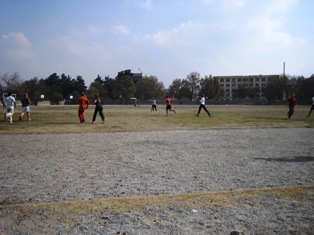
kabulfrisbeeAfter a leisurely breakfast with Steve, both of us in our jammies, we all went to the German high school where they have a track and sports field that is made available to the foreign community between 10 and 12:30 to jog, play Frisbee, soccer or walk in outfits (especially for women) that are not OK outside the school compound. It is a joyful reunion of mostly young foreigners of all nationalities and a place where they can mingle without having to be worried about attracting the attention of bomb throwers.

The school is tucked in between the UNDP and army compounds and heavily protected. Getting to the school entrance is, I imagine, like entering Baghdad’s green zone; it is a heavily fortified battle zone with more tanks and armed soldiers per square inch than anywhere else in the city.

Steve and I opted for the old people’s activity, and walked the tracks while joggers and faster walkers kept overtaking us. We talked about everything and nothing, with a little gossip thrown in here and there for good measure. Contrary to public opinion, men (not just Steve) are just as good at gossip as women. Occasionally we had to duck for an overhead Frisbee with heavily perspiring young men and women dashing after it.

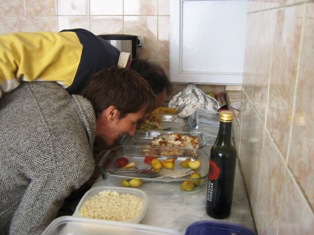
kabulleftovers1Back home it was time for lunch. Steve was about to eat the now two week old spaghetti which had purple spots on it. This did not seem to deter him; it was the smell that finally made him throw it out. We are finally making a dent in the backlog of leftover dishes – some now over a week old. I think we are down to three or four now. Today the cook starts cooking new dishes again so that is how we get behind.

kabulkiteOur next door kite-flying neighbor invited me up on his roof to fly a kite with him. I would have liked to but I declined because I had some serious design work to do. Over the next few hours it slowly emerged out of conversations, reading and old notes. I have something now that is solid enough to start the process that is to, eventually, create a strong team, even if I don’t really have the intact team in the room today, a real possibility.

Maureen and I had more leftovers for dinner (the cook does not come on Fridays) while Steve went to a fundraiser /winners-and-losers party in the US compound. I lent him my Obama button – he had to show everyone that he belonged to the winning group. When he came back he told me most everyone else did as well. He did not see any McCain buttons.

I narrowly escaped two stuff-buying expeditions to Chicken Street over the weekend, Maureen went once and Steve twice. At the high school field we met David, the accountant for the Turquoise Mountain Foundation, which is another handicraft outfit, started by Rory Stewart (the man who walked across Afghanistan in the winter). David was carrying a shopping bag from Holland’s major grocery chain (Albert Heijn) which is why I sought him out, thinking he was Dutch. He wasn’t, but had lived in Amsterdam for some time, hence the bag, and only spoke rudimentary Dutch. Steve wrote down his number – it’s another potential shopping destination for those rare moments we have nothing to do.

Talk like a parrot

Yesterday was all about making plans, a necessary activity dreaded by some, taught by many and botched by even more because it has become such an organizational ritual. Ali prepared the group for the exercise by showing them his unit’s capacity building plan and the resources made available to support the provinces. Some over-enthusiastic participants wanted to elevate our approach (the LDP) to something akin a state religion. They want the tools to be made obligatory, get the government to create LDP policies, create government positions in the provinces, LDP committees and what not. I got worried. I often see this phenomenon where people feel powerless. They demand central government intervention (the archetype of the heroic leader riding in for a rescue), the creation of committees or new staff positions. These things create the illusion of progress; the kind of progress that is evidenced by being able to tick something off your to-do list. Of course it is pseudo progress and the only thing it does is drain scarce resources. I suspect this may explain why central bureaucracies in many developing countries have gotten so bloated. We, the development types, carry much responsibility for that. We have created a monster!

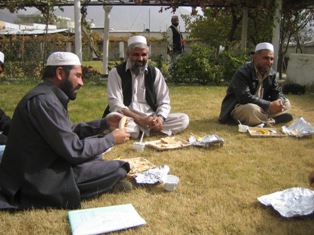
.dinersurlherbe2I am slowly starting to get to know the participants just when they are about to go home. It takes me a while and when you see people only for three days as I did last March, it isn’t enough time. Now I added another three days and I am beginning to find out who is who and from where. I sat with some of the men eating on the grass and we talked about our new (US) President. They asked me what the difference was with Bush (gulp) and why we were all so excited about Obama. When I told them I found Obama inspiring, one responded, “he talks like a parrot.” This, I quickly found out, was considered a compliment

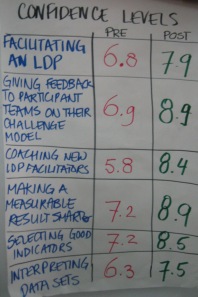
prepostAnd then the workshop was over and everything defaulted to what had become before plus whatever people gained from being here for three days. I know that somewhere in Afghanistan there will be an Open Space session in the near future; hopefully there will be some improved management and leadership (we will wait for the data to support this) and a little more confidence to tackle the enormous challenges ahead. I know that for the group as a whole confidence notched up a little. I already have data for that.

The cold weather has suddenly moved in – the temperature dipped and my dual-mode airco, set to heat, is having a hard time blowing warm air in against the cold air that seeps in through ill fitting doors and windows. Six years ago I arrived here the 16th of November and I have memories of intense cold. Until now it has been like summer. With the cold weather the clouds have also moved in. Gone are the cloudless blue skies. I try not to worry about leaving Kabul airport in the clouds again but it does occupy a piece of my mind.

Luckily I will be very preoccupied with other things till then. On Saturday I am helping one of the director generals develop the rudiments of a team so that he can start to tackle the enormous challenges on his plate together with his direct reports. I have had the most minimal of briefings with him (not with his reports) and suspect I will not know until I see them what exactly they need to be working on. I will have to conduct the retreat on a wing and a prayer, since tomorrow is everyone’s day off.

On Sunday a large event starts in one of the big hotels. Over a hundred people convene to try to solve issues that cannot be solved by any one group alone. I have been asked to facilitate a panel as well as the group work leading up to the panel. The intent is to get the six DGs to make decisions, promises or commitments to actions that will remove obstacles and unclog bottlenecks. The original format was a panel consisting of the DGs (6) facing 34 provincial directors who are asking questions about why things are not moving, with the remaining 100 people watching from the back. Luckily I have been given the freedom to redesign the event to allow for a more consultative approach to problem solving. It is a considerable design challenge given that the point of departure is 12 major problem areas rather than a shared vision.

A place of their own

For a moment the loud thunderclap scared me until Maureen told me it was just that, as we sat around the dinner table. I had not expected thunder and rain. It has been cork dry with bright blue skies until now.

As usual I arrived at the office yesterday a little after 7. Every morning the car with a driver and security escort sits waiting in the driveway, inside the compound – a new security measure, until we emerge from the house. At the office most of the staff arrives between 7 and 7:30.

The first activity in the upstairs ‘capacity building team’ office was a challenge: how can we fit one more person in the (large) bedroom sized office that is already accommodating six small desks, a bunch of bookcases, a kerosene stove and a large meeting table with 5 chairs around it. They tried several scenarios. One involved putting the desks so closely together that the more bulky doctor could only get to his seat by sucking in his belly and slide sideways in between the desks. They finally succeeded with the help of some heavy lifters from the support staff. Moving bookcases provided an opportunity to get rid of years of old flipcharts, file folders and other office debris, a good thing.


The Open Space agenda we had created the day before hung on the walls and everyone organized according to the agenda and joined the group they had signed up for. I joined the group that was proposed by some members of the Kandahar team on ‘Brakedown Management.’ Expecting that I was to be a resource person, or even teach, I quickly discovered that they were fully prepared to teach the session and had come prepared with a session plan, handouts in Dari and Pashto. I asked occasionally for translations and learned that the breakdown they were talking about was about not meeting their own expectations about performance. They illustrated this with a bar graph that dipped.

Participants from Khost, Paktika and Kandahar provinces had signed up for the session, all struggling with major security issues. They explored the notion of a performance breakdown in the context of total societal breakdowns, a hospital falling apart, and travel too dangerous while a measles outbreak was raging in the background. Everything appeared to be breaking or broken already in their provinces.

At lunch I spent some time with the women. In class and during lunch they sit, as they always do, separate from the men; during breaks they stand together. Sometimes I join them. Their English is very good, better than many of the men. They tell me stories about the endless boredom of the Taliban years. They also tell me that they have a long way to go towards fair treatment, “not during my lifetime,” said the one whose only pieces of exposed skin were her hands and her face. They have come to expect and accept that they are not taken seriously.

One of them is a very senior woman in the ministry of health, soft spoken, unassuming. “When we get a big chair (meaning a position of authority) all the men exclaim that we will fail.” Their biggest headaches come from their peers, educated men, and their own husbands. Their biggest supporters are illiterate and uneducated men who appreciate them. Some of the more enlightened men in our workshop, true leaders, are unenlightened when it comes to women, even – or may be especially – their own. One of the star participants in this group has boys studying for degrees and girls married off at a young age – no need to educate them. When I asked why he shrugged his shoulders.

Women have few private spaces in the public arena. In our downstairs office, near the training room is a toilet marked: For Ladies Only. But when you bend down to sit on the toilet your nose is only inches away from a urinal; not even a toilet to call our own. The other toilets in the place are not marked that way; you have to roll up your pant legs and tuck any loose clothing in to stay dry.

Toot and tea

I am drinking endless cups of green tea and eating copious amounts of dried mulberries in the evening, Jon’s farewell gift to me. Dried mulberries are called toot in Dari. He gave me a shopping bag full of toot. This only represented a fraction of what he is taking home to South Africa. That’s what happens when, as a foreigner, you express a desire. As soon as people knew he wanted toot they brought him kilos and kilos of the stuff. I filled a large bowl on the dining room table, emptying only half of the bag. They are a bit like pistachio nuts in that, once you start, it is hard to stop eating them. The tea replaces beer and wine – as we have none here. Green tea most resembles white wine, albeit only in color.

Yesterday we started the three day workshop within half an hour of the established starting time – this was a tremendous improvement over the last time we all met in March. Everyone seemed eager and most were seated at the appointed time except for a few stragglers from the central ministry of health. Some teams had come from very far away. The only missing team was the closest one, from Kabul province.

I was disappointed that the female trainers did not show up. When it comes to women we still have the same 5 women in the workshop we had 6 months ago, less than 10% of the participants – no progress there. On the other hand, the first day of the workshop was orderly chaotic and produced exactly the outcomes we had hoped: much sharing with and learning from each other so that everyone knows what everyone is doing: all this in a room that was entirely filled with large bulky chairs and required much pushing and shoving to get around.

I heard some wonderful stories about the leadership program, how it was being rolled out and how it has changed people’s behavior in clinics and offices. All teams had brought the statistics to prove that these behavior changes actually made a difference for patients. A few people could hardly contain themselves, gushing over with enthusiasm about how they themselves have been affected and how that has spilled over onto others. I am missing a lot of stories and even more nuance because all is done in Dari and I only occasionally ask for translation. The most touching comment was from a colleague in Kandahar, a Taliban-dominated and rather insecure area, who uses our internet site (LeaderNet) to follow virtual events we offer. He prints the material posted on the site and distributes it among his counterparts to make them think about changing one thing or another, or introducing something new. A constant big grin on his face compensates for anything that is not going as planned.

The central team bravely sat in a fishbowl and reviewed their work in front of all their underlings, exposing, with grace, both their clean and dirty laundry; not very Afghan someone commented. The participants listened intently and then pointed out that the central folks were not a coherent team, which was true, and then everyone laughed and the chief took his marching orders from this.

In the afternoon Ali and I presented the idea of Open Space and watched the incredulity on people’s faces change into excitement. Once they understood the idea they put together a good program for themselves for the next day. It includes workshops on priority setting and root cause analysis tools, how to expand and sustain the leadership program, how to inspire people and work through breakdowns and how to make a good plan.

I find myself engaged in a type of improvisation that is fun rather than stressful. There is a saying I learned from a Brazilian that goes like this: In the end, everything works out. If it hasn’t worked out yet, that’s because you haven’t gotten to the end. I am optimistic that at the end of today we can once again say that we accomplished what we set out to get: confidence up in conducting and expanding the leadership program, further into the provinces and its health facilitaties.

I spent some more time in the morning with Jon, downloading as much as I could from his vast store of public health knowledge. Coupled with his deep concern for those people who are always left out of the equation, he is teaching me much about questioning policies and not taking anything for granted or at face value. I still have a lot to learn about the subject but lodging with three public health physicians for a week helps.

A few hours after I said goodbye to Jon he walked back into the office because his flight was cancelled and someone had forgotten to tell him. That also meant he missed his onward flight to Cape Town. He took it all in stride and we got to have him for another evening of stories. The cook had made fresh meals and either thrown away some of the old meals or consolidated them into ‘mixed platters.’ The spaghetti is still there but no one but Steve touches it anymore and it has become a bit of a joke. The new meal was good and the apple-walnut-cream desert even better. It looked like it had come straight out of my 1950s Betty Crocker cookbook (“Romantic Dinners for Two”) that I bought in Beirut in 1978 when I wanted to show my culinary skills to my new American man.


November 2008
M T W T F S S
 12
3456789
10111213141516
17181920212223
24252627282930

Categories

Blog Stats

  • 137,070 hits

Enter your email address to follow this blog and receive notifications of new posts by email.

Join 76 other subscribers