The enormous hotel seems to have hardly any guests left, the place is deserted when I walk down for a few minutes of internetting, and so is the restaurant. I am the only one left from our team; everyone has either returned to Phnom Penh or lives here. The hotel management must have thought it a good time to do some maintenance work. Workmen are busy dismantling or rebuilding pieces of the hotel. It’s noisy.
I tried the egg noodle breakfast this morning. It came with slices of tongue, offal and one lonely shrimp and costs one dollar. Cambodia is a dollar economy. Only fractions of dollars are paid in the local currency, the reil, which exchanges for 4000 to a dollar, everything else is paid with dollars. I calculate that everything is also about one fifth of what it costs in the USA. The single dollar bill is the most common currency around and can buy you quite a bit of fruit, a few moto rides, lots of cookies and candy, a breakfast and two thirds of lunch or dinner.
My Saturday morning has been reserved for sightseeing and Sokleang has generously offered to be my guide and interpreter. We rented a tuk tuk for a foreigner’s price so the driver had a lucky day. First stop was the Man’s Hill (Phnom Prosh). 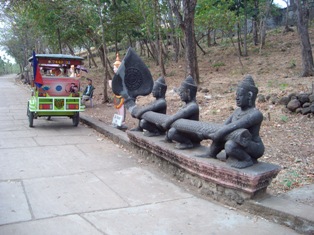 , The legend on how this hill, and the higher one next to it, came into being speaks to women’s deceitfulness and cleverness and men’s honesty and stupidity. The men and women built separate hills in a competition about height that would end at daybreak. The women lit fires which fooled the men into believing it was daybreak and they stopped working. The women won. The moral is that deceitfulness wins and women are good at that while men are honest and dumb (and lose). I think the story was made up by men. In this, as most other parts of the world women rarely win.
We made offerings to the people who were killed by the Khmer Rouge or died in the fields around the hill. Their skulls, some very small, are piled up high in a large lotus flower basin. 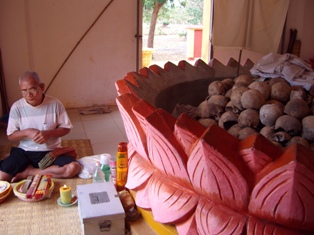 An old caretaker sits by its side and receives our offerings on their behalf and blesses us. He talks for awhile with Sokleang about how he managed to survive the dark years. I think it involved deceitfulness and cleverness (and so he won). The place is very peaceful now. “It was peaceful then too,” said Sokleang, “because there were no more people, just the birds. The people had all been deported or killed.” From time to time she tells me things about that time. I have a thousand questions that I am afraid to ask. Sometimes she answers one, but rarely spontaneously, without me asking.
Next stop was a mini Angkor Watt sort of temple, dating from the same era but without the wild fig trees. It had been destroyed in the KR time but had been (somewhat) re-assembled and new pagodas and Buddha statues added; the frescos inside the newer buildings that tell stories from the life of Buddha have been repainted after the KR had obscured them in a futile attempt to stamp out communion with the divine. I am sorry I don’t know the stories and Sokleang is of little help as she is a Seventh Day Adventist.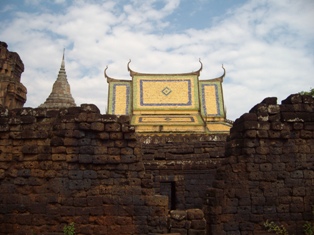
Along the road are small wooden houses on stilts that get smaller as one moves further away from the main road. And then suddenly there are enormous multi-storied houses built by people who made it in the world. The houses stand in the simple surroundings with their gilded gates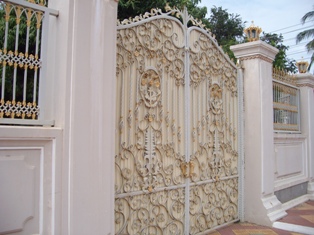 , shiny tiles, smoked glass picture windows and balconies everywhere. I learn that many of these McMansions are owned by American-Cambodians, people who presumably made it in America. I wonder what ‘making it in America’ means and I doubt that, back in the US, we grant them the kind of status that they enjoy here.
We ended our tour with a few steps on swaying bamboo bridge that is swept away each June when the rains make the river wild. After the rainy season is over and the river calms down, a new bridge is built again, year after year. It is a spectacular piece of architecture, a matchstick wonder from a distance, exactly as the Lonely Planet guide described it.
We parted at the market and I had the rest of the day to myself. I took a mototaxi ride to the British café (Lazy Mekong Daze) on the Mekong River that is a few blocks upstream from Mr. Joe. It is a similar place, smaller and with slightly higher prices, 3 dollar rather than 2.50 for a meal. I splurged on a mango shake which brought the entire meal to 3.50. I walked back along the dusty streets of this sleepy provincial town with its old French colonial architecture. Even the market was sleepy, I suppose because it was siesta time. Lunch time is long here, a two-hour break quite common. Once you see the hammocks strung under all the stilted houses and sometimes by the side of the road you understand why. People take their time to digest their lunch. That too is very French.
A common sight on the street is women in pajamas, not because they got up late but because it is like a local pantsuit. Sometimes they are flannel, the kind I wore as a kid, and sometimes they are made of a silky material. You know they are not used as pajamas because the hair in curls and slippers are missing – actually, they wear slippers too I noticed on the picture I took.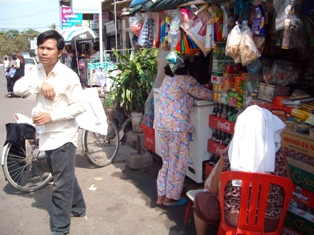
And now it is back to work, after this little intermezzo. We have a little less than 2 days to get everyone ready for the first of the actual leadership workshops, everything we have done so far has been a prelude to this: on Tuesday we will have the participant teams in one room, 13 pairs representing the staff of 13 health centers who will do the work and become ‘managers who lead.’ And the work is to prevent the young people here to take wrong turns on their journey into adulthood and, more importantly, help each other stay on the straight and narrow. It’s pure self-interest of course for today’s adults as these young people will be governing this country and running the economy in some 30 years.


 Sylvia's Journal
0 Responses to “The clever win”