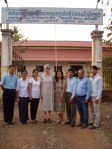
The young men who is the night attendant on my floor in the hotel is studying a mimeographed paper called ‘Leadership and Communication,’ in English. I flipped through it. It’s theory that comes from the US. I’d love to sit and chat with him about what he is learning but the period in which we are both in the hotel and awake is very limited. Many of the young people on our team are also studying in the weekend, after work hours. There is a tremendous commitment to improving oneself through study.
For the last time we pile into the car for the 60 km drive to Chamkaleu, three people in front and four in the back of the pickup truck. We arrive with mopeds streaming in from all sides and once again we start exactly on time. The discipline here about arriving and ending on the appointed time is striking; it helps that this is a society of early risers and there is little traffic this far out in the province.
Nara from the provincial health department opens the day with a morning reflection about what we did yesterday. This is where not understanding a word is a handicap. I am trying to get the facilitators to adopt this practice of reflecting regularly but it is still very new and the responses from participants superficial (question: what did you learn? Answer: leadership!). I explain that the role of the facilitators is to make explicit what is implicit, to have people notice how their feelings and moods are affected by design and methods; to help them articulate vague and unexpressed feelings of engagement into actionable lessons about how alignment around a shared vision can mobilize otherwise inert and passive people.
I struggle behind the scenes to get the translations of the results that each health center has committed to produce in the next five months. We are looking at flipcharts with script that is already undecipherable for me, made more incomprehensible by words crossed out or added. Even for the best English speakers this is not easy; a word by word translation leaves me with multiple meanings. I seek a kind of precision that is hard to get, even in English, as I try to wean people from imprecise abstract language that is copied from highly conceptual documents and has little meaning to people who do very concrete work.
I can see the pieces falling into place for the facilitators when I notice that one has improvised a session that is not in the notes and should have been, logically connecting one session to the next. From time to time I check on translations especially when the group is suddenly energized. I have learned in the past that such surges are sometimes caused by the (real or perceived) expectation of goodies coming in from the NGO or donors. People spent much energy on making of lists of things they want to have (and be given). The idea is to stimulate people’s creativity and encourage them to look for the resources that are already there with people’s energy among the most precious and least well managed of them all.
The last session before the break is Covey’s circle of influence. This is interesting because it is so very American in its key assumption: the only thing you can control in life is your own behavior, attitudes and, in principle, your thoughts. This society knows a thing or two about control and so, not surprisingly, the central belief is challenged and needs some digestion. Bunthoeun leads the discussion with great verve and a booming voice that reverberates so loudly through the sound system that I take refuge outside the classroom. He was told earlier that he scares the more timid women and needs to speak more softly to the females. I am told he is trying after he gets feedback from his peers.
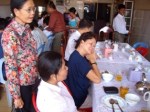
For lunch we go back to the same restaurant which has more wonderful soups, vegetables and fish ready for us but also many flies. It is hot again and some of the food is too and so my face gets red. They are worried that something is wrong with me and I explain it’s my northern skin, unused to heat of any kind but nothing to worry about.
There are a few features about eating here that I like at lot, one is the large beer mug filled with hot water from which you retrieve your eating implements, forks, spoons and chopsticks. The other is the young women that walk around with large bowls filled with rice and spoon more on your plate as soon as you finish. People eat huge quantities of rice – it’s always the centerpiece of the meal.
The afternoon starts with an ice breaker, as each afternoon has, accompanied by much laughing. The provincial chief has arrived to be with us in the afternoon. The session he was going to facilitate has come and gone without him. I am curious what will happen next, since we had announced earlier that he is on the facilitation team. He jumps in at the end of the session about sphere of influence and gives an example that has to do with drinking. It’s a message about being a role model and controlling one’s own behavior and not succumbing to group pressure – a rather unusual message in this part of the world I gather, but received with applause from the group.
In the meantime Leonard is busy preparing our presentation to USAID tomorrow afternoon and so we have to recreate the vision in English, from pictures and Khmer words. I create a new mind map. It has the same content but is organized a little tighter in four categories: staff, services, environment and sustainable results. We carefully pick words that can be found in the picture and resonate with our funder.
In the meantime Rany is doing an exercise about listening that is always an instant success in Africa and needs very little explanation. Here it’s different. Rany needs to demonstrate the exercise twice and explain it in great detail. I am puzzled by the difference and explore with Leonard, in the back of the room, the patterns he sees in Cambodia that he already told me about two years ago in Nepal. Some concepts and tools are picked up much faster here than in Africa while others require considerable effort. People ask questions or make comments that surprise me and that no one has ever asked before (‘what if you don’t want to listen’? Or, ‘people are used to being interrupted by cell phones, what’s the big deal’?)
But in terms of energy I have found my match in this country, or at least with this group of facilitators. They have boundless energy, like I do and they are doing much of the work I usually do, freeing me up to write long entries in my blog and reflecting on what I am seeing happening here.
We end the first workshop and my task here with formal speeches and then the 60 km drive back again. We ‘debrief’ over dinner that includes singing and incomprehensible dancing, in an open air restaurant with bugs everywhere and geckos feasting as much as we do. Everyone is happy, proud, relieved and exhausted. Although I still don’t understand a word of what people are saying I am happy and proud too and enjoy watching these people I have gotten very close to these last two weeks, thinking ‘this is what people ask for when they say they want to live in peace and happiness.’

 Sylvia's Journal
Recent Comments