Archive for February, 2009

Finishing touches

At 8:30 AM we showed up at the Boston Spa, a full service beauty salon owned by an Ethiopian businessman who made good money in Boston. He traded in his two swanky beauty salons on Newbury Street for this one, plus the resort where we visited last Saturday and another one 500 kilometers further north. A framed Boston Sunday Globe cutting on the wall tells the story of successful Africans returning to their homeland to help the middle class expand, and look good in the process. His own success is allowing others to be successful – this is the trickledown theory. He employs an army of young and gorgeous beauticians, trained at Addis’ Aroma College. The staff-client ration seemed to be 6 to 1.

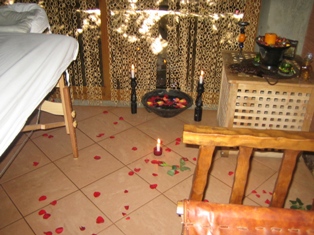
I started with the hot stone massage while Liz started with a facial. After that we traded places. Hot stone massage was a new experience for both of us. It combines heat, hands, stones and oil. The room was decorated, like the one in Kuriftu resort last week, with rose petals, white towel sculptures and candles on the ground. One nearly set my dress aflame.

The hot stones amplify the pressure of hands and made for a wonderful massage with the heat just on the edge of tolerable. I was surprised the masseuse never dropped the slippery stones; she was clearly very experienced. After I was done she rubbed the oil slick of my body with a hot wet towel, gave me a robe and walked me across the hallway, carrying all my stuff. That was a good thing because I felt all slick and rubbery, hardly able to walk straight and not much of a thinker either. Luckily the distance was short.

The facial room, aside from more petals, candles and sculpted towels, had a tray with various electrical implements that looked much like a dentist tray. I have only once had a facial in my life, a present from Sita and Tessa, some years ago, for Christmas. That was one hour. This one was booked for one and a half hour and I wondered how she could possibly fill all that time. As it turned out it was not just a facial but a delicious head massage, shoulder massage and, once again, a lower leg and foot massage to kill the time while my nutritional mask was drying. All the while a music tape was looping over and over, with muzak made from popular seventies songs and some new age instrumentals.

My face was scrubbed, vacuumed (which sounded like the glob-glob of octopus tentacles getting a hold of my face), something that I imagined to be a sort of a mini cattle prod (not sure what the instrument looked like but it killed the bacteria I was told; if there had been any more volts it would have been a form of torture). I had no idea that my skin needed that much work. But then I learned that we white folks have thin and dry skin that needs much protection; black people have thick and oily skin and Chinese people have very thick and dry skin. She learned that in the Aroma Academy and had to take special classes to be able to treat the foreigners. My fragile white skin required five layers of lotions and creams: tonic, dry skin cream, some other cream, sun screen, and after sun screen. The cosmetic industry has a good thing going for itself.

With a last pat on my cheeks and forehead she ended the session, brought me a sugarless lemon juice and left me quietly to return to the world. Liz emerged a little later, also looking a little dazed, and enchanted with her hot stone masseur. We walked upstairs in slow motion and enjoyed a very leisurely lunch, mezze and quiche, our last macchiato and a pizza-to-go for our pre-flight dinner. The taxi driver who took us back to the hotel had a picture of Obama glued to his dashboard – he was just as happy with our new president as we were.

We spent the rest of our time in Ethiopia cleaning the oil from our skin and hair, packing, doing our expense reports and catching up on the news that happened while we were otherwise engaged. And now onwards to Amsterdam.
Delivery

We finished our work this morning with a visit to the chief of the national AIDS program in his well appointed office. Even his secretary had a desk that was fancier than any senior official we visited in the region; no comparison for anything further down in the administrative hierarchy. The senior leadership team has benefitted from countless and probably costly training in country and overseas as well as personal coaches. That they have their act together is obvious but, as the chief admitted, it is not trickling down. This is where we hope to join forces; even though it is on a limited scale, in 2 regions and 5 zones each, at least for now.

Liz, Yohannes and I delivered our findings and recommendations at our funder’s office to a small team that listened intently to our presentation. We received their blessing and some additional exhortations to look at private management consulting firms that will benefit from being involved in our work. It would be a good deal for them: being paid for opportunities to develop their staff and be part of an approach that is different than the usual expert-driven management consulting approach.

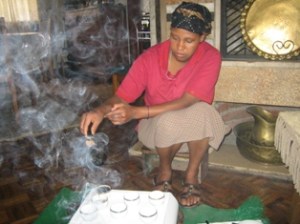
eth_teamWe returned to the office and tied up some loose ends, took pictures, delivered thank you gifts and said our goodbyes before our colleague Belkis took us to her mom’s house for a last Ethiopian meal. It was completed with a coffee ceremony that included smelling the roasting beans, popcorn and a cup of great coffee.eth_coffee
After that Belkis took us out shopping in her large SUV with stick shift, something she has not entirely mastered. Scratches on the car attested to her self-proclaimed limited driving skills and we had some close calls. Liz was blissfully sitting in the back and could be in denial while I was trying to stay cool in the front, trying not to show occasional rushes of adrenaline. Needless to say there was much honking and angry frowns. Luckily there wasn’t much traffic and the worst that could have happened would have been a fender bender – which would of course have put a literal dent in our afternoon plans. Rest and relaxation is reserved for tomorrow morning when we go to have our hot stone massage and facial at the Boston Spa.

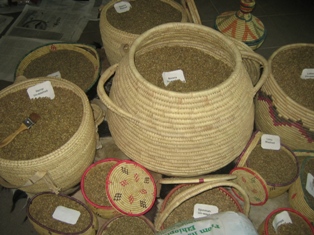
eth_beansBelkis showed us her own home on the outskirts of the city not far from a coffee roaster where I stocked up on beans. We visited some handicraft places and purchased gifts for people we owe something to back home. Back in our hotel it was time to see if the new acquisitions would still fit in the suitcase (they did). We ordered out for chili pizza from Don Vito’s and indulged in a glass of Chianti and another fattening desert. Our last work-related activity consisted of writing up our notes, and passing on tasks to our colleagues in Boston and Addis. And with that our job here is done.
Drag, click and (power)point

I woke up from a vivid dream that involved the delivery of a baby and a graduation project in landscape design. One might conclude that I am more than a little preoccupied with designing a good project and delivering this baby on time to our funders; this is supposed to happen tomorrow morning at 10:00 AM, one hour earlier than we had originally planned and close on the heels of our last visit to the federal HIV/AIDS program folks. We are jealously guarding our free time on Friday afternoon.

A rejuvenated (vaccinated they call it here) Liz joined us as we set out to the town of Nazareth (or Adama as it is called as well) to a zonal health office. Although it was not a long trip (from 7 AM till 1 PM), it did take the wind out of us and after our return to Addis we could have done with a nap, but we had more meetings and did not get back to our hotel until 5PM. The nap was inevitable then, a full hour long pre-dinner snooze.

Our visit with an expert in the Family Health Department revealed to us some of the headaches that form part of his daily life. We had to coax it out of him as he told us at first we had the wrong man and he could not provide us with answers. Since he was the only one around he had to be our man and we ended up getting a flavor of what he is up against, further informing our design.

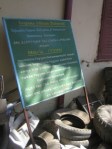
The work environment of many offices looks rather chaotic to us outsiders, with piles of file folders, boxes, large computer sets stacked on or between multiple desks. Outside, a department that used to share the premises had moved out and left behind several large cannibalized generators, rubber tires and an assortment of rusted tools and bits of machinery that made the courtyard look more like a junkyard than a health office. Our host noticed me taking a picture of the mission and vision statement that was written on a board amidst the junk and old tires. He was quick to explain who owned the stuff and absolved himself from any responsibility. We left it at that.

There is a certain fatalism that accepts such disorder and chaos as inevitable and irreparable; the powerlessness weighted on me with the kind of force that causes an instant depression. Although not everyone is busy, I did feel sorry for the people who are. The people we met all seem to be working on their own, fighting their battles in a despondent and unquestioned isolation. Many obstacles appear impossible to overcome as they involve resources and thus require dealing with issues and practices that are either political or unethical or both. When allusions are made to this there are always shrugs or some nervous laughter but never the indignation that could fuel action for change. People may write letters to show they have tried to unclog channels but I don’t think they do it with any expectation of a resolution; it is more of a going-through-the-motions response, you have to do it. All this creates new crises as people give up and leave for better jobs elsewhere. This is called brain drain – another intractable problem that is portrayed as unsolvable by many.

Next on the agenda was a search for data on which to base the selection of our target zones. It was an informative wild goose chase that had us referred from one office to the next, seeing a total of 8 government officials and some retracting of steps before we got something that wasn’t quite what we wanted but the best we could get. The latter came not even from government workers, but from a duo of expert-coordinators seconded by a private agency like MSH.

Our final meeting was with our MSH colleagues, who work on different projects, to make sure that what we propose will enhance rather than detract from what they are doing. We are supposed to be ‘One MSH’ even though we do very different things. But then again, management and leadership is relevant to all and we believe that it will solidify our ‘One MSH’ here in Ethiopia.

After an Italian dinner downstairs with food that was too rich for our own good, we dragged our tired bodies upstairs and finished the powerpoint we will deliver tomorrow to our funder. Good enough for now was the operative word that ended our 13-hour workday.

Inside out

There was something in the Ethiopian food we ate yesterday that made Liz very sick and sidelined her for the day. I was reminded of my bout with food poisoning some 25 years ago in Coney Island. I thought I was going to die then. She did too but didn’t; instead she spent the day in her room letting her body get rid of the toxins. Hopefully she will be well enough to join us tomorrow on our venture out of Addis. I experienced some intestinal rumblings myself but nothing serious enough to intervene with the plans for the day.

In the morning we visited NASTAD, a group with a mandate that overlaps slightly with ours. We met with the country director and a consultant who man the small country office in Addis. Each new visit puts into place another small part of the giant Ethiopian HIV/AIDS puzzle.

After that we visited a health center with a nurse as the medical director. I learned that doctors don’t want the job. Of the health centers in Addis most are led by nurses who have the difficult task of keeping doctors in line, a huge headache. The doctors, from the descriptions we got, appear to be a bit of an undisciplined bunch, coming and going as they please, not required to punch their time cards (unlike most everyone else in the system) and letting the nurse-in-charge deal with the messiness of managing money, people, supplies, data and drugs. I commented that I did not see any grey hairs yet and was told she was only one month on the job.

Asked for examples of the challenges that she was up against she told the story about the new PMTCT center that was opened with much fanfare over a year ago but not in use because the septic system was not installed. It had been forgotten in the planning and no one noticed it when the construction company handed over the keys. Since then the health center has been asking the authorities for a septic system but it has not even gone out for bid yet. The new building will be old before it is even in use; just one more example that underperformance in health centers isn’t just a matter of missing technical skills.

One more meeting in the afternoon completed our investigations for the day. Our design is shaping up as we test ideas with various stakeholders, each pointing out things we missed or that need refinement. In the process we are also trying to pin down how much everything might cost so we can stay within budget limits.

Late in the afternoon I participated in a phone call that was a technological feat: a team meeting by phone with people in Chicago, Cambridge (US), Addis and Islamabad to prepare for a leadership program launch in two districts in Northern Pakistan next week.

The program for tomorrow is still unclear; some of the people we had planned to visit in health zones some 200 km from Addis are not available. They are being trained in something, a national pastime – the BPR is sometimes referred to as ‘Business People Removed’ (for training). We will remain in suspense where exactly we will travel tomorrow and how and where we will meet with our man from USAID. All we know is that we will leave at 7 AM and that our path will cross someplace. We cannot communicate directly with him because his cell phone fell into the water and damaged his simcard. I trust that all will be revealed in time.

Smells and squeaks

A little box mounted on wall of my bathroom periodically puffs out small clouds of a sweet smelling chemical that neutralizes the natural smells in the bathroom. I try to imagine the hotel room designers sitting around a table listening to salespeople from companies that cater to hotels. It must have been a very good pitch because not only all the guest rooms but also the conference rooms have these puff machines. Sometimes I forget about it and the little squeak that accompanies the puff startles me. It sounds as if someone is letting out a deep sigh in the bathroom.

We had some more visits today to potential partners and vetted our emergent design with various stakeholders in order to make sure that there are no last minute surprises that require an entire overhaul. So far it is holding up under review; even better, we got some advice and ideas that improved it.

We met with the management institute but aren’t sure yet whether we can engage in a contractual relationship as per our and their governments’ regulations. This caught us by surprise and we are not sure how this will resolve itself. We also met with the chief of the Global Fund Secretariat and the chief of the Clinton Foundation, each showing us a different facet of the vast and complex development landscape.

We returned to the hotel exhausted yet there was more work to be done. Liz is facilitating a virtual strategic planning course and reviewing the homework of five teams. I had less work to do and was glad that I was not in any virtual event; it makes for very long work days.

For dinner we went to the Old Milk House restaurant, located on the 10th floor of an apartment building that has seen better days. It was a little creepy downstairs and the elevator even more so. But we made it up and down safely and ate a delicious Ethiopian fasting meal (no meat and no dairy) in between. It was served by a very solicitous young waiter who must have been disappointed about our mousy appetite as we did not even finish our single order. At the end of the meal a woman dressed in the traditional white dress served me my umpteenth cup of coffee of the day. She carried the coffee paraphernalia on a tray with a brazier with sweet smelling charcoal; a more traditional version of my squeaky puff machine.

Emergent design

We had our first visit with a potential beneficiary of our assistance, the chief of the regional health bureau and his deputies in one of Ethiopia’s larger states; the one that holds about one third of the country’s population. This started to provide us with some context, a view from the top. We hope to get more views to complement his but this is not that easy. Having only three days left makes scheduling visits very challenging. There are just too many variables, the elusive holiday of Thursday just one of many. Cold calling doesn’t work very well so we have to network ourselves onto people’s busy schedules. This takes time, one thing we don’t have much of.

A visit to Amhara region in the northwest had to be cancelled to our regret because the chief is out of the country (I wonder whether he is being trained in something). Instead we will be visiting two zones south and east of Addis, taking us on a trip that will last the entire day.Thus we will get at least a few opinions from further down the food chain.

We also met with the dynamic trainer from the local management institute who is still ready to hook up with us and get this leadership program started. She joined us after teaching all day, with no visible sign of wear and tear – she’s just the kind of person we need. In between these two meetings we spent hours with two of our own colleagues, both former ministry of health employees, who took great pains to educate us about the intricacies and complexities of getting health services to the people.

We had lunch in a place that clearly catered to foreigners, both in taste and buying power. It also had a bookstore with self improvement titles and announcements of yoga and Al –Anon classes. A few floors below gorgeous looking beauties happily penciled our names in a few time slots on Saturday for a hot stone massage and a facial. By then we will have delivered the goods, to everyone’s satisfaction we hope. So this will be our reward before we board the plane at midnight for the long trip home.

Over our high-calorie room service pasta-with-spinach-dinners and glasses of Chianti Liz cobbled together the elements and assumptions of a budget, a task that is not as intimidating to her as it would be to me. In the process a preliminary design emerged that hangs together and that we believe addresses the various needs that have already been communicated to us by various stakeholders. It will serve as a working hypothesis which we will test during the next three days.

Hapless

Sometimes I think we, meaning the development community, have created the monster that we are now fighting, each one in our own way. As I researched the regional AIDS commissions (HAPCOs) that we are supposed to focus on for our management and leadership capacity building I found more Google hits than I could ever hope to review in my lifetime.

I downloaded the most important and most recent ones, which took a while. In the process I discovered that everyone and their brother has been ‘building the capacity’ of these folks. The World Bank helped with money and experts, probably flown to Ethiopia in Business Class; the Germans helped them write job descriptions and mainstream HIV/AIDS awareness and policies in all the ministries; UNICEF helped them develop a strategic plan that covers everything and the kitchen sink; there are more, no doubt.

I reviewed one of the regional HAPCOs’ strategic plans that took 2 years to develop and is now at its five year end. I wonder what came of all those intentions. Burn-out is all I can imagine. Not that nothing has happened. I think a lot has. There are spectacular numbers in all those reports about orphans sent to school, people on treatment, people counseled, anti-AIDS clubs founded, leaflets and condoms distributed and much more. But when I read about the internal organizational weaknesses that were identified I kept thinking, ‘what has happened about those?’ Are they working better in teams now, communicating better, coordinating and setting priorities, etc.? All I can see is that more structures, more documents, more plans, more steering committees, more task forces are created than you can shake a stick at. Of course each new group of people makes coordination a little bit more complicated and demanding. Sometimes I think that we deal with our inability to tackle the really messy and intractable human problems by creating all these structures and documents and what not. It gives the illusion of doing something at least (reminding me of the old saw ‘don’t just sit there, do something!’).

I feel for these ‘hapless hapcos’ with all these people taking them to workshops, coaching them (often written as ‘couching’), asking them to account for all the monies given, or maybe even hiring the good ones away. And now here we come, with more offers to help, but also more distractions, more reports that will have to be produced, more accountabilities. I do think we have something to offer them but realize that that is what every consultant who shows up thinks too. And then I read in one of the reports that people, locals and foreigners alike, are disappointed with the Ethiopian communities for not taking any ownership and putting their own scant resources into the fight against AIDS. Should that surprise anyone, given the avalanche of external inputs?

Before delving deeper into the capacity building avalanche Liz and I did some more sightseeing. It is Sunday after all, a day of rest and the focus of our sightseeing were two churches and two musea.

We visited the same buildings that I visited last time, on top of Entoto Mountain. It was a beautiful day with spectacular views over the city and on the other side of the mountains with views that reminded me of Switzerland. Back in town we visited the National Museum and took a look at Lucy’s skeletal fragments and a reconstruction of her standing up that was done with help from an American museum according to a little plaque in a corner of the glass case. Lucy’s bones are 3.3 million years old – a number that I find hard to grasp. I wonder what Lucy would think of us and our world if she were to come alive now. Magic and wizardry, probably.

Toil

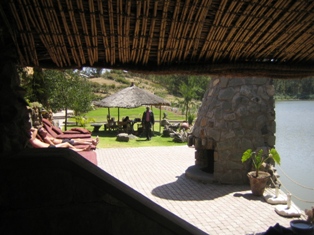
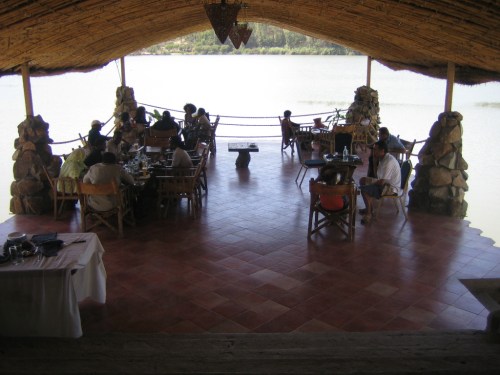
All day we luxuriated at the Kuriftu Resort and Spa in Debre Zeit, located at a small lake about one hour’s drive out of Addis. We bought a day pass for about 20 dollars that entitled us to a lunch, a swim, a kayak trip across the lake and 25% off on all spa treatments. As soon as we arrived we registered for massage, me the aromatherapy and Liz for the Swedish massage, followed by a pedicure which required the electricity to come back on (it eventually did).

It surprised us that coffee making in Ethiopia required electricity but it was the reason given for an hour delay. When it finally arrived we had already progressed to beer in frozen mugs – the coffee rather substandard (maybe because it required electricity) for a country famous for its beans. The local beer on the other hand was just what the doctor ordered on that fine summer day sitting by the lake, watching the pelicans and other water birds frolic right in front of our eyes. It is a tough assignment..kuriftu_spa3

The only thing that spoiled the fun was the pontoon boat with its throbbing music that carried a few passengers around the lake. We read our books, I did some water colors while we feigned not to listen to the type A American embassy guard sitting behind us in the company of one male (type B) and four gorgeous young women, everyone busily flirting with the tough guy. We wondered what people would think of the US if this is the only representative of the American tribe that they ever meet, Loud? Obnoxious? Sexy? Exciting? Funny? Arrogant? All of the above?

ethiopia-007We had a lovely lunch, opted for non Ethiopian, and then regretted that we had scheduled our massages so close after lunch. We were each led into an elegant little room under the large thatched roof with rose petals sprinkled across the floor and the massage table. There were intact roses as well, tucked into rolls of white bath towels and nonchalantly dropped around the room in between the small candles that dotted the floor. sparoomThe wall to ceiling window looked out over a series of rock basins full of thirsty and twittering small birds. The one hour massage was perfect. When it was all over we dragged the experience out a little longer with a pedicure, possible because the electricity that operated the pedicure chairs and footbaths was back on.
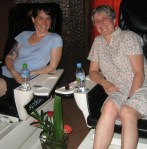
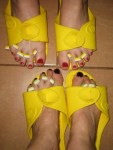
double-pedicureSitting side by side we had our calloused feet sanded down, our legs exfoliated, our cuticles trimmed and our nails varnished a shiny red/orange and red/brown. I immediately managed to smudge the nail polish on my big toe.shiny_toes
We ended the day with another ice cold local beer looking out over the lake while gossiping about our colleagues back at home. During the drive back to Addis, we talked and talked as if we were on a first date. I suppose we were, as we have never travelled together. Liz has now moved into my hotel and, although not given an imperial suite, still has a large room that is light years nicer and cheaper than the one at the Sheraton, plus of course free internet. We decided to skip dinner, still full from lunch. Instead I ordered a tiramisu as a late night snack while vegging out in front of the TV, having done nothing work-related all day – this is rare on trips but I can say that Liz made me do it. I know I would have been working if I had been here on my own.

Governments

My first day at work consisted mostly of figuring out who we should talk with to get a better understanding of what people who need to manage and lead HIV/AIDS programs are up against. It is also to find out who would be or would not be interested in the management and leadership work that we are asked to do here on behalf of the US government.

Ethiopia receives unbelievable amounts of money to spend on HIV/AIDS prevention and treatment. The monies that the country received from the three main funding sources (US government, Global Fund and World Bank) in 2005 exceeded by several million dollars its entire health budget of 2003; yet the staff, both in numbers and skill level, can hardly implement the existing programs. So there is much work to be done. This is not just technical skills training – that is being done by many. What’s less common is coaching people how to work effectively in an environment where multiple groups, local, bilateral and international, are tripping over each other, to do the good work; where agendas, both hidden and overt , do not always match up and the potential for duplication and things falling through the cracks is enormous.

The country has been in the process of reengineering itself and Business Process Re-engineering (BPR) is on everyone’s lips (and has been for many years now). We have to figure out how to mesh with that as there are obvious commonalities in our respective goals and the BPR process, in spite of its critics, is unstoppable.

Thanks to our colleague Yohannes’ efforts we received the green light from those in charge of civil service reform to partner with a local management training institution. We had wanted more than that, namely the opportunity to talk and learn more about the reform committee’s challenges but that invitation did not come forth – at least not yet.

The Institute is the same I started to work with during my previous trip, now nearly a year ago. But those attempts were squelched because of budget constraints. Now, we are suddenly receiving US taxpayer monies to do something much bigger than what we tried to launch a year ago. Go figure… when everything else in the world is coming to a screeching halt, we get the money we needed last year. It comes from a different pot of course.

If anyone thinks that government work can be rationalized, think twice. There is little rationality or, for that matter, efficiency. It’s the nature of the government beast. Its primary function is not to run like a well oiled machine that turns inputs into outputs (although we like to think it should). Governments exist to satisfy the needs of their constituencies. This is the only thing that can explain why people run for office. Those with the loudest voices or the squeakiest wheels tend to get the most (whether for themselves or on behalf of others without voice). Moreover, many needs stand in opposition of each other. When you think of that it is a wonder that governments achieve anything at all.

In the morning we reviewed the work that Liz had done during the week in an office that first had three desks and three occupants. When we returned from an errand, our seats were taken and our temporary office was full of new desks being put together by a noisy and sloppy crew of workmen. We are in a brand new and not quite finished building that was only a blueprint during my last visit. There was much hammering around us.

Liz had put together a presentation to our colleagues working on the various MSH projects about management and leadership and the resources available to them to improve themselves or others in these areas. People were invited to listen to us over lunch break – and many did – enticed by a free lunch: pizzas with odd toppings, not quite Italy, not quite Ethiopia, not quite the US.

I think we overwhelmed people a bit with the enormous array of tools and models and concepts and were asked to give them a few that they could use right away, which we can and we will.

After lunch we started to focus on how to squeeze all the conversations we need to have into next week. We are expected to hand over a fairly detailed plan on how to spend the money by next Friday 11 AM. It is a short week, we discovered, with a Moslem holiday in the next 5 or 6 days. Which holiday and when exactly no one could tell us. It appears that the decision whether to close offices for a holiday (outside the official ones we could find on the internet) is often postponed till the last minute. As a result one might find clusters of children wandering to school in their colorful uniforms to find the school closed. I am glad I am not a working mom here.

In the evening we were treated to dinner in a cultural restaurant by friends of one of our colleagues in Cambridge. It was an Australian/Belgian couple with two small children who are in the development orbit right now and wondering what their next move will be. Their cross cultural and linguistic challenges resonated deeply with me. Like Axel and me, they too met in a place recovering from a nasty war. There was much to talk about.

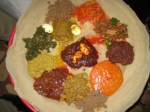
Our dinner was served while we sat on low stiff chairs, pushed closely together, around a table woven from grasses on the spongy injera bread. One’s fingers are the utensils and they are never to be licked. At the end of the meal the dishes are cleaned by taking the entire ‘table’ away and coffee is served in the same small cups I remember from Yemen and Lebanon, with popcorn. A few leaves of the herb Rue are put in the coffee. We have this growing outside our garden at home to keep animals out (it stinks).

After dinner dancers performed regional dances. Each dance required a new costume and made me marvel about the variety of styles in this one country. Many of the dances were of the ‘rubber body’ variety and I made us all touch our necks, mine still whiplashed and stiff like a plank. I was very grateful that I was bypassed when one of the dancers invited Liz to shake her body in the same way. Of course the foreigners were easy targets. Liz was a good sport.

And now it is weekend. I like this midweek departure from Boston, with its less than full planes, and then arriving just one day before the weekend starts. Liz is badly in need of pampering, having already spent three weeks on the road, two of which in Nigeria, and so we are going to splurge all day in a spa in a fancy place an hour away from Addis. I needed no convincing.

From groentesoep to imperial suite

The economic turndown also showed itself on the plane leaving Amsterdam; it was only half full. Once again I had an entire row to myself after my neighbor moved to the row in front of us. That was a good thing because for the 30 minutes that he did sit next to me he imbued the entire row and especially his seat with the smell of Dutch groentesoep (vegetable soup). The pungent smell lingered for a long time after he moved. I have nothing against vegetable soup, I like it, but as a smell on humans it is not so great.

We left Holland a little later than planned because the plane could not disconnect itself from the jet way – as if some mechanical umbilical cord tried to keep us from leaving. It took two batches of mechanics jumping up and down something to shake us loose.

While flying over the Alp and the Mediterranean I watched Oliver Stone’s ‘W’ and was most intrigued by the senior leadership team scenes. I think it would make good discussion material for such teams about what it means to lead at the very top. As a psychologist I was also drawn into the parental dynamic and wondered how much of world affairs is influenced by powerful sons (or daughters – but there are less of those) who feel the need to prove themselves over and over again and show their dads, dead or alive, that they are worthy human beings, while breaking things along the way. The book I just finished (We Were the Mulvaneys by Carol Oates) is about the same topic. I think I have never quite disengaged from my original professional ambition to be a family therapist; a person who I believe does the world’s most important preventive work.

I have observed this dynamic up close and nearby but the harm that can be inflicted on others in the process is usually contained and mostly local, unless of course the family produces a future president of the most powerful nation in the world. In that light Obama’s story is just as interesting.

In Khartoum we refueled and I watched the day turn into night in no time; as a northerner this short twilight is always a surprise. I much prefer our drawn out process and the slow transition from light to dark and vice versa.

The last part of the trip gave me just enough time to scan the bulk of the background documents that I had been saving into one ‘to read’ file. I am lucky that Liz is already there and can brief me on the lay of the land and all the things she already found out after a week in Addis. She’s known as a super productive worker; I have already noticed that.

We landed in Ethiopia exactly at the appointed time and I was out before Kalid the driver, who was sent to pick me up, arrived. He intercepted me just as I was about to get into a taxi. I arrived at the hotel and was given what appears to be the imperial suite, a three-room affair with a huge terrace where you could hold a party for fifty people. It looks out over the red light district below and a good chunk of the city. ethiopia-005It has several gurgling Italianate fountains with cast iron lovers and vines, a gas terrace heater like you find in cities that use terraces all year round even when cold. There’s more: a vending machine, a gas grill and about 5 outdoor furniture sets (large round tables and chairs) plus a swinging settee. I have a strong suspicion that it is not just for me. In fact, when we did a workshop in this hotel during my last visit this is where we had our coffee breaks. But now, late at night, all is quiet and I am here alone.
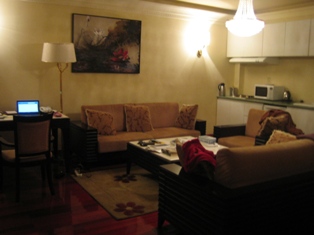
ethiopia-006Inside there are two large flat screen TVs, one in my (king size) bedroom and the other in the living room with kitchenette with its well stocked refrigerator (drinks only), four burners, microwave, 8 kitchen cupboards with only the most essential china and silverware for two, and a granite counter top. There is also a fake fireplace with a plastic log, also of the Italianate style. These Italians surely left their marks here. And finally I have fairly good speed wireless. All this for 60 dollars less than the US-government allowed maximum rate so I am actually saving money for the American tax payer. A flyer on my desk of the hotel group that, I suppose owns this hotel invites me to ‘bring my exhausted sole & depart singing…’ So stay tuned.


February 2009
M T W T F S S
 1
2345678
9101112131415
16171819202122
232425262728  

Categories

Blog Stats

  • 136,982 hits

Enter your email address to follow this blog and receive notifications of new posts by email.

Join 76 other subscribers