




Ethiopia receives unbelievable amounts of money to spend on HIV/AIDS prevention and treatment. The monies that the country received from the three main funding sources (US government, Global Fund and World Bank) in 2005 exceeded by several million dollars its entire health budget of 2003; yet the staff, both in numbers and skill level, can hardly implement the existing programs. So there is much work to be done. This is not just technical skills training – that is being done by many. What’s less common is coaching people how to work effectively in an environment where multiple groups, local, bilateral and international, are tripping over each other, to do the good work; where agendas, both hidden and overt , do not always match up and the potential for duplication and things falling through the cracks is enormous.
The country has been in the process of reengineering itself and Business Process Re-engineering (BPR) is on everyone’s lips (and has been for many years now). We have to figure out how to mesh with that as there are obvious commonalities in our respective goals and the BPR process, in spite of its critics, is unstoppable.
Thanks to our colleague Yohannes’ efforts we received the green light from those in charge of civil service reform to partner with a local management training institution. We had wanted more than that, namely the opportunity to talk and learn more about the reform committee’s challenges but that invitation did not come forth – at least not yet.
The Institute is the same I started to work with during my previous trip, now nearly a year ago. But those attempts were squelched because of budget constraints. Now, we are suddenly receiving US taxpayer monies to do something much bigger than what we tried to launch a year ago. Go figure… when everything else in the world is coming to a screeching halt, we get the money we needed last year. It comes from a different pot of course.
If anyone thinks that government work can be rationalized, think twice. There is little rationality or, for that matter, efficiency. It’s the nature of the government beast. Its primary function is not to run like a well oiled machine that turns inputs into outputs (although we like to think it should). Governments exist to satisfy the needs of their constituencies. This is the only thing that can explain why people run for office. Those with the loudest voices or the squeakiest wheels tend to get the most (whether for themselves or on behalf of others without voice). Moreover, many needs stand in opposition of each other. When you think of that it is a wonder that governments achieve anything at all.
In the morning we reviewed the work that Liz had done during the week in an office that first had three desks and three occupants. When we returned from an errand, our seats were taken and our temporary office was full of new desks being put together by a noisy and sloppy crew of workmen. We are in a brand new and not quite finished building that was only a blueprint during my last visit. There was much hammering around us.
Liz had put together a presentation to our colleagues working on the various MSH projects about management and leadership and the resources available to them to improve themselves or others in these areas. People were invited to listen to us over lunch break – and many did – enticed by a free lunch: pizzas with odd toppings, not quite Italy, not quite Ethiopia, not quite the US.
I think we overwhelmed people a bit with the enormous array of tools and models and concepts and were asked to give them a few that they could use right away, which we can and we will.
After lunch we started to focus on how to squeeze all the conversations we need to have into next week. We are expected to hand over a fairly detailed plan on how to spend the money by next Friday 11 AM. It is a short week, we discovered, with a Moslem holiday in the next 5 or 6 days. Which holiday and when exactly no one could tell us. It appears that the decision whether to close offices for a holiday (outside the official ones we could find on the internet) is often postponed till the last minute. As a result one might find clusters of children wandering to school in their colorful uniforms to find the school closed. I am glad I am not a working mom here.
In the evening we were treated to dinner in a cultural restaurant by friends of one of our colleagues in Cambridge. It was an Australian/Belgian couple with two small children who are in the development orbit right now and wondering what their next move will be. Their cross cultural and linguistic challenges resonated deeply with me. Like Axel and me, they too met in a place recovering from a nasty war. There was much to talk about.
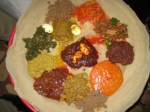
Our dinner was served while we sat on low stiff chairs, pushed closely together, around a table woven from grasses on the spongy injera bread. One’s fingers are the utensils and they are never to be licked. At the end of the meal the dishes are cleaned by taking the entire ‘table’ away and coffee is served in the same small cups I remember from Yemen and Lebanon, with popcorn. A few leaves of the herb Rue are put in the coffee. We have this growing outside our garden at home to keep animals out (it stinks).
After dinner dancers performed regional dances. Each dance required a new costume and made me marvel about the variety of styles in this one country. Many of the dances were of the ‘rubber body’ variety and I made us all touch our necks, mine still whiplashed and stiff like a plank. I was very grateful that I was bypassed when one of the dancers invited Liz to shake her body in the same way. Of course the foreigners were easy targets. Liz was a good sport.
And now it is weekend. I like this midweek departure from Boston, with its less than full planes, and then arriving just one day before the weekend starts. Liz is badly in need of pampering, having already spent three weeks on the road, two of which in Nigeria, and so we are going to splurge all day in a spa in a fancy place an hour away from Addis. I needed no convincing.


 Sylvia's Journal
0 Responses to “Governments”