Our morning starts with a visit to the chief of health services. He greets me enthusiastically and I can now ask him in Dari how his family is and how is travels were. He travels a lot to the provinces and because of that has a good idea of what is happening at the basis of the pyramid. He wants to organize quarterly meetings and rotate them in the provinces and have his staff travel there instead of provincial staff travelling to the capital city.
He talks about good provincial teams and bad provincial teams. Where they are bad, he says, ‘the staff is crying.’ But he cannot do anything about it because some of the provincial bosses are well connected and powerful. This is the impotence of senior leaders that is much more rampant than people at the bottom of the societal pyramid think – the paradox of powerful people feeling powerless. This doesn’t necessarily mean that they acknowledge this and ask for help. But this very senior doctor does.
We talk for awhile so that I can understand his predicaments better and offer ways in which we can assist him. He agrees to bring his senior managers together again, the team building that derailed a bit last week. We will meet on the day that I was supposed to have left and we will give it another try. But this time I extract a promise from him: if he is called away by his superiors, he will say no to them. I realize this is not easy, and may not even be possible. We agree that if he cannot say no, we will cancel the meeting.
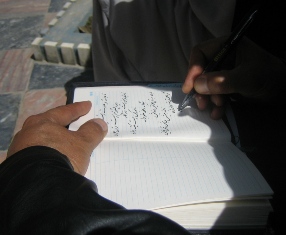 On our way out of the ministry we run into a man who is the son of a famous Afghan poet, and the brother of another, both named Mushda. We ask him about a poem that we can use in the sessions with the senior leaders that will help raise spirits and speak of unity and collaboration. He immediately starts to pen, in beautiful handwriting, in Ali’s diary, a poem that his father wrote 50 years ago about unity between Sunni and Shiites, between Pasthuns and Hazaras. As we walk out of the heavily barricaded ministry compound onto the street I ponder this extraordinary encounter with poetry right in the middle of the ministry’s flowering courtyard.
In the afternoon we help the policy and planning people create a shared vision and talk about their hopes and dreams – something they have never done before. The turnout of these very busy people is good. We spend a long time talking about what a vision does, rather than what it is. I do an exercise with the kind of elastic that is used in men’s underpants, cut lengthwise into two rounds of about 4 meters. With it I demonstrate the constructs of structural conflict and creative tension, the kind that a vision generates. It gets the message across but, as I find out later, is a little too risqué for my Afghan colleague when I ask him whether he wants to do the exercise tomorrow. Foreigners get away with much countercultural mischief.
After work we drop our colleague off at her apartment that is close to the airport. She invites us in for tea. I say yes right away and then realize I should have refused at least 3 times before accepting. This leads to a discussion about cross cultural disasters when people invite you and you say the wrong thing. I am assured that it was an honest invitation and that my immediate yes was appropriate.
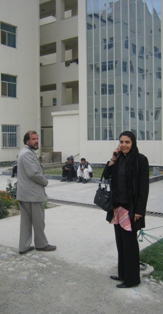 Zelaikha lives in a high rise complex that is visible for miles – several multistory apartments with a bright red roof on top amidst colorless one story mud brick hovels built by people coming in to the city from the rural areas. Eventually these mud brick dwellings will be demolished and the people pushed further out onto the slopes of surrounding mountains, to make place for more of the high rises.
Zelaikha and her family own their flat. She lives there with her mom, sister and brother. Other siblings live higher or lower in the tower. Some of the buildings are 2 years old, others 4 but they all look like they have been there for 20 years: cracks in the wall, run down and people trying to live like they’d would in a village – with part of the contents of their apartment moved into the public hallways and stairwells, laundry draped over gallery banisters; toys and kids everywhere. When the bad weather moves in the wind howls around the canyons created by the high rises and the electricity goes out. Her mom and sister join us but don’t partake in the juice and tea.
The mother has raised seven very successful children: four of the five girls are doctors and the rest are engineers. I ask her if she is proud and my question gets lost in translation because she shakes her head and smiles. I smile back. They lived in Iran and Pakistan during the Taliban years – with all these well educated girls there was no room for them in Afghanistan. Most of them are back and happy to be home again.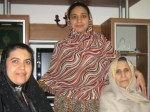
It takes us forever to return to the guesthouse, all the way on the other side of town. We drive under grey skies and through dust storms that reduce visibility to about 2 meters while I listen to the conversation in Dari between the two people in the front seats. I am beginning to recognize a word here and there. My vocabulary is increasing rapidly – there’s nothing like total immersion.
At home I find our new house mate has arrived; Janneke from Holland. There is clearly a Dutch theme to my stay this time. We discover quickly that we have several friends in common and she worked at a place where I applied for a position some 17 years ago. Obviously I did not get it and that turned out to have been a good thing. She may actually have interviewed me all these years ago but we did not recognize each other.

 Sylvia's Journal
Recent Comments