



The chaos of getting 22 people off in 7 cars to 7 different destinations as close to 8 AM as possible did not materialize. Our Ghanaian colleague Philip had been fretting over getting this right, not an easy task, and then everything was right. At lunch time everyone returned and the field visits had been completed without a hitch, with spirits high. There had also been some bonding across organizational divides; there is nothing like sitting together in a car going over bumpy roads. It reminded me of a field visit I made with a bunch of family planning professionals from all over Francophone Africa in Benin. We travelled over bad roads for 700 km, from early morning to deep into the night. We sang songs for hours, told jokes, changed tires and pushed the car out of mud; we became friends for life!
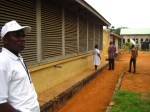
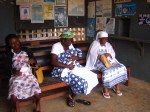
I accompanied two gentlemen from the ministry of health and we were expertly chauffeured by driver Valentine over roads that had lost their hard top here and there. Although our destination was not far, it took us exactly an hour to get to our destination. We were warmly welcomed by the midwife in charge, just outside the Labour Ward where some hard work was being done by two women who had reached their term. No husbands were present – labor, even with an extra ‘u’ is women’s work.
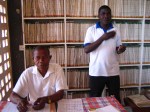
Over the next couple of hours we chatted with various employees and explored the buildings and rooms that were part of the health center. The senior leaders were told to present themselves as students, counter cultural for sure. There had been much concern before the visit about whether this was possible and shouldn’t we surprise people. But none of these fears came to pass, as I knew from experiences elsewhere.
The health center consisted of the main block with wards and consultation rooms, a block of dilapidated staff quarters, an incinerator, two containers that houses the generator and the ambulance, a block of rooms for specialized services and something that was referred to as the ‘new’ building, a large unfinished structure in a corner of the compound. Work had started some 8 years ago but they had run out of benefactors or the benefactors had run out of money. Inside it did not look like a new building anymore.
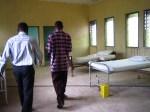
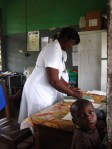
A matron who had been taken out of retirement had settled into one corner of the building overseeing a makeshift recovery ward. The ward has two beds, one covered with two crib mattresses instead of an adult mattress, a bench and a crib. ‘It’s not enough,’ she said. Sometimes she has to ask the least sick person to move over to the hard bench. We were all inspired by her commitment, passion for her work, concern for the community and can-do attitude. She surely was able to make something out of nothing. Asked about her retirement, she answered that she was too good and too strong for that and that she plans to continue working under contract as long as she can.
Throughout our tour the accountant accompanied us, pointing out the places where resources would make a difference and places where they themselves had made a difference in the absence of a response from their own employer, the government of Ghana.
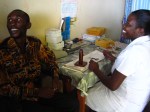
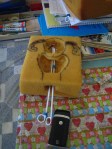
At the family planning clinic we found the nurse talking with one of the outreach workers, a young man who does vaccinations as well as HIV/AIDS outreach. We asked the nurse to teach our driver how to put on a condom. He was a good sport and demonstrated at the end of the lecture that he had understood everything well, from hand washing to opening the package and rolling the condom down on a wooden model; all this done with great care and clarity and a good dose of humor.
On our way back to the hotel we stopped at a tiny community health center staffed by community nurses. We learned much about the reluctance of the (very poor) local people to be referred to the next level health center and how this has led to true telemedicine: the nurse in charge calls the physician assistant, who is the person in charge of the referral health center (the one we had just visited ) who coaches her trough his cell phone on how to give care that he would have given. It is not ideal but she learns from this and the patients benefits; another form of can-do/make-do.
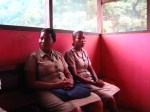
I interviewed three young community nurses who are entering their second year after 3 weeks of practical work. They had just returned from their community outreach rounds, checking up on the vaccinations of babies and mothers. Their eyes sparkled and their uniforms were spotless but brown; the coveted white uniforms are not for them until they pass next year’s exams.
After lunch we compared notes among the seven teams, using appreciative inquiry as our approach: what had they seen that was inspiring, touching, surprising (in the positive sense) and life-giving (literally and figuratively). What we heard stood in sharp contrast to the supposed incompetence, low morale, mediocre care, inertia, drug supply problems and poor management that we are usually being told about by the top people in the ministry, people like the ones we had in the room.
We were encouraged by the interest and enthusiasm from our participants; there is no more coming and going and, aside from things like punctuality, everyone is fully participating and deeply involved in the program. I provoked them around the punctuality issue. There is much denial about their own behavior and they are rarely confronted, except by their bosses, who probably don’t manage themselves very well either. There is also much inertia and little sense of collective responsibility. A few individuals are proud, and want recognition for being on time and ‘sticking to the norms.’ Yet there is no action to make sure their whole team is present, even after several hints. Although Americans are culturally considered individualists, and Africans collectivists, when you look closely you see that the educated elite has drifted far afield from the collective sense of duty and responsibility, may be not in their words, but surely in their actions.
We ended the day with two exercises, one called the Helium Rod, which we fabricated out of flipchart paper, and the other about shared vision, using a gadget that we also constructed out of material found locally. Experiential exercises are still a novelty here. It is one place where we can put a mirror in front of the participants and show them what they actually do, as opposed to what they say they should be doing. In a place where senior people don’t ever get direct and honest feedback about what they should be doing differently, this is the only way to confront people so they can see what they need to work on. Intellectually they buy this, but there is a sense of impotence when it comes to action.
Today the rubber will hit the road. In a reflection about the effect of the appreciative inquiry many expressed concern about it being a bit artificial and not contributing to the solution of problems. The problem-focused approach to work and life is so deeply entrenched, and so pervasive that it has become embedded in their very cells and doing anything else feels wrong. We told them we will get to these problems later but first wanted to establish a solid foundation of knowing what is going well so that this can be supported, enhanced and extended.
Today we will focus on their challenges. We will put them to work, in teams, on analyzing how they can remove obstacles they observed in the field. I have a premonition that they will find ways to push the responsibility for solving these problems further up the chain, thus reinforcing the practices that firmly keep in place the roadblocks that everyone can list in their sleep and that have been identified in countless reports for as long as I remember but that no one feels empowered to tackle.


 Sylvia's Journal
0 Responses to “Make-do/can-do”