Archive for December, 2009


Immersion

We are dipping deeper into Afghan society while staying firmly connected to our Dutch and American roots. Axel had two interviews today, both more informational interviews than a job interviews, important for purposes of networking. Someone out there, I trust, needs just what Axel has to offer.

While Axel was talking business in the Kabul Coffee House Ankie and I picked Janneke up at the old German Club and went for real coffee in the Wakhan Café, spending a delicious two hours of speaking only Dutch – a rare treat. My re-immersion in Dutch short-circuits my English now and then when I keep talking Dutch to people who stare blankly back at me.

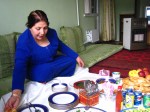
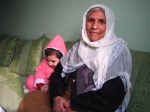
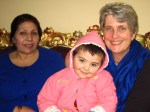
We left Ankie and Janneke to their shopping and made our way to the Russian quarter called Mikroyan for lunch with the aunt and uncle of my brother Reinout’s doctoral assistant at the university of Tilburg, a transplanted Afghan who had invited us to become part of his family. Armed with a dictionary and in broken English we talked our way through a spectacular lunch with grandma, daughter, son in law and grant child.

The family story was sad, as so many others, one brother who disappeared during the mujahideen times and, after much waiting, was finally declared dead, but apparently there was never a body. The picture of a handsome young man in uniform eternalizes him, never growing old, like his brother-in-law. The other handsome young man in the frame is the brother who left with his wife and small children and ended up in Holland. All that grandma has left with her in Kabul is one daughter and her husband and small child.

After lunch Axel had another interview in a part of the city that gives us the creeps. It is where many foreigners and their offices hide behind barricades, blast walls, sand bags and heavily armed guards in bullet-proof vests. This is where MSHers used to live and where we could walk freely seven years ago, with very little outward signs of a city under siege. At the time it wasn’t. Our current quarters are much like that except for the prohibition on walking.

While he had his interview with a Dutch friend of Pia, I had a heavenly Thai oil massage that was badly overdue. After the massage I killed time till Axel was done in one of the local supermarkets where I bumped into the minister of health who was shopping and wished me a merry Christmas. I usually see him on official duty when he is always surrounded by armed guards and people with wires around their ears, as if he was a president. It was comforting to see him as an ordinary citizen, shopping.

Christmas is arriving here and trees can be bought. The German club has a tree with light outside the dining room.

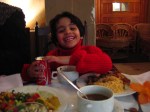
After a brief moment at home we headed out again for another social event, a dinner in the fancy Intercontinental Hotel offered by my boss to our man in Herat and his government counterpart, the provincial health director who had also brought his wife and 5 year old daughter. I was surprised, and then again not so surprised, when I was asked to sit at another table with the wife and daughter. This mirrored my experience in Herat where I was asked whether I wanted to spend the evening with the wife or join the men. Then I joined the men but now I was prepared with my dictionary. I took it as yet another impromptu Dari lesson and learned a few words more and made a new little friend in Herat.
Treats

The drive to the office this morning was a treat for the senses: the smells that came from the warm Uzbeki naan stacked on the front seat and the snow on the mountains surrounding the city. I had to pinch myself that this was real and I had that giddy feeling again – I am really living in Afghanistan!

I like Thursdays because the week is coming to an end thereis the promise of sleeping tomorrow and take a break from the intensity of work. And this Thursday was extra special because we had planned our first social event in our new house.

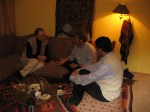
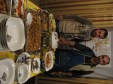
This first dinner party was catered by our housekeeper and cook who stayed late to leave us a spotless kitchen and every dish cleaned and put away. With some technical assistance from the cook from guesthouse zero they had been busy for the last few days preparing a spectacular meal and presented us with a table overflowing with goodies.


Our guests were Afghan-American, Afghan, American and Dutch, some people knew each other but others had never met. Two people escaped the US embassy compound by emphasizing the work relationship building aspect of our dinner party. This was only the 2nd time in 6 months that they had been let out of the US bubble, apart from their quarterly leave. They also never have a chance to eat Afghan food as strange as that may sound.

I had invited one of the general directors from the ministry who came with his wife, also in the ministry and his young son. We practiced pointing at body parts in Dari and English, while his wife and I conversed in halting English and Dari sentences. In the meantime Axel learned a lot about traditional Afghan herbal medicine. It was good we had several Afghan-Americans in the room who were called to find the right word now and then in either language for non-everyday expressions.

We hatched plans to try out a hammam sometimes with the ladies and also plot another escape for our new US bubble friends. All this stands in sharp contrast to what everyone in the US thinks about living here. It’s very nice!

Stepping up

Our weekly meetings with USAID and our weekly call with Boston make Tuesdays and Wednesdays into 11 hour days. The pace is intensifying. We are gearing up for gearing down. In 13 days we will be in Dubai, on our way home via Atlanta. Before that much has to be finished or started.

The joy of today was seeing our provincial health advisors (PHAs) during their quarterly meetings at our main office. I have known some of them for some time. The first time I saw them in a meeting together was more than one a half year ago. Many are still there; one has become a provincial health director, the representative of the minister of health at the provincial level. He has taken everything he learned during his time as a PHA to heart (or Herat for that matter). His PHA tenure was like training wheels on a bicycle. He is now running a tight ship with a wonderful team, one of our model provinces.

Our job is capacity building which is hard to measure in the short time spans that evaluators give us. And so, more often than not, people count the number of workshops given. This is something that irritates people who are looking for impact and it sometimes irritates me. But what I am seeing here is the cumulative effect of many workshops given to the same people over time. This is usually something that is frowned upon: why train the same people over and over when others should also have a chance?

What I am seeing more clearly now is that by giving many workshops to many different people we dilute the impact to such an extent that there is little to show years later. The provincial management support strengthening program on the other hand is highly focused: a small group of people is trained, coached, mentored, ‘refreshed’ as they call it here, over and over. It may be a significant investment (although compared to the military bill it is small change) but the payoff is visible now.

We did after action reviews with them to see how the planning for health emergencies has paid of with the arrival of H1N1 – it looks good. We are also looking for what was there to learn from the handover of contracts from one NGO to another, not an easy task because there is money at stake, livelihoods, and reputations. Once again, given what could have gone wrong, I am deeply impressed to see how much didn’t.

But maybe the best thing is that the facilitation techniques that I and other colleagues first modeled years ago, to an audience that knew only about powerpoints, and bad ones at that (too many, too many words per bullet, bullets per page and letters flying in from left and right) are now part of their repertoire. They have become facilitators. That is probably the most rewarding thing of all. The confidence is enabling them to be at ease with soliciting opinions from the group, even when they are controversial or counter to their own views. As far as that part of my previous role as consultant is concerned I have worked myself out of a job.

My new job is very different and requires me to practice what I have been preaching for a long time. That it is all actionable knowledge I can now say with certitude as a practitioner. I have my eyes (as well as the eyes of my superiors) set on the most senior ranks in the ministry – a place that generates much fear although few people actually realize that. It’s a journey into the unknown past a set of doors that are barely open.

Side by side – 2

More side-by-sides today: people putting their guns down to pray, the gun remaining within reach of the prayer mat. Policemen in the dark city as we drive back home from dinner with blinking red lights on their white leather bandoliers, as if they are Christmas trees, they look very festive but they are not there for decoration.

The whirlwind of the changes that come from Washington, all requiring new powerpoint bullets, new language, new strategies and pronouncements, sinkl back into the slow Afghan and US government bureaucracies that move at a glacial pace. Never fast enough for Washington, but then what happens, after we respond promptly? I don’t think I have ever seen so many people jump so high when asked, produce written pieces (bullets) and throw things over the wall.

The paperwork needed to be completed for us to ramp up our activities is caught up in perpetual loops it seems, as we need signatures from each of the four US ambassadors we have here and pass through the channels that get to and from them, endless.

Peter did his debriefing with the deputy minister and those who fund us, explaining that it is ludicrous to expect people, who earn less than what is required to pay the rent in a small and substandard apartment, to manage projects worth hundreds of millions of dollars. This seems a sure way to ensure corruption and graft. For a surgeon to make a decent living, this requires a private practice on the side, or rather after having briefly shown up at work to refer patients. They are not supposed to, but could you blame them?

Things don’t add up when you read the plans that are hatched in DC, they never have added up in the past. There is no evidence that they will now; yet, the cynicism coexists with my idealistic fervor that somehow, this time, we are going to make a difference. Maybe this is why I have a hard time expressing an opinion about Afghanistan, no matter how many articles or editorials I read. Everyone seems to be a little bit right and a little bit wrong.

Side by side

The frustration spills out of the senior government official when he returns from being called out of our meeting. It is dark outside and the government workday ended 2 hours ago but we are in his office for a late meeting that could not be accommodated during regular working hours. He apologizes when he returns and says that he had to attend a group of parliamentarians who came for some sort of photo opportunity with a ‘weak’ colleague, someone whose name he is anxious to give us, but he won’t because he can’t. I wonder if he can’t because of loyalty or because of fear.

All these extremes are side by side here: loyalty and fear, committed and creative professionals on one side and abusers of resources that don’t belong to them on the other.

I accidentally crossed paths with the minister who hurried by with his entourage of heavily armed people – I was told to freeze on the stairs, I did, as this was an order, not a suggestion. Here is a doctor who has made an oath to heal people but is entourage is trained to kill. I wonder what life is like when you are always surrounded by armed guards. It must affect your view of things.

In the small windowless room outside the office of a woman I am working with are three heavily armed guards and on the bookcase a bulletproof vest; the colors are camouflage green and brown and dark somber suits for the civilians. But my counterpart, next door is dressed in a pink dress with little flowers and matching scarf. I notice the contrast, these two opposites, side by side.

On the way home, later, after an Indian dinner with EC consultants we hurry past dark streets populated mostly with armored vehicles and men with guns and suddenly there is this two-storey TV screen that shows a commercial of a housewife in what could have been Greenwich Connecticut, washing expensive dishes in an expensive sink in a large an expensive kitchen with Joy. If not an ad for dishwashing liquids, it must be an advertisement for a bank – this is the place where you get money if you have it or this is what you want money for.

Our consultant Peter has explained to me that there is need corruption (comes from getting a salary that doesn’t cover basic needs), and shows up as the petty bakshish that you have to pay to get your name on a list or allowed to enter someplace for a service that is otherwise free. And then there is the greed corruption that is probably stimulated by the Greenwich kitchen ad because it also promises things that are supposed to come along with money (joy, loving wife, caring husband, obedient and smart kid).

Some Afghans still live in the stone ages, others live in Connecticut and some live in la-la land, all of them side-by-side.

Unpaid bills

The ministry of health didn’t pay its internet bill and as a result no one has been able to connect with the internet for days now. I got to send out an email through our ISP on behalf of the office of someone high up in the government. It felt a little naughty and scary but I did hit the send button anyways.

We are all busy reading the 1001 analyses and op-eds that have flooded the web in the wake of the Obama speech. Axel had time in between his Dari lesson to find them, pdf them and send them onwards. Reading all of this could easily become a full time job. We are pleased to see that many people picked up on the absence of the civilian aid business in the speech but we are learning that we are not forgotten, just not center stage.

The nexus between civilians and military is an interesting one that probably would require the recruitment of anthropologists rather than development workers or military folks. I think that these two US tribes are further apart from each other than the Pashtuns and the Tajiks. Throw those ethnic groups into the mix and it gets even more complicated, the languages alone (military speak, aid speak, Pashto speak, Dari speak, etc.)

When I applied for my job it didn’t say anything about ‘able to work in an environment that is in constant flux.’ Now I understand why: we are in a constant holding pattern: holding for the elections, holding for the certifying of the election results, holding for the recount, holding for the runoffs, holding for the inauguration, holding for the announcement of the new cabinet….this is where we are now. The announcement of the new cabinet was supposed to have happened today but the grapevine says Tuesday. The grapevine also says that most of the ministers will be replaced (sacked?) and many will be investigated. We are wondering whether we should brace for something.

Still, we try to go on with our business as if our work is regular work with timesheets, workplans and quarterly reports. In the meantime Axel continues to learn Dari and is now able to write me short Dari email about being sick of eating lamb fat (that’s what you get for complaining about too much chicken): Nan besyar charb bud. There was (bud) too much fat (charb) and now he doesn’t feel all that well.

First barf

Although part of my weekend, I was summoned to the Ministry of Health to attend the weekly staff meeting of one of the director generals. Two people representing projects from the European Commission also attended but they work at the ministry anyways and don’t have to come from afar.

We were given a brief presentation about the government’s efforts to support the provinces and why it doesn’t work. There are valiant efforts to make it work but they bump up against something that is ill-defined: departments that do not respond but we don’t know why. Is it intentional? Resource-related? No consequences? Still, the analysis of a year worth of meeting minutes that raised issues that are still unresolved, was interesting.

Although none of us represented donors, we were all asked to take back requests about funding a provincial conference to celebrate the things that did get resolved and the good men and women (very few) that are actually serious about improving the health of their provincial populations. A little over a year ago I attended a similar conference that was hijacked by a UN agency that will remain nameless.

In between meetings I did the rounds of our staff seconded to the ministry to make sure they were warm; I had after all approved the purchase of gas heaters. One was not used because it didn’t work. This should not be surprising (I have never seen so many new items malfunction or not function), but the inaction from one of our staff who is supposed to be a management coach was disappointing. I couldn’t help myself and gave a short lecture about taking action when a result is not the one that was intended.

The 2nd meeting was canceled when I showed up, also not uncommon. There is a lot of nervous movement in the ministry because the cabinet announcements will be made tomorrow. The big question is, will the Minister of Health remain, and if so, will his top team? I just learned that most of the ministers will be replaced and many investigated, so the nervousness is understandable. So things are a little on hold for now until we know our (new or old) counterparts.

I walked over to the physical therapy place at the 400-bed hospital across the street and found the staff eating their lunch. I was promptly invited to a tasty lunch of rice and spinach, accompanied by green tea. Few of the staff spoke English, except the project manager for the demining project who lived in England for some time. We talked about the courage it takes to become a de-miner (the opposite of a suicide bomber) and the terrible tragedies created by mines. It is what keeps everyone in the orthopedic and PT practice busy.

I ended up spending a few hours at the hospital, sitting by the woodstove and speaking in broken Dari and English with the other PTs and the one patient. At some point there was excitement in the air because the first snow was falling. The Dari word for snow is ‘barf’ and this was then the ‘awal barf.’ They tried to explain to me the local ritual surrounding first snow but I didn’t understand enough words to make sense out of it. It included a plastic bag, an envelope, pretending that the melting snow in the plastic bag in the envelope was a letter from France or Britain and then running away laughing. Everyone had a good laugh about either the joke or me not understanding, and I laughed along with everyone else.

I was given a new exercise that requires a small children’s ball which necessitated a significant detour through a choked Shari-nao. I chose the 2 dollar ball over the 30 cent ball because it was not as dirty, the cheap one had been hanging in a net through several seasons.

Operant conditioning

The Habibia school did not let us walk on their tracks for our weekly Friday airing. But we didn’t mind since we have discovered a much nicer walk in the ‘high-up gardens’ ( Bagh-e-Bala), the park surrounding a small pleasure palace that overlooks Kabul’s Parwan quarter.

This time we could actually get into the palace and even onto the roof. It is a lovely small palace inhabited by 3 wizened old looking men, who were huddling around a small stove on which they make tea and, presumably cook their meals. There is no furniture and no heat. The only thing in the large echoing hall that reminds the visitor that this was once a place of luxury is the enormous crystal chandelier that hangs lonely from the decorated ceiling.

Outside the gardens are neglected, as is the building itself, last restored in the 60s according to Nancy Dupree guided tour of Kabul number III. A large swimming pool sits in front of the palace, with a high diving board and two enormous floodlights that must once have lit the large terrace.

After our walk we visited Turquoise Mountain in its restored fort, a little ways down from the palace. A young sales associate gave us a tour of the workshops where exquisite wood carving is done in the traditional Nuristani style, the calligraphy studios, the jewelry place and the store itself with its high-end products, most of which have one more 0 on their price tags than I am used to. It’s a little incongruous to see such items here in Kabul and apparently they do their best business in Dubai, New York and other places with money; the local market couldn’t sustain a place like this.

We ended up, once again, for a late lunch at the Herat restaurant where we found our colleagues who were returning from their weekly Chicken Street outing, carting more bags of stuff to Guesthouse zero and beyond. The waiters at the Herat restaurant are starting to recognize me, as do the little petty traders at Chicken Street who call me Sofia and offer to me my bodyguard for a dollar (life’s cheap here).

We bought Axel some knitted socks to keep his feet warm now that it is getting noticeably colder. I tried on some fur hats that you can safely wear here but probably not in the US or Europe but I decided it wasn’t cold enough for that. The inventory of many shops has shifted to winter stuff but with few foreigners around, I am wondering who is buying all this stuff.

For dinner we went to Guesthouse 26 where Iain and Paul reside when they are not in Granada and France respectively. We were treated to a Stella Artois and goat cheese on naan for cocktails and a Cote du Rhone to accompany our dinner, such a treat. We resolved the problem of Afghanistan and, with a big nod to Pavlov and a little nod to Skinner, we concluded that it is all about operant conditioning. And for this we do need the extra boots on the ground, against the loud protestations of my inner anti-military voice.

Birthday Coin

Axel surprised me by getting up before me and setting the birthday table with croissants from the French bakery and a fake flower arrangement selected with great care in our local shopping street with the help of a driver. Getting real flowers would have required a trip across town that would have taken half a day.

Hajji Rahim, the driver who took me to the office stopped along the way to pick one of the last roses alive on our route and offered it to me as a birthday present. That made for lots of flowers, one real and many fake on this 58th birthday.

The rest of the day was entirely in the service of the US counter-insurgency strategy (COIN), producing documents that indicate how what we do relates to Obama’s speech (I could find one line, on page 5) and indicating our approach to regionalization and Afghanization, two important new words in our vocabulary although the actions behind them are not new to us at all. The internet went down at critical moments of the collaborative writing exercises and we rushed hither and thither with pen-drive to make up for the disconnectivity.

In the meantime Axel went on an outing into the old city to look for a remote and an all purpose DVD player so that we can watch Seinfeld when we are really tired and incapable of doing anything else.

For dinner we went to Razia who had cooked one of the most elaborate Thanksgiving dinners I have had in a long time, including two elephant chickens, stuffing and all the usual and unusual Thanksgiving trimmings. For desert there was everything, from a birthday Schwarzwalder Torte, including candles, for me, 2 apple pies, pomegranates, a fruit mousse and ice cream.

Joining in the fun was an eclectic company of people, a Syrian from Duxbury, a NARC, a young and an old engineer, a young woman from the US army, our film maker friend , a young Kenyan health policy specialist who works for Agha Khan and anIndian American peacenik who runs two NGOs in addition to having a job and, just like me, is getting calls for peace and against extra troops from her Quaker friends in the US.

Sint nist

This week is the week of Sinterklaas in Holland and, as I had hoped in Afghanistan as well. As it turned out, Sinterklaas did not show up at the heavily guarded Dutch embassy, not even in a tank, because there were no kids. Axel was particularly disappointed.

We did meet all sorts of interesting people, not just Dutch, and an entire military delegation from Holland, obediently sipping their water while we had our Heinekens. I also met an old friend from my study years in Leiden who now happens to be the ambassador.

We couldn’t be dropped off at the embassy entrance because it is in the no-no zone where the Indian embassy got blasted twice. The second time blew all the doors and windows out at the Dutch embassy but everything was nicely repaired, a fire blazing in the fireplace, Sinterklaas candy spread out on dishes everywhere and an unlimited supply of Heineken en good South African wine.

I eavesdropped on the conversation between the ambassador and various generals and colonels and marveled at how different the Dutch look at the situation here: the development and diplomacy pillars are large – I am still combing through Obama’s speech to find the US development pillar. If it is there at all, it’s tiny.

I had a long conversation with my colleague Ali about the American approach and he sighed deeply – for those 30.000 times 1 million dollar a soldier a year, couldn’t the Americans just help set up some local businesses, agri- or other, to help people back on their feet, hire some people to keep the place save and employ locals? Yes, why not?

The Obama speech is like the proverbial flapping of wings of a butterfly on one side of the world, creating a storm of requests from our donor here in Kabul for this or that statement about our work, the impact of our work and the Afghanisation of our work, presumably so that questions asked in DC can be answered compellingly and with speed. We are scrambling.

Still, in between all of this I managed to witness the birth of the idea of a Masters of Public Health Program within the Kabul Medical University – a huge step forward, very exciting. I accompanied Ali who is on the task force that will design the program, but skipped out early to join our After-Eid Bingo party that I had organized with some of my Afghan colleagues.

The party was a bit chaotic, but then, what else could it be when you try to feed 200 people out of plastic bags with small Styrofoam containers with chicken, kebabs, rice, fruit, yoghurt and coca cola. Guesthouse staff showed up, drivers, day laborers, gobbling up more meals than I thought possible, and then trying to keep them afterwards for a game of bilingual Bingo with real prizes. It was good old fashioned fun, something I think we could use some more of given the general sense of doom people feel after the Obama speech, no matter how inspiring – who really believes that more guns and boots can lift spirits.


December 2009
M T W T F S S
 123456
78910111213
14151617181920
21222324252627
28293031  

Categories

Blog Stats

  • 136,984 hits

Enter your email address to follow this blog and receive notifications of new posts by email.

Join 76 other subscribers