Archive for February, 2010


Mercenaries and leaders

Some weeks ago a team went out to Farah Province; one of the provinces considered insecure. Farah borders Iran; Herat province is on its northern border, relatively secure, and Nimruz province, a dangerous place, is to its south. Travel in Farah is risky. There is also, as far as I know, only one female doctor in the entire province. This combination leads to often lethal consequences for those who are seriously ill, who are victims of accidents or violence, or simply having a baby.

The team was looking at the hospital there that is barely functional and thus not helping to build confidence in the country’s government to care for its people. It is teetering on the brink for all sorts of reasons. The US government has stepped in and is making a significant amount of cash available to upgrade this critical part of the health system for the citizens of Farah Province.

According to the report, several of the single story buildings have been built by different agencies and donors for different purposes and following different standards. They are not fit for hospital services and what is there cannot benefit from proper maintenance as there is no plan nor are there resources available to fix what needs repair. There is no drainage, no waste management system, no septic tank and no water supply.

It is hard for us who are used to gleaming hospitals to imagine having to rely on a place like that for our survival. And I haven’t even mentioned the staff. Salaries and benefit are greatly inequitable and a source of friction between those paid by the government and those paid by the NGO that runs part of the hospital.

The staff list attached to the report lists all of the hospital staff; there is a column named ‘designation’ which lists each one of them as ‘mercenary.’ This makes me think of the Hessian mercenaries that fought on the British side in the revolutionary war. It is true that this country is steeped in warrior imagery, but hospital staff as mercenaries?

Still, not all is about war and destruction here. Today I visited the Blood Bank which has made a remarkable turnaround in its ill-fitting and deeply depressing Russian built bastion. There are still traces from the Russian days: its elephantesque architecture, and the habit of closing everything for lunch time. But the legendary Russian disregard and disrespect for the people who come through its doors, either to give or to get blood, has changed a hundred and eighty degrees.

In large flowing Dari script on the walls all who enter are reminded that blood is not for sale and that, if someone claims the opposite, a particular mobile number should be called. Corruption used to pervade the practice of this organization but now all is transparent. Some people don’t like this and are using heavy-handed techniques to throw the current leadership out.

The 60 odd staff members, from the lowly guard at the door to the young and energetic director and his many female staff in between, have all been transformed into ‘managers who lead.’ I got to give them their certificate that proclaimed they had successfully completed a course called ‘Leadership for Infection Prevention.’ And then I got to see what their leadership looked like.

This was not a hollow term: I heard and saw several examples of creative thinking and taking initiative: from getting Afghanistan’s president and vice president to give blood (and photographs to prove it) to cubbyholes at the entrance with plastic indoor shoes so that the muddy street shoes stay at the entrance to the building.

The best part was how the Blood Bank team, as part of their effort to raise voluntary blood donations, had been able to convince the Shia leadership to counsel their flock to donate their blood to the Blood Bank rather than letting it spill on the ground during their annual self-flagellation ritual. In my book that is leadership!
Navy treatment

Leslie is a uniformed US Navy physical therapist. He is part of a US Navy medical team that is embedded in the military hospital, built some time ago by the Russians. I assume this because of the square and chunky concrete architectural style (functional without any elegance or esthetical value).

He is a trainer and assigned to assist the local PT team with the rehab of amputees and war-wounded. When he heard that there was this American woman with shoulder problems his curiosity was peaked. Fahima asked if I was willing to have him look at my shoulder.

He stood waiting in the hallway with his interpreter because he was not allowed to enter the female PT room. Since I could also not enter the male PT room we were left with the staff lounge and the lunch table became the examination table.

He checked my range of motion and strength while my PT looked on. I became a training session. I learned that I am a prime candidate for frozen shoulder (female, in her late fifties and post-menopausal) and my PT was instructed to watch out for signs of imminent frozen shoulder. This reminded me not to take this shoulder business lightly. I was given a few exercises and Leslie instructed my PT to treat me as if I had just had my rotator cuff operation and start from scratch with my exercises, the same I did faithfully every morning in September.

In the meantime Sara took pictures of the PT team receiving the supplies provided by my PT place in Manchester that had been packed in our container the day before our return trip to Kabul via Holland. She got to witness what happens in the female PT treatment room – something that appears more like a social affair than the serious treatment in separate treatment rooms practiced in the US. For me these ‘sessions’ are always great ways to practice my Dari. We can have more and more interesting conversations now that my vocabulary and master of grammar is expanding.

More snow and rain is coming down, as if the winter realized it had not done its work yet not that spring is just around the corner, and is in catch up mode. Sara would have preferred two sunny days on her last weekend here but the Afghans are happy. This is after all primarily an agricultural society and people like rain and snow because it means water and water means new life in spring and new life in spring means food.

While we were at our Dari class Sara watched 6 episodes of the (British) The Office and prepared our goodbye dinner party with people she has met and people I thought she should meet before she leaves.

Spooky, suave and calming

We have a very busy social life in Kabul and on Fridays we are busiest. We had hoped to give Sara a tourist tour of Kabul but the rain and sleet made going up on a mountain for a panorama view of Kabul rather pointless. We were in the clouds.

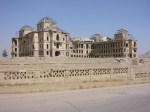
We did take her down to the spooky Darulaman palace at the end of the road with the same name, going southwest right by our office. A shell of its former glory, what’s left of the palace stands there as a monument to war and destruction, destroyed beyond repair itself. It has been like that for more than a decade I believe and I wonder on whose to-do list this mammoth structure figures.

The newly dug and cemented jewies (open drains on each side of the roads) were no longer draining the snow/rain mixture that was consequently flowing into the street turning everything into mud. On days like this Kabul is very ugly.

We made a last stop on Chicken Street for Sara to buy a few more scarves to gift. We found the chief doctor herself shopping for scarves at the same place and so Sara got to meet her after all.

From there we drove in circles for about half an hour until we found the new Kabul Health Club – the same that we had not found last week. But this time we had a phone number. It took about 4 calls before we found the place, or rather the place found us as they had put a young man out on the street to flag us down.

Inside we discovered another part of Afghanistan – the educated, suave and polished Afghan diaspora that had returned and was determined to (a) help Afghanistan become more like the London, Dubai, Paris or New York they had reluctantly left when the relatives called them back to Kabul and (b) make it more palatable for them to live in.

The health club could have been in London or Dubai with brightly lit and elegantly designed dressing rooms for him and her, each with their steam rooms and saunas, a restaurant, a juice bar and a place to have nails, face and hair done (ladies only for now). The young couple whose venture this was, supported by several generations of family, greeted everyone warmly and flitted from one place to another trying to attract pre-paid one year memberships. The prices being American and the place as far from our house as it is, we decided to wait a while to see whether we can live without it.

Next stop on the agenda was for Sara and me a visit, once again, to the Thai beauty spa, me for a massage and Sara for a pedicure. An hour and a half later, all oily and shiny, while were waiting for our car, several (western) men entered the place, we assumed for a ‘gents beard trim.’ But thenl we noticed that only one of them actually sat down in a barber chair. The others, including two bulky men with military vests that had all their many pockets filled with various lethal objects – walked into the one place where, as far as we know, neither massage nor barber work is done. This parade of testosterone was so out of place in this beauty salon with its diminutive Thai ladies and pictures of smooth skin and Thai hair styles that it made us very curious.

We tried to casually walk by the room in which the men had entered but all we could see was four guys (two armed) sitting in a living room with several Thai ladies. Were we witnessing some historical secret talks? We will never know.

We drove home through more snow and sleet to find our house with doors and windows wide open because the leg of lamb that Axel was cooking had smoked up the house. He was doing this without knowing the oven temperature and had improvised a little bit too much on the hot side.

Nancy and Bill came over for dinner. Nancy lived here in the 50s and speaks fluently Dari – her husband Bill got here in 2002. Between the two of them there were a thousand stories to tell requiring many more than this one dinner.

It’s good to hear stories from people who have lived in a place for a long time as it puts all the current crises in perspective. I found this rather calming.

Dusty

We have been using the words ‘until the dust settles’ quite a bit lately. The top tiers of the ministry are not fully staffed and there are, as my African wisdom calendar said, many rivers coming together creating turbulence (or dust).

But today it felt as if a giant new vacuum bag full of dust was shaken out over the ministry. None of the new dust is likely to settle soon. The whole place was stirred up by a new org chart that was activated today by the country’s presidential team, producing major changes in reporting relationships – some logical and long overdue and some incomprehensible.

Apparently new org charts are produced repeatedly and once in a while one is approved after much haggling between power broker. Org charts are always about territory and territory means power and the ability to put your friends and family in positions that get nice salaries. This latest org one appears to have its origins in various power battles between people within the ministry and between various government structures that have something to do with staffing, salaries and rules about transparency and equity.

Some people lost whole directorates, others gained new departments, some were split in half and lots of people were unhappy. Since the dust is not settled, and it is weekend in Afghanistan, we don’t quite know all the implications of these changes in the boxes and lines on the org chart. Time will tell but messy it is for sure.

We did get another audience with the chief doctor and her staff and I got to talk about senior leadership challenges, the spiral of visibility and vulnerability that women leaders at the most senior levels get caught in, the balancing acts at the top between the urgencies of now and the necessities of the future; attention to the loud voices of those with power and the absence of voices from those to be served. I am glad it’s not my job.

My boss offered my assistance ‘day and night’ to which I protested. As it turns out this is a literal translation of the Dari expression that means anytime. But first it is weekend. Friday is off for everyone.

Kabulungs

One of my colleagues in Cambridge told me that the EPA did a survey back in 2004 that found the suspended fecal particulate matter in Kabul to be the highest in the world. This has to do with all the animals in town and the dry desert climate. Giardia too may be airborne, as some other colleague here in Kabul told one of our house guests. This may explain the constant throat clearing that we are all collectively engaged in. Hearing others doing this throat clearing drives me nuts and doing it myself is mostly ineffectual, also driving me nuts.

I am imagining the layers of soot, fecal matter and other debris that are floating in the air and then settle in my lungs and wonder whether it is worse than the smoking I gave up some 30 years ago. It is one of the less attractive side effects of living in Kabul, aside from the restricted movement – but so far all of it is worth it.

I just wrote in mirror script on the inside of my office window that is covered with a thin film of soot: please clean me. I could have written it in Dari as I know both the words and the letters, but writing Dari in mirror script is still a challenge.

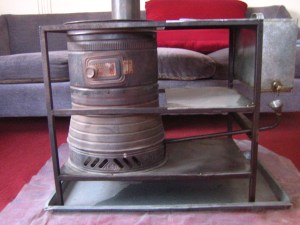
In our language classrooms there are traditional diesel stoves; a little more primitive than the German designs we have in our house. The bukhari wataniye as it is called is the most basic of designs: a small faucet is turned to slow down or speed up the drip-drip of drops of diesel fuel from the storage tank on the right into a tiny funnel attached to a fuel line that runs into the chamber of the stove on the left. You light a match which lights the fuel and voila…drip, drip, drip. The alternative to the traditional fuel stove is the traditional wood stove which is equally bad for your health according to Axel who read something about our various inefficient heating systems in the New Yorker.

Truth to power

I have a Kenyan flip book on my desk that provides me each day with a piece of African wisdom about leadership. In my experience most of it is ignored in Africa. Also, all of it is applicable to Afghanistan where it is also ignored – but people could be excused because the sayings come from Africa.

As part of my (self-appointed) role as a cross-cultural boundary spanner I am introducing the African wisdom to folks in Kabul. Today, on Ground Hog day, the message from traditional Africa, Kenya to be precise, is “If the leader limps, all the others start limping too.”

The message holds true for Afghanistan as much as for Kenya. I see much limping around me. Some of the limping comes from growing up in a society that knows much violence and some of it comes from not having had enough exercise with both legs. And then of course there are people who had their legs crushed or shot out from under them. I’d limp too.

I am beginning to see that time management issues and the inability to focus are not results of missing skill sets. A culture that is so hierarchical and so stratified practically guarantees that time will not be managed and attention not focused if hierarchy is involved. Those in lower level positions (and one can fall from an exalted status to a lower or no status in no time at all here) cannot push back or stand up against higher ups who don’t respect time limits, hijack meetings or push their agenda onto an already crowded and carefully designed program. Ergo, sending people to time management and focusing workshops will make no difference.

But I can see that people so badly want these to be skill issues rather than cultural issues. Most people can learn new skills but cultural habits are so much more difficult to change. Actually, none of this is exclusive to Afghanistan – I see the same behavior in our own government. Challenging your superior(s) is risky business in any culture. Just try to tell the boss of the boss of your boss that time’s up.

Status

I sometimes forget what it is like to be in the company of women. My young friend Sabera who I met just over a year ago at a conference in Dhaka had invited me to a lunch with 4 of her (female) colleagues and friends to say goodbye before she goes off to Dhaka to get her MPH from BRAC University’s School of Public Health.

High up on the fifth floor of Central Hotel we sat in the sun overlooking the ‘new city’ section of Kabul, just about level with one of the magnificent forts that is perched on one of Kabul’s many hills.

While helping ourselves to a spectacular buffet lunch that Sabera offered us we talked about what it is like to work in a society that doesn’t recognize that it cannot right itself without its women. Here I was, once again, with a bunch of phenomenal women who are professionals and making a difference against so many odds.

I can’t remember anymore all the things we talked about but I do remember basking in the warm sun and the glow and spirit of these women, one old (like me) and the rest much younger. One of them has a brother who has become a Dutch citizen, speaks fluently Dutch and lives in Groningen. We will meet sometime when he comes for a visit. Another Dutch-Afghan connection.

One topic that comes up a lot in conversations here is all the people we work with in the ministry are doctors, few know anything about management or leadership (yup) and many look down on nurses and midwives.

But even female doctors can sometimes be less than kind to their non-doctor sisters. Status does get in the way. There are plenty of tales of doctors, male or female, who cannot accept the oftentimes superior practical skills and advice of nurses and midwives- even if it may kill the patient.

At my Dari class I learned to go shopping for a ‘ser’ of sugar (a measure for flour and sugar representing 7 kilos) and ask for change from a bill (‘black money’). Some of the shopping language I had already learned on the street and so we sped through the lesson at breakneck speed.

During the break between classes I met a Dutch woman whose Dari was far superior to mine. In fact she is trying to write a curriculum about autism in Dari for psychiatric nurses. This place and its various inhabitants continues to surprise me.


February 2010
M T W T F S S
1234567
891011121314
15161718192021
22232425262728

Categories

Blog Stats

  • 137,070 hits

Enter your email address to follow this blog and receive notifications of new posts by email.

Join 76 other subscribers