Archive for April, 2010

Dari distractions

I know just enough Dari to fool people into believing that I understand. This has led to a few awkward and costly misunderstandings the last few days.

First the cook showed up on our doorstep with ‘supplies’ (probably yogurt, hot peppers, coriander and limes). The guard who responded to the bell at the outside gate (we never open our own door here) walked over to me and mentioned that the cook was at the door. With the clarity of hindsight I now know he said also that he had things with him, but at the time I didn’t understand. So, in my best Dari, I told the guard that the cook should go home since it was a public holiday (Mujahideen day). And so the guard sent the cook home, with all his supplies, including the yogurt we so badly wanted.

Early this morning the electricity went off. After having the generator on for most of the day we noticed that no one else in the neighbourhood had generators going. I called the other guesthouses and they too had town electricity. It took us about 5 hours to figure out what the guard had probably told us early in the morning. I had understood the words for burned and broken but not what these adjectives referred to. When the night guard arrived at the end of the day he figured out that the fuse, outside our house in a box on the street, had been burned (aha). It was fixed within minutes.

With the generator humming in the background, we had a quiet day at home, satying put all day except for a brief outing into town to complete our shopping for gifts to take to Holland. It was a domestic sort of day. I finished a baby sweater, for the next kid that comes along, baked cookies in an oven I don’t understand (cookies did not come out well), washed the dishes, and studied Dari.

For lunch I prepared a Lebanese meal which we shared with the guard and drivers. I think they liked the mana’ishe (wild thyme pizza). Axel did an after action review with himself about the writing workshop he designed for five SOLA students and conducted on Wednesday. I think he has found his calling! He also downloaded ‘House’ (14 hours of download for one episode!), which we will watch tonight over our Pad Thai dinner – the cook is out so we get to choose what we eat. One more day off, tomorrow, will complete this very long weekend, that started on Wednesday and end on Sunday, only 2 days before our take off to Holland.
Alfabet

Some of Kabul went to work today but most people took a day off, bridging from holiday to weekend. As a result traffic was easy today and it took me less than 30 minutes to get to my lunch appointment with Denise, in the Flower Street Cafe which isn’t on Flower Street. It’s the place where young good looking expats are hanging out. If I were single and much younger, that’s where I would go to check out who’s in Kabul.

Denise heads up one of our sister projects that complements ours by focusing on strengthening the NGOs that deliver the health services. Her project has recently been asked to provide more support to one of the departments of the ministry we are also supporting; and so we got together to make sure we are aligned.

We have more experience in working with the ministry than her team has. We are used to working in this extremely difficult environment and have developed a considerable degree of frustration tolerance. One of our dilemmas is how to respond to the numerous requests for this and for that, as if we are a supermarket for whatever makes offices work (people, equipment, internet, etc.). We are navigating these treacherous waters with sometimes a ‘no’ and sometimes a ‘yes.’

After lunch I stopped at one of the supermarkets that caters to expats to stock up on the things we foreigners cannot do without (like very dark chocolate and cold medicine). I spotted a laminated chart with the Dari alphabet. The shopkeeper proudly pointed out that he also had the English one but I told him I knew that alphabet already and preferred the Dari one. It now hangs in the hallway so we can practice each time we walk to the kitchen.

Axel’s employment prospects are growing by the day. There is much paperwork to be completed before the final go-ahead. We suspect this may come the day before we leave for Holland, next week.

Oranje bitter and herring

I was the only one in an entirely orange outfit; then there were the Dutch embassy employees, some women wearing an orange scarf and most of the men in suits wearing a tiny little orange ribbon. There was one Afghan gentleman wearing what is known as Karzai’s signature robe, the blue/green chapan; and then of course the military (Dutch ISAF) in their usual camouflage outfits.

One things that was very noticeably was the height of the young Dutch men who towered over everyone else. Dutch males are competing with Sudanese males for the tallest in the world. A few of these skinny giants were with us last night.

It was the Queen’s Birthday Party. It is actually the queen mother’s birthday (April 30); but the current queen was born at the end of January which is not a good time to celebrate outdoors in Holland so we kept her mother’s birth date. Last night wasn’t even the 30th of April. The Dutch embassy had to organize the event around Mujahideen day (today), a bridge vacation day, tomorrow, and Friday when everything is closed.

Security notices had been flying around the internet to be careful. Two years ago Karzai was nearly killed on this day. Apparently, it is a day when AOGs (armed opposition groups) flex their muscles.

After consultation with our security people we got permission to go into town and were even allowed to pass barricades because of the Dutch passport and the invitation. We arrived just when high government officials and other Afghan and foreign dignitaries as well as many military (ISAF) men were leaving the compound and the place was opened to the Dutch community living in Kabul.

Beautiful carpets were laid out over the gravel and mud to welcome us through barricades and past grey blast walls, metal cages, armed men and other signs of war. Overhead crimson canopies were erected to hide other protective constructions and so everything looked quite festive.

Large pictures of Holland’s famous sights (tulip fields, cows and windmills, stately houses in Amsterdam along the canals, orange-dressed fans in a football stadium, close up of a tulip) were strung along another blast wall with potted geraniums in front.

And then there were the Afghan waiters (all male of course) with orange aprons or dressed in traditional farmers costumes with their wide pants, striped fronts and small black caps, quite cute. They were carrying around trays of small canapés (salmon, pate) that would have been more at home in a fancy French restaurant.

And then came the long awaited trays with fresh (raw) herring. I stood close by the service entrance and was able to take one of the few whole herrings that were placed on top of the small pieces on toast. I was very selfish and managed to get two entire herrings.

The herring tray was followed by a tray with small glasses with oranje bitter, an orange colored gin that is only served on this day of the year I believe. For those wanting the plain gin, uncoloured, or Heineken or wine, all was available in unlimted quantities.

We met interesting people, among them two Afghans who had lived in Holland and spoke better Dutch than we did Dari; we talked with the military who are all deeply upset about the decision by the Dutch people to pull out of Afghanistan (Uruzgan). They all believed they have done transformative work there and made the province, among the poorest of Afghanistan, a better place to live in, especially for young girls who are now going to Dutch-built and supported schools.

Expectations

After our meeting with our donor I had my performance review with my boss, sitting in the back of a pick up truck. By the time we arrived at the office I had my rating (meet expectations) which will be communicated with HQ to determine my salary increment. It is not easy to get the higher ratings of ‘exceed expectations,’ let alone the highest one of ‘outstanding.’

I would of course have liked to get an ‘exceeded expectations,’ but I am not sure anyone knows what can be expected of me, here, in the nebulous arena of capacity building in management and leadership. My conversation with my boss, as well as my own preparation for this, had highlighted again how difficult it is to be in the business of ‘building capacity’ at the most senior levels of a government bureaucracy in a place where there’s a bit of a leadership crisis, not just in the ministry but everywhere in this country, from top to bottom.

The dilemma in my job is that it is easy to improve leadership and management in a place that is well led and well managed; such places don’t need us of course. But here, where management skills, even at the highest levels, are inshort supply and where there is essentially a leadership vacuum, combined with much activity at various levels that cannot withstand scrutiny, there is only so much we can do.

We can, and we do suggest or, if we have a boss’ blessing, put into place processes, procedures, create plan templates, facilitate planning meetings and all that, but we cannot make the boss hold his (rarely her) staff accountable for results, get rid of dead wood or manage politically well connected non performers.

As outsiders who are not holding many strings, we can tell our superiors about corruption stories (oh there are so many, and such clever ones: donated hospital blankets sold in the bazaar while the old hospital blankets are cut in two so that the numbers add up; or old rancid oil used for cooking the hospital food while the fresh oil is sold in the bazaar) – but we can’t do much about it.

Some people at the highest levels are sincerely trying to stamp such practices out while others have a stake in not succeeding. The only way to not get too depressed about is to soldier on and hope that the honest higher ups will eventually prevail and lightning will hit the dishonest ones.

Another dilemma I was confronted with today is about speaking out as a kharidja, a foreigner, whose voice and opinion is more respected (say some people). I am encouraged to be more forceful and forthcoming with my opinion while at the other hand building the capacity of my staff to be listened to and respected. In my view the former undermines the latter and so I tend to be more of a coach than the provider of expert opinion.

And of course everything everyone tells me is only an opinion that may, or may not be shared by nil or thousands.

In a jam

The main road through Karte Parwan, past the Intercon Hotel and Bagh-e-Bala is being improved, expanded and paved (‘cooked’). There are two wide lanes, paved and ready for use, but at rush hour only one was open. The lane should be able to hold three cars abreast (there are no white lines) but somehow nine lanes had pressed into the space for three; six lanes going our way and three in the opposite direction.

The whole place was one large parking lot and our driver, Hadji Safar, decided to take a short cut off on the left, but we got even more hopelessly stuck. He managed to turn the car around between two jewies (open sewers) without getting his wheels over the edge and ease back into the space we had formerly occupied. It was a good occasion to quote the saying, ‘faster is slower.’ It took us 2 hours to get form the ministry of health back to our house, a distance of only a few kilometres, 25 minutes on a good day.

I was lucky that i was not traveling along. My co-passenger was one of my staff. We killed the time by deconstructing a complex mess-up in the office that we can ascribe lightly to cultural differences, or deeply to things more sinister (or just the other way around). In the end we agreed that an Afghan proverb described the situation best: if my heart is not narrow, no place can be narrow (aga delem tang nabasha, jay tang neest).

All along during the drive, cheek by jowl with other motorists, I made a point of smiling to people who looked tense. I was able, each time, to get a smile back. I consider this good preventive medicine in a place where road rage can easily get out of hand given the amount of guns that are floating around here; no doubt some of them in the cars we encounter or travel alongside with.

At the ministry we had attended a meeting that was designed to get organizations like us to pay for staff and other things (nobody even nibbled on the request for the new headquarters). It was one of these meetings with multiple layers of meaning. After the meeting, during our long ride home, I understood what was really going on and realized that our response had been the wrong one – a moral high road maybe, but missing the boat in other ways.

The endless requests for things, people, stuff, money is at times exasperating, yet entirely understandable. For one, the strategy ultimately works as there is always someone who is willing to sign the check. In this case that should have been us. Not offering to hire staff would essentially undo a few years of capacity building, as the capacity that we did built is about to slip from our hands – contracts are up and there are better offers out there. There are no easy solutions and we are too far ahead in this game of hiring the people the government needs but cannot afford, to turn our backs.

Thwuck thwuck

Thwuck, thwuck, thwuck went the helicopters, rattling our thin glass windows in their poorly constructed frames. They veered south, no more than 500 feet over our heads. A first one batch of 5 and then another batch. In between there was the rumble of low flying planes, labouring towards something that required this much airpower. Off to the unruly, unruled and unrulable south?

The people flying these things, Americans I supposes, are also working in Afghanistan, just like me. For them working in Afghanistan is an entirely different ball game. I sit here with the door to the garden open, listening to the twitter of birds and the voices of children, playing real ball games.

I am reading Dexter Filkins’ The Forever War and in doing so catch a glimpse of the stuff that happens far from our beds, the ugly stuff about this (and Iraq’s) forever war. It’s the picture that most people have of Afghanistan. It is very different from ours.

This morning I handed out the pictures Axel took during our outing this weekend, to the drivers and guards who came with us. The neat thing about Axel’s graphic design skills is that he has everything set up to print out pictures. When we go on a walk to a place we have been before, he prints the pictures and we hand them out, nearly like a Polaroid, except much nicer quality. It is what I have always wanted to do but am never set up to do. People love to have their picture taken here, even women (we do ask first of course).

At work we are cycling into our annual performance review and work planning period. Back in Boston I hated this time because the process was designed by accountants. But here I am part of senior leadership and thus have some say over the process. We use it as a time of reflection and capacity building in house, a use of time I find useful and productive.

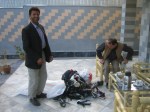
While I was at work Axel went with driver Fazle on his day off to deliver the cleats and shin guards and jerseys to the womens’ soccer team, practicing in the far northwest corner of Kabul. This to make sure that the girls had first dibs on the goodies. I asked Axel to take pictures to bring back as proof. He did.

Teacup wine and soccer cleats

My army physical therapist was called to go on a trip someplace and so, once again, I skipped my weekly PT session. My PT visits are now so infrequent that I might as well do without them. I have asked my US-based shoulder surgeon to review my Beirut MRI and interpret it, but so far I have not heard a thing and so I muddle along with exercises that may not be the right ones.

It was another beautiful summer day in Kabul. We had breakfast outside and enjoyed watching the roses open up right in front of our eyes. At noon we joined Pia for lunch in the overpriced Lebanese restaurant that was a far cry from our seaside eating experiences in Lebanon: no views (other than barbed wire and blast walls), and no bottle of chilled white wine. The food was good though.

Since the raids on alcohol serving establishments over a week ago it is not so easy to get a glass of something with lunch or dinner. There is no mention anymore of alcohol on the menu, so we asked. Yes, there was wine (red only) and beer and would we mind that it was served in a tea mug? We didn’t but drinking wine that way does take away from the pleasure and I am not sure it is worth the hefty price that alcohol now commands.

We went straight to our Dari classes. They seem to depress Axel these days as he feels he makes little progress and all sorts of unpleasant childhood memories about learning another language are activated. This is too bad as there is no better way to learn Dari than in the circumstances in which we find ourselves – plenty of practice with drivers, cooks, household help and all.

Back home we had a visit from driver Fazle who is also the coach of many of Afghanistan’s soccer teams. A colleague had sent a huge duffel bag full of cleats, shin guards, jerseys, socks, shorts and what not; it is supposed to go to the women’s soccer teams but many of the supplies are rather large for women. He promised he would take everything first to the girls – to take what fits, and only then would he go to the boys. Here, you never know for sure that the girls get served; they are after all second hand citizens. I gave Fazle my camera, saying I expect pictures.

Into Afghanistan

Today we went into Afghanistan. This may sound strange but being in Kabul is not quite being in Afghanistan. Unlike Kabul, not a pretty city, the country side of Afghanistan is stunningly beautiful. The visible traces of violence, and destruction that have marred this magnificent place make your heart ache.

We had been cleared by our security folks to go to Istalef which is about 50 km north of Kabul on the Shamali plain along the road that takes travellers to about one third of all the provinces north of Kabul. It is the road to the Panshir, to the Salang Pass, further north to Mazar-e-Sharif. It is where the Bagram airbase is located. Because of this the Shamali plains are strategic and so there has often been heavy fighting in this area, all through history.

From a distance Istalef looks like a green patch that was slapped against the side of the brown mountains, halfway between the flatland of the plains and the enormous and ragged snow-covered peaks. This makes it look small and insignificant. But it never was, mostly because of its strategic location; you can see far north and south from the village and so everyone wanted it.

Massoud had his headquarters up there some time. There is a French connection (Massoud attended the French Lycee Istiqlal in Kabul and received is first publicity from the French government and press). We passed by the ‘ecole mixte’ and saw many other signs of projects that have a picture of the French flag and Dari translated into French.

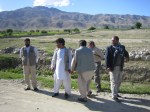
We drove up to a place in the shade for our picnic. One of our guards who lives nearby, arrived on his motorcycle with his cousin. They brought a large pot of homemade yogurt, something for which Istalef is well known. The guards bought fresh bread, some of it filled with dal, potato and sweet potato, in the village and everyone shared with everyone.

I had tried to organize our party (several of my male colleagues) to share the task of preparing a picnic but no one had bothered and so everyone ate what I had brought. Axel had to agree that this was a male thing – men have wives who prepare such things, and I happened to be the only wife around.

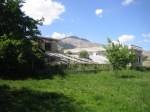
After our picnic we walked up to the roof of the still bombed out hotel where four years ago Sita and I also had a picnic with our MSH colleagues who then lived here. I am glad that Axel also got to see the place. Now only Tessa hasn’t been here. Come on over Tess!

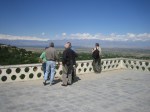
You need a little bit of imagination to look past the crater, the blackened or collapsed walls and the bricked up windows to see the fantasy place this could be. The roof also serves as a huge terrace with breathtaking views in all directions over the plain, framed by spectacular and high mountains.

Below is we could see a small stream where cars were washed, and children were playing in the water. Yet all around this idyllic scene are the remains of mud-brick houses that were destroyed by aerial attacks and heavy mortar.

The hotel itself has never recovered except for the garden that is lovingly tended by the gardener who lives amidst the debris in a greenhouse made from plastic. His roses could win prizes in garden shows in England.
Other than yogurt, Istalef is also famous for its turquoise and brown pottery.

We spent quite a bit of time walking up and down the main street looking for the perfect pieces of the somewhat brittle pottery. I haggled about the prices in my best Dari and we are now the proud owners of several small and large bowls, including some dishes from which to eat the famous yogurt and a pot in which to make it.

Gifts, gap and other good things

I am progressing well in my Dari book. I have four more chapters to go which qualifies me for holding all sorts of conversations with Dari speakers about everything but specialized and technical matters. The drivers, guards, cook and housekeeper have stopped talking to me in their broken English. Now I am speaking with them in broken Dari – and we more or less understand each other. There’s nothing like total immersion.

Today I learned the names of the months. They are the names of the zodiac and so the seasons and months are aligned, unlike in our Gregorian calendar. We are now in the year 1389 and in the month of soar which means Taurus and my birthday is in the month of qaos, or Sagittarius. All morning I practiced them with the driver and I think I have mastered them now.

After my Dari class I joined Axel at the Flower Street cafe which was mostly occupied by young foreigners intently gazing at their laptops. The Flower Street Cafe has wireless internet as well as good cappuccino and sandwiches. This attracts a particular crowd that doesn’t include many Afghans.

After lunch we picked up our pretend beer that now tastes as good as the real thing, at the New Rose Supermarket in Shar-e-nao. Next and last stop was Ibrahim’s shop off Chicken Street to buy a wedding present for my nephew and his bride. Coming from Afghanistan what else but a carpet to bring as a gift? Ibrahim took down rug after rug from a pile of the most beautiful things, each more interesting than the previous one.

The beauty of the handicraft that are made in this part of the world never cease to amaze me. Axel and I don’t have exactly the same taste but we finally agreed on a Yomut (or Yamoud) rug that comes from Herat where this particular group of Turkmen settled. Back home we unfolded the rug on our terrace and Axel photographed it from the balcony. We will ask the mother of the groom whether we picked the right thing.

Owning, buying and selling

Today was all about alignment, or rather, mis or non alignment. Sometimes, in our eagerness to show results or do something (don’t just sit there but do something) we plough ahead leaving those who we are supposed to bring along, behind, chewing on the goodies (trips, per diem, certificates, uniforms, badges, pins, bags) given to them and eventually forgetting all about what they were supposed to do, or even care about. And then we get upset because they don’t seem to care at all, or don’t have the same excitement that we have for whatever it is we are trying to accomplish.

Lots of stuff that is in development plans ends up this way; it gives development a bad rap. This is particularly true for training. And so today was about figuring out how to get people along; how to pass ownership from us to them. There is a common misconception that you can make someone ‘own’ something. I have never seen it happen. I have gotten very good at spotting when that transfer of ownership doesn’t spontaneously take place.

For me the signals are clear. When something remains ‘unclear’ or feet are dragging, work plan upon work plan, strategy upon strategy is developed, meeting after meeting takes place and nothing significantly changes, it’s sure sign that someone in a position of power hasn’t ‘bought in.’ And nothing is owned without buying it first. And nothing is bought without someone selling.

So that brings us back to selling, which is what we do. We sell expertise, we sell solutions, we sell advice, and sometimes we sell hope and encouragement. It’s a very difficult job under any circumstance. Today was one of those days.

A four-day workweek is a good thing, it is weekend now. I can go home in good conscience now that it seems that our hapless travellers are returning home from Dubai in the early morning hours tomorrow; with, I am told, their suitcases.


April 2010
M T W T F S S
 1234
567891011
12131415161718
19202122232425
2627282930  

Categories

Blog Stats

  • 136,984 hits

Enter your email address to follow this blog and receive notifications of new posts by email.

Join 76 other subscribers