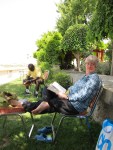
Archive for July, 2010

Mobilizing

Events of today reminded me of two important things: (1) when you travel pay the extra 100 dollars or so for travel insurance and emergency or medical evacuation and (2) put every new contact in your electronic or paper address book. Together these two simple acts combine to be a powerful set of tools to take care of people in case of a serious accident away from home.

We, and our children, know about this first hand of course from our own accident, but when the heat of the moment is gone, you grow lax and complacent, and eventually you forget.

Both tools were needed today. Early this morning I received a call from my colleague, the distressed father and uncle of yesterday (ISAF) accident victims. He asked me to mobilize my network and make contact with the embassies of the two countries his sons (and one daughter) have made their home. They had all come to Kabul with their wives, husband, and children for a joyful event, the celebration of the wedding of their brother, tomorrow. But all that has changed now.

As I racked my brain where to start I realized that I did not have all the numbers I needed to call at my fingertips. To track numbers down I required more phone calls (and because of poor phone lines and constant dropping of calls, even more calls than I care to remember).

A medical doctor of very high rank in ISAF who I had met at a conference some months ago, and then in a meeting at USAID a few weeks ago, sprung into action. As a result of that the three young men are now receiving the best possible care they can get in Afghanistan, at the NATO hospital at the military section of the airport.

I also tried to mobilize the consular sections of the German and British embassies but they may not be able to do much because assistance (medical evacuation) is a costly affair (hence the travel insurance bit).

It will be interesting to see how the two different health insurance schemes (German and British) deal with such tragedies suffered by its citizens abroad.

The Germans already made it clear that domestic health insurance does not cover an accident in Afghanistan and other than giving names of evacuation companies I don’t expect much else.

I am pretty sure that the victims did not have the kind of insurance that will cover the expenses of flying them and their wives and children to their homes in Germany and the UK. At such occasions, even membership in national Automobile Associations may have helped.

Axel noted that with all the bad press the Germans got for killing civilians in Kunduz, some months ago, they’d jump on this opportunity to correct their image and come to the rescue of an Afghan who lives in Germany and whose wife and child carry German passports. You’d also think that ISAF with its direct air link between Baghram Airfield and Germany for injured soldiers, could solve our problems in a flash. But that assumes two things: that the patients can travel by air and that all parts of the system communicate and, together, look at the whole. In the latter case, maybe they do. But maybe they see a different whole than we do.

As if he knew about the sad turn of events, even the ice cream seller outside our gate has selected a mournful song from his (limited) Chinese megaphone repertoire. He usually plays ‘Fur Elise.’ Not is is something in a minor key.
No words for it

Axel’s birthday did not quite go as planned. It started out OK. We picked up a friend in town and went for a lovely walk in Bagh-e-Bala, toured the little pleasure palace again, took pictures of the caretaker, and promised to bring him medicine that will make him strong. We finished our walk with a cup of green tea sitting on a carpeted platform between the rose bushes.

After that I went for my usual Friday massage. Monalisa had made a slip in the bathroom and had pulled a muscle in her arm so I got to have Jamila work on me. Massages are not very Afghan. Afghan women would probably be horrified with the idea of total strangers touching their body, even if female. But Afghan-Americans brought the practice here and Jamila became a masseuse, a very good one.

For a birthday party we had planned to go to a fundraiser for Razia-jan’s girls’ school but then things started to go bad. An ISAF SUV hit a vehicle with four young Afghan men in it. As it happened, these four men were the sons and nephews of one of my staff, on their way to buying supplies for an upcoming wedding – my sewing project for the day had been for that very same wedding. One of the nephews died instantly, the others were taken to the hospital in critical condition.

In the meantime demonstrators set the ISAF vehicles on fire and a large crowd collected shouting and throwing stones. It was good that we weren’t anywhere near. We are not exactly sure what happened; there were reports of gunfire and efforts by the local police to quiet things down. We decided to stay put and skip the fundraiser.

The party dress for the wedding is done now, but the wedding is probably not going to take place any time soon. My colleagues all rallied around the very shaken fathers and said their prayers for the 24 year old who died.

There are really no words for this tragedy. It is all intensely sad, especially since it was not an ordinary traffic accident. It made us realize that even when things are quiet at the surface, underneath there is much resentment against the foreign military who have hijacked the city with their blast walls, occupying enormous tracts of Kabul’s prime real estate, who have blocked streets and now this, convoys that make everyone stop in their tracks, except these kids.

It was not a good ending to Axel’s birthday and it wiped out all the positive thoughts I had during my massage about my work here and things lightening up.

Russian trees and mango rains

Our yard is full of little trees, seeds sprouted from the ubiquitous ‘darakht-e-rusi’ or Russian tree. It’s an ugly kind of tree that you see in the US in abandoned city lots. The guard and driver this morning described to me the tree: it is an invasive species and the Afghans love to cut it down; hence the name.

I spent most of the day with Lonna from HQ who is on a whirlwind trip of Central and South Asia looking for business opportunities for our organization. It was fun going with her to meetings and seeing her do her sales pitch – I don’t think I can do something like that and so I was paying close attention while marveling at the ease and grace with which she made the pitch.

We are supposed to do this kind of pitching all the time but we are not very good at it and have little time. So having such a ball of energy breeze in from the head office is quite an experience.

In the afternoon we managed to squeeze in a little shopping. As I am writing this she is trying to stuff a small carpet and a lovely Afghan jacket into her suitcase that needs to go to Bangladesh and then Nepal before going home to DC.

In the evening we were invited to a dinner (thank you American taxpayer) to celebrate the successful (people say) completion of an annual event that brings all key actors on the Afghan health scene together. It was an outdoor event with tables set around the pool of the Intercontinental Hotel. It is a lovely spot and one could easily forget to be in a country that is associated with war.

We were seated at the VIP table with the current acting minister and her predecessor who got the ministry jump started after the Taliban. She and her team made a series of extraordinary decisions then that remain solid now, nine years later, and on which much of the extraordinary progress in health has been built. We ate our meals under a light spring rain, the kind that coastal West Africans call ‘mango rains,’ something that is highly unusual in Kabul in the middle of its hot and dry summer.

Divide and rule

I have observed a road construction phenomenon here in Afghanistan, that looks very pretty but that has some nasty side effects. Many of the new roads are divided roads with pretty parks in the middle, filled with trees, roses and flowering bushes.

Here in Faizabad the brand new main road is designed in the same way. It has a 4 feet green strip in between the lanes that is protected from intruders (cars? dogs? but also the gardener) by a four feet tall fence with sharp ‘fleur-de-lis’ decorations. I watched a man practically spear his private parts by trying to get into the protected space.

One feature of such divided lanes is that there are only a few openings to get to the other side of the street, so a car may need to overshoot its destination and then turn around. But Afghans don’t do that. Instead they drive on the wrong side of the road to their destination if it lies before the next opening.
Last night, when our driver drove on the wrong side, telling us about a bus and a car colliding that way, he seemed oblivious to the land rover that was barreling straight at us. Everyone swerved and this story had a happy ending.

The women sighed and complained once more about their undisciplined male compatriots and their inability to learn from experience, theirs or someone else’s.

Badakhshan III

Everything for the workshop had been loosely planned, a little too loosely for my taste and way too loosely for my roommate’s taste. She is, in temperament, 180 degrees different from our one male colleague who traveled with us from Kabul. This difference can be a great source of irritation and even upset if not treated lightly. At the end of the day we could laugh about it; I hope we can continue to do so until they meet in the middle: one has to let go a little more and the other a little less. These are the pitfalls and potential blessings of working in a team: you can end up a sourpuss or a slightly better person.

It was good that only half a day had been scheduled: everything took twice as long and so we filled the entire day. We sat in the basement of a branch of our guesthouse. Because we were in the basement we stayed fairly cool although despite not having any electricity to run fans. But the coolness also attracted flies, and so we had to spend the day together down there.

When the day was over we debriefed, first the larger team (Kabul team plus Badakhshan team) and then the Kabul team only with two local colleagues sitting in the outer ring, listening in. At first everyone struggled to say good things about the day. The default is critique: everyone critiques everyone, from the president all the way down to the villagers. After a very cursory list of what was good (only one comment, not very compelling but apparently made up to please me) everyone rushed into full critique mode. But I stopped them in their tracks. Back to good, I told them, and then explained why. It has something to do with leadership.

At the end of the day our local colleague and host made another stop at the fruit stand. We had a 20 minute break in the hotel to refuel my computer and ourselves before we were called downstairs again for another outing.

This time we drove on the other side of the river, downstream, after we picked up another doctor (everyone in Afghanistan appears to be a doctor), the fruit (more melon) and cold water. After driving for some time I asked, where are we going? Our host said, to a lovely place. And before I could ask where that lovely place might be he quipped, to the Taliban, and then pointed to the doctor we had picked up and who sat in the front seat, and said he was a Taliban commander. Afghans like to make jokes about this; what else can you do?

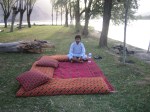
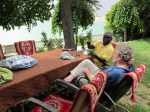
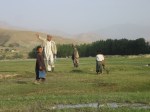
We arrived at the spot after crossing small side streams of the big river, and when the cars could go no further, by walking on the wet grass, jumping over puddles and wading through streams until we reached our destination: an idyllic green strip along the river where the new doctor had brought out a carpet and cushions. It’s funny how back home we would be worried about making a carpet dirty while here carpets are like garden furniture – you put the carpet on the dirt to keep yourself from getting dirty. It was a lovely sight, this small instant living room by the river.

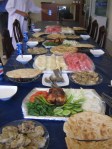
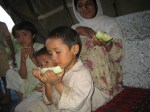
While the men organized our dining room ‘sur l’herbe,’ we women approached a large tent that was pitched a little further from the water next to an enormous patch of vegetables. It was full of women of every age, from very little to the old matriarch who turned out to be only 40. After the initial greetings and curiosity was satisfied we were invited inside the tent for a meal of homemade yoghurt. When some of our melons arrived we had a feast and everyone slurped up the juice melons while we finished our yogurt, broke pieces from enormous round breads made in the tandoor and stored behind a cloth curtain.

It was nice to be with my colleagues who could translate all my questions so I could chip away at my insatiable curiosity.

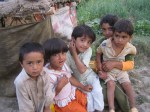
When the sun started to set we said our goodbyes and made our way back to the cars, passing more tents and simple mud-brick dwellings, and tons of little creatures: animals and humans alike. After a while everyone understood that we liked the little creatures and they brought more and held them frightened in a tight grip to pose for pictures.

As we traveled back I noticed a single tree standing lonely on top of an otherwise bare mountain range. I was told that it is a symbol of the victory (one of many) over the Russians who tried to hit the tree and the mujahideen underneath it but missed repeatedly. That was 30 years ago but the tree and the story are alive and well.

Although we had planned to do some work in the evening, by the time we got back it was dark again and everyone was too tired.

Badakhshan II

After a wonderful lunch in a guesthouse that caters to tourists who come to walk or ride the Wakhan Corridor (“are there really tourists here?” I asked incredulously) we had a brief tour of the provincial hospital that is being renovated by the Germans. Things are improving here: new roads are being built, the hospital is nearly done, a new women’s ward; there is lots of construction going on and things are looking up.

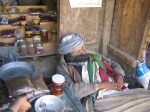
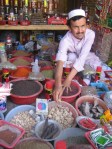
The new town consists of small shops lining the smoothly paved new road. The old town consists of small ancient wooden shops that sell mysterious spices and teas, traditional medicine right next to heavy chemicals that kill aphids and other creatures that can damage crops.

Our host stopped at the market and bought a 5 kilo white melon and a 10 kg water melon and then we drove over rough tracks to the outskirts of town, to a Concern Worldwide environmental and forestry project that included demonstration gardens and pleasure gardens, one for women and one for men. The latter had the more attractive real estate, right by the river. That’s where the melons were ‘killed,’ right by a half submerged skeleton of a Russian tank. The two giant melons became supper and were gone in no time, the rinds feeding the fish in the fast moving river.

On our way out we were asked to please write in the new guestbook of the project. We got the very first page of the very first guestbook. We praised the place, the beauty and the peacefulness of the place. This too is Afghanistan, a vision of what could be.

Badakhshan I

Kabul International Airport is very crowded in the morning because most departures are scheduled early. We found enormous crowds and long lines of people at the various check points. On those occasions (I believe they are the only ones), it is good to be a woman here because there are few lines and less check points. Most of the travelers are men.

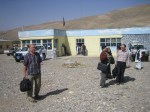
We flew in a small plane over the magnificent and ragged mountains. All the tops are still covered with snow, and, given that it is the hottest month now, will probably stay that way. We flew low, may be 1500 feet above the mountains and I could make out the half frozen ice dams, shimmering turquoise in the sun. In less than an hour we landed on a flat strip between the mountains, near the fast flowing Kokcha River that merges further north with the Amu Darya into Tajikistan.

We were taken to the Aria guesthouse, half above, half behind a hardware store with an ancient and smoky generator sputtering in the otherwise clear mountain air. It took awhile to get our rooms assigned because of double bookings. Finally I ended up with one of my colleagues in a room with two beds, a fan, a tiny refrigerator, a shower/toilet and, to my great surprise, an internet cable that connected me to the world.

My colleague took off her various coverings and stretched out on the bed. It seemed that the program for the morning was ‘recovering from the trip.’ Even though it had been a very short trip, I felt tired and as soon as I stretched out I fell asleep. We were woken up from our nap by a knock on the door. As by reflex, all the coverings went back on. A tray with three packets of cookies (‘Jam Hearts’), a thermos with green tea, a packet of UHT cream, a jar of Russian cherry jam and two Laughing Cow cheese triangles was placed on the floor.

I commented that this felt like a vacation for me but my roommate said it was boring. “Why?” I asked, “When else do we have time so simply hang out and talk?” But for her, being in the province is about being shut in because of the uneducated country bumpkins (men) who are a nuisance. As a woman she is at a disadvantage; all the cover ups, despite the heat underneath them, are seen as a necessary evil, a form of protection against male mischief. For her Kabul is a much better place.

Like two girls in a dorm room we talked. She talked about her time as a refugee in Iran, as a doctor in one of the Northern provinces in Afghanistan, under the Taliban. Although life was boring then too, at least she was allowed to work as a doctor and see patients. Provincial life was better there than in the big cities.
Despite everything that is wrong in Afghanistan for women, for her it is still better being here than in Iran where she and her family were treated as second class citizens. “When an Iranian child cried,” she told me, “the parents would threaten that the Afghans would come and take the child away.” Afghans as boogey men, not that much difference from the reactions traditionally dressed Afghan men get in the western world.

In Iran she was harassed in the market for letting a strand of hair show; encircled by stern looking men who accused her, then in her twenties, of not respecting the customs of the country that had so graciously accepted her and her family as refugees. For four years she was bored out of her mind, crocheting bedspreads and table covers that they would sell in the market (‘for a good price as they were very fine!’). Now she is a highly respected member of one of my teams, one of the few senior women on our staff.

Rumblings

Last night we had a girl’s night out, plus Axel. We joined Meghann and Mary (just back from Australia) and said goodbye to Carolyne who is returning to Australia after a just-in-time consultancy to polish the health proposal presented at the Kabul Conference.

We had gin tonics and chilled white wine that were the highlights of an otherwise mediocre meal that pretended to be Spanish. We sat on a cushioned and carpeted platform in a lovely garden next to a swimming pool that had been turned into a fountain.

The meal left my stomach rumbling, and with a slight hangover (my tolerance for alcohol is quite low these days) I woke up before dawn to get to the airport in time to catch our flight to Faizabad in Badakhshan.

Waves

Sometimes, when I scan the never-ending flood of email, and I find too many in there that require complex decision making, or that are full of complex human emotions, I have to fight for a moment a wave of despondency. ‘How can we manage all this?’, I wonder, while wanting very badly to run away to a faraway island without internet.

Despite all the rhetoric about work, professionalism, objectivity and not mixing these with the personal, I don’t think I have ever worked in a place where these were as intertwined as multiple strands are in a piece heavy rope. I find myself constantly listening for what is not said but shown on faces or between the lines. It’s an exhausting and difficult practice in this culture that is so different from mine.

Since I will be in Badakhshan for the next three days I am trying to attend to urgent and time sensitive emails, meetings, assignments and other tasks. I am told that I should not count on having an internet connection. So my desire for a faraway island without internet connection will be partially fulfilled.

[This also means a chance of no posts for Monday and Tuesday]

Lakeside

We left early this morning for a visit to Qargha Lake, a 45 minute ride out of town over potholed side roads to avoid the traffic jams on the main roads. The lake is adjacent to the Kabul Golf course. You’d have to be really addicted to the sport, or simply get a kick out of the idea that one can play golf in Kabul.

The entrance fee to the Lake Qargha park is 1 dollar. The ticket, sponsored by Azizi Bank urges the ticket holder to Please Have The Ticket With Your Self (our driver did). We went to a guarded restaurant owned by a local commander who is on good terms with our security team. Apparently he owns everything around as far as the eye can see. He earned his reputation by resisting the Russians quite well if I understood the explanations in local language by our driver and guard. It was a safe place that required an additional entrance fee of 2 dollars per person.

Inside the walled entrance we found a beautiful landscaped restaurant with a variety of sitting areas, some under green arbors, other under trees, some with rattan furniture, others with office furniture or ballroom chairs. And then there were of course the ubiquitous carpeted platforms, in the sun and in the shade, in places covered and shielded by cloth canopies and satin pink, green and red curtains that made me think of a boudoir.

There was an aviary, a pool with large carps and a peacock strutting around as if he owned the place. There was also much debris from the Friday visitors: limp bread in the carp pool, wet tissues and plastic bottles blown into corners and on the ground; and under some of the trees, the black and yellow splotches of the overripe mulberries and apricots that dropped by the handful, it is that time of the year.

We sat high up overlooking the receded turquoise waters (in the winter, our driver told us, the water comes up to the railing, at least 9 feet higher), while the wait staff cleaned the place up with large hoses, drenching the grass under our feet.

We were the only guests till lunch time. We read for awhile and then took an exorbitantly priced boat ride across part of the lake. AB had been eyeing the jet skis parked on the beach but then realized that the motor might not be all that trustworthy as it briefly sputtered on and then died again; the 8-seater boat, though expensive, was more reliable.

By lunch time ominous dark clouds had gathered on the horizon, coming down from the Paghman mountains. A powerful dust storm blew everything that was loose off the tables, including the heavy ornamented table cloths and tissue boxes. Menus swirled around, umbrellas toppled and rolled down the gentle slopes and the few guests that had arrived by then quickly ran for cover inside.
The enormous music installation and large TV screen was turned off but the CDs rolled around in the wind. We were waiting for the rain storm and wondered about the giant TV screen and electronic equipment that stood unprotected on the porch. But no rains came and the wind eventually died down, just when we had finished eating.

After lunch a colleague joined us and then went for a swim. We watched the Afghan men watch the mixed couples have fun in the water in a way that is unthinkable for Afghans. None of us felt comfortable swimming, certainly not me; even with clothes on, one does tend to show one’s shape with wet clothes. Axel and AB didn’t want to swim in the lake because, despite its turquoise waters, is rather polluted. I overheard the manager of the hotel make a
comment about those foreigners who frolic without shame, men and women alike and I was glad I had not gone into the water.

At 4 PM we were dropped off at home, exhausted from a day of doing nothing. We took a nap while SCH, who had been working all day, watched the Number 1 Ladies Detective Movie. And then we went out for dinner. It is her last night here. How time flies. In just over a month we are heading home again.


July 2010
M T W T F S S
 1234
567891011
12131415161718
19202122232425
262728293031  

Categories

Blog Stats

  • 136,984 hits

Enter your email address to follow this blog and receive notifications of new posts by email.

Join 76 other subscribers