Archive for August, 2010


Nearly normal

After pancakes, more bubbles this morning. The one day old bubble mixture and the increased humidity made for some awesome 7 to 9 feet long bubbles. I am practicing because tomorrow I need to be able to perform in front of two little boys when I visit them at their grandma’s house. I posted the bubble pictures on my facebook page.

I woke up from a rather telling dream in which a woman I only faintly know, was told to live with her small child inside the tank of a septic system. Inside the place was made habitable because it was lined with enormous sandbags, raising the ‘floor’ above the yucky muck at the bottom. A man in military uniform was inspecting the walls and the smells. I don’t recall his verdict.

I remember looking down in the hole and watched the woman change her baby’s diapers. She was sad that she couldn’t get out into the clean air. I watched her with a heavy hard knowing I was able to move around and get away while she could not.

The dream did not need much interpretation: the military being deep into doo-doo, being inside a tank lined with sandbags, not able to get out, etc. In exactly one week and one day we will get out.

Friday is massage day. Monalisa greeted me with a cup of Starbucks coffee. She gets it through her sister, another story I need to explore further. I got the Afghan masseuse because Monalisa had worked too hard, 7 massages in a day for days on end. The doctor ordered her to do management tasks for a few days.

On our way back I stopped at a pharmacy to get some liquid glycerin to make the bubbles last a bit longer. The guard asked me what the glycerin was for but I couldn’t explain it in Dari, not knowing the word for bubbles. And so I told him and the driver to wait after they dropped me off so I could demonstrate. Although I was not able to show a good 9 footer, they did get the idea and were impressed.

The rest of the afternoon was quiet and relaxing. I made almond biscotti while listening to a BBC radio play of ‘A Suitable Boy,’ and then hoolahooped some more so that I can hoolahoop like Meghann.

Play day

Today was mostly a play day. Aside from a brief excursion to the supermarket, we were home-bound. Axel was at home the whole day. He has not been feeling so well, so we took it easy on this day of Independence (celebrating the Treaty of Rawalpindi in 1919, granting Afghanistan full independence from Britain).

Despite our low energy, we made giant bubbles with the Klutz bubble wand I had brought from the US. We are testing dishwasher detergent to see which kind makes the best bubbles. So far we have tried Gulrang red and Gulrang yellow. Yellow is better. According to Mr. Giant Bubbles the climate here is not so good for bubbles – too dry.

The climate at this time of the year is, on the other hand, excellent for kites. We are in the middle of kite season and they are all around us, some more than 1000 feet up. They are all of the thin paper kind – not the fancy nylon ones that sell for up to 80 dollars in the US. Kites get stuck in barbed wire or in trees all the time. Every day we find new kites on the roof of our guard’s house. No point in wasting 80 dollars each time.

While Axel made 5 feet long bubbles I practiced the hoola hoop. I am making some progress although I cannot quite copy Meghann’s acrobatics. After that we played a board game until it was dark and the lone mosquito came out.

We discovered that one of the local cheeses makes an excellent cheese fondue. We don’t have white wine so we added a little bit of Dr. Beam to help with the melting and then dipped locally made French bread into the pan. We could have fooled ourselves that it was the real thing. We could even taste the missing Kirsch and white wine!

For desert we watched James Bond in Quantum of Solace. I am not much of an action movie lover. Little did I know that there would be three chases in the first 5 minutes and then all imaginable kinds of chases spaced throughout movie: a car chase, and old building/cistern/running across tiled roofs chase, a church chase, a motorboat chase, a plane chase, a chase in a fancy opera house and finally a big fight in an exploding building.

The only reason I can handle it is because I can stick my fingers in my ears and I because I know that James will, in the end, not lose his life nor his job, even if it looked like that for most of the movie. I am still catching my breath.

Firm with firms

Today Karzai ordered all the private security companies to pack their bags. Foreign companies are asked to leave in the next 4 months; local companies have to find something else to do. He offered the Afghan employees of these companies a place in the police force. Only embassies are allowed to keep their own (registered) companies to guard their embassy compounds.

I think it is a good idea because the private security companies had turned whole neighborhoods into war zones. Of course it is easy for us to applaud the move because we have our own security staff and guards. We have a philosophy of being far below the radar and so we don’t expect much to change for us. But some of our sister projects rely on these companies, and many restaurants in town. I wonder about the buzz this has created in headquarter offices in Kabul and around the world.

I also wonder whether foreigners would be willing to entrust their safety to the Afghan National Police? That is after all the idea. But given how often fake checkpoints are set up by criminals or insurgents in faux ANP uniforms, I can see why people would not be too comfortable with this arrangement. How do you know that the people defending you won’t actually blow you up?

But all the news is not grim. Yesterday Axel and I had a lovely evening with our friend Razia jan and her many housemates. We arrived just in time for the breaking of the fast, with a date, as is the custom, and a glass of lemon water.

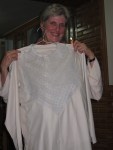
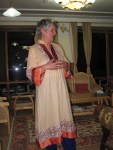
After a delicious dinner Razia jan showed me the mother-of-the-bride dress she had made for me and another one for the day-after-party. I modeled the dresses in front of the assembled housemates, under loud acclamation. One of Razia jan’s housemates had been a photo model in her teens in Korea. She is the one who organized and orchestrated the fundraising fashion show. I had watched her carefully during that afternoon of rehearsals and so I was able to add a few flourishes to my show.

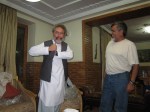
Afterwards the traditional Afghan outfits for men were brought down: the peran, tombon and waskot (waistcoat) – wide pants with a drawstring, a long tunic, heavily embroidered on the front and a grey vest. After some initial protest Axel was talked into modeling these, again under great applause. We dismissed the all black one and the black one with wine-red embroidery as not good colors for a wedding; the light blue and light green outfits were not quite his size or color.

We finally settled on a white one – I don’t know if Axel will actually wear it at the wedding (it will go great with Sita’s wedding dress) or keep it for fancy events in Kabul. And of course we imagined Jim by his bride in a more fitting outfit than a suit. I took a picture and sent it to him. We can still have one made to size if he wants to but we also know that is highly unlikely.

Sustain and gain

It is very hot and in my non-airconditioned concrete office, with a window/door on only one side (no breeze flowing through) it is getting rather uncomfortable. Luckily the days are short and people leave on the dot when the clock strikes 3 PM. This is actually late; most offices clear out at 1 or 2 PM.

We spent hours today getting from our side of the town to downtown; in the end we got out of the car and walked as the traffic was blocked as far as they eye could see. Someone important or something important was happening or passing by and everyone else was stopped. There were armed and uniformed men everywhere. This is supposed to comfort us.

I arrived halfway through the meeting I was supposed to attend and the power point had already been completed. It was a good thing I had studied the materials and boned up on TB and how to advocate, communicate and mobilize communities to eradicate it, as this was the topic of the presentation.

Today we tackled the hot and complex issue of donor-supplied salaries for people who work as consultants in the ministry. Entire departments are run by consultants. The compensation levels are all different with the UN agencies topping the list; further down come the WorldBank, the EU, GAVI and then us (USAID monies).

Our consultants work across the hall from people who get their topped up salaries from one of the above sources; they are higher, and thus a source of discontent. There is an upward spiral that rewards the small pool of good English speakers and writers with a work ethic that pleases the donors. It’s a buyers’ market, everyone wants them now that Afghanization is written into all strategies and 50% of foreign aid has to flow through the government. These people are worth their weight in gold. And so they ask for more money. Of course their salaries have nothing to do with the civil service pay scale that pales in comparison.

People talk about sustainability but if you think about financial sustainability, the ability of the government to take over these salaries at some point, you get an enormous headache. The only chance at that is if all the minerals and oil deposits that people are finding in this country can actually be extracted and sold for a good price with care taken that most of it won’t be siphoned off by people with power and arms. That’s a challenge that requires a miracle.

The sustainability that is possible is the capacity development that will increase the pool of people who can manage large projects and funds wisely and transparently. As it is, these are exactly the kind of people who are asking for higher pay.

Tradition, voice and loyalty

All through the day people came alone, in pairs or small groups to do ‘tapos’ (paying one’s respects) with my staff, office neighbor and father of the two injured boys. Having read the ethnography about this tradition I recognized it and realized that I too had to do this, even though it may not be expected of me.

I have asked to tag along with one of my female staff members, sometime this week to visit the stricken family. I lent her the book and asked her to report to me about its currency (it is nearly two decades old) and its applicability to people living in Kabul. But from what I saw today I think it holds. After all, what is 20 years for a tradition that dates back hundreds of years if not more?

I had a long conversation with one of my colleagues from HR/Head Office who is here on a short assignment. I realized how starved I was for conversation with a female colleague (my Australian colleague Chris is in the US) about work-related issues, especially with someone who understands the two contexts I live in, my own and the traditional Afghan one. “It’s potentially a collision course, if you think about the widely differing worldviews and upbringings that are present in the project,” she said with a smile, and I nodded. I knew that already and it is actually a miracle that I can be effective at all. She is from Indian descent and thus had an even greater appreciation for what I am up against.

After our talk I found myself googling Exit, Voice and Loyalty, the title of the organizational classic written by Albert O. Hirschman in 1970. For Americans Exit is the expression of choice in case of dissatisfaction with the status quo. The whole country is, after all, the product of people (immigrants) choosing Exit (from their country of origin) over Voice. For us Europeans it is not. Now half American and half Dutch I find myself wavering between the two options of responding to the tensions that are the result of living in a world where my values about relationships between the sexes are so at odds with what I see around me.

Fortunately, or unfortunately, depending on one’s view, I am a little more Dutch than American, with my roots in the Lowlands, and so I tend towards Voice, driven for a great deal by the concept of Loyalty. I ordered the book today because I think it is time to re-read it. I am sure I will read it differently than I did 20 years ago when I was first given the book at the beginning of my career at MSH (and was thinking hard about Exit). I will read it this time to find some advice on how to do Voice and Loyalty.

Good griefs

I finished the book about grief and the ‘performance’ of emotion among small town and rural Pashto women of areas in Northwestern Pakistan. It makes me want to read more anthropological studies done by women, as this one was so different from what I have read about Pashtoons in the writing of men (Pashtoon and non Pashtoon).

What I learned is that within their overwhelming powerlessness, the women do have the power to excel in the bearing of grief and their ability to flaunt their social restrictions (parda, the veil) when they have to act in the service of the object of their grief (the injured son or other close male relatives). But these are not the kind of individualized expressions of personal grief as we know it in the west, but highly choreographed narratives and performances that strengthen their role and status.

This is a kind of power that men are afraid of, maybe similar to the mysterious reproductive powers that men have been afraid of in all societies (and still are in some). And so, not surprisingly, this power is downplayed by the men as manifested in various traditional forms of communication (romantic stories, poetry and humor) precisely, according to the author, because it is acted out in a realm that men have no access to.

I can see why the younger and educated women from this background have such a hard time reconciling their professional roles with the heavily prescribed rituals and behaviors that dominate women’s lives, if not in their own immediate families, at least in the larger kinship communities from which they hail.

From reading this book (and Axel is now reading Louis Dupree’s classic and monumental work on Afghanistan) it occurs to me that doing any so-called ‘development’ work, or worse, military intervention in this country, is madness without having anthropologists on staff. I have yet to run into one. Where are they? Where did they go?

Today my colleague, the father of the boys who were in the ISAF accident more than 2 weeks ago, returned back to work. Yesterday the boys were finally evacuated on a military plane with all the hospital equipment and gear that has sustained them over the last two weeks. Both have emerged out of their comas and are speaking again.

They have no memory of the accident. The description of their state resembles that of Axel after our accident: the nerves that are not working, the broken ribs, the double vision, the concussion and contusions, the deafness as well as the memory loss. The state of the older boy who was driving resembles mine: the guilt and the replaying of the scenario, wishing to replace the bad action with a good action. Mine was an endless loop, replaying itself in my head over and over again, accompanied by the rapid heartbeat and the sweat and the mantra of ‘oh, what have I done!’ I was so lucky that no one died. He is not.

The transport to Germany required signatures all the way up the chain – it was finally Hillary’s signature that sent them on their way. And so, no longer needed daily at their bedside, the father has come back to work, communicating by cell phone with his sons on the path of full recovery.

All clear for Dems

I had it all planned out: a half hour walk on the exercise, a pancake breakfast and then off to the rug shop where I bought Axel’s birthday kelim that I no longer like and want to exchange.

But somewhere over on our side of town the Hazaras and Kochis clashed. It is part of a longstanding battle that has to do with tribes and land. The police and army got involved, there were shots fired and we were told to stay home.

Since there was no information from our security folks about the fight Axel surfed the internet and found many of our usual sources for information blocked; a censorship that we had not experienced before. Clashes like that, political like those, are apparently kept out of the public’s eye to avoid creating any more waves among the already excitable population, especially with the elections only a month away.

In the afternoon the all clear was given so we could go to our language lessons and then to a pool party at the International club, one of the few places where foreign women could actually swim in a regular bathing suit (as opposed to total body cover). I have no intention to swim here in this country as I can’t imagine being in such a state of undress when there are male Afghan waiters moving in and out. I will wait with the swimming until we are in Lobster Cove.

The pool party was organized by Mary who is the person in charge of Democrats Abroad, Afghanistan Chapter. There are about 117 people on the list but only 7 showed up, two of them brought by Axel and me, colleagues of mine who are actually Independents. It was a bit of a sorry show, especially since only 7 or so of those 117 are registered to vote in the next elections and will have their ballot sent to Afghanistan. We joked around for awhile about Sarah Palin and then had our business meeting on when and where we meet next and how to mobilize the vote out here.

And then we had cheeseburgers and beers.

Culture, emotions and adaptive work

I picked up a book about the performance of emotion among the Pashtoon women in the North West Frontier Province in Pakistan. It is a wonderful piece of ethnographic writing about the misfortunes that have befallen women, the ‘performance of grief.’ The scholarly but easy to read book presents a counterpoint to the more commonly known narrative of Pashtoon men with their code of honor, revenge killing and all that.

The opening chapter about doing ethnographic fieldwork is fascinating because it explains something about being a foreign female in these lands. I have always considered myself and my non Afghan sisters somewhat of a third gender but I now realize that this is not entirely correct.

We can be among the men and the women and move around, seemingly, in either world. But I am learning now that this is not true. The author explains how being among men, as a woman, in the highly segregated places of her fieldwork, she could never get close to the women unless she stopped moving back and forth between the men and the women. It is as if one is not entirely a woman until one moves into parda (purdah) with the local women and behave with modesty (downcast eyes), subservience and shyness when in the company of men (who would be close relatives, not strangers as that would be taboo).

Although I work and live among a group of Afghans who are highly educated and used to this Western mingling of the sexes, I have an inkling that for some this behavior may be problematic, more so because it could never be expressed. I am not behaving as a woman should in that (granted, very rural and not very educated) culture, rarely casting my eyes down, unless I am walking on uneven ground, never subservient. I can’t help but think that my behavior grates on some men here.

One chapter is about the expression of emotion and I realized instantly that our glorification of Daniel Goleman’s emotional intelligence writing is fine within a western context but entirely inappropriate in this culture. Expression of emotion is a ritual performance, highly gender-dependent, learned early in life by girls and boys, and a collective rather than an individual experience as it is in the west. It is as if a new window has been shoved in front of me with someone whispering, ‘here, look through this, now what do you see?’

I look through this new window pane at my experience of the last 10 days and begin to glimpse why I am having a hard time. I am seeing emotions expressed in behaviors that to me dictate the need for talking things over. It is part of the western management credo in which I am so thoroughly trained: when the surface appears to hide things that are swarming and squirming underneath, investigate!

Now I am trying to look through that new window again and I see steady rituals, maintained over 100s of years with protagonists and extras who all know their place, their role and the rituals they ought to perform. And suddenly there is me, throwing a monkey wrench into the works. Could that be?

I think about my male predecessors and wonder why they never talked to me about these things. Were there any clashes at all? And about what? Or did they just let things slide because of the discomfort that confrontation would bring?

This morning when I woke up I thought about a phrase from Ron Heifetz, noted surgeon/psychiatrist/cellist and most famous as leadership developer at Harvard’s Kennedy School. Heifetz always talks about adaptive work (as contrasted to technical work where there are experts who know the answer). Framing the adaptive work is the work of leaders and the compelling challenge is always, “how can we learn our way out of this mess?”

I recognize that Heifetz is the product of an individualistic society, and so am I. We believe that individuals can change on their own. And here I am in a very collectivist society where an individual who chooses his or her own path takes enormous risks.

My adaptive work, then, in the next 13 months, will be to figure out how to ask the questions that lead to self-initiated and self-propelled change (not imposed) in this context. It requires, among other things, learning at least one of the languages of this place. I need words.
Figs and clicks

The second day of Ramazan was a workday but only a few people showed up. The streets and offices were empty and stores closed. Walking to my office I pass many fruit trees, two of them fig trees. I plucked a few dark purple figs from the tree for when I would get hungry. I had brought a hardboiled egg just in case. My colleague AB is fasting along with everyone else but for this I have no drive nor desire.

I took furtive sips from my water bottle that was hiding in back of my computer, ate the figs and the egg and made it through a long day dedicated mostly to emptying my overflowing mailbox. In the morning we had our last incomplete directors’ meeting. Our Finance and Operations Director is back and his predecessor is arriving early in the morning. We will finally be able to do a proper handover from one to the other, about 6 weeks overdue. This should be a week of many resolutions and decisions.

In our meeting we talked about how and when to consult with whom and where the boundaries are between our jobs. It is not obvious and will probably remain rather grey. Despite the clamor for clarity, and the countless job descriptions and manuals that experts produce for this purpose in my line of work there is little that is crystal clear. I am finding that the higher you rise the more of your time is spent on relationship building and maintenance, something that is rarely mentioned in job descriptions. The emphasis is on ‘technical’ but I do very little technical work.

After sitting the whole day in a hot and sticky room with a fan blowing papers hither and thither I arrived home hungry and exhausted. I was thinking of all the people who actually fasted and did hard labor without even a fan, and who don’t have an air conditioned bedroom in which to retreat, then multiplied by 30 days. I can’t really complain.

The guards were busy in the back of the house preparing for the breaking of the fast. It starts with fruits and dates. Our pear tree had lost a loaded branch which they relieved of at least 20 pears. We lent them our juicer and they produced the most delicious pear juice, enough for all of us.

We ate our dinner in front of the TV, switching back and forth between EuroNews and the BBC whenever the screen got too pixilated, with heads and bodies no longer matching. The TV makes clicking sounds when the picture breaks apart, as if the San people from South Africa have taken over, click, click. Our TV does that when it gets tired, too hot or the antenna dish got kicked. We were too lazy to try to fix it.

I watched a fierce (and pixilated) debate between women who favor wearing the veil and those who don’t, somewhere in a suburb of Brussels. The topic is so complex that every argument sounds reasonable. Why can’t we let women wear whatever they are comfortable with as long as it doesn’t jeopardize others (as in driving a car or piloting a plane in a burqa).

When I look at pictures from the 50s in Western Europe or even the US you see lots of women wearing scarves and when you go to southern Europe you find most of the older women with a veil or black scarf. When I was a teenager I often wore a scarf. My father had brought me one from Italy that I still have, with horse imagery on it. It had nothing to do with oppression. And here I am learning from some women that they like the anonymity of having most of their bodies hidden even if it is very hot.

Forbidden toast

Today was the first day of Ramad(z)an and for us a very quiet day. We slept in, had a chili omelet on the terrace and then we started to fantasize how we were going to spend the 2 days in Holland after the wedding, before we head back home to Kabul, on September 10.

We cruised the internet as if we were planning a honeymoon, looking for a B&B in Holland that would allow us some quiet and relaxed moments in between the hectic wedding week in the US and our extraordinary life in Kabul.

We found the most picturesque B&Bs in a small town north of Amsterdam, in Enkhuizen. They all had rave reviews but homemade websites that wouldn’t allow instant occupancy checks or bookings. We sent inquiries about vacancies and are waiting the responses.

We booked our hotel in Dubai for our return trip; the selection criterion was reliable air conditioning. When we get back it will still be in the upper 30s at night. We booked something near one of the gigantic air conditioned malls in case we want to go for a walk.

We are not fasting along with everyone around us although we are asked to not consume or drink in front of our colleagues. The lunch room at work will be closed for the next 30 days and so for lunch we either snack unobtrusively on cliff bars (very cheap here – we think they have fallen of the truck together with our apples from Washington State) or go home for lunch.

Around 6 PM Axel decided that it was time for cocktails. He had been able to find limes (rare here) and decided on Daiquiris. It was then that we found out that we don’t have unfettered access to the internet. Anything related to alcohol is censored. We were just about to send out an SOS on email when he found a recipe hiding deep inside a food website that had escaped the censor’s eye.

We toasted to the good life that we have, not because of where we are but because of being together.


August 2010
M T W T F S S
 1
2345678
9101112131415
16171819202122
23242526272829
3031  

Categories

Blog Stats

  • 136,412 hits

Enter your email address to follow this blog and receive notifications of new posts by email.

Join 76 other subscribers