Archive for September, 2010

Inspirations and aspirations

Today was a day of inspiration. Chris and I had lunch in the women’s lunch room. We talked about organizing a children’s day and compared notes on the kind of games one would make available to kids on a day like that. As it turns out Afghans have something similar to apple bobbing, sack races and what we call in Dutch ‘koek happen’ (eating cookies dangling from a string with hands tied in the back). Chris knows of similar games in Australia. Funny how these things appear to be universal. How did that happen?

A new and long awaited staff member arrived today, Sally from Australia. She will be in charge of writing up our stories – something that we are not very good at, either because of poor English writing skills or because we have no time.

After work I went to the house of someone who worked in our predecessor project that ended in 2006 – but the house still carries his name. Now it’s the headquarters of the School of Leadership, Afghanistan (SOLA). From now on I will be teaching there on Thursdays, after my work day is over. Today was my first class.

My class follows Axel’s class. Two of his students are in both of our classes – a family affair. His class is large (12, boys and girls) will focus on English writing; mine, with only four girls today, will focus on English conversation. The late class is a little problematic for some girls because it gets dark early now but I cannot come earlier.

I started my class asking each girl to explain their name, both their family name and their given name; who gave it to them, what did the name mean. I learned something about Islamic history and Persian in the process. We talked about naming as an expression of vision, of a parent for a child. This led to a conversation about inspiration and aspiration: who inspires them and what they aspire to be. I am humbled by these girls who have not had an easy life – large families, little money and endless moving, from Afghanistan to Iran, then to Pakistan and back to Afghanistan.

Their homework for next week is to draw their vision and, before showing up in class, show their drawings to people who inspire them and can help them articulate their vision more, make them more compelling. One girl who wants to be president of Afghanistan said that people will laugh at her vision. I advised her to only show it to people who are supportive of her aspirations (two mothers, two sisters, a father) because those are the only people who really count.

On our way home I realized that this is one of the joys of working here – not anywhere else to be found: the opportunity to encourage young women who will help Afghanistan pull itself out of its mess to pursue their visions.
Introduction

Today I introduced Axel to the ministry of public health, referred to as the MOPH. He got to see the building, the garden, the EU container and meet several of the people I work with regularly. In the 9 months he has been here he never set foot inside the MOPH compound.

He accompanied several of us to a weekly consultative forum that brings together, on a weekly basis people in various functions who are trying to strengthen Afghanistan’s health system.

One of my staff spent a lot of time last year to look through the consultative group’s meeting minutes, covering 6 years, interview various stakeholders, and review the original and revised terms of reference. The resulting data was plotted on graphs and turned into percentages presenting a picture of this consultative body to itself that served as a starting point for a conversation about process and improvement.

There was much interest in this introspective meeting and more than the usual number of people showed up. The only group that was poorly represented was the government itself – not unusual and part of the problem we tried to address.

The irony is that these government officials are too busy for such meetings and thus the alignment between the various actors is weakened which then leads to calls for better communication and coordination. These are favorite and ubiquitous recommendations that can be found in any organizational assessment report anyplace in the world. Such recommendations are sufficiently vague that they don’t necessitate individual behavior change, even though that is exactly what is needed.

When I introduced Axel to MOPH colleagues there were, of course, many jokes about leading and following and Axel played the part as a faithful trailing spouse, which triggered more laughs. But then he was honored at the beginning of the meeting, introduced by the Director General as a honorary member of the consultative group and received a warm applause.

Stops and starts

After months of lingering, Ali and I are picking up the leadership and management work with senior government officials at the central level again. We, or rather I, had held out the last 9 months hoping that the minister would demand that all her senior staff become better managers and leaders, but she didn’t and without it we weren’t getting the kinds of commitments we needed to engage whole directorates in a four month long process.

But then senior leadership got reshuffled and suddenly there were opportunities for new beginnings, new senior leadership teams, the discovery of missing visions, misalignment. And so Ali and are now doing the rounds again among the director generals and finding a positive response. There will be action again, beginning next week. We will start with the curative medicine teams and help them look at their management systems that leave something to be desired. It will all be in Dari and I will follow from the sidelines.

Of course it is possible that with the new parliament, to be announced in the next few weeks if the calls for invalidating the results don’t bring everything to a halt, the acting minister may not be voted in for the second time. That would be her last chance because one cannot be voted on more than once by the same parliament. In that case the president has to appoint someone else. That will of course trigger a new reshuffling. Association with a replaced leader is a liability here.

The highs and lows that go with these stops and starts are part of the pattern of our life here. My mood fluctuates up and down along with these stops and starts.

I have noticed that my mood also fluctuates alongside the level of trust I experience here. There is the ‘being trusted’ and the ‘me trusting.’ The latter is a little murky. There is much gossip. Men engage in it as much as women do. People seem to love to talk negatively about each other and sometimes take me into their confidence. It is as if they want to help me decide who I should and who I should not trust. But I am a little wary of such storytelling because there are agendas, a settling of accounts, or less malignant, a way to lift oneself up above the others; none of it is helpful.

In my line of work it is better to start with the assumption that people are generally well intentioned, competent and honest. If I later find out I was wrong, so be it. It is better than the other way around. And so far I have not been all that much disappointed.

Kindling

Sonia’s and my life intersected less than a year ago. After months of trying Steve and I finally managed to visit her in her uncle’s apartment to determine, on request of a private Connecticut all girls school, whether Sonia would be able to enter 9th grade and whether her family supported her.

At the time we said yes to both questions but months later, when her attendance at the school and the coverage of all fees was secured, relatives of her father made it clear that if he were to send his daughter to America, they would excommunicate him from the family. I don’t know how that works but it was apparently enough of a threat that he withdraw his permission for her to go. That would have been this September. Everyone but Sonia was devastated; Sonia on the other hand was very pragmatic: if not this year then next.

We suspect that she sent her brother (who also goes to school in the US) as a messenger/missionary to the relatives in Ghazni and he turned them around. So now Sonia has received everyone’s blessing to go next September. The school was encouraged by this new twist and, I have been told, wove Sonia’s story in the speeches at the opening of the new school year. They also collected money and bought her a Kindle which they loaded with some 60 books.

Alison from DC carried the Kindle to Kabul and it is now sitting, all juiced up, in its bright blue leather case on my table. I have checked out its content. It is the candy store equivalent for books – the old classics, new fiction, probably a whole school year of reading, five Kindle pages of titles. The idea is that Sonia will be behind in some subjects, especially reading. Axel and I carried about 12 pounds of text books with us in June – math, French, algebra, science – for her to check out to see whether she is behind, on par or ahead. But in English and American literature the school assumed she is far behind. Hence the Kindle.

Of course Sonia has no idea what a Kindle is. I called her to tell her the gift had arrived. I asked if she knew what a Kindle was. “Sorry?” she asked, “could you repeat?” I then tried to explain what it is. The conversation went something like this.

Me: “It is an electronic book reader.”
She: “What? Come again?”
Me: “It is like a kind of computer that has at least 60 books inside it”
She: “Huh?” “There are 60 books, where?”
Me: “The books are electronic and inside the thing.”
She: …[Silence]. “Should I come to your house?”
Me: “No, I will come to your house and explain how it works.”
She: “Oh.”

The girl has no idea indeed and I have no idea on how to explain a Kindle. For many people in Afghanistan it is still hard, in spite of familiarity with computers, to grasp what the adjective ‘electronic’ does to the familiar things made of matter.

Sonia will SMS me when I can see her over the weekend. I can’t wait to see the reaction of the rest of the household. This kid is leapfrogging a whole family into the digital age.

Haring with the General

The day started with a summons from the minister to help her with her thank you letters to the various people who welcomed her, worked with her during her visit to the US. They were the leaders of various UN agencies, the World Bank, the US congress, the UN in New York, the Lancet and No Woman, No Cry, whose director, Christy Turlington Burns film, Every mother counts, greatly moved her.

I am working with one of her staff to transfer the skill of writing good thank you letters. When I was 12 my mother taught me that skill and for years I had a sample of a thank you letter, in her handwriting, hidden under my desk blotter. I kept pulling it out whenever there was a thank you letter to compose. As a result I am pretty darn good at it now and it is time to pass the skill on.

In the evening we were invited at the Dutch embassy for a celebration of ‘Leiden’s Ontzet,’ which is one of the oldest victory celebrations in Holland. On October 3, 1574 the rebels pierced the dikes and flooded the countryside around Leiden to flush away the enemy Spaniards. It was sink or run. They ran.

The Dutch rebels rowed across the water with food for the besieged and starving inhabitants of the city: haring and white bread. Legend has it they also brought the contents of the cooking pots the Spaniards left behind, a stew now considered very Dutch, ‘hutspot,’ consisting of potatoes, carrots, onions, mashed together into a thick orange mass and served with sausage.

The Dutch embassy had invited General Petraeus to partake in this very Dutch event. We did not know this but we could have figured it out from the tank-like SUVs (weighing 9000 pounds and costing more than a small house each) that were parked between the various embassy perimeters.

The celebration was a small and intimate affair that allowed us to chat with the man who is so much in the news. We asked about Woodward’s book and his now famous quote that I remember mostly because of its [expletive] part. He smiled and said he tries not to use those words but they sometimes slip in.

We discovered his father was a Dutch captain and so there is some affinity with the Dutch, although he did politely decline both the raw herring and the Dutch gin (apple juice in a gin glass looked exactly like it).

We met some old acquaintances and made new friends. One of the old acquaintances, a Dutch/Afghan, who ate herring like a Dutchman, had run for a seat in parliament. He thinks he got 1000 votes; whether that is enough or not we don’t know.

A member of the October 3 Committee had flown in from Leiden with several hundred pounds of haring, sausage for the hutspot and corenwijn, a special variety of Dutch gin. Small bowls of hutspot with the sausage were served in addition to the herring. After the speeches we could also have a glass of gin, except the military (Dutch and American) because McChrystal banned alcohol for uniformed men (except the Belgians who threatened to leave if not allowed their 2 beers a day).

The Afghan staff knew quickly who the herring lovers were; as a result I ate more than I ever have at one sitting. The committee member turned out to be a Scott, married to Leiden’s principal city archivist and a citizen of Leiden. His Dutch was so impeccable that we did not realize he was not a native Dutch speaker. But then someone reminded us that old Scottish was very close to old Dutch.

Unraveling

I read (or rather listened to) Margaret Atwood’s Penelopiad which lets Penelope tell the famous story from her perspective. Her story is, not surprisingly, quite different from the one that has been told for centuries, his story.

I felt a little like Penelope as I started to unravel a sweater I knitted all through last winter. I got the measurements wrong so I will start all over again. The wool for the sweater, a bag full of Shetland wool skeins, was a gift from Alison who had found it in her mother’s attic after she passed away. The nice thing about gifts, especially unnecessary ones, cousin Nancy wrote me on facebook, is that such gifts remind you of the giver. And so I am thinking of Alison on this nice fall evening.

The unmaking of the sweater is taking a long time. It is as much a labor of love and patience as the making was. Unlike Penelope, the unraveling takes place in clear daylight as there are no suitors to keep at bay. My Odysseus is right here with me.

There is another unraveling that is going on here and that concerns the elections. The foreign news media are reporting on the thousands of complaints that the Election Complaints Commission has received. There are stories about some very brazen and heavy-handed tactics used by the power brokers, government officials and candidate agents, some of them recorded on phone videos. I am beginning to suspect that the official announcement of winners and losers will be more tumultuous than Election Day itself .

There are a lot of loose threads and very little confidence that anyone can tie those up neatly. Re-knitting my sweater will be a whole lot easier.

One year and counting

Today, exactly one year ago, I arrived in Kabul to take up my new position. It has been a wild and amazing year – with highs and lows, delights and frustrations; a year in which I learned more than I can remember.

It has been a year in which Afghanistan became real, multifaceted and not quite as dangerous as people back home thought; a year in which I mastered enough of the language that I can order pizza in Dari and converse with our drivers and guards.

Originally my assignment was for one year only. We would be home now. But we added another one. If it passes as fast as last year did we will be home in no time.

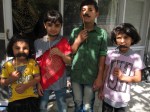
We celebrated the event with one of my Afghan colleagues, his wife and his four wonderful kids, one boy and three girls. They flew balsa wood airplanes, which disintegrated in exactly two hours; they blew giant bubbles with the bubble wand and smaller bubbles with wands made from a clothes hanger; the oldest two learned to hoola-hoop in about 10 minutes and wore themselves out; they played with the exercise ball and then they posed for a picture each holding one of the mustaches (brut) or beards (rish) on a stick that were leftovers from the wedding decorations.

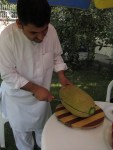
We had pizza from Pizza Brasil which the grownups liked more than the kids. We put out sweets which they ignored in favor of a giant melon that their dad carved up expertly.

After tea we gave the family a tour of our house. Their house is in the process of being finished, has been for a long time, a bit like the main road outside our office. They were curious about how we foreigners fill our houses and said they got some ideas for their own.

The kids all had to try the elliptical machine which was a little too difficult for the youngest one (5) who could not reach the handlebars.

After the house tour they requested their leave (may we go now?) which probably was a literal translation from Dari. We sent them off with a bag with goodies for everyone plus the picture of the kids with their mustaches and beards.

I liked the way we celebrated my anniversary here because it was all about what is good about this country: good company, good food and good weather, and kids that played like kids do everywhere else in the world when given the chance.

Booms and such

We were in the middle of an orientation about the Health Management Information System (HMIS) when a loud boom went off, followed by what sounded like metal rolling down a tin roof. The presenter paused for a moment and we all looked at each other but no one said a word. Then he resumed as if nothing happened.

I found it hard to concentrate after that. For about 15 minutes I tried to follow the presenter but my mind was otherwise engaged in two parallel thought streams: (1) what was that? It sounded like an explosion. Was this the next event that we had been anticipating for so long? What had rattled down a roof, and where? Where did it happen and were people hurt? And (2) was I the only one thinking these thoughts? What about all the other people in the room? Chris has a little girl in a school not far from us. Was she worried? Why didn’t anyone get on the phone?

I had to call one of my staff to join us and used this as an excuse to get out of the room. Outside I found two of my female colleagues with cellphones to their ears. “What happened”? I asked. I was taken to the cafeteria, which abuts the wall that separates our compound from the main road. The cook showed a piece of metal that had come in over the wall. The man who does our copying took the piece to security. It had been too hot to handle when it landed in the compound.

“No, not war!” was the answer to my question, put awkwardly in the local language to one of the guards. He said something I only partially understood, about a house, nearby. I made up the missing words with my own imagination, a gas tank explosion maybe? Later I saw our security chief. I asked him what it was. He shrugged his shoulders. It was nothing, just the demining people blowing up mines. There are still mines in the mountains around Kabul and, I guess, they still find them from time to time. This is the reason why we are not allowed to go on walks up there.

And so I was reminded that a boom is not necessarily a bad boom. It can come from many different causes and we can make it up to be one of many things. That’s also how rumors become facts.

Good company

Today was one of those days where I realized how being in all female (rare) and mostly male company (normal) affects my psyche in different ways. In the afternoon I went with one male and two young female colleagues to present our leadership program to the executive board meeting of the midwives association. Two years ago, in Bangladesh, I met two of their members and since then I have always been warmly received in their midst.

If my young female colleagues come across as shy and inexperienced in the usual (older) male settings I am used to see them in, they were completely in their element in this company of (mostly but not all) young women. These women have devoted their lives to helping babies enter this world under the best possible circumstances. That they themselves do this work under less than ideal circumstances, especially those living in the southern and eastern provinces, makes their work all the more remarkable.

I congratulated them on finding themselves repeatedly in the world news, in a positive way, as Millennium Development Goal #5 (reducing maternal mortality), was being scrutinized in New York at the MDG Summit this week. The gathering has just been reminded everyone, once again, that women’s health is given short thrift in many countries and that midwives can do something about that.

I was proud of my team that had produced an excellent powerpoint, in the local language, and gave the eager midwives a taste of what this leadership program is like. An enthusiastic question and answer session followed the presentation and everyone wanted to sign on right away, even though we can only start with about 7 teams. The others will have to wait.

These total immersion sessions in Dari are good checks on my linguistic progress. I can read the powerpoint text, albeit slowly, and ask for the meaning of words I don’t recognize. They are words like facing challenges, activities, measurable results, none of which ever show up in the fairy tale books that my teacher has me read.

Post election blues

Everything is about expectations. When people are upset with one another it is almost always because expectations weren’t met. It plays out at the couple level (wife upset because she expected husband to take the garbage out), at the team level (team didn’t complete expected work as per specifications), organizational level (bank didn’t honor clients withdrawal requests) and country level (we gave you all this money and we expected you to manage it as if it was your own!).

But sometimes when expectations aren’t met there is relief, as was the case with the Afghan parliamentary elections. There were expectations of major fraud, widespread violence, so much even that the UN evacuated much of its staff. And then, when there were no major bombardments, rocket attacks, kidnappings, election workers going postal and such, everyone applauded how the Afghan government (with help) had managed this.

But wait a minute. According to the Afghanistan Times of today, the Free & Fair Elections Foundation of Afghanistan (FEFA) reported 276 incidents in and around voting places by the Taliban in all but 2 provinces; 157 serious acts of violence by the power brokers and their supporters in all but 6 provinces and 300 instances of intimidation and coercion of voters, candidates’ agents and observers by local power brokers. This is what some 7000 FEFA volunteers, observing about 60% of all the polling places, reported.

They also recorded plenty of instances of blatant or not so blatant voting fraud like fake voting registration cards, underage voters, men voting for their wives – although I imagine that many (men) may not consider this fraud –, voting materials missing, polling centers opening too late and delays in counting votes.

If you expect widespread violence and major fraud and you get this, I suppose it is a reason for relief, though not for celebration, as some think. There is still much that can go wrong, especially when the results are being reported and some people don’t like what they see.

The mayor of Kabul has ordered all candidates to remove their posters, from the gigantic 6 by 4 meter ones that practically obstruct the mountains around Kabul to the small handbills pasted on anything within view of the voting public. Kabul’s mayor means business. Apparently there is a fine if you don’t do this.

The rented spaces are already empty, I suppose the rental agreement ran out on the 20th, but many large posters still grace the large poppy mansions, hanging from balconies and covering the high walls surrounding them. There is something narcissistic about not taking those down – some people may love to keep seeing themselves as savior. I suspect some may be around until the weather does them in.

For us, life is back to normal – the holidays are over, the tension leading up to the elections is gone and we are (still) a little blue after the wedding.


September 2010
M T W T F S S
 12345
6789101112
13141516171819
20212223242526
27282930  

Categories

Blog Stats

  • 136,984 hits

Enter your email address to follow this blog and receive notifications of new posts by email.

Join 76 other subscribers