This morning at about 7:20 AM my colleague Dr. H and I walked into a parallel universe – the universe of ISAF, just east of the Kabul airport. It had been hard to get instructions on how to get there because the military either don’t leave the base or they don’t drive through Kabul, or both. As a result, they couldn’t explain how to get there. I was told to ‘take highway 7 east and then go to Abbey gate.’ No ordinary Kabuli would know where that is as no one uses these terms. It is military-map-speak. There was also no Dari speaker anywhere near to explain to the driver where the hell the place was. But we found it.
The entrance to the base is a process, not a door or gate. We worked our way along meter-high blast walls that looked they could withstand an earthquake, wires and endless check posts, eyes cans, whole body scans and long lines of Afghan workers showing up for duty. Along the way I spotted a truck from Feenstra Vleesgroep BV from Dokkum (Friesland) – what was it doing there and how had it gotten there?
On the narrow path, paved with large chunks of stone (no high heels allowed), we encountered men wrapped up in so much gear that they looked and walked like zombies. I think they could easily walk through active warzones with all that protection and come out unscathed.
Once we passed all the checks, following the young female German lieutenant, she pointed us to an old Volkswagen truck. She apologized. The back was filled with old newspapers and the front was full of gear. She had to climb in through the passenger side because, as she had already said, it was old, from the time the Germans had populated this base by themselves.
We drove over beautifully paved roads with white stripes in the middle, like one would in Europe, and everywhere signs of the Germans. On the other side of the wires and walls we saw orchards and maize fields and Afghans living in mud brick houses; no asphalt roads with white stripes on that side; no roads at all. I wondered what it would be like to live so close to America (or
Germany) and yet have no access.
The base, which houses all the operational units (the planning people are closer to town) is home to several thousand people, a veritable city on the edge of Kabul. Many people never find out about Afghanistan, or even Kabul. It is self contained. There is the Marouf store and gemstone center – a glassy storefront that would be right at home in a tourist center. We learned there was a Thai restaurant (a three-course meal for 17.50 Euro, with tropical drinks without alcohol), a bazaar, a Moneygram store and a travel service and streets with exotic names, and then the barracks. And everywhere, as far as they eye could see containers and generators.
People were lounging outside in the sun, most in uniform, sitting at picnic tables in front of their two-story barracks. I got to check out the bathroom in the French hospital, now taken over by the Americans which was obvious because of the Haloween display, a hunched over person in camouflage with hospital gloves and a facemask.
The conference was interesting mostly because we were the only people who are actually living in Afghanistan, the other universe that most attendants don’t know. The presentation was well received though with few questions. I imagined that our picture of life outside the wire will take some digesting.
Of the 100 or so people in the room only 6 or 7 were civilians, including us. There were probably about 10 women. I still have a hard time looking at women who wear camouflage jackets and holsters and guns – call me old fashioned but to me fighting wars is something that men do. I did notice one woman sitting in a back row thumbing through a stack of family pictures as if they were baseball cards – I noticed the wistful expression on her face. It confirmed to me that women have no business here.
I learned today that each country has its own formulation of what camouflage looks like. The US, the Croates, the New Zealanders and the Afghans have pixalated camouflage clothes (some with large and some with small pixels); the French, Brits and Australians have organic blobs, like amoebes, splashed on their jackets. The colors are grey, tan, and dark green in various combinations. Only the Afghan military has the color of bright green, the happy color of new life, in their camouflage. I liked that. But they also have the accented red of the Afghan flag which contrasts with the bright green – it’s a Christmas contrast but also the juxtaposition of life and death in this bloody place.
The organizer liked the distinction we made between needs and wants (the army wants everything and has the resources to satisfy them) and the notion of creating feedback loops between the various actors. This included of course a feedback loop with the foreign and national armies, hence our presence.
By way of thank you for our efforts we received a medal and an engraved pen and pencil set. I imagine my great grand children looking at the medal (‘Outstanding Health Support in Difficult Places’) and making up stories about what great grandma did to get it and missing the real reason (a powerpoint!).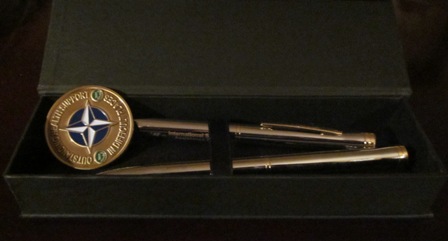
We left just when the smells of fried chicken and the fumes of frying fat from the adjacent cafeteria became unbearable. I stuffed myself with Dunkin Donuts type (giant) croissants and brownies to make up for the missed lunch.
On the way back we were escorted by two Croates. During the ten minute ride we discussed the origin of the necktie (cravat, from Croate) and what it had been like to live in Yugoslavia when it exploded. They are in Afghanistan to repay their debt to the international community and my Afghan colleague Dr. H. thanked them.
Even though it was my day off the workday wasn’t over. We rushed back to the ministry and met with the minister to present the areas where we can’t move without her support. She re-iterated the priorities of the ministry for the next five years which match our organization’s strengths quite nicely.
From there I barely made it in time to my Dari class. I finished the Iranian story about the lady of the thousand stories and then we talked using all the new words I had learned.
As if the day wasn’t long enough, in the evening we rallied to Restore Sanity. The Kabul rally didn’t quite match the Washington rally but it is the thought that counts. It was also nice to feel part of something big. Some twenty of us Dems Abroad came together in the basement bar of a Chinese restaurant. By night the streets of Kabul are too cold and too dangerous for such a show of support for our embattled president. Blindfolded we pinned American teabags on pictures of the Tea Party leadership. I won a bag of pork rinds, contraband in this place.


 Sylvia's Journal
0 Responses to “Parallel universe”