Archive for October, 2010


That vision thing


At 10:00 Am this morning Axel, Doug and I sneaked out of the office for a private tour of the Murad Khani urban restoration project by Will from the Turquoise Mountain Foundation that is undertaking this massive project.

He and others have seen through mountains of garbage, kilometers of red tape, and who knows what other obstacles why holding fast onto a vision that is becoming reality right now. The digging and constructing is still going on but what has already emerged is breathtaking.

If ever I need an example of the power of vision and how it transforms people and things into something only dreamed of a few years ago, in spite of numerous obstacles, it’s right here in Kabul, about a 20 minutes ride from our office. I think I may take people on a field trip to see what having a vision, a shared vision, does. Some people think that this vision stuff is fluff but what we saw today is all but fluff.

We visited a primary school that is now teaching 200 kids from the neighborhood. When we visited a group of kids was practicing circus acts. The school is in one of the many restored old buildings, with classrooms filled with eager little kids, boys and girls three to a bench, singing us a welcome. The teacher hoisted on of the girls top of a schoolbench to read the numbers one to 10 in English. I could have stayed the whole day there.

We went to a pristine little clinic, set up in a few small rooms with a male and female doctor. They were able to reduce the number of cases of watery diarrhea to very low levels, tackled the problem of acute respiratory disease and organized a community that never was organized to pull together the necessary funds to send a very ill 29 year old mother to Pakistan for treatment not available here.

A new urban health clinic is being built. We met the young female Iranian-German architect who is specializing in buildings that are green, use local technology (mud clay, straw and egg whites for waterproof walls and roofs) and makes sure that surfaces allow for easy infection control.

On the way back to our office I talked Doug into considering a vision-driven intervention rather than a problem-driven one to deal with one of the large urban hospital that has been sucking up drugs and money as if there is no tomorrow. The visit had made the case better than I could in a hundred years. That’s what seeing things for yourself does. I am a big fan of field visits.

I left work in the midst of a terrible dust storm that blocked everything further than 10 meters away from sight. Everyone wrapped their heads with whatever cloth was on hand. At such time scarves come in very handy.

Today was SOLA day. Three girls showed up, all also part of Axel’s writing class. We talked more about vision. One of the girls is slowly filling in a poster with details about her vision, every week there is more detail. Today she had included a round table with people sitting around it and with microphones in front of them. It is about working together to solve the problems of Afghanistan. I wondered whether the Taliban were at the table but I did not ask.

Instead I asked what they would do if (once) they were president of Afghanistan and they had one million dollar to spend. How would they allocate it? Without any hesitation all three said ‘education,’ though they did not all start with the same age group. That they picked education is not a surprise. They themselves are beneficiaries of education when they are not victims of ignorance.

This led us to a fascinating conversation about the future husband, if there were to be one. After revelations about the age their mothers were married (12, 14) and whether there was such a thing as a good marriage (not obvious), we discussed the ideal husband (kind, let’s me work, talk with other men, move around freely).

Very quickly the conversation drifted into horror stories about girls being bought and sold for 25 thousand dollar. I wondered whether some of these thousands of dollars come from the enormous amounts of dollars that are sloshing around in this country.

This slideshow requires JavaScript.

Where’s my lithium?

All the good and all the bad things one could imagine as well as everything in between happen here, all the time. Being in Afghanistan is one very long roller coaster ride. I think I have said this before. I am reading Obama’s Wars, many of us are, and learn that you don’t have to live in Afghanistan to be on the Afghan roller coaster.

A high level US government official claims that president Karzai is on meds for being manic depressive. So what’s the big deal? One cannot help being manic-depressive here and maybe we should all be on meds.

Manic: In today’s newspaper a small boy, looking no older than 14 or 15 (he is a 10th grader), appeared on the front page next to his home made airplane. It is being looked at by aviation experts to determine whether it can be issued a certificate of airworthiness from the Ministry of Transport and Civil Aviation. It looks a bit like it could be a ride at the fairgrounds. It has three wheels, a triangular wing above the fuselage which is shiny blue with white stripes. I was so excited to see this – imagine this boy from Bamiyan, amidst all the chaos and disorder in his country he is dreaming big and then turning his dream into a real thing that can fly. Thank God for always having a next generation – it is Afghanistan’s only hope. If only the adults could remove barriers to other boys (and girls) to turn dreams into innovations the possibilities are endless.

Depressive: Somewhere in the west of the country armed men stole a truck full of fortified biscuits intended for school children. They also entered a clinic, removing all drugs and dressings and throwing all other supplies on shelves and in cupboards on the floor. The staff fled. Nobody could interfere or do something about it. I can only conclude that someone in a high place is protecting them.

Where’s my lithium?

Coordinate

Today we tackled the complex issue of coordination. Several of us went to see the minister who had blocked out one and a half hour for us – an unknown luxury. In the end we took even more of that.

As part of an effort to re-energize one of the consultative groups we had realized that this one group had way too many objectives: information sharing, donor alignment, policy discussions, feedback on policy implementation, just to name a few, each requiring different audiences, different frequencies and different leadership. We proposed instead four different mechanisms, some of which exist already but are essentially dormant, having lost their inspired leaders.

Coordination is probably one of the most used words in reports and the least understood organizational function. There is no dearth of coordination mechanisms, sometimes even coordinating bodies to coordinate the coordinated. The discussion circled around various issues, doubled back on itself, and moved into side roads.

At one point I felt like everything needed to be ‘cooked’ a little more as they say here but the minister wanted no more cooking and tasked everyone around the table to get on with the job. I was assigned to assist in this effort and pointed out to the acting leader of this small committee that this may well be the reason why people don’t like to go to such coordination meetings because they often return to their office with a new job. We both did.

Exposed

Today was full of small management glitches – they kind that are maybe not very serious in their consequences and beautiful opportunities to remind people to check assumptions and expectations before it is too late and they turn out to be wrong or not met. That is probably the number one cause of organizational irritations in any part of the world. If not nipped in the bud, these irritations become organizational dysfunctions, like when people no longer talk to each other or stop taking action because they think it/they/you are no good.

I also learned from my (female) Dari teacher that I had exposed my ankles too much and people were talking. I was grateful that she told me and realized that the many men around me could probably not say anything about that because it meant they had been eying my ankles. It is true that I have been wearing a long skirted dress that ends about 6 inches above the ground. Somehow I thought that by now it would be OK – I don’t know why, wishful thinking maybe, and besides I like the dress. My teacher told me to wear pants underneath them – the lacy pantaloons that women wear under dresses. I don’t have them but I have leggings. I am not sure that is OK. I guess, to be on the safe side, I will return to pants. Since winter is coming that is not too much of a sacrifice.

Ankie left for Dubai and then Holland and then Cameroon (if the French aviation fuel is flowing again next week), and Sophia, our new house guest moved in. I don’t know Sophia, other than that we are friends on facebook, which is why I asked her to stay with us. She is from our Washington office and this seemed like a good opportunity for us to get to know each other.

Back to basics

One of my staff leapfrogged over me to become deputy chief of party. This change will remove at least 100 emails per week out of my mailbox leaving me more time to focus on what I came here to do in the first place: to strengthen the management and leadership development interventions at the provincial and central levels. It’s taken about a year to get to this place. Not that it was a waste. On the contrary, it was a very productive year in which I learned much about what it takes to get health services delivered to the population.

Aside from the leadership work I still have the drug management unit in my portfolio – another steep learning curve for me – and the central capacity building team which focuses on child health interventions, policy work, coordination between provinces and central levels and PR/strategic leadership communications.

In the afternoon a few of us went to the inauguration of the Afghan Social Marketing Association, an accomplishment under the rubric ‘Afghanization.’ Axel worked with these folks, and the project that birthed them, for the last several months and so it was nice to see the culmination of the many (and mainly) man hours that went into the preparations for the launch as well as this organization’s new life.

We came early to the fancy Safi landmark hotel in downtown Kabul, expecting that the presence of the top ambassador of the US would involve major security. As it turned out neither he nor the security checks were there. We had to wait about an hour before the top US official arrived which gave us plenty of to network with old friends, old-timers we had heard about but not yet met and some new arrivals.

In the latter category, we met one half of the couple that some of our USAID friends in Ghana and Kenya had told us to look out for. We will be planning an escape for them and look forward to get to know them better. This is of course the good thing about living overseas – there is a constant coming and going of people and always the opportunity for new friendships.

Glitter and gauze

Chris and I went out for a morning into the real Kabul, not the areas we foreigners usually go to. We picked up M. and her two small boys. They live in Khairkhana, an immense popular neighborhood on the northwestern side of Kabul. Many of our staff live there. It takes a good 45 minutes to get there from our house. They commute this distance twice a day – like I used to do in Massachusetts, but under very different circumstances.

M. took us to the kind of fancy dress stores we drive by but never go inside. The dresses are gauzy and glittery pieces of art, gaudy yet beautiful, especially rows and rows of them in the most vibrant colors. This is what the women wear at weddings and at parties at home – something that Axel and my male (foreign) colleagues and friends will never get to see ‘live.’

Afterwards we went to M’s tailor who took my measurements. I had wondered about this somewhat intimate act by a male tailor (I have not seen female tailors in tailor shops – it appears to be a male profession). I had to take off my scarf and let him measure my body. ‘How does that work with Afghan women?’ I asked M. It must be rather uncomfortable to have your bust measured so blatantly. Of course the tailor never touches the body but still. M’s husband, she told me, stands close by and watches carefully so nothing inappropriate, like touching, would happen.

We settled on a design from a well-worn copy of busty Indian or Pakistani women. There was not enough cloth (picked up last week at the agricultural fair) for long sleeves. M. said that half sleeves were OK for me because I am a foreigner. For her it would not be OK. How sad, I thought, that women here can never feel a warm summer breeze caress their bare skin. Imagine not knowing what that feels like.

This slideshow requires JavaScript.

Hidden beauty

Ankie accompanied me to the spa for the weekly massage. Our massage tables were placed side by side. It was Ankie’s first real massage and my umpteenth. She got hooked just like I was; but she’s going home and I get to have another massage every Friday. This is at least one advantage to living here. We had our picture taken, all wrapped up in sheets, during the cool down phase of our treatment.

All oily and relaxed we had lunch in the garden of one of Kabul’s tea houses that are hidden behind tall walls in a lovely section of town that hasn’t been invaded by poppy houses yet.

Next stop was an open house of the Turquoise Mountain foundation. All the students’ work was on display, some for sale while many of the students were there to take commissions. There was exquisite calligraphy, pottery, tiles, Nooristani wood carvings and jewelry.

The Turquoise Mountain Foundation has been digging out trash and restoring old buildings in Kabul. A maquette and wall with photos chronicled the efforts.

Our friend Will is going to give us a tour of the real thing next Thursday. Several of the workshops were the various art forms on display are practiced have been transferred to the renovated old buildings. This project is a wonderful example of everyone working to repair and preserve some of old Kabul’s beauty which is otherwise hard to spot between the blastwalls and razor wire.

Rumi in our cells

Tonight was the second time that we saw Ahmad Sham’s Sufi ensemble. It was at the American Institute of Afghan Studies where the Fullbright and Humphrey fellows and scholars have their clubhouse. One of our Afghan friends is a Fullbright scholar and she had passed on the invitation.

What we saw there was a world that is light years away (ahead) from the fighters and mullahs whose minds are still in the Stone Age. The room was full of bright, enthusiastic and articulate English speaking Afghans who had studied in the US. If only they could wiggle loose from all that constrains young people here and be let loose on ministries, businesses and parliament, then Afghanistan would be in good hands I imagine. Some are already loose, running businesses, making policies – they even created an association for policy advisors.

There were few women in the audience – Ankie and I, a few escapees from the US embassy and USAID and, later in the evening two of the students from the school where we teach. We asked the Fullbright fellows where the women were. ‘They married,’ was the answer. In this country that means for most that they are ‘out of the game.’ Couldn’t they talk with the husbands and let them come to the alumni program night? I asked. ‘A good idea,’ they said politely but I could tell they thought it was a rather stupid idea.

The music was stupendous; a Rumi song that takes about 15 minutes with a cadence that gets into your very cells and moves you from the inside out. It has become my favorite. Just when our driver showed up there was a tabla solo by a young men that left us transfixed and unable to move. His fingers moved so fast over the drum’s surface that you couldn’t see them, just wisps of air. He mimicked one horse, then a whole bunch galloping by, then a train, coming and going and finally a variety of notes up and down the scale. Never have I heard anyone playing drums like that.

This evening came on top of a day with several encouraging developments, accomplishments, and a good though small class in the after school program. It was one of these days where Axel and felt like pinching ourselves to make sure that we were really in Afghanistan. A good day indeed.

Readiness

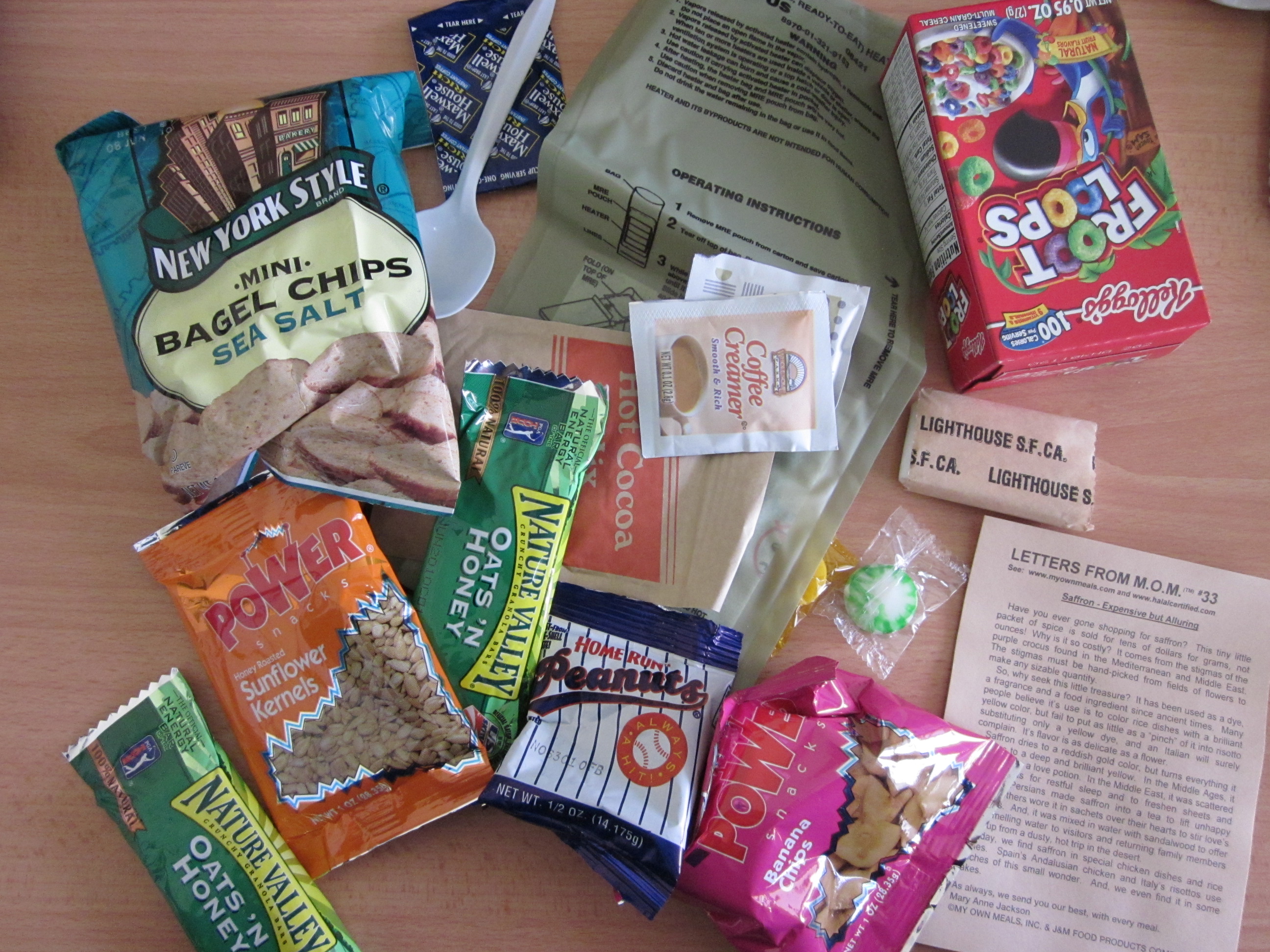
One of my colleague who manages to live on MREs (Meals-Ready-to-Eat, military fare that has fallen of the truck) had promised me a snack pack for taking notes at a meeting yesterday. This morning he delivered the promised snack pack. It included 2 hard candies, a one serving box of Fruit Loops (but what about the milk? Was I supposed to mix the coffee creamer with water and pour it into the box that had scored lines to turn it into a bowl?).

There was a Nature Valley bar, a bag of Power banana chips, a small pack of sunflower seeds, New York bagel chips, cocoa powder ready to mix, one serving of Maxwell instant coffee, domino sugar, pepper and salt (for what?), a plastic sleeve with a heating element, presumably to heat water for my cocoa or coffee, Red Sox label peanuts and a letter from M.O.M (My Own Meals, the company that packages these) about saffron, including a website in case I want to learn more about saffron.

My colleague lives on these and has bought a year’s worth of snack packs and complete meal packs. He does not participate in the Afghan food economy. It’s very cheap he told me; a year’s worth of supplies is what we spent in two weeks on groceries. But what about these juicy apricots, the pomegranates, the kebabs, I wonder. I suppose it works if food is nothing more than a physical necessity and not high on your list of priorities.

Today we started a two-day partially in-house partially out-of-house training using the leadership development approach that I had wanted to introduce about a year ago to all our colleagues. But then everyone was too busy. Now people want the training. It goes to show that for everything there is a right time and a wrong time.

We did a few attempts last May but it went nowhere. Now we have four teams actively participating: two community health teams, one drug management team, a university team and a few hangers on.

The program is done in Dari. I sit, once again, in the back. I know the program and the daily agenda inside out and can follow some of the discussions. Still, I have a long way to go. And when they switch to Pashto I am lost.

I was proud to see the local facilitators teach the program as a team and with great confidence. One of them is a young woman who has recently been promoted out of a poorly paid and dead-end consultancy job to a UN-financed program manager position in one of the ministry’s directorates. I have seen her grow in just a short two years into a formidable facilitator without any accompanying increase in her ego. It makes all the troubles here vanish – change is possible, even here; especially here.

Women as human beings

Today, our local newspaper told us,that the number of women drivers in Herat has increased by 60%. Of course it probably started from very little, but still. The title of the article was Afghan Road Rage but it was about men’s reactions to women driving. The woman who was featured in the article had a dented Suzuki, the dents coming from young men who didn’t think women should be driving, and a scarf tightly wrapped around her head.

The article ended with a quote from a young male student, “I see women as human beings deserving of all human rights.” Now there is enlightenment! Other people interviewed for the article didn’t think women should ever be behind the wheel. Their mullahs told them so, and that, here, is truth!

I attended the opening of a conference about the pressing problem of not having enough or good people to manage the pharmacies in private and public health facilities. The entire event was in Dari and so I treated it as a Dari class. With my dictionary I tried to translate the words on the banner and discovered the Dari translation was quite different from the English text.

Then, when the slides came on I tried to look up the words but by the time I had found the meaning the next slide was on. Still, I learned one new word per slide, words like assessment, framework, goals, graduates, etc.

A distinguished gentleman sat next to me who turned out to be a professor at the university. He was trained in France in the 60s and so we spoke French, a language that I rarely speak anymore as it is associated with a generation that has mostly disappeared through death and emigration.


Categories

Blog Stats

  • 136,984 hits

Enter your email address to follow this blog and receive notifications of new posts by email.

Join 76 other subscribers