Archive for December, 2010


Big stuff and small victories

Sometimes, when people ask about the big things we are supposed to produce, the ‘deliverables’ in our workplan and project document (Afghan ministry of health staff are managing and leading the health program competently so that the health of Afghans is improved – something like that) I feel a sense of incompetence, of failure. It is so hard to produce such outcomes when you have only influence, no authority to bring about positive change, most of it behavioral change of adults. Yet we promised miracles and we are held accountable. I am held accountable for my part of the Big Victory. The irony of all this is that if we had not made that promise we/I might not be here.

Since I have arrived over a year ago, or even earlier when I came as a consultant, we have been trying to implement activities that, at least on paper, should have, if not impact, then at least some measurable effect before we close the project nine months from now. My responsibility is to help my teams to produce changes in adult behavior and attitudes in a society and culture that doesn’t match the culture in which our models have been developed. There is little that follows linear causal pathways; there is much political interference; there are habits that produce effects opposite to intentions, at least in my eyes, yet they are maintained because they must fill some other function that is not visible to me.

A long time ago I learned that if you listen carefully to the stories of people’s lives, they tell them in a way that gives meaning to everything they do even if, to an outsider, they make no sense at all. As I learn more about the context of their lives, their histories, their experiences, their hopes, dreams, worries and fears and I begin to get it. That is when I realize the futility of some of our so-called change interventions. It is like trying to cheer up a depressed person with smiley faces and exhorting them to not be depressed.

In the absence of The Big Victory I don’t have the professional satisfaction of a job well done. Something I experienced as a consultant, the delivery of a report or the giddy feeling at the end of a workshop when everyone is happy and in high spirits and pondering the difference one has made while settling into the airplane seat for the long ride home.

Now, I don’t have those experiences. For one, the work is never done and secondly, the nature of the work isn’t like something you can check off from a to-do list. I have to seek my professional satisfaction elsewhere.

There are things that compensate for the buchari diesel fumes, the clammy cold of unheated concrete buildings, the intense air pollution, the restrictions on our movements, the terrible traffic and the constant bumps in the road.

They are the small victories of seeing someone change because they want to, and knowing that whether I am here or not, that change is permanent and will continue on its own.

It is when I see cracks in hardened opinions, a new insight peeking from behind the hard shell, an ‘aha!’ or an attempt to try out a new behavior; a woman who speaks out assertively and is emboldened by the experience; a beautifully written school application essay by a young Afghan man, after some coaching by Axel; my students drawing their visions and then starting the long journey towards realizing them.

A small victory is when nearly half the delegation from our project to a meeting with partners consists of women; when a new mom gets 3 months maternity leave instead of the one month she was given when her first child was born; the day care center (‘kodakistan’), now gender balanced, with 6 lovely little persons who run to greet me whenever they see me, letting me practice my Dari on them and asking me where the bubbles are (the giant bubbles I blew with them in the summer).

But my biggest small victory is that M is going to Egypt in less than a month to study something that is dear to our hearts: how to develop women leaders. We started working on this nearly a year ago. The obstacles were countless and big. We chipped away at them like a sculptor chiseling through hard rock to reveal something beautiful that was there all along and only needed to be uncovered.

Now, a year further, we are busy lining up our ducks, trying to make sure we haven’t overlooked anything that can derail this wonderful opportunity – it looks like we are good on the logistics, visas, money, and moving right along in structuring the experience. We still need to align others, at HQ and in Egypt, so that their efforts combine with ours to deliver the results we are looking for. This kind of thing gives me the lift I need to tackle the big stuff.

Working with bureaucracies

Last summer the responsibility for a gigantic medical equipment procurement was placed in my hands by a colleague who went on extended leave. I had to learn quickly what it takes to order 100s of pieces of medical equipment for hundreds of health facilities in a place like Afghanistan following US government regulations and Afghan standards.

I learned that there were no standards nor specifications and that someone knowledgeable had to do that. I learned that you need samples and some assurances that what you get is actually the same as the sample you were shown before you ordered and that you had to be alert to dishonest business practices.

I learned that you had to worry about time-to-delivery and whether we would still be around to pay the bill (and if not, who would) and that you needed storage space and figure out how the stuff would get to the facilities far away from Kabul.

The whole enterprise required hiring local staff to do the legwork and international experts to do the oversight and decision making about the quality/price/time to delivery formula. I got involved in the start up phase of this huge assignment by establishing a timeline and writing the job decsriptions for the people to be hired.

In September my colleague returned and I handed the whole thing back over to him, he reluctant, me smiling.

Now, four months later, I watch how the process unfolds, a process that looks more and more like an obstacle race. I have learned a lot since then about procurement. I have a new admiration and appreciation for my colleagues who are in charge of procurement, both local and worldwide and those who have to manage it.

I had no idea how complicated it is to get stuff, the right stuff of the right kind/quality, to the right people at the right price to the right place at the right time without (and this is the kicker) breaking any laws or violating any federal or national regulations.

When I look back at the timeline we developed in August I am astonished how far we were off. The complexity is tenfold of what I perceived at the time. Now, 4 months later many of the things we thought would be done by now, aren’t done and can’t be done for reasons that have to do with control and controls from this then that stakeholder. We are struggling to think of creative ways to get around each next obstacle that is put in our way, a new one around each and every corner.

This experience supports my assertion (adopted from James Q. Wilson’s Bureaucracy – Basic Books, 1989) that the freedom of bureaucrats to take action in the pursuit of efficiency is significantly, if not wholly, constrained by the decisions of their political superiors. The public sector cannot be efficient even if our lives depended on it (it’s own life doesn’t depend on it – a bureaucracy is forever).

In the public sector there is no straight line from A to B, there are no means that go directly and logically to ends no matter how much our plans and concept papers pretend they do.

People are sometimes shocked when I say this in public. Bureaucracies cannot be efficient because they are beholden to powerful stakeholders that care more, right or wrong, about interests and agendas of their constituencies than on managerial efficiency. I marvel how everyone always appears to discover this as an unpleasant surprise even though their daily lives at work are constantly upset by this reality.

Processing

I started downloading the audiobook The Decline and Fall of the Roman Empire (Part I) about 48 hours ago; Most of its 40 hours of listening pleasure have made it onto my computer but there are still a few hours to go. One learns patience here, none of this instant satisfaction with giga-fast downloads we were used to in the US.

I listen to books on my iPod every morning during my half hour exercise routine. I couldn’t do it without a book; I would be bored out of my mind. Now I look forward to the next 30 minute installment.

It will take me nearly 3 months to complete the Decline and Fall, which I won’t start until I finish Anna Karenina, sometime in March. I won’t know how Rome fell until next summer. I never would have thought that Afghanistan would be the place where I would catch up on my classics. All this thanks to the Manchester (by-the-sea) Public Library.

Early this morning there was a suicide bomber followed by firefight on Jalalabad Road. It is the road that goes to the UN compound and from there the shortest distance to the border with Pakistan. The road is on the other side of town and one we travel rarely. I have only been there twice since I arrived and have no need to go there at all. It has been calm in town so the violence came as a surprise. Rumors have it that the ISI is flexing its muscle, a tit-for-tat for being rapped on the fingers because, allegedly, it disclosed things that should not have been; worse than Wikileaks.

My colleague S and I attended a meeting at the ministry of a committee that is tasked with completing a strategic planning process, all the way down to activities, performance indicators and other accountabilities. It is hard to come in late into a process that is well under way and to have missed some key events that produced the raw material we have to work with.

S and I asked the kind of dumb questions one can only ask at the beginning, but not later on. So we did. I realize I am listening and watching acutely for signs that our questions are unwanted, it is a fine line to walk. I have been on the other side, being mightily irritated when people asked questions that were not asked when we all set out (or that I should have asked myself). It can lead you in circles back to the beginning.

We were called into the process this late to take the seat of the main facilitator of the process, who left for Christmas. It is a true exodus this time of the year. For those of us who stay Christmas is a regular workday and life goes on; the Afghans have had their holy days already. It is not a great sacrifice for me to be here over Christmas – not my favorite holiday, except for Christerklaas which we will miss. But we do miss being with the girls, their men and our granddog.

Crossing boundaries

It was a busy day for being a rest day. Axel went to cheer driver Fazle’s soccer team (they won), Steve went to pay his debts on Chicken Street and I focused on organizing our January trip to Holland and then India. Most of the reservations are made now – we have the tickets to Holland and back and the rental car. For the Indian segment of our trip I spent hours checking possible places to stay until Mr. Manodj from Delhi presented me with a pricey but enticing tour of Delhi, Jaipur and Agra in our brief vacation post-Holland.

In the evening we all met up at the French lycee for an evening of traditional music from the north of Afghanistan (Door Mohammad Keshmi) and the south (Zarsanga), the former singing in Dari and the latter in Pashto. At the end the two singers came together to improvise across language and political boundaries. The crowd went wild – music is indeed a universal language, masking rivalries and other unpleasantness. These are moments when we all wonder, why can’t everybody get along like the musicians did?

On the way home we stopped for a late dinner of street-side kebabs and fries. It was a festival of salt and grease (therefore very yummy). Axel is now sitting up straight waiting for the heartburn to set in and planning to stay upright for a couple more hours while the rest of us go to bed.

This slideshow requires JavaScript.

Needleworks

I made my way again to the backside of the ISAF base for my weekly massage. The place was less crowded. Lisa is working on extra rooms in the back and a more discrete and secure entrance and exit, through a car gate rather than straight into the main room through a metal front door.

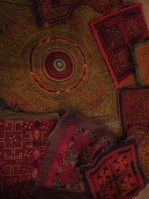
Afterward I joined Steve on Chicken Street. His being here temporarily resuscitates the micro economy of Chicken Street. The store owners have missed him badly. We went to see Mr. Khoshal which means Mr. Happy in Dari. He has an vast collection of Central Asian embroidery, ancient and modern pieces, on silk, wool, cotton and shiny nylon Chinese fabrics.

Unimaginable hours of embroidery by women all over the region have produced these master pieces. I wonder how they got to Kabul. Were they sold, bought or simply discarded and picked up someplace. Many are stained, mended a thousand times, parts of the fabric ripped, the silk disintegrated and all are dusty and marked by a hard life.

I am intrigued by these pieces and the histories they contain. How were they made, by whom, for what occasion? How did the girls or women produce such fine work in poorly lit homes, without eye glasses? And where did they come from? How did they get to Kabul? Was it a happy reason or a sad one?

After our shopping expedition we took the guards and drivers to lunch in the Herat restaurant where Axel can’t go anymore, he thinks, because of his missing gall bladder. He gets heartburn simply from my mentioning the kebabs that are interlaced with fried goat fat. Axel had stayed home and cooked his own, fat free lunch.

Loss, love, hate and redemption

Steve had taken us out to dinner last night. We ate the best Indian food in Kabul. The restaurant did not have a great atmosphere or décor but the taste of the food made up for the lack of it many times over; and Axel could get a beer, a great treat these days.

We drove back across town to our house on the eve of Ashura. The entrance to the big Shia mosque near our was house was decked out in green, red and black banners that said ‘welcome with Hussein,’ in the swirly and decorative Dari script. Hundreds of cars and motorbikes were lined up on the road, either parked or already cruising, an activity that was to go on all through the night and next day.

Many of the cars, mini buses and bikes have enormous green, red or black flags tied to them, reminding me of the giant American flags that we saw during the first few months after 9/11 in the US. But this is not about patriotism. It is about grief. The Shia are mourning the death of Hussein, the grandson of the prophet.

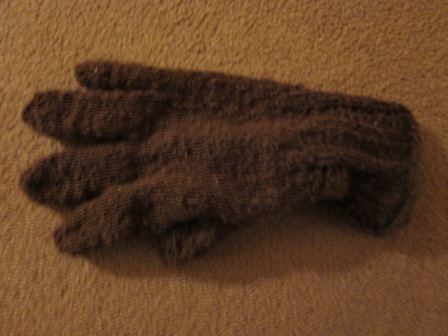
We were all told to stay at our houses – not a great sacrifice on our part and a welcome holiday for doing things we have no time for during the week (like reading and sewing and finally finishing that darn glove).

I had no interest in seeing any of the parades that were taking place in the Shia sections of town. The chance of seeing young men beating themselves bloody had no attraction to me. In the days leading up to Ashura Axel had seen a man carrying what looked like a snow chain except that it had sharp spikes on it. Steve had quite a few stories from his time in Shiraz, several decades ago, that made my skin crawl. Staying home seemed like a very good idea.

All day the local TV stations beamed us images of mullahs preaching and mosques filled with hundreds of men dabbing their eyes with handkerchiefs and moaning in wave after wave of collective grief. Women were wearing green head bands in separate services, though preached to by a male. One channel showed the Hollywood (but certified) film ‘The Message,’ last night and again in the morning.

Only one (of our few local channels) had a secular program on this otherwise holy (and holi-)day, an Iranian movie about a schoolmistress and an epileptic and mute school girl, traumatized after she saw her mother drown in the family’s swimming pool while the father was out hunting with his buddy.

The guilt-ridden father was handsome and young. He had to be both father and mother to the girl, washing and ironing her clothes albeit clumsily. The two naughty sons of the hunting buddy teased the poor girl and set fire to the house dressed up as American Indians, feathers, tomahawks and all. The fire nearly killed the girl. but then everything worked out fine with the schoolmistress becoming the new mom (and the dad, I am sure, handing over the chores).

Because the mistress was teaching a class full of mute girls she spoke Farsi slowly and I could follow much of the story. The film’s message of the redemptive power of love was quite different from the message beamed out from all the other religious channels, emphasizing hatred of the enemy and bottomless grief.

I finally finished knitting the right glove while watching TV and listening to my book on tape from the Manchester library. It’s not quite perfect but good enough to serve its purpose. Now I can unravel the clawlike left glove and try to duplicate the right one, in mirror pattern. It is a good omen for other difficult things I have been trying to do.

Bitter and sweet

After many ups and downs and countless visits to Afghan and Pakistani doctors and hospitals the mother of one of my staff died. The men will go to the funeral in Logar province, a two hour drive from here. This is one thing I cannot participate in. For one the formal ceremony is a men’s affair. The women will be at the home. But Logar is also of limits for us foreigners and the presence of a foreigner is a risk for everyone. The security situation makes it difficult for us to participate, even if only marginally, in the lives of our Afghan colleagues.

In our last day of the workshop we covered the topics of scanning methods, listening, inquiry into current reality, stakeholder analysis and work climate. I am discovering that there are parts of our program that have a very different feel and effect in an all (Afghan) female group. We had the women act out situations in which the other is not listening and then identify what makes for good listening. I noticed that the women have a high tolerance for not being listened to. This should come as no surprise. I am used to seeing (senior) men, in this same exercise throw up their hands in frustration after less than a minute of not being listened to.

I decided to drop Covey’s Circle of Influence because the center circle (one can control one’s behavior and attitudes) does not necessarily ring true for women here; the decision to walk out of the door, what to wear, and who to visit or invite is, for many Afghan woman, not their decision but their husbands’. And as far as attitudes are concerned, these are so shaped by the interplay of culture and religion that the word ‘control’ hardly applies. This became clear when we talked about life’s purpose and personal vision – most, with few exceptions, were about servitude (to God, husband, family, patients).

The hours I spent learning Dari are paying off. I can now understand a good part of the conversations and participate without having every sentence translated. The total immersion added a few more words to my vocabulary which is becoming ever more firmly anchored in my brain’s language center.

M. discovered the chairman’s hammer. The basement is also the meeting place for Toastmasters International, where Afghans practice monthly how to become more polished speakers. The hammer and speaker’s lectern are part of Toastmasters equipment. M. held the hammer like a weapon. It’s an unusual sight seeing a woman waving a hammer. It surely is an object of power. Under my breath I muttered, “you go girl!”

During the training my facilitator mentees experienced some very real life challenges; as when someone from the leadership team, who had missed most of the sessions, started voicing an interpretation (right or wrong) about what concepts and words meant in a way that created some disturbances and confusion. Managing this dynamic is a difficult facilitation challenge to manage for newbies. But that is how we learn: you trip, you stumble, and there lies the treasure! I can remember a few of such stumbles and then treasures found as a result.

On the way home one of the two facilitators bought us the sweetest mandarins, called maltas, to celebrate our sweet success in bringing this first leadership workshop to completion with everyone excited and hungry for more. We dropped her off at home before heading to the office for M to pick up some emails and her kids at the daycare center (kodakistan) and me to get my newspapers (I wanted to see how Holbrooke’s death was reported).

At the gate we said goodbye to our driver. He logged many kilometers and even more hours going all over town to collect us in the morning and drop us off at night. He drove a rental mini bus of the kind that are ubiquitous in Kabul, with a cracked windscreen and a large bunch of plastic grapes swinging wildly below the rearview mirror as we bumped along unpaved roads. It even had an (empty) ski rack on each side of the roof.

Concentrations

Last night we watched the third and last (as far as we know) of the three modern day Sherlock Holmes movies. They are delightful, complex and fast and so unintelligible that they leave us wondering ‘huh?’ All three require multiple viewings, and this last one (‘The Great Game’) certainly stumped me. It is about what happens when Sherlock gets bored.

Maybe it is because I was concentrating too much (though not enough) on my knitting. It was attempt # 35 or thereabouts at the same darn glove. The complexities of movie and glove interfered with each other. In the 90 minutes of the movie I unraveled and restarted the wrist section 5 times. I am working on the left hand; not because I finished the right hand (I nearly have) but because the right hand is too big; it would fit the hand of a large man, two of my fingers easily slide into the section that should hold just one; the lacy wrist part incongruously lining the giant fingers.

Although I said several times to Axel that I was going to stop this madness and start another project, with a higher chance at success, I couldn’t help myself and started all over again when the movie was over and the distractions gone. What drives me to continue this project, I wonder?

Maybe the whole thing is a metaphor for my desire to wake up Afghan men to the treasure trove of women’s talent that is in their midst. Like the gloves, I have never done it before and I know it is very difficult, and, I am learning, it requires endless stops and starts. The drive comes from vision: for both glove and women in Afghanistan I have a very clear vision of faraway success.

I came home to a house with all windows and doors wide open despite the winter weather. One of our bucharis (stoves) had misfired and filled, first Axel’s room and then all others, with diesel smoke. I found Axel sitting at the dining room table wheezing and coughing, complaining about a headache, telling me how it could have killed him if he had been asleep in his office room. That was only a theoretical possibility: he doesn’t sleep there, we don’t have a diesel stove in our bedroom and would never have one lit during the night. Still, the air quality is in our face again and would be one reason not to live too long in this country.

When I got up in the morning I noticed a dark black ring around the air purifier and its instruction book lying on the ground next to my bed. It was an unpleasant reminder of the blank gunk that gets attracted to the air purifier and that otherwise would have been in our lungs as well. That, the misfire fumes and the usual fumes that waft unnoticed through our house during the winter months. Right now we do worry a little about the concentrations of diesel particles in our lungs.

Hope, intent and the possible

For the next three days I am sitting in the back of a windowless basement room watching my two female mentees facilitate the leadership program for the Afghan Midwives Association.

I have forgotten what it is like to be in a room with only women. My one male staff member who was assigned as coach to the facilitation team could not accompany us for family reasons. The only male in the room is a young boy who accompanied his mom. He is well behaved and sits quietly in a corner. I gave him paper and markers and the English alphabet to practice.

On our way into town one of the facilitators realized she had left her prepared flipcharts at home. I asked her whether she could redo them at the workshop site. She replied, “yes, hopefully.” My immediate reaction was to say, “no, not hopefully! You can or you cannot?” Of course the word hopefully was a translation of “incha’allah” a word that stands at the end of every statement of intent. It is an acknowledgement of man’s powerlessness in the face of God’s intent with us. All human intent can be derailed if God wishes to do so, even the preparation of flipcharts.

In true Western fashion I consider much of what is needed to prepare for a workshop under my control – I over plan, over anticipate; I have contingency plans A,B,C all lined up in my head like a British queu. And when things are not under my control I know they are under the control of other, more powerful people, except of course for ‘Acts of God’ (as defined by our insurance industry) like volcano eruptions and earthquakes. That’s when I would use the word incha’llah.

As we worked our way into the center of the city the ubiquitous construction of open gutters blocked the entrance to a side street on our way. The detour made it difficult to find the building in which the workshop was being held. “See,” my colleagues said, “what happens when you leave incha’allah out? We lose our way!” Here, God is everywhere, and while I plan, (S)HE laughs.

I took great delight in seeing the transformation of my two young female colleagues. They stood tall, spoke with confidence and were so very different from how they are at work when in the company of men, where they look small, act from a position of low power, often speaking with soft voices (if they speak at all). I wish I could show my male colleagues how confident and talented these ladies are. For now they have to take my word but I hope, before I leave Afghanistan, that they can see for themselves.

And while I was basking in this vision of the possible, Steve visited Turquois Mountain’s Murad Khany’s urban renewal project, also a vision thing, and Axel attended another vision-drenched event; a graduation ceremony of one of his students at the Turkish high school.

This slideshow requires JavaScript.

Complexity and tradition

Today was one of those days that put complexity and the real deep work of development center stage. I am reading an excellent piece of research and conceptual thinking about capacity building. It is dense and refers to disciplines and philosophies that are hardly know here, except where carried in from the outside by consultants who may or may not be good at making the stuff digestible.

On page 19 of the Capacity, Change and Performance Study report (by Heather Baser and Peter Morgan, European Centre for Development Policy Management, April 2008) a table compares assumptions in different planning approaches, grouping them in two categories: traditional planning and complex adaptive systems. The rubrics are: source and nature of direction, objectives, role of variables, focus of attention, sense of structure, shadow system, measures of success, paradox, view on planning, attitude towards diversity and conflict, leadership, control, history, external interventions, vision and the act of planning itself, point of intervention, reaction to uncertainty and effectiveness.

I checked my own assumptions against those in the table and found myself squarely in the traditional column. A humbling experience for someone who, at least at a philosophical level, thought herself conversant with the complex adaptive systems approach. When I had to look at my practices I was far off the mark.

The study is not an easy read. Just forwarding the large file to colleagues is not a realistic option. This is after all not a reading culture and if it is dense for me, I can’t even begin to imagine how daunting it would be for others not familiar with the systems thinking and complex adaptive systems literature.

This is one of those rare moments when I long to be at headquarters, where this sort of intellectual exercise is not considered a luxury and acknowledged as critical to informing our work.

In the middle of all this pondering we had a meeting about what seemed like a simple request from USAID about 8 months ago: to order medical equipment for 500 health facilities. We tried to wriggle out of the assignment because some of my colleagues knew how complex and how time consuming this was. I had no idea. Now, 8 months later we are just beginning to scratch the surface. If I didn’t know that procurement is at the heart of much development assistance, I do know that now and how complex it really is.

There are cultural habits that leave new equipment tightly wrapped in its original packaging because the boss says so, leaving me guessing why this is such a common practice (the more seasoned folks can tell exactly why).

There are pragmatic and bureaucratic reasons: if it doesn’t leave the storage room it can always be accounted for and no one can accuse the storekeeper of stealing. [Steve told us a story about a guard who buried a broken chair to avoid accusations that he had stolen the chair. His son was there to witness so he could unearth it in case the accusation happened after his death.]

There are unethical business practices that lead vendors to promise one quality and deliver less quality for the same price. There is a scarcity mindset that leads health facilities to ask for the moon, blurring the lines between what is needed and what is wanted; one never knows when the source of all these goodies dry up. Or there is simple greed – wanting ever more. And finally there are managerial variables such as number, price, quality, time to delivery, storage, etc., and technical variables: specifications and quality.

We ended up hiring someone to look at all of this. He is a surgeon who knows Afghanistan’s health systems, structures and practices well. He explained to us this morning what a minefield this is and all the ways that we can taint our reputation with the many stakeholder groups that will hold us accountable, each holding us to a different standard (cost, quality, time to delivery, appropriateness, serviceability, etc.).

And while we discussed this millions of dollars worth of stuff, the ground shuddered from the heavy road building equipment outside our office and our eyes watered from the gas leaking from the defective gas burning stove that kept us warm between the chilly concrete walls and floors of the Herat Conference room.


December 2010
M T W T F S S
 12345
6789101112
13141516171819
20212223242526
2728293031  

Categories

Blog Stats

  • 136,984 hits

Enter your email address to follow this blog and receive notifications of new posts by email.

Join 76 other subscribers