Before joining some of my colleagues at the ministry (it is a workday for the government) I was invited by one of my staff to his house for a pre-work social with his wife and youngest daughter, an architectural student with impeccable English. They served me fresh apricots and plums from their country house – a place I will not be allowed to visit despite everyone assuring me it is safe.
He lives in one of the ugly Russian apartment blocks, many still pockmarked by gunshots from the Russians and Mujahideen. I have always considered these buildings eyesores and assumed they were also poorly built. But today, in spite of the intense heat in my part of town, these flats were cools even without fans. There are many trees that provide shade and the walls are thick. So I take back some of my criticism (they are still eyesores from the outside).
At the ministry we tackled the difficult question that the Kabul Conference organizers and funders have posed: what have we (the Afghans and those providing funds and/or technical assistance) learned from 10 years of capacity building. It is a very complex question especially since the organizers want evidence for recommendations – yet when looking at the so-called evidence most of it consists of opinions, points of view rather than evidence.
In my book capacity building of individuals can only happen if there is a counterpart and a sense of what capacity is weak or missing and a plan that spells out how one is to go from point A to point B. But not all advisors (those who are supposed to do the capacity building) have counterparts – as we used to joke: we are asked to paint a wall but there is no wall to paint. It is the critical factor that distinguishes those capacity building efforts that have borne fruit and those that have not. It is that simple.
I returned home in time for my Dari class. I have reached a plateau. Where once I thought my Dari was progressing very well and I could understand a lot I now think not. Maybe this feeling is part of a more generalized malaise, induced by the heat, the deteriorating political and security situation and Axel’s absence. And so I am plodding on, wondering sometimes whether I should quit now that my assignment here is coming to an end. But then I so much enjoy my classes that I don’t want to quit.
We read a brief essay in Dari about teamwork that a colleague had been circulating. It comes from the association of Afghan engineers and is a complex piece (both linguistically and culturally) about why the boss should not expect to always have the last word and how to handle opposing views in a team setting. The fact that it was written from within a very hierarchy conscious culture made it all the more interesting.
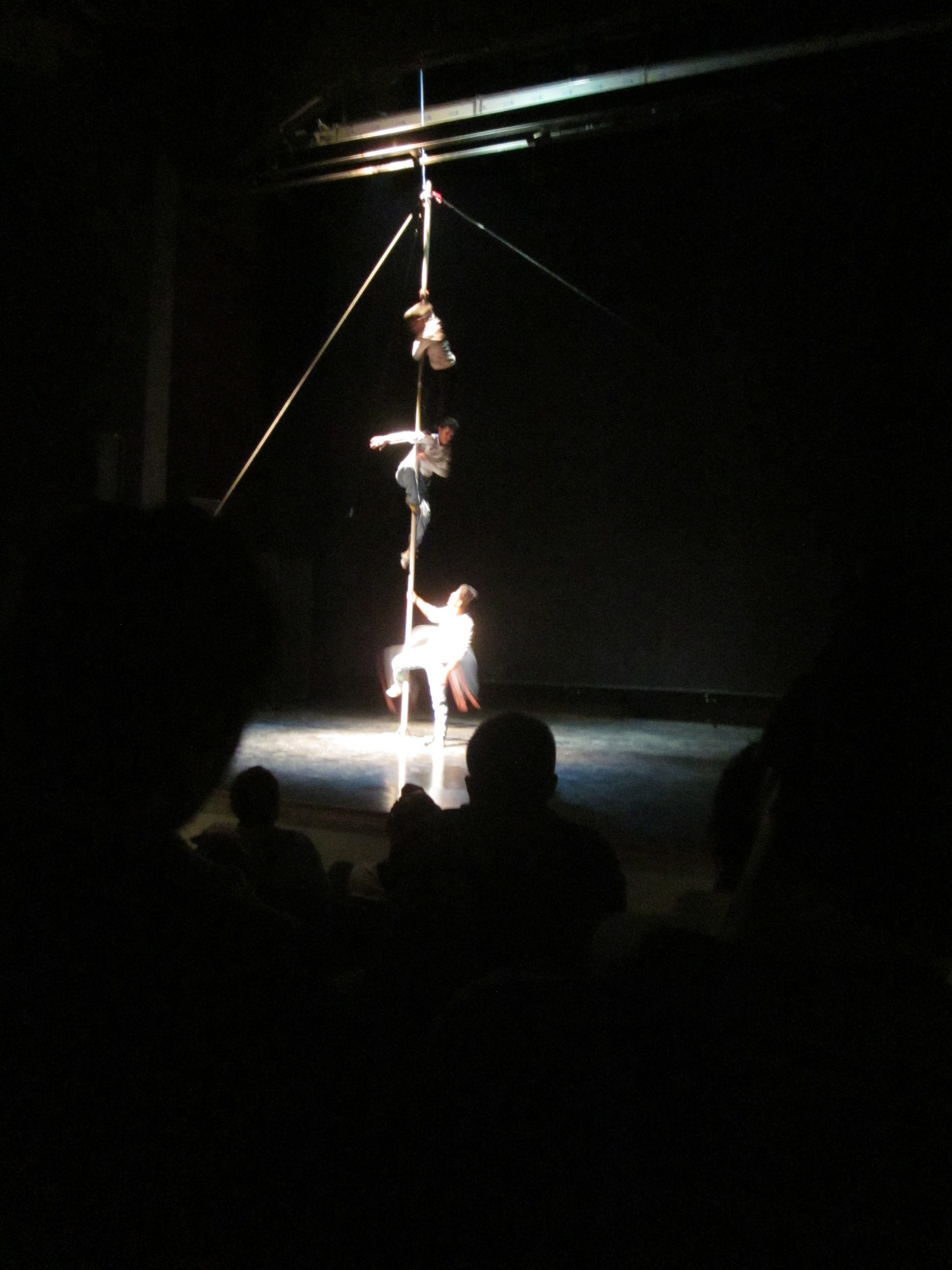 In the evening I went with two colleagues and their families to a performance by young circus artists – 9 teenage boys who showed us a combination of tumbling, pole climbing, uni-cycling and other easy looking but very difficult acrobatics that required great strength. I have a feeling that in one of my colleagues’ houses there will be some tumbling around bedtime tonight.
The shows put on by the Alliance Francaise are always wonderful. The hall and auditorium where all this takes place are modern, clean, dust-free and comfortable, making you believe you are in France or Europe rather than in Kabul. The French here are masters of the Art of the Possible and always manage to lift my spirit.


 Sylvia's Journal
0 Responses to “Tumbling along”