Archive for June, 2014


Ghenggis up close

IMG_0734

IMG_0741

IMG_0747

IMG_0754On Sunday it rained and was cold, like early April in Massachusetts. We set out with two colleagues from the Rehab Center who kindly sacrificed their day off to show us a small piece of their enormous country.

The roads are rough, with holes everywhere – I will complain less back home. The winters do a terrible job on the asphalt and repairs are probably postponed. Mongolian drivers are among the worst drivers I have seen – on the daily route to the Rehab Center we see at least three or four cars stopped because they ran into each other. Cars go left and right to avoid pot holes and drivers are rather selfish (this is actually not so unique). Trying to get into a line or cross a busy street is nearly impossible, so I suppose one learns to be selfish and aggressive.

We stopped by the side of the road where two mangy (or were they simply shedding) Bactrian camels (two-humped) were tied to a stake by the road. Our Mongolian hosts indicated we should get out and ride the camel about 20 feet one way and then 20 feet back. We also were offered a large leather mitt on which an enormous bird was placed, weighing more than Faro – an eagle I suppose – with huge talons and beak but eyes that showed no more life in them than one would observe in a plastic replica. The spirit had gone out of this bird and one could easily understand why – sitting by the side of the road in a bleak landscape, being carted to and from work in the boot of a car and tied to a pole. He (she?) and a mate, even larger with a wingspan of about 2 meters, were like the dancing bear or performing monkey. Our Mongolian hosts paid the 25 cents for each of us, contributing to this terrible practice because of politeness and a little curiosity.We returned to the car, wet from the drizzle, our hands smelling sour from the inside of the mitt and the camel’s coat.

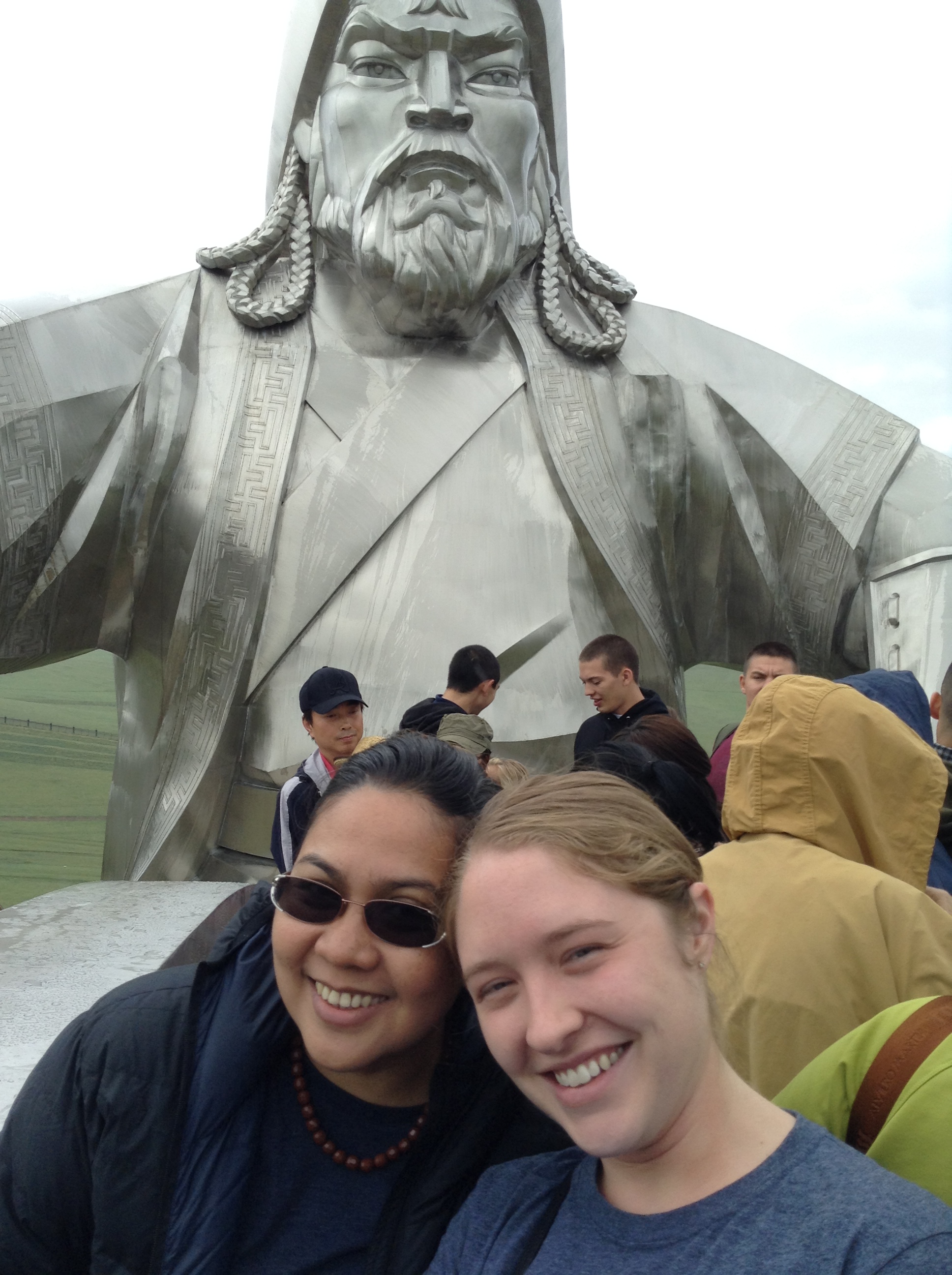
We continued our journey (54 km east of Ulaanbataar) to the Ghenggis Khan Statue Complex. I had expected a series of slightly larger than life status with Mr. Khan in various poses. Instead we saw the largest equestrian statue in the world. Sitting proud and tall and made from 250 tons of stainless steel, 40 meters high, Mr. Khan, the national hero, dominates the landscape. He looks east towards his birthplace. His statue sits on top of a circular pedestal with 36 columns representing the 36 khans (Ghenggis being number one) to Ligdan Khan (presumably number 36).

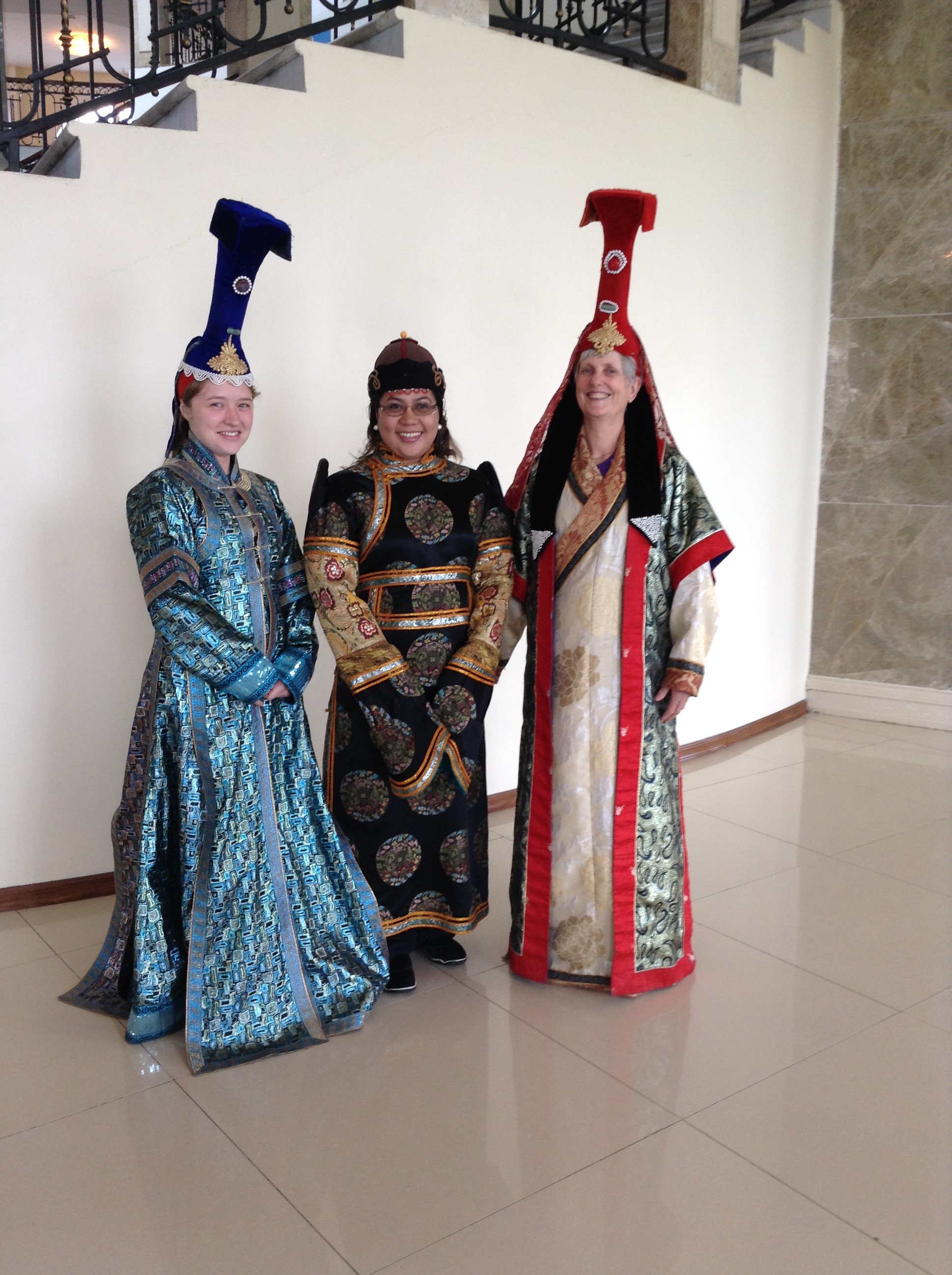
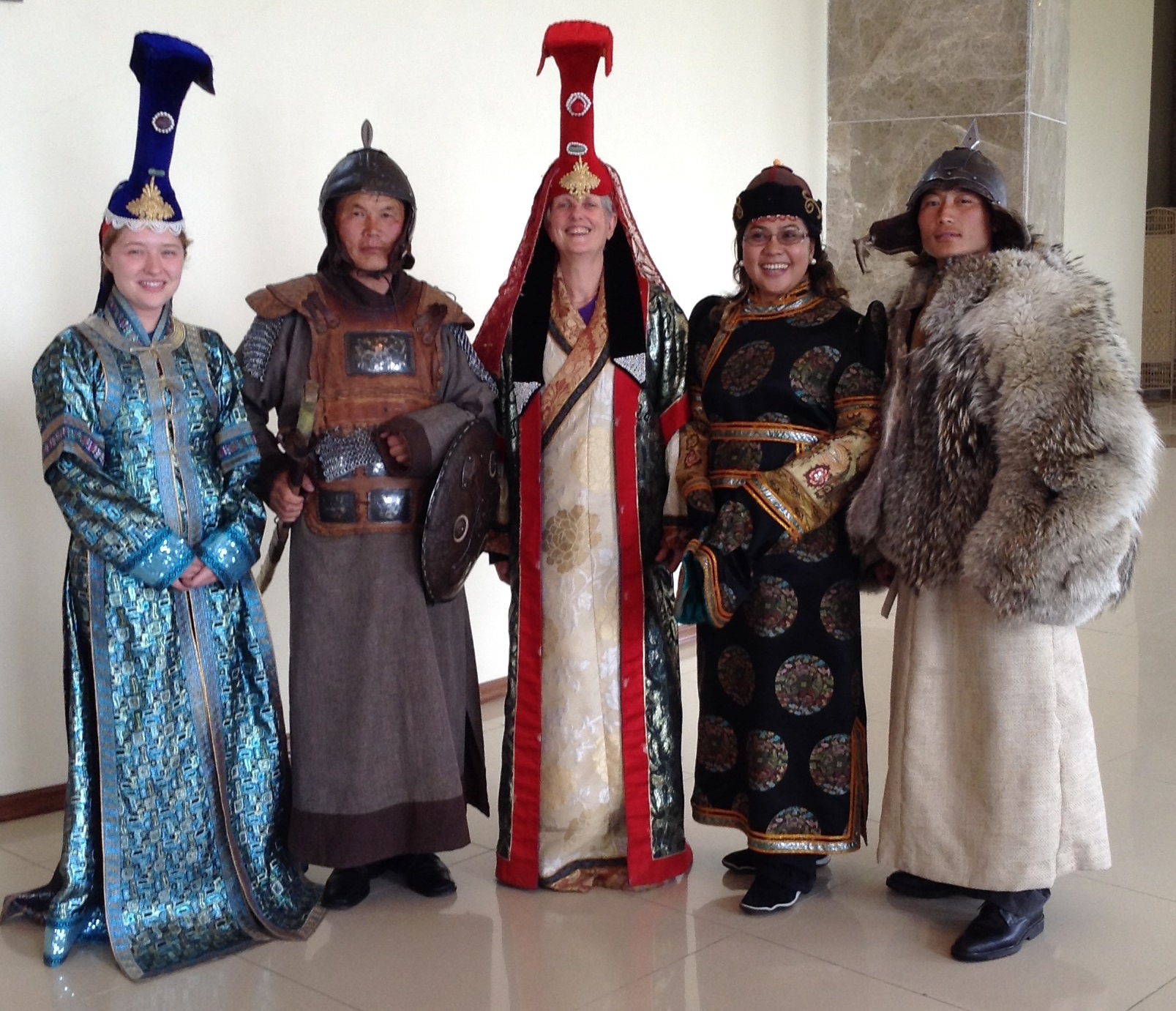
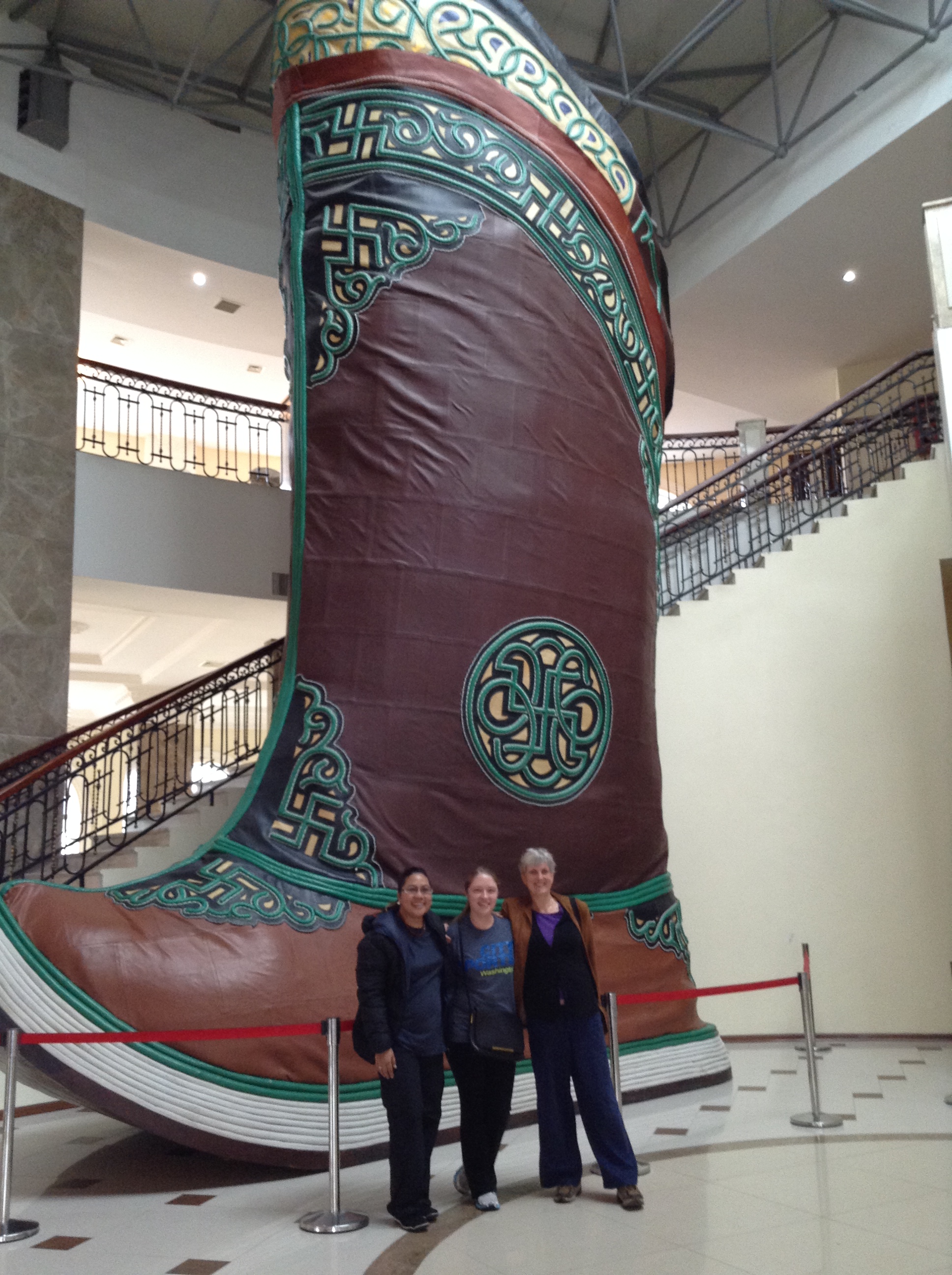
Inside the base is a museum, a movie theatre, a restaurant, post office, and two gift shops plus a 7 meter high replica of his riding boot. For a couple of dollars you can ‘rent’ some traditional clothes: fine embroidered gowns and fancy hats for women and rough leathers and wolf furs with chainmail, helmets and other war faring paraphernalia for men. You can then roam around the complex in your gowns and make pictures to your heart’s content. Of course we did so and enlisted some local men in their scary outfits to join us for various group photos.

We walked up a very narrow staircase inside the back of the horse to emerge between the horse’s ears with a close look at Ghenggis’s face and the surrounding landscape. A few of the lodging yurts are already in place but the landscaping has barely started. Here too there are no trees – a few scraggly ones planted as part of a more grandiose plan to match the grandiosity of the center piece. We drove back in more drizzle, zigzagging across potholes and avoiding other cars doing the same.

We made it back in one piece and without a scratch, had a late Japanese lunch and settled into the local Starbucks look-alike for a macchiato to divide roles and responsibilities for the managers’ workshop that starts tomorrow.
Art and spirit

IMG_0675

IMG_0689

IMG_0691Saturday was a day of play and rest for Maggie and me while our trainers completed their last day. Our guide and interpreter took us to the Gandan Monastery which is located on the edge of the city. It was established at its current location in 1838 and grew over the next century into a complex that included 9 dastans or institutes, a library and housing for some 5000 monks. It attracted people from all over who practiced the Tibetan form of Buddhism. I recognized the similarity with the monasteries Axel and I visited in Sikkim some years ago.

In 1938 the communists destroyed most (some 900) monasteries in the country. Five of the Gandan monastery temples were destroyed and what was left served as barracks for Russian soldiers or barns for their horses. The monastery did continue to function, although under strict supervision and on a very small scale during the rest of the communist era until the Democratic Revolution of 1990.

Now the place is thriving again and expanding. There are 10 temples and some 900 monks. Our guide keeps calling them monkeys, not out of disrespect but because she confuses the words. After all, if one is monk, two might well be monkees. It is a logical mistake.

An enormous golden statue (my guess: some 3 stories high) of the Bodhisattva of Compassion, Janraisig (Chenresig in Tibetan) stands in the center of the biggest temple which has become a symbol of independence for Mongolians. The original was carted off to the USSR and can be seen in the Hermitage we were told. How they got it out of the building (and how the Mongolians got a copy back in) is a miracle, the latter attesting to the craftsmanship of the Mongolians.

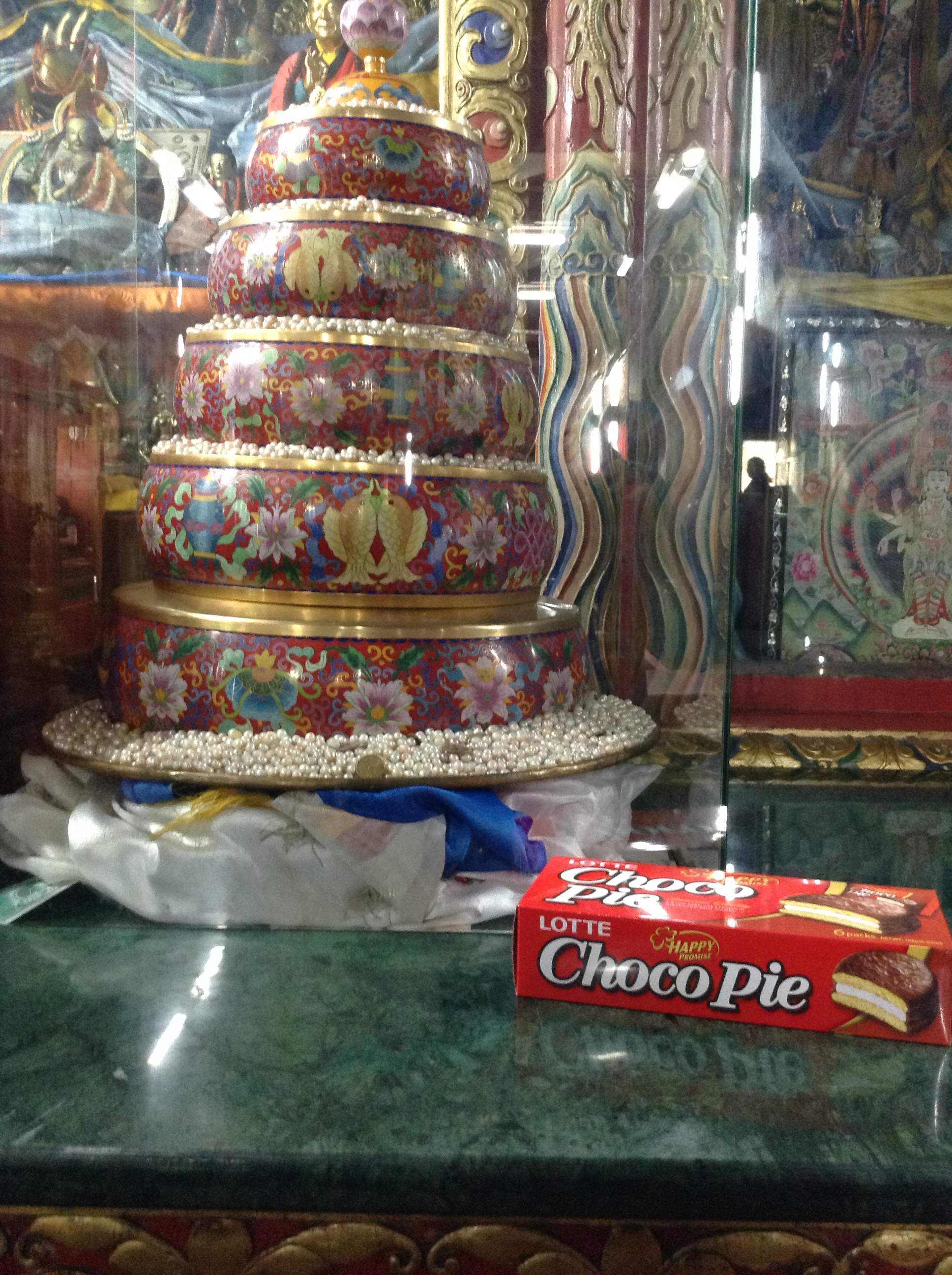
In other temples monks were reciting from the (Tibetan) books of prayer, rocking back and forth. They received gifts, like boxes of Choco Pies which were placed next to religious artifacts, creating some dissonance for me but apparently none for the locals.

We followed our guide and received blessings from several monks by bending over in front of their seat. They placed the prayer book on our forehead. Leaving the temple is a bit tricky with the uneven stones and high thresholds because once cannot turn one’s back on what is inside the temple. It occurred to me that for wheelchair users a visit to this temple is at least for now, out of the question.

An American gentleman started to follow us and listen in to our interpreter’s explanations. We invited him to join us and discovered that he is a visiting OB/management and strategy professor at a Chinese university and was in Mongolian to cross one item of his bucket list, a motorcycle ride across the steppes. He had already done one from the most southern tip of South America to Alaska. He is a circumnavigator, an elite club of people who have gone around the world a few times. It includes many celebrities, among them the former queen of Sikkim, who I knew about from our Sikkim travels.

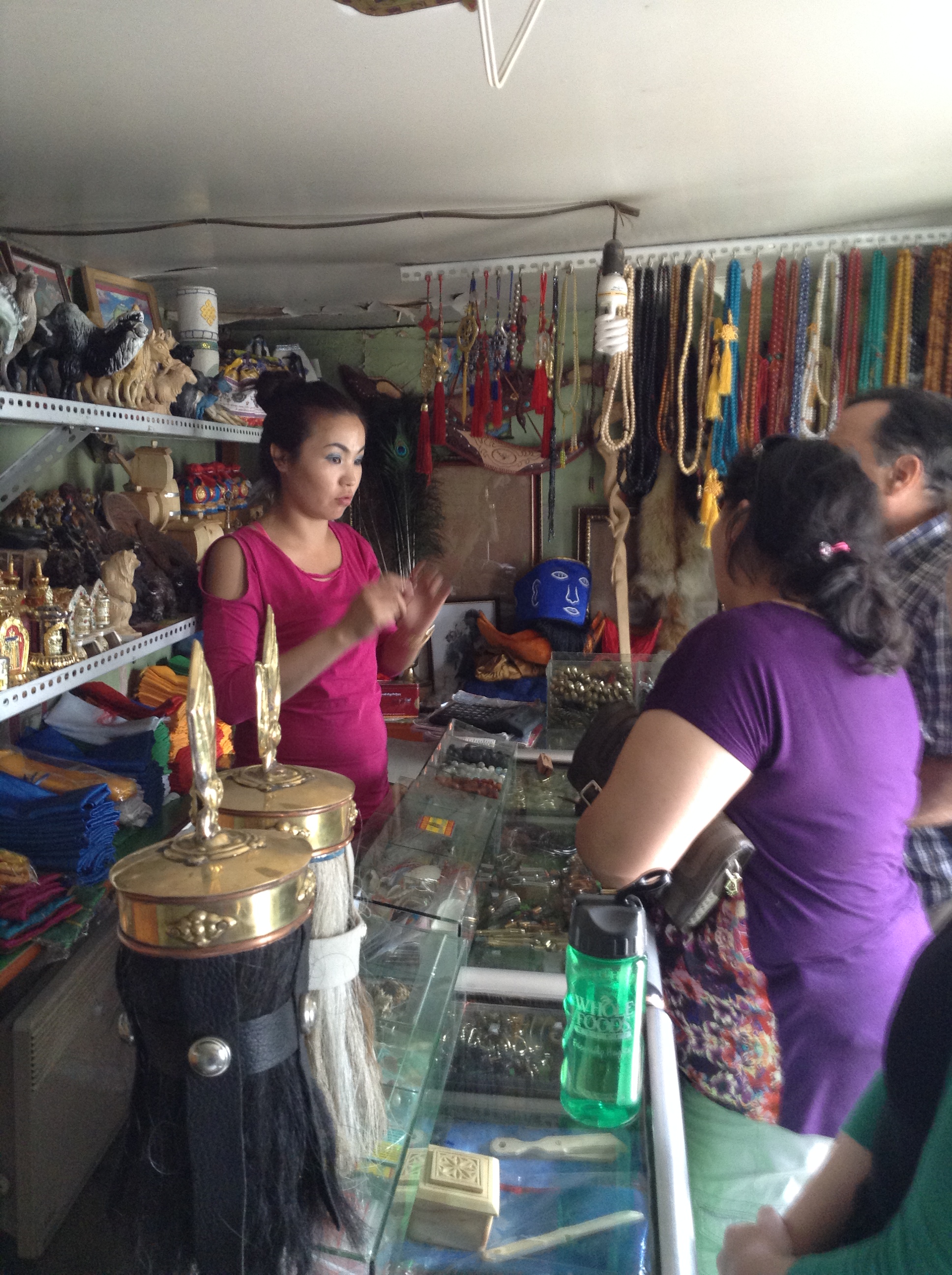
Outside the temple complex are souvenir shops that sell trinkets, mass-produced art and amulets for protection against the dangers of the world. We decided that our new friend needed to buy some protection against the dangers of traversing Mongolia on a motor bike. Maggie and I bought a charm to protect me against flattery and her against interferences to doing a good job. For a dollar and a quarter each, we also bought 9 hedge hock quills in a shaman’s shop. A dollar and a quarter is not much, we reasoned, to protect us against the dangers of travel. We did not buy the more powerful protection, in the shape of an embroidered roll, for 25000 Mongolian Tughrik (about 14 dollars), considering this a tad too much for superstition.

Celebrations

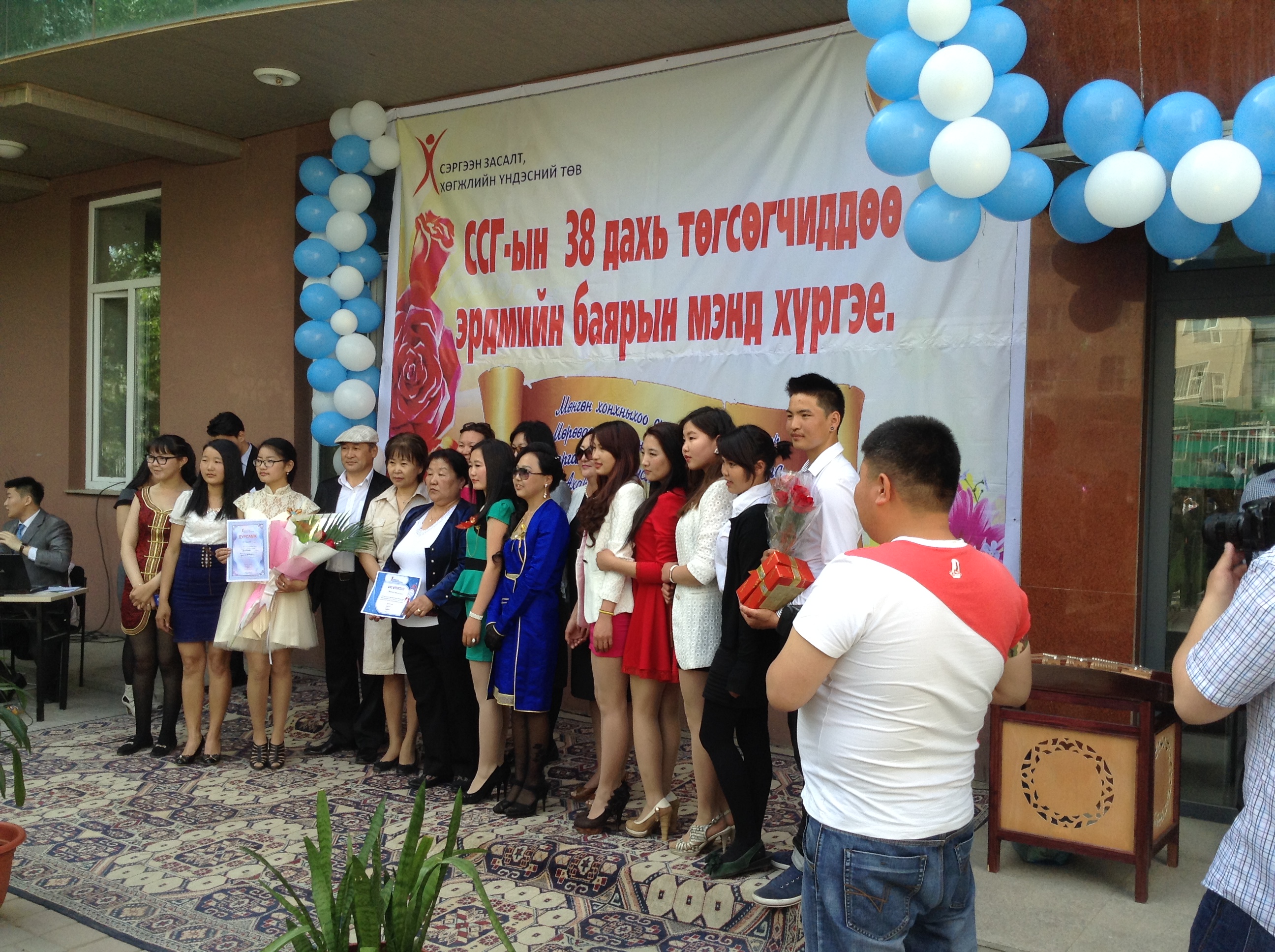
At the end of Saturday we returned to the Rehab Center to be part of the graduation ceremony. We found the students and trainers sitting in a circle and sharing the impact of the week of hard work. Our trainers were sitting each next to a translator so they could follow the heartfelt words from the participants. It was very moving to hear how people had been affected and obscured all the hassles and frustrations of the week (and believe me, there were a few).

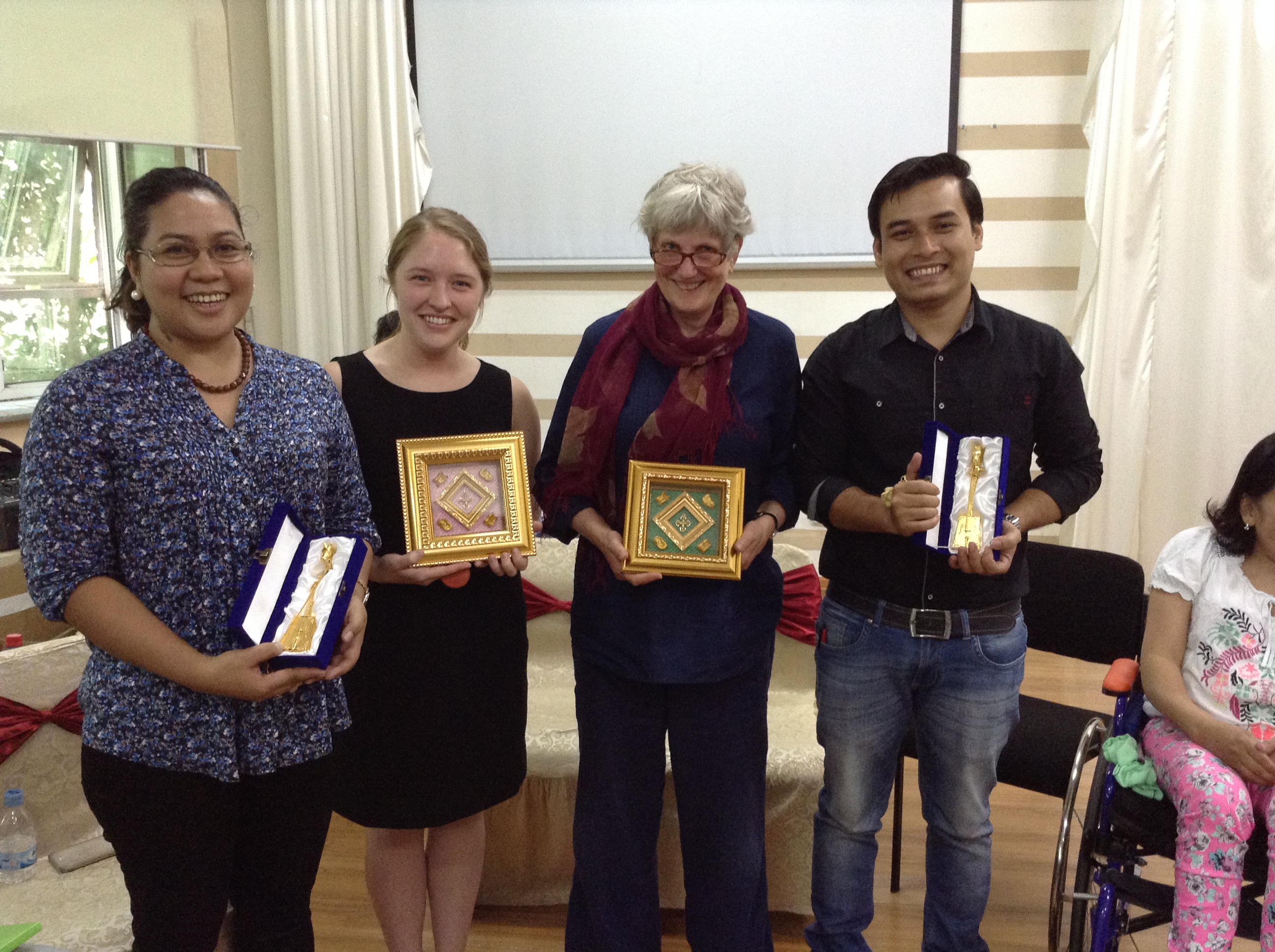
Since Maggie had done the speechifying at the beginning, I got to do this at the end. It is always easier because the group has bonded and I could talk about the difference I had witnessed and do some exhorting which now made sense to everyone. The institute’s general director handed out the certificates, we applauded a lot, made the group photo, exchanged contact information and cleaned up the room to set up for Monday’s managers workshop. This is an important part of the package because these newly trained providers will need a lot of management support to apply what they learned.

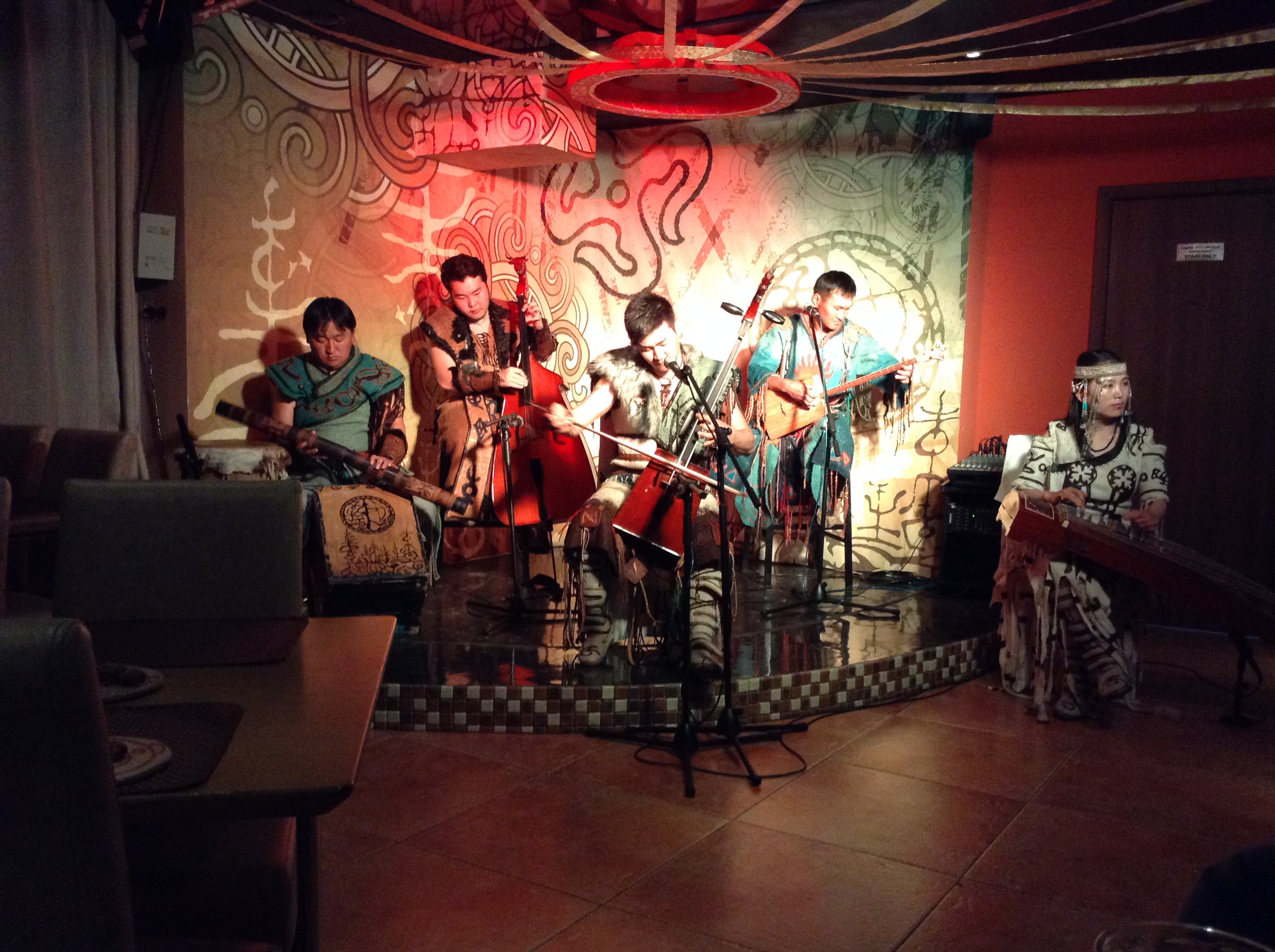
We treated ourselves to a dinner at Modern Nomad, a chain of Mongolian restaurants in the region. The UB restaurant featured a daily show of traditional music and dancing which we didn’t want to miss. It was also the last evening here in UB for our Indian trainer who was leaving the next morning.

The first thing that struck me when the players entered was their ‘indian-ness’ (as in Native American Indian): the woman’s headdress with the dangling turquoise and silver beads, the rain tube, the fringed skirts and shirts, the animal symbols, the throaty songs and of course the facial features. The instruments, especially a one by five feet lap harp with many strings, the felt boots, the fur coats and the drum made from a Chinese tea box indicated that we were in a cold place near China.

But now (urban) Mongolians dress in North Face and drink coffee (lattes) which the Russian introduced quite successfully, taken out from Starbuck-look-alikes in paper cups. Their music comes out of their smart phones through ear buds. A large Times-Square-size TV screen on the main drag advertises for shades and blinds that are controlled by an app from one’s iPhone. I was asked whether Mongolia was connected to the world. Urban Mongolia clearly is, but there are 1000s of miles in each direction where nomads still roam and life is probably the way it has been for ever. Although I have a suspicion that they may have iPhones with an app that tells them the weather and where the grass is greener.

The cousins who traveled across the Bering Straits millions of years ago must have dropped some of the habits and clothing traditions as they moved closer and closer to the equator and beyond. I wondered whether the rain tube, which I associate with the Amazon Indians, travelled south or if not, how and when did it get here?

The musical instruments were variations on traditional Western string instruments but more angular, with the strings being made from bunches of silk strands, the bows not that different. The cello had a bull’s head at the top; later I also saw them with horse heads. Like the Native Americans, animals feature prominently in the traditional lives of Mongolians.
IMG_0703

IMG_0708

IMG_0712

IMG_0715

Diet

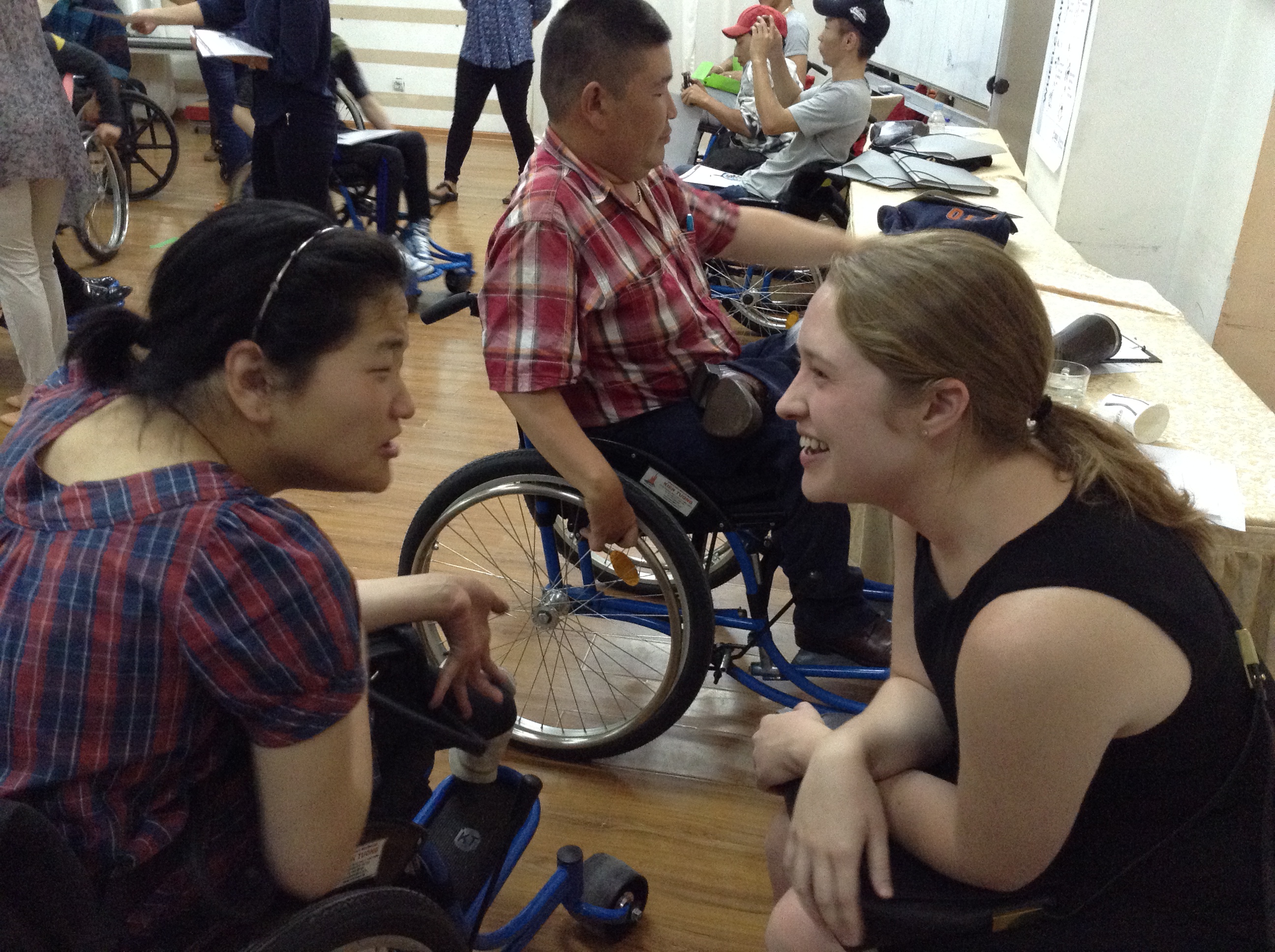
We completed our rounds of interviews on Friday and put together the agenda and materials for the stakeholder meeting. The basic provider workshop has entered its practical phase and students were busy fitting clients who were brought in from outside with the appropriate wheelchair. It remains a moving experience to see people in wheelchairs helping other people in wheelchairs get more comfortable with posture-supporting adjustments to the chair. They were busy changing wheel position and height, making support cushions, and adjusting foot rests. After that they helped them practice going up and down ramps, steps, turning and doing wheelies. I am so awed by all this.

We were invited to dinner by the ministry people at a Mongolian restaurant and tried some of the most typical foods, like sukhuur, a kind of hot pocket with meat or vegetables. I was glad I choose vegetarian as Maggie reported plenty of gristle in her pocket. She kept pushing the food around her plate to give the impression of eating. We started with tea (mesh teabags in tiny boxes imported from Arizona believe it or not), ate our pockets and then finished off with a Ghinggis Khan draught.

The food is starchy and meaty with pickles and salads occasionally as side dished. After a week I am starting to crave fresh vegetables. It is understandable that veggies are not part of the diet in this country of nomads, deserts, steppes and harsh winters but this would make it hard for me to thrive here.

Purpose, passion and playfulness in windy places

We continued our visits to learn more about the organizations that will participate in our stakeholder/coalition building meeting next week. I am working from the initial design we used in The Philippines. That meeting produced the intended effect as now, several months later, the various parties continue to work on things they committed to. We learned this from one of its champions who is here with us as the lead trainer of the basic service provider skills training.

First we had meetings at two of the ministries that have a mandate to support people with disabilities. The buildings were clean, bright, and airy. Young well-dressed professionals moved to and fro from offices that were equally bright, clean and attractive, sitting in arrangements of two large desks facing each other rather than the entering visitor. Nowhere did I see stickers from donors on furniture or equipment that indicated that others were responsible for what was there. Mongolia’s GDP is right up (or down) there with the DRC, Indonesia, Cabo Verde and Ukraine. But these government offices don’t have the feel I am used to when working with the public sector.

Afterwards we visited two NGOs that take actions on behalf of vulnerable populations. Mongolian NGOs have their offices in apartment complexes where rent is lower than in office buildings. As a result we got to see the inside of a few of the thousands of Soviet style housing buildings that make up a significant portion of the capital.

There is a feeling one gets when entering these buildings that borders on depression despite the lovely sunny weather. I can’t imagine what the experience would be when temperatures are below 30 (C) and winds from the steppes and deserts come raging through the wind tunnels that these apartment buildings create.

I am reminded of Christopher Alexander’s Pattern Language. The entrance experience is as wrong as it can get – soul depleting rather than soul enriching. Adding to this feeling are the poorly maintained playgrounds which are ubiquitous but which would not pass safety inspections in my book.

But then, once inside the apartments, the occupants had done a good job to counteract the entrance experience. The spaces, small as they are, were bright and full of color. The association of parents with children with disabilities is doing a great job to educate and relieve parents and appears to have been successful in networking itself with those who can support it through volunteer labor, donations and projects. The other organization has brought together wheelchair users and plays both an advocacy and support role. Both have been successful in pushing for government attention to conditions that are unacceptable. They are good examples of my motto that purpose, passion and playfulness make organizations successful in fulfilling their mission, more so than expertise and technical skills as the latter can be found but the former has to come from the inside.

Learning about Mongolia

Yesterday I spent five hours in a virtual coaching workshop with my colleagues in Cote d’Ivoire after the workday was finished here. It makes for long workdays but it is thrilling to be able to support the team there despite being 8 time zones away.

Our new translator is more than a translator – she has become our cultural and tour guide. My excitement about seeing a yurt across the street in the backyard of a high rise gave way to astonishment about the number of yurts encircling the city. Thousands of yurts dot the landscape expanding higher and higher up the surrounding hills. On the city map that the hotel provides they are indicated as tiny little white dots. They appear to be the Mongolian version of slums and are permanent structures even though they can be taken apart and re-assembled at any moment.

The rise up the economic ladder is seen when fixed structures are built next to the yurt. We drove a little ways into the area known as ‘gir’ to see some of the yurts close up. One can buy a yurt (in a box) or construct them from scratch. Our translator estimated that one could ship a yurt in a box to America for about 1000 dollars. Not a bad price for a dwelling – but one wonders about what it is like to live in a yurt in this harsh climate.

We also learned that the name of the city, the only big city in Mongolia, means ‘red hero’ a reminder of Mongolia’s communist past. Despite the brutal Stalin regime that killed several of her family members (Llamas and nobility) uur guide believes that Communism saved Mongolia from being wiped out by China, much like native populations anywhere got wiped out or nearly wiped out by the dominant powers of the day. It would have been a sad ending of what was once an enormous empire that stretched all across Asia and bordered several oceans. References to Mongolia’s grandiose past are everywhere: names of buildings and institutions, statues of Ghengis Khan and conquerors less well known in the West and even the Huns which originated from here and overrun Europe long before Genghis appeared on the scene.

It is summer here now and like in New England people come out of the woodwork dressed in shorts, summer dresses and sandals. Still, the days are starting cool and then the thermometer climbs to 29 Celsius before dipping back down when the sun goes down. Layering of clothes must be an art here as one can go through all four seasons in a day.

graduationNRDCThe National Rehab Center where this week’s workshop is held had its annual graduation ceremony for its vocational training program participants. It was a moving experience seeing these young kids, deaf, mute, with cerebral palsy, step up, sometimes with considerable effort, to the podium to receive their certificates with joyful family members clapping and holding back tears. I wonder how they will manage after this as they enter the workplace. Will it be as supportive as this school has been?

We were received by the Vice Minister for Population and Social Protection and visited a foundation that supports community based rehabilitation, two ends from the spectrum of stakeholders. We also visited the Church of the Latter Day Saints which has an important presence here and ships in wheelchairs and provides the training to use them well. We are inviting representatives from these and other organizations to our stakeholder meeting next week and making the rounds to understand their concerns and visions.

Because I had gotten up at 3 AM I had a hard time keeping my eyes open towards the end of the day. I scheduled a massage at 8 but don’t remember much about it as I fell asleep halfway through; I had one more call with the head office before tumbling into bed, oily and relaxed.

Roots, weather and eyeballs

I tried to explain to our new (and third) translator where the word ‘stakeholder’ comes from. When I try to do this an illustration from one of the Amelia Bedelia books which I read to our girls when they were young, pops into my head. Amelia, who takes every word and command from her mistress quite literally was asked to ‘stake the tomatoes.’ When the mistress came home each tomato plant was attached to a piece of steak. The illustration was priceless.

We use the word stakeholder all the time and often quite mindlessly as the meaning is well understood in English. But things get tricky in another language. I have learned from my work in French that an inquiry into the linguistic roots of a word can sometimes be helpful to get the right translation. It occurred to me that in a country of nomads, the meaning of ‘holding a stake’ may be hard to grasp. I was right. Staking a claim is not quite the same here as I imagine it was among the early American pioneers and gold diggers.

As part of the inquiry we learned about traditional nomadic life where the ‘claims’ to one’s dwelling (or rather moving stock) is entirely determined by the season and the prevailing winds. Knowing what it feels like to have Canadian weather fly in from across the large and cold landmass of our northern neighbor, I could only barely imagine what weather comes in from the vast steppes and deserts surrounding Mongolia. This must make for some wicked weather. Claiming a stake against marauders may well be of little use when the worst enemy is the weather.

The stodgy hotel we visited yesterday had an annex hotel somewhere in the countryside (this is what people call anything that is not Ulaanbataar) that consisted entirely of yurts and a golf course. The yurts are covered by a greyish thick cloth with the wooden structure only visible from the inside. There is a small chance that we get invited to someone’s 2nd home in the country, which would be a yurt and would require an overnight. Maggie is worried about this as someone who worked here told her that guests are treated to the best part of the goat or beef, the eyeballs. We are working on a strategy, just in case. I once ate eyeballs and freshly harvested intestines, still filled, in Yemen and remember the popping and spilling of the eye’s content in my mouth, but there the memory stops.

Noodling our way forward

Our main counterpart is a bit like a butterfly. He is also a bit like a New Yorker. The butterfly part refers to his tendency to never sit down anyplace for long and the New Yorker part is about walking very fast. We always seem to chase him. In his building, where the current workshop and the first one next week take place, this means we are walking up and down the stairs a lot. This may well be a good thing because the hotel is connected to a mall with a supermarket where they sell a lot of chocolate and other sweet things. They also sell hard liquor, especially Vodka, which comes in a great variety of brands and qualities. You can tell the Russians were here.

On Tuesday morning we arrived early at the workshop with the two facilitators who are working very hard these days. We didn’t see our counterpart until late in the morning and, without internet connection, there as little else to do than watching the training and the videos. I don’t mind seeing the videos again and again. They are very inspirational and instructive. The majority of the participants are wheelchair users themselves. Many bussed in from the country side and are neither health nor wheelchair professionals. They are sitting in ill-fitting and inappropriate wheelchairs and many have accepted the presence of pressure sores as unavoidable. The concepts of fitting wheelchairs to the users’ needs and the strategies to avoid pressure sores are entirely new for them. Although these concepts were also new to the providers we worked with in the Philippine, it feels like so much more advanced in comparison to what we have here. At least there is a large cadre of health professionals who can be mobilized for the cause – here, the few abled hospital staff had to shut down their services for the duration of the course as there are no others to fill in.

Maggie and my job this week consists of checking on arrangements for next week’s stakeholder meeting. Maggie’s focus is on the administrative and logistical aspects, something she does extremely well and with grace, given that she has been doing this checking for months now, and mine is on content and process. This week our major goal is to get the invitations out of the door and to the right people.

The invitations require an agenda of course. We gave one that was modeled after the Philippines event. At least we know that this design works ; it is the best we can do in the absence of any meaningful talk with key stakeholders which should, ordinarily, shape the agenda. We are making some educated guesses. Tomorrow we will meet with the Secretary of the one of the two key ministries involved in serving people with disabilities here in Mongolia.

We also checked the venue for the stakeholder meeting which will be in a hotel rather than the hospital where the other events are taking place. It is an oversized square of a building that reeks of old Soviet glory and self-importance. To us it felt stiff and unwelcoming. The friendly staff at the reception were given the difficult job to undo that first impression. They did well but the banquet lady was someone you don’t want to tangle with, brusque and no nonsense, uttering short sentences, mostly limited to yes and no. We saw the room, tried for a larger size and round tables, were told no and resigned ourselves to make do, assuming (and secretly hoping) that some of the invitations will come too late and not everyone invited will show up.

The lowest hotel floors are occupied by stores selling winter clothes, nice, and probably expensive, clearly aimed at a clientele that has to put up with poorly heated buildings during the long harsh winter. We did one feeble attempt to locate flipchart paper (the hotel has easels but no paper if we understood the banquet lady correctly) and were pointed to a building across a busy artery. No one spoke English. we pointed at printing paper and indicated large or roll with our hands but the staff looked at us with pity and shook their heads. We poked around in corners hoping to find what we needed to no avail.

Maggie and I parted company in taxis, me to return to the hotel to try an internet (webex) experiment (a workshop on coaching) with my colleagues in Abidjan, Maggie to dispense the per diem to the current workshop participants.

Back at the Ramada I visited the Maxall Mall’s foodcourt which is adjacent to the hotel’s restaurant in the hope to get a sushi take out dinner. Alas, the rice wasn’t cooked and I couldn’t wait. I descended to the basement supermarket to buy a noodle-in-a-cup meal. The selection was very difficult. There were countless variants, occupying nearly an entire aisle. None of the labels were in script I could read (Chinese, Japanese, Korean or Mongolian). I had to base my selection on the pictures on the wrappers – which had little to do with the dried contents. I went for Kimchi flavor but I suspect that they are basically all the same, no matter what the picture promised.

While on my 5 hour conference call I washed away the spicy Kimchi noodles with local beer. It only comes in large sizes and is best drunk very cold, reminding me of Budweiser which is sold here in (also large) bottles and apparently quite popular.

Immersion

IMG_0597.JPG (2)

IMG_0602.JPG (2)

IMG_0605.JPG (2)

IMG_0607.JPG (2)After checking out the quality of the internet connection by skyping with Axel who was just starting the day (it was excellent) I tumbled into my big comfy king size bed and fell into a bottomless sleep for about 5 hours. This may not seem long but it was at least 3 hours longer than my sleep during the previous 24 hours. I woke up to an empty city which, I learned later, is because life starts late. As the day grew older more and more people and cars and busses appeared until total gridlock at about 6 PM.

We joined our physical therapists trainers in the hotel lobby. They had arrived last week from the Philippines and India and started the basic wheelchair training today. We joined them for the opening and got to sit at the table with high level officials. Maggie gave the speech which she does well and succinctly so everyone can get on with the work.

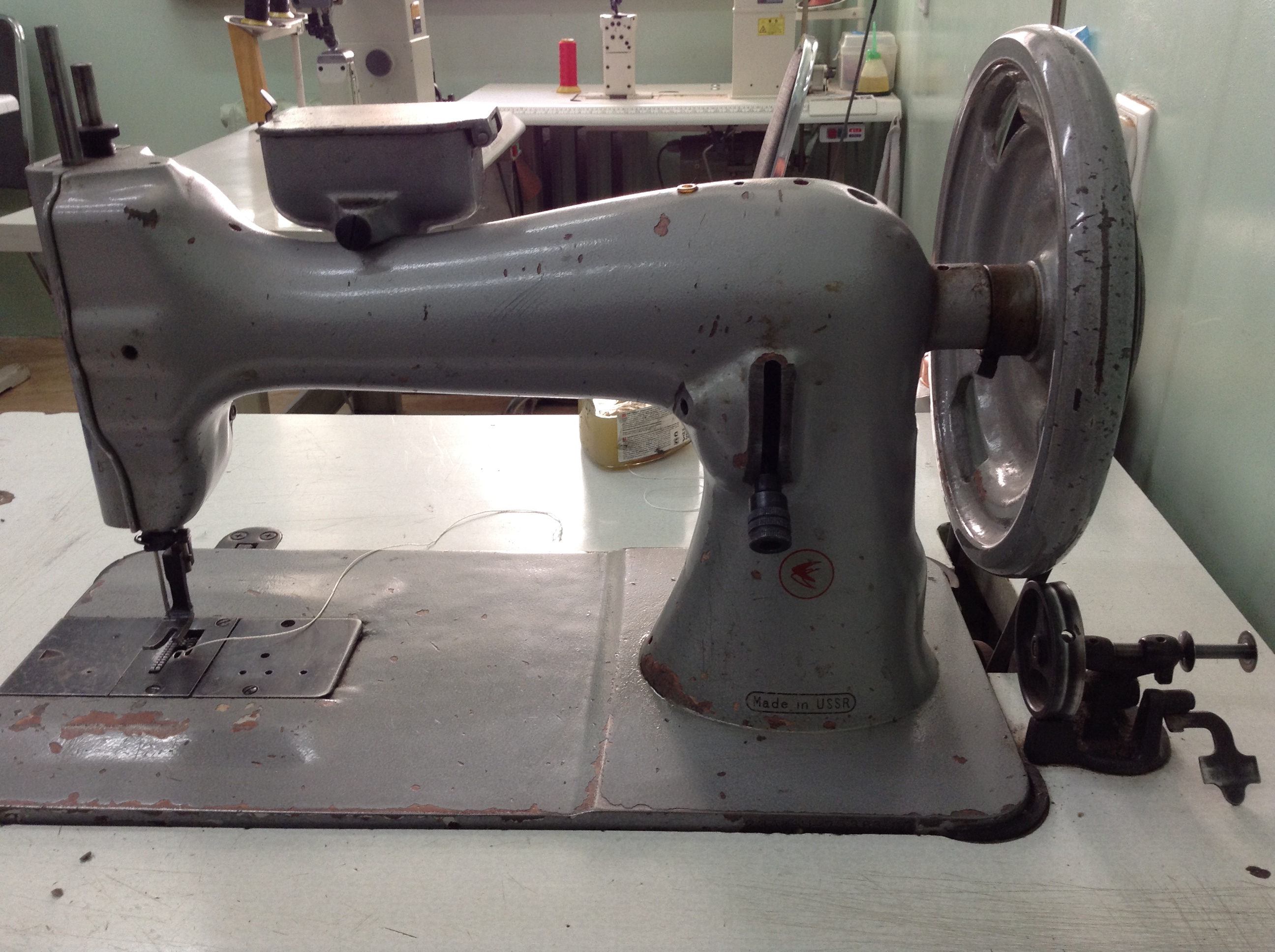
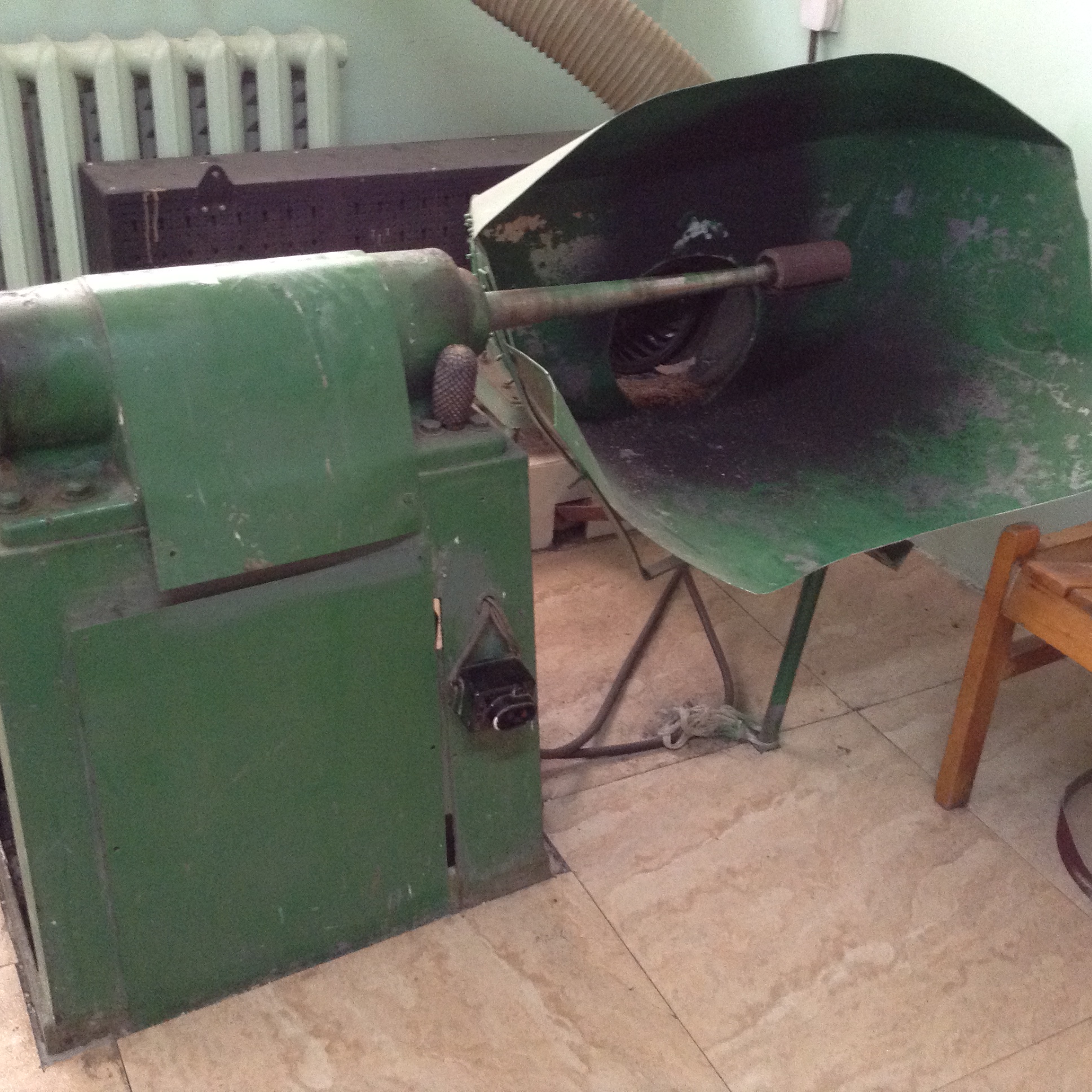
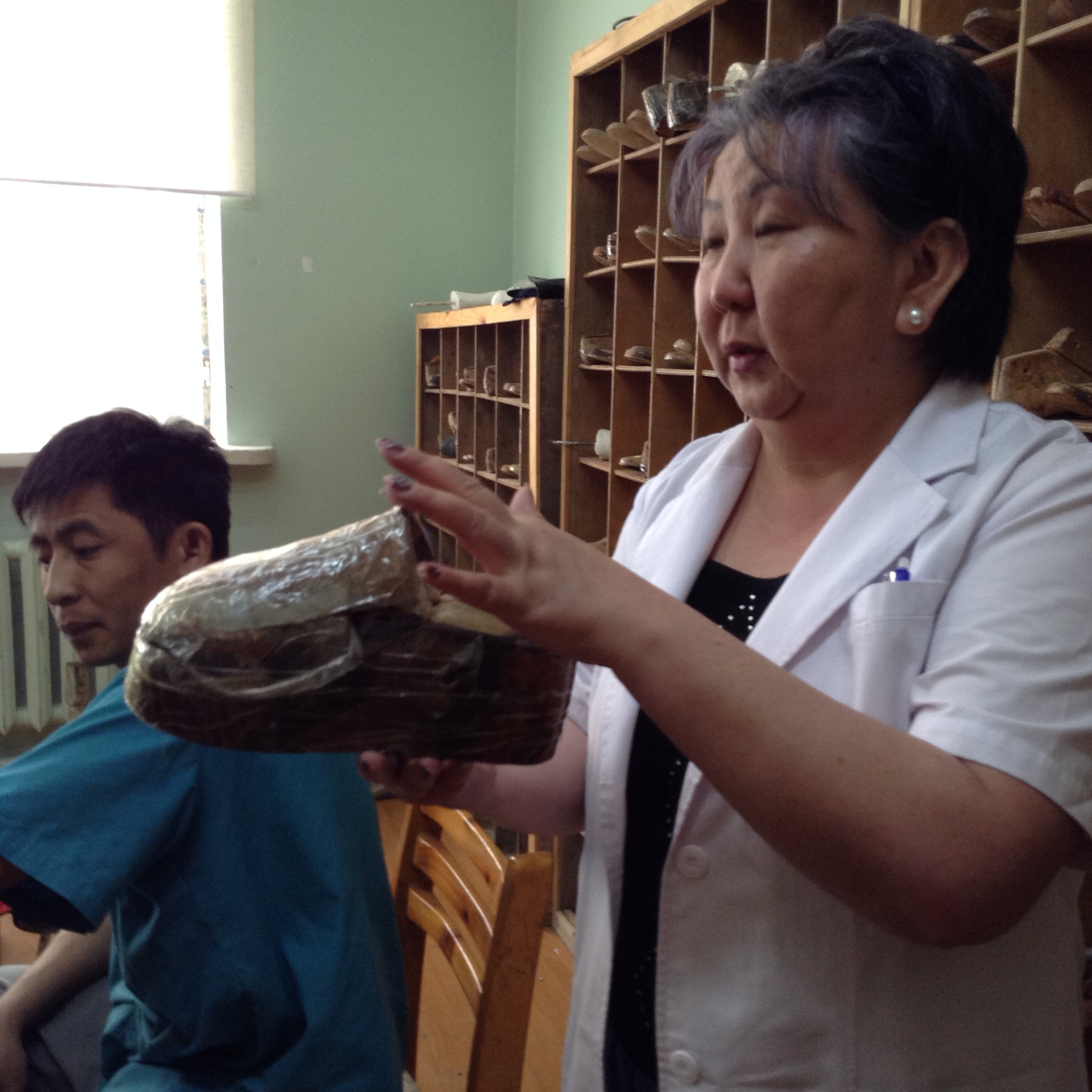
During the morning we received a complete tour of the National Rehabilitation and Development Center which included a 30 bed rehab hospital, full physical, occupational and speech therapy services, a vocational school for people with disabilities, training them in one year to become gainfully employed in a variety of occupations (tailoring, plant care, cooking, computer repair, software applications, and handicrafts). In the afternoon we continued the tour of the orthopedic devices workshops where enormous ‘made in the USSR’ machinery was bolted to the ground. They looked like (and probably were) relics from the industrial revolution.

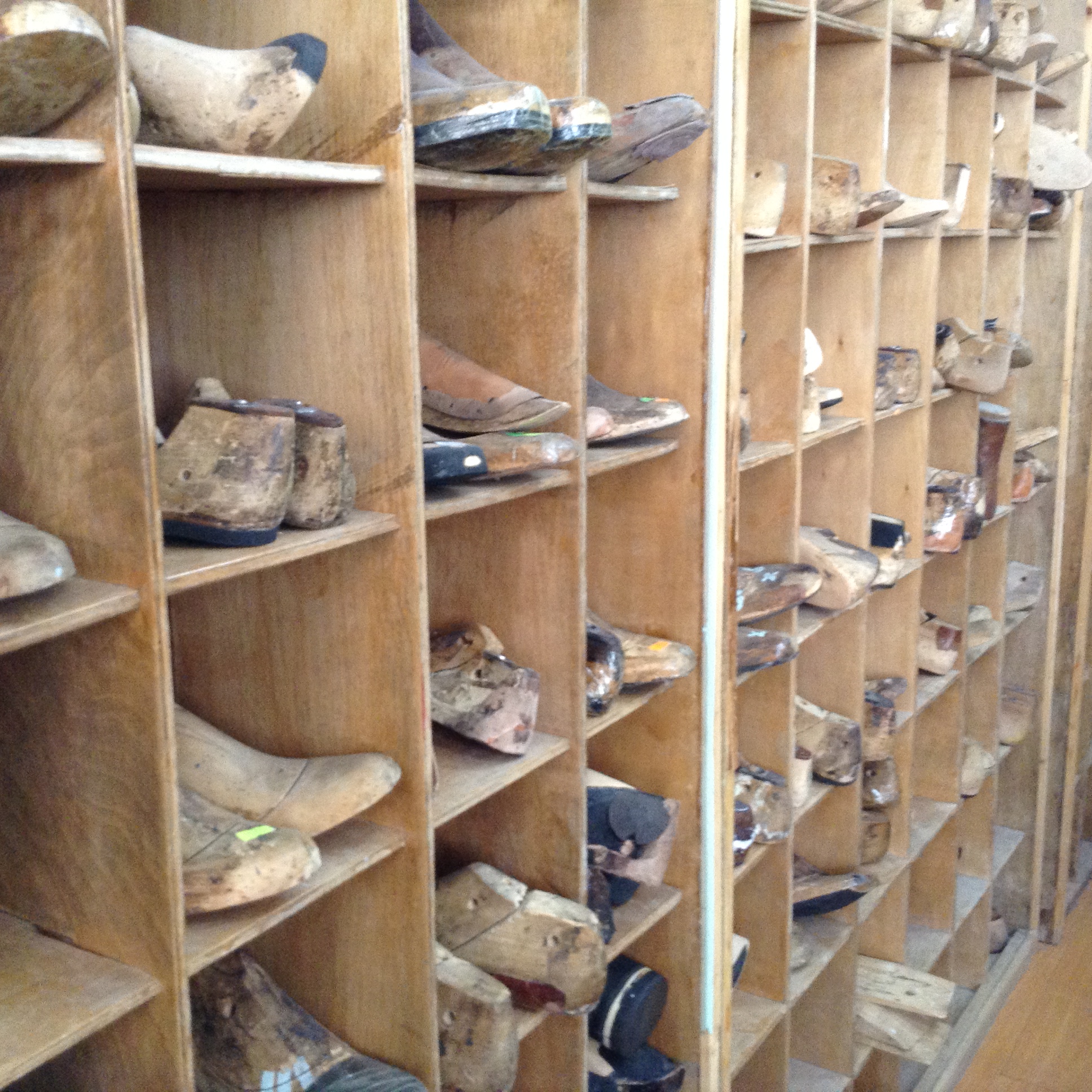
Mongolia has respectively looked to what used to be the USSR, then China, then UK, then USA, depending on the affinities (and university education) of the ruling elite for economic support and technical assistance. The rehab place was born during the USSR period, as was the part of the city where it is located. The lasts in the shoemakers’ workshop looked like antiquities; the hand tools of 50 years ago were still in use. Several of the large machines had broken down and local repair had been exhausted with critical parts no longer available. The mostly older staff had either been learning on the job with a few educated in the USSR. Most are about to retire and recognized that there are no young apprentices ready to take over. The place looked like a good use a few injections of modern technologies, training and young blood.

In the middle of the day Maggie and I were taken to the Channel 1 TV studio for a live broadcast on the ‘Right Now’ actualities program. We sat around a large table in a glass enclosed room in the center of the studio, with microphones clipped to our lapels. The doctor from the rehab hospital was with us and was, to our relief, the focus of the conversation as he had some messages to pass along to the audience. All this was done of course in Mongolian so we had no idea what he said, until suddenly we were questioned about international standards and the translator told us it was our turn. It was all over and done in no time, while I was still wondering whether we were on or just rehearsing the conversation.

It has been a challenge to operate in an environment where we are clueless about what people are saying. We also can’t read the Cyrillic script although my five years of ancient Greek helps a bit for the few letters the two languages have in common. There are only a few people who speak English so we are keeping a translator within arm’s reach.

In the land of Khan

I met up with my colleague Maggie who flew in from Dulles. Last time we flew together to Manila I was in a wheelchair – this time I was on foot like most other travelers and back to normalcy. We joined hundreds of other travelers to Ulaanbaatar (I can now spell the name correctly) in a plane that was bigger than the one who took me from the US to Korea. I can’t help but wonder what everyone is going to do in Mongolia. There were only a handful of people who looked like they came from Europe or the US, no Africans, the rest all from the region, at least originally. I can’t quite figure out what Mongolians look like but will do so today I presume.

The neon signs one sees when entering a city at night are Cyrillic, at least appear so to the untrained eye. Our taxi driver couldn’t tell me more as his English was limited to Hello. So I googled it and found this fascinating story at wikipedia. http://en.wikipedia.org/wiki/Mongolian_script
In the entrance to the hotel the pillars and walls were decorated with traditional script that looked more like vertical Arabic and Kufic. From this you can tell that there has been a lot of galloping in all directions to and from Mongolia.

The large neon sign at the airport welcomes one to the Ghinggis Khaan [sic] International Airport, in script I can read. We name our airports to recent statesmen in the US (Kennedy, Logan, Dulles, Reagan) but here the only true hero seems to be Mr. Khan. As I waited in the lobby for our check in I leaved a tourist brochure to see if we could see anything of this country other than the capital city. There are day tours to Mr. Khan’s legacy tomb, national parks and cultural events showing nomad life. All at considerable costs.

Entrance into the country was easy as pie – no visa required, fast moving lines, free wireless and clean toilets. The women’s bathroom included a tiny pedestal sink decorated with cartoon characters to allow children as small as Faro to wash their hands without being hoisted up by their moms. I have never seen anything like this anywhere in my travels, a public health message aimed at Mongolia’s youngest citizens?

My view from the room reminds me of Russian I last visited 40 years ago when it was still the USSR: large square buildings and empty wide avenues. But right across the street, in a rundown backyard of a medium rise apartment building is a yurt – I am really in Mongolia. The city lies in a shallow bowl surrounded by green hills devoid of trees, probably all hacked up for heating in the winter I suppose, and not replanted. I imagine it can get very cold here, we are very far north.


June 2014
M T W T F S S
 1
2345678
9101112131415
16171819202122
23242526272829
30  

Categories

Blog Stats

  • 136,982 hits

Enter your email address to follow this blog and receive notifications of new posts by email.

Join 76 other subscribers