Archive for October, 2014

Fifty years

Our meeting with Yale colleagues to prepare a series of leadership workshops with French ICRC country teams next year ended earlier than we predicted. We had time to amble over to the 6 or 7 food carts that line up outside Yale’s skating rink and compete for lunch customers: Thai, Ethiopian, Bengali, Indian, Mexican and more. I bought two Bengali Burritos (naan rolled up around Bengali fillings). When I thanked the men with one of the few Bengali words I know (donabad=thank you) they looked puzzled. I suppose Bengali burritos could also be made by creative Central American cooks, which would have required a gracias.

The train back to Boston was so full that I didn’t find a window seat – this is where the plugs are. My devices ran on empty so I closed my eyes and surrendered to the swerving of the train. I had brought my embroidery but fine work like that is not possible with that kind of movement Trains are better for knitting. I am waiting for an assignment from Tessa.

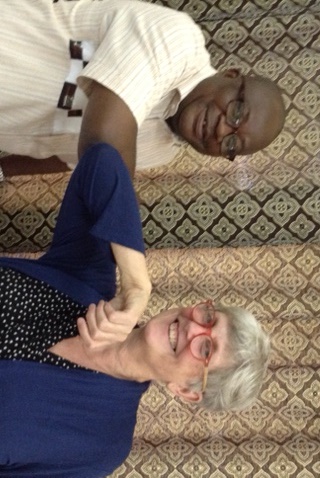
Axel picked me up and we headed straight north to his 50th class reunion at Hebron Academy in Maine, near to nowhere. Not much had changed – it is still nowhere – but there are now girls and kids from 18 countries, many from Asia.

It was fun to finally meet this bunch of people Axel had talked so much about, some of the wives and listen to the eventful and uneventful life stories, all the stuff that happens in 50 years.

We arrived when the Friday night dinner was already in full swing. It was a joyful reunion. We discovered that the parents of Axel’s roommate Hank – having lived underground for the last two years of the war, had emigrated from Holland a few years later. I was astonished that he could still converse in Dutch. We talked about our favorite Dutch food. Axel never knew this about his past.

On Saturday there was breakfast, with students and parents and alumns in the enormous dinning hall. Teenage boys were stocking up on protein for their games: 6 or 7 hard-boiled eggs in addition to scrambled eggs, sausages, bacon and milk, was a common sight.

We headed off to the chapel for convocation – where we ran over time due to long and lengthy speeches by coaches and others to honor exceptional alumns.

With breakfast barely digested the 50 year alumns and their wives were invited to the Headmaster’s house for another fabulous meal and more reconnecting.  The afternoon was not programmed with time to keep on talking, watching a variety of games (field hockey, football and soccer) or taking naps which we did.

Then there was one last meal, now without students and parents who had left campus for a few days of freedom. But no meal here goes without speeches. We had all reached our fill with the speeches, a result of too many purposes wrought together: awards, inductions and honoring of long term faculty. We didn’t know any of these people. Yet somehow the assumption must have been that stories about people one doesn’t know are interesting to everyone. That may be true up to a point.

The combination of too many of such stories and speechifyers who didn’t notice that whole tables were leaving, activated memories of having to listen to long winded speeches 50 years ago.  Back then a reaction was risky but now it produced a schoolboy kind of silliness in these men in their late sixties that was endearing. Being the oldest now, they could get away with it. We gathered outside on the porch of the dining hall outside, while the speakers droned on. The men formed a tight circle as if a team of players, hugged each other, promised to stay in touch and then said their farewells. It was a bittersweet thing to watch – they may never come together like this again.
Fall fun

The doctor stopped calling about my temperature. I must have convinced him that I was in the clear. But I am not telling people anymore. This is of course the unintended side effects of the panic.

My brother and his wife came for a brief visit, in between visits to both our daughters where they got to see how they live in beautiful New England places. And our beautiful place of course. They mostly lucked out about the weather and got to see a fall festival in Rockport with cooks (female Italian and male French)competing on how to turn mystery seafood (only disclosed when they were at their stations) into a prize winning meal.

Of course we ate lobster and other seafood and then sent them off on a romantic weekend on deserted Cape Cod. When the big storm came they retreated to Boston and skyped me from a noisy Irish Pub to say they had a great time. They are off today, flying back to Holland.

Yesterday I took the train to New Haven for two workdays with Yale’s School of Public Health which is a partner on one of our global projects.

I took the train to avoid rush hour and long rides in the car from Boston to New Haven and back. It was both pleasant and scenic, along the Rhode Island and Connecticut coast. The train delivered me in rainy New Haven where an Egyptian taxi driver helped me practice the remnants of my Arabic while driving me to my AirBNB, an old Victorian house on a tree-lined street not far from the university. He had come 15 years ago in pursuit of the American dream. Had he found it, I wondered. “I now have what Americans have.” But it did not include a wife and children, nor his own taxi. He had gone from shipping containers in Egypt to driven a taxi in New Haven. I wondered what he had given up for this but the ride was over and I will never know,

My hostess was not home and she had instructed me to let myself in through the backdoor. It is a weird experience to sneak into the house of a total stranger like that. As it turned out I surprised the boyfriend who was fixing the media center; just like in the olden days when boyfriends fixed the stereo.

Panicked

Axel had a routine procedure done at a small surgical center in Peabody. Since he was given general anesthesia he wasn’t allowed to drive himself home. I took the morning off and became his ‘ride.’

Axel likes to chat with people and casually mentioned his wife had just returned from West Africa. All the alarm bells went off. People in the US are more panicked than in Cote d’Ivoire.

When I came to pick up the patient I was called into the nurse’s office. She told me she had to follow procedures. Could I confirm that I had been in Sierra Leone? I don’t know how they got that idea and so I disconfirmed that and told her I had been to the Ivory Coast. She wrote it down, and then asked , “in which country were you on the Ivory Coast?” Americans’ poor geographic knowledge is partially responsible I think for the panic here. People think Africa is one country and so anyone who has been to the western part of that country, with its ivory coast, must be a serious threat.

I explained to her that I was very far from the Liberian border and that I had not been in contact with sick or dead people or animals, had not eaten bush meat or bats and had washed my hands multiple times per day, greeting people with elbow salutations. I also mentioned I had been back for a week and had no symptoms. Still, we had to go through all the procedural hoops.

But it didn’t end there. The Director of the facility was alerted and he alerted the MA Department of Public Health which told him to contact me daily for temperature updates. So he called last night. It was an awkward call and he kept saying how much he appreciated what I and my colleagues were doing for public health in the world, but could I also please tell him my temperature.

I told Axel to stop mentioning my visit to West Africa or I have to start putting my daily temperature on my blog and facebook.

But I can see the dilemma – if I were really sick there are powerful incentives to hide it. After all, even if it is shortsighted, who would want to see his or her life disrupted, put into quarantine, friends and family lifted from their beds as well and all the bushes and flowers around one’s house killed with bleach and bedding carted off to be burned, when it turns out it was only a case of the flu? I can see why people may not want to step forward.

Hotlines

Last night I attended the 40th anniversary of the (volunteer staffed) Counseling & Referral hotline of the Planned Parenthood League of Massachusetts (PPLM). Some 30 years ago I was one of those volunteers and took calls from distraught teenagers or married women who didn’t know what to do about an unintended pregnancy. For the teenagers, if they were over 3 months pregnant, they needed to go to court to get consent when two parents were not able/willing or asked to give this. Imagine that, 2 parents, while many of the callers had no dad at home! That was the law. We had an elaborate network of lawyers who prepared those girls to go to court, stand before the judge and get the consent so they could have an abortion. Our current Democratic candidate for governor of Massachusetts was one of those. It was a labor of love.

We also got calls from young men and women asking whether you could get pregnant the first time, doing it standing up, etc. We defused all sorts of myths and counseled people on what to do or referred them to others. We also would put them on hold and check with our fellow counselors when we didn’t know what to tell them.

Now almost 30 years later, the hotline still gets some 20.000 calls a year, despite the wide availability of the internet to answer questions (although not always correctly). Clearly, the need for sexual, family planning and reproductive health education is there. Some of these might be children of those we counseled way back.

The competition, the so-called Pro-Lifers have now established their own hotline pulling people into an orbit that is full of misleading information.

The celebration and reception given to old and current volunteers was inspiring with wonderfully touching and funny stories about our work. I must admit I had forgotten much about it other than the camaraderie and the excellent training we were given.

This morning I looked for my diaries for that time to see if I had written anything about that experience and discovered a big gap for that period. I did not write anything between 1985 and 1987 – for reasons I will never know.

But that got me reading my lines before that period when Sita was about the same age as Faro is now. What I found is an account of how I came to be what I am now – something I had forgotten. I decided to start typing my entries that started in 1976. It will be an interesting journey.

The other ill

I returned home without a fever, re-assuring my entourage that I had not brought Ebola to Massachusetts. Nevertheless not everyone wanted to hug me or shake my hands so I continued to elbow a bit here and there.

Back in the office I learned that some of my colleagues are in Liberia and doing good work to make sure that sick people who don’t have Ebola, or pregnant women can use the health facilities. I can imagine no one wants to go to a clinic or hospital when these have become depositories of dying Ebola patients. In the panic around Ebola we tend to forget that more people need help for other ailments and more are dying now, probably, of these illnesses because they can’t access that care. I was wondering whether I would have agreed to go there and I am not sure. I am proud of my brave colleagues.

Women power

I don’t think I have ever heard a group of about 40 African men speak freely about their feelings in the company of their bosses and peers. But something got sparked over the last few days and the district teams were truly on fire last night after, they talked about saying ‘thank you’ more often (this is rather counter-cultural), reflecting on their own contributions to tensions and conflicts, turning complaints into requests and coaching their teams.

We completed the program with a lot of ‘feel good’ speeches but also exhortations to now stay the course. I am glad that I went, in spite of warnings from around me to stay in bed and recover fully. I am recovered fully now.

With Malalai getting the Nobel Peace Prize, the observations and contributions from the handful of women in our program and a recent blogpost on MSH’s website  (about a brave Nigerian woman who may have singlehandedly stopped the spread of Ebola in Nigeria, I am once again reminded what singularly important role women play in society and how men, who don’t let them develop or use their talents, are shooting themselves and the rest of us in the foot.

Show time

The entire morning, and part of the afternoon, the teams had a chance to shine in front of the DG. First each was given time to explain a poster they had put together and worked on all day yesterday: their challenge model, their action plan, a graph showing how they had progressed towards or beyond the target they had set back in May.

After the morning break each team was asked to tell us about some of the practices (or lack of practices) before they started this program, and then what they are doing different now. Although each filled in an elaborate chart covering many pages, they were asked to give the highlights, the most important new behaviors they have adopted, and, which presumably, made them successful in reaching or overshooting their targets.

The new behaviors concerned leadership practices (mobilizing others, focusing, understanding root causes, working effectively in teams, inspiring, aligning stakeholders not thought of before); management practices (monitoring not just once a year but monthly, looking at and using data for planning purposes, planning around challenges rather than doing the yearly cut-and-paste ritual) and good governance practices (being more inclusive, empowering women, using resources judiciously, and setting direction through a shared vision and a focus on goals, etc.).

After lunch we were treated to 11 stories about direct or indirect effects of this program on others. The facilitator team is keen on documentation, something that we don’t always pay enough attention to. Interestingly, several of the stories where not about our program but about people who work under or with our participants. They learned from our participants, second hand, and then, when given permission, used the new tools and understandings to make changes they had wanted to make all along. I think I am going to re-define leading as removing constraints that keep people from using their talents and do what they had wanted to do all along to make a difference in the lives of others.

Mystery

Sometimes I don’t understand how things work here. We were invited to a restaurant (‘The Albatros’) by the local delegation in honor of the Director-General of the Ministry of Health who came all the way from Abidjan to hear the teams’ progress so far. His presence is very motivating to the participating teams because they have little contact with people that high up.

One of our facilitators, who is also a director of one of the health districts, showed up at the restaurant, when we were all seated, with lots baskets, pots and pans. They were unwrapped and unpacked on a table and revealed a copious meal with many different dishes and side dishes. How she managed to be with us all day and cook for some 25 people is a mystery – and not just a simple meal: we had rabbit, chicken cooked in various ways, sauces, tomato and onion salads and more.

What is also a mystery is why a restaurant would agree to host a party with all the cooking brought in from outside. Maybe they made all their money on the wine.

We were eating under the watchful eyes of Arnold Schwarzenegger or someone of his ilk on a giant plasma screen. He was doing dangerous things with cars, women and casinos. I have a hard time in restaurants with TV screens and try to seat myself so I can’t see them. But I was seated next to the D-G, in full view of the action movie. No one paid any attention to the flashing and exploding going on on the screen, interspersed with women who were in various states of undress. I had to muster all the discipline I have and keep my gaze focused on other things.

Once people started eating all conversation stopped and everyone concentrated on the food, which was accompanied by water and wine, countless bottles of each. The food was very spicy. I was glad I no longer had a sore throat or coughing fits.

When our plates were empty the Regional Director who is hosting us and the DG said their words of thanks and we were on our way home, back to our hard beds and my thimble of NyQuill.

Lighting a match

We met all day on Tuesday to review where we are in the longer process of leadership development and prepare for the days to come. All of the facilitators were there, the same team I started with now five months ago, minus one, the most senior member of the team who is now advising the president which puts him, hierarchically, in the stratosphere and outside our reach.

The review of what happened since May was inspiring to say the least. The team has made this program their own, always being a few pages ahead of the participants. If they hardly knew what coaching was five months ago, they have been doing it since we had our first long coaching training over skype, me in Ulaanbataar, they in Abidjan, and taken to it with abandon.

Today was an extra day, inserted very wisely by the facilitation team as they realized that the district teams never have the time to reflect on their management and leadership practices, produce the required documentation to show links between leadership and management development and public health results, share their accomplishments and record their progress towards the targets they set back in May. So it was a quiet day for me and Alison. With our internet flash drive keys we were able to catch up on our email and other tasks, without losing any of the exciting stories.

After lunch, we watched the film Inside Story about a Kenyan soccer player, his vision, and the many obstacles on his way, not the least a few unprotected sexual encounters that got him HIV and which he passed on. It’s essentially a film about HIV, made in South Africa, with support from MSH. It illustrated beautifully what we are trying to do here. Of course a film about soccer would always be a hit, anywhere in Africa, but the HIV angle made it also a film about the teams’ work.

After the film the district teams shared with us some of the surprising side effects that this program has produced: increased prenatal visits and deliveries by skilled personnel, brought about not by the participants in our program but by people they told about the training and shared their learning with. All these surprising stories involved midwives and nurses who ran with the tools given to them, mobilized communities and other resources to move to newly minted visions and new freedoms given to them by their superieurs to do what they had wanted to do all along but never felt empowered to do. Something is rubbing off.  I just lit the match back in May.

Elbow greetings

We met at the MSH office yesterday, meeting new and old colleagues. We reviewed our program and then were on our way in northeastern direction to about 30 kilometers from the Ghanaian border. The trip took us nearly 5 hours over increasingly poor roads; at the very end the asphalt was in such poor shape that we drove mostly on the sides, skirting the biggest holes.

It is rainy season and the rain comes on suddenly and hard but doesn’t last long. We were driving a fairly new SUV and were comfortable inside. I managed to do a lot of knitting so that Faro’s cotton hoodie is hopeful done in time before the weather requires wool sweaters.

We met up with the rest of the team at our Abengourou hotel where we will hold the workshop. We are no longer greeting each other with the usual ‘bisous’ (kisses) three or four times, alternating cheeks. Now the greeting is a touching of elbows, where all skin is covered. Short-sleeved people need to put on something to cover the naked skin, something not quite respected by all; it is after all short sleeve weather here. At the entrances to hotles and offices you will now find large pails with soap and water. The simple act of hand washing may finally take root as a regular habit, something that has eluded health professionals for decades and is responsible, partially, for the rapid progression of Ebola across the region.salut-coude

Some miscommunication about dinner landed us in a ‘maquis’ the kind of small local restaurant you find all over this part of West Africa, where you eat outdoors and there is no elaborate menu, just local dishes. Our Ivorian colleagues insisted on us eating fried yams (ignames) as it is the season. This was, surprisingly, not on the menu and required that someone go out and get the yams. As a result we had to wait more than an hour for our meals to arrive – but it was worth the wait.

The mattresses in our hotel are hard like a plank, and so is the pillow – you cannot fold it. I can do my early morning yoga and exercises right on the mattress without making a dent. I was considering this morning to send someone to the market to get me a piece of softer foam but then again, I slept very well for 9 hours thanks to my nightly thimble of NyQuill.


October 2014
M T W T F S S
 12345
6789101112
13141516171819
20212223242526
2728293031  

Categories

Blog Stats

  • 136,980 hits

Enter your email address to follow this blog and receive notifications of new posts by email.

Join 76 other subscribers