Archive for September, 2015

Blissfully home

2015-09-27 19.36.57 2015-09-27 13.24.15 2015-09-27 18.18.56September is one of my favorite months. I arrived back in Boston under blue skies and a perfect temperature. When we arrived home I put on my bathing suit and went for a swim. After that we sat on the beach, Axel was experimenting with water color mixing and I finished the final row of the second sleeve of my Aran cardigan that I started  in Maine. Long airplane rides are perfect for knitting, especially when accompanied by a great book. The latter was Atul Gawande’s ‘Being Mortal.’ I finished both the book and the sweater. Now comes the blocking and assembly. I hope that I have just enough yarn to finish the neck.

I had a quick Skype call with a team in Brasilia that is starting a event that is similar to the one I just finished in Kinshasa. I passed on the lessons I had learned and wished them well. I returned to the beach which had gotten a lot bigger with the tide was going out. Since tonight is one of the highest high tides of the entire year (12.2 feet), we also witnessed one of the lowest low tides. The cove was nearly completely empty. We checked the mussel population (still disappointing) and scooped up several dozen large oysters. They have settled in well. Five years ago we marveled over the occasional tiny oyster and now there are hundreds of them, including some very large ones.

We had a dinner made entirely from things we caught or grew: a leek, squash and eggplant stir fry, home fries from our giant potatoes and oysters. Only the wine was imported. It was a blissful end of a trip and a blissful beginning of my next intermezzo at Lobster Cove before I head out again on dates unknown. Facetime with the kids and grandkids put the finishing touches on a wonderful homecoming.

I missed the lunar eclipse. After a trip that took about 30 hours door to door, eight o’clock was a sensible bed time for me.

Just trying

We stayed in a comfortable hotel, with good beds, a pretty good kitchen and a shower that worked exactly as intended. My ride from the airport, to our training center each day and then to the airport again was easy and rather painless, considering Kinshasa’s traffic reputation.  Things worked as good, or better than in most other African cities I have visited recently.  I was spared all these experiences fellow travelers to the DRC complain about. I guess I was lucky. But on my way to the airport I got a glimpse of that other Kinshasa.

Just before we were supposed to leave with two physical therapists who were heading home to Lubumbashi, my colleague M who hands out per diem was called out of her room to sort out a problem with paying the bill. Then I got to see the effects of our per diem policies: we give people several hundred dollars to cover their expenses: meals, laundry, drinks and incidentals. It was probably a month salary if not more, and all that given in hard currency. Everyone went on a shopping spree. Then, when the hotel presented one of them with her bill of nearly 200 dollars there was panic. She didn’t have that money and was looking expectantly at my colleague M. to sort it out. I told M to remover herself from the scene as it was not her problem. Besides, the Congolese are very good at ‘se debrouiller’ a wonderful French term that basically means ‘figure it out.’ It took a good 45 minutes for things to be sorted out, eventually with the help of a friend who had come to the rescue. Even then, already past departure time, there was a disputed laundry charge. I vowed never to share an airport ride with local folks who haven’t paid their bill. And then, when we were ready to leave the other fellow traveler had wandered off. It was good we had calculated a large safety margin to get to the airport.

On the road we were stopped by two policemen in orange vests and the words ‘Police’ written on their caps and uniform. One walked over to the driver’s side and demanded that our driver open the window. The policeman indicated with his hands that he wanted to see the driver’s papers. I am glad I was not driving as I would have rolled down the window – I learned early in life to obey people in uniform, or else dire consequences await me. But our driver completely ignored the policeman, staring straight ahead as if he wasn’t there. Then the policeman started knocking on the window but our driver kept looking straight ahead, waiting for the lights to change; and when they did, he pulled away. To my surprise there was no angry reaction from the policemen. They probably stopped another car and tried again. I suppose this is how they supplement their no doubt meager police salary. Just trying, I suppose.

Traffic on the busy congested road is like a modern ballet of cars. There are no lanes, although the occasional mid-road barrier does create some left/right traffic order. But 180 degree turns across the length of the road are common and all the sides of busses and camions are scratched and dented. Our driver expertly wove in and out, making swift turns to occupy any small opening and crawl forward.

The last few miles to the airport is different: a six-lane highway with very little traffic; beautiful empty sidewalks, sun-powered lights and no sign of the petit commerce, the little stalls, shops, moto-taxis and pushcarts that fill the sides of the earlier section of the airport road – I assume it is banned in this modern part of the city. I could have been in the US. I suppose it is possible to modernize roads but it looks weird; soulless and cold, uninviting, un-Congolese. The airport is also brand new; yet the architects forgot about electrical outlets and Wi-Fi. One wonders how this is possible in a country that runs on cell-phones?

There are taxes to be paid at the airport. I know the drill: 50 dollars for this and 5 dollars for that. But the clerk asked for another 20 dollars. He used some complicated reasoning when I asked him how that figured into the 55 dollars I had already paid. The taxes are in Congolese francs, he said, and because of the exchange rate I had to pay more. Yet the receipt was in dollars. Luckily I knew the exchange rate, 900 francs to the dollar; for an extra 500 Congolese francs (= a little more than 50 US cents) he wanted 20 dollars. He told me he was patient and could wait for me to fork over what had, in the meantime, become 10 dollars. It was his bad luck that I was also patient and could wait as my flight wasn’t leaving for another 3 hours. When I mentioned to him that we were really talking about half a dollar he accepted my single dollar bill, stamped my receipts and I was cleared. It was a win-win of sorts: I paid and had my receipts for the 55 dollar taxes and kept 19 of my 20 dollars, he pocketed 50 US cents, and we both stayed within the laws of the land. Not as much as he had hoped, but still – these ‘tips’ can add up I imagine, with hundreds of foreigners coming through in a day. Just trying may be worth the risk of getting caught, if such a risk exists.

The airline employee who checked in a passenger next to me also accepted a handshake containing some bills– for what, I wondered? An upgrade? After the transaction she checked the bills and, showing no sign of surprise or disappointment, slipped them into her uniform pocket. I wondered what the take was after checking in several hundred passengers each day, and whether business class would be full.

By the time I arrived in Kinshasa the technical training was done and the capacity and coalition building began: for one day representatives from relevant government agencies, organizations of disabled people, local NGOs and representations from international NGOs and donor agencies came together to learn about the importance of appropriate wheelchairs and start thinking about how to get policies and supporters in place to advance the (signed and ratified but not implemented)  UN Convention on the Rights of People with Disabilities here in the DRC.

The last two days of my short visit were dedicated to imparting the principles and practices of managing a rehab center where wheelchair services are either already provided or will soon be provided. The purpose was to make sure that these centers would run according to the international standards for such a service as developed by WHO. We co-trained with Congolese colleagues who are also in the senior leadership program that we work on with Yale University in parallel. They were fabulous and much better than us, foreigners for obvious reasons – they know the context, they have years of experience running a rehab center, they are trained in proper wheelchair fitting and they are passionate about advancing the agenda of wheelchair provision in the DRC. I told them they could run this program on their own, without outsiders, and I meant it.  Not only did they know their stuff, they also managed the sessions within the prescribed time; the participants were also very disciplined, a good start for a management training. Each day we started and ended exactly as planned. This doesn’t happen very often in my experience; and here we were in the DRC!

Changed lives

I joined my colleagues around dinner time, straight in from the airport of Kinshasa. I arrived just in time to say hi and bye to two physical therapists from Zimbabwe and Kenya who had accompanied the advanced training in wheelchair fitting. They were leaving, tired and content. I would have been too if I had so directly changed the lives of several families with severely disabled children and some adults as well by providing them with a chair with all the supports to let that would allow them to participate a little more in ordinary life.  One boy of about 9 with cerebral palsy spent most of his waking hours in a room; and because he couldn’t sit without support he would squirm on the floor and look at the ceiling. When his mother left the house she put him on his back, as if he was still a baby. I watched her with the boy on her back, his movements uncontrolled and jerky – but she remained still and straight. It was another one of those moments where I counted all my blessings.

I learned from my colleagues who did the training that the mother rarely took him out as she was fearful of the comments, gossip and disdain from her neighbors. He was lucky that he had been selected to be fitted with a chair – a win-win arrangement for all: the students got to practice their skills and the boy and his family would be able to experience a more normal life.

On the road again

A colleague of mine calls the AF salon in Paris her CDG office. I tend not to work here but rather relax and eat as there is much good food to be had.

I spent the day preparing for my trip while Axel was the official photographer at the Manchester Club’s annual golf tournament in Peabody and so we said our goodbyes in the morning.

Axel is not a golfer but there are two golf courses that make him wish he was one – this one in Peabody and another one in Jackson New Hampshire up the road from the valley golf course – he prefers the one higher up where we have skied in the past.

Axel being unavailable to drive me to the airport our friend Andrew jumped in, saving me, and the American taxpayer, a taxi or bus fare.

I tested a new chemical to knock me out during night flights and it worked beautifully; it is like Nyquill but without the medicine. As soon as we had departed it kicked in. I woke just before we landed. Managing sleep during this trip is important as I choose the last possible departure date – leaving no time to catch my breath before it is show time in Kinshasa. I have no regrets – this last summer weekend was perfect – I would not have missed it for anything in the world – I have missed too many perfect summer days this year.

Reunions

It is now Sunday morning; one wedding and one memorial service after my last post. The wedding took place on Friday at a beautiful estate west of Boston. There are several of these jewels hidden in the woods around Boston. They harken back to the good old days when wealth could buy you distance from the misery of poor city dwellers; wide vistas, big lawns cut by hired hands, verandas to catch the sun or shade from it any time of the day, light everywhere and rain spouts made from copper.

The weather was on our side – a lovely late summer afternoon amidst family and friends, good food, good drinks and a smiling couple. For me it was also a reunion of sorts as the bride and groom had met in Afghanistan as MSH employees. It was thus also a coming together of MSH’s Afghan hands, including its founder; some flying in from as far as France and Japan. Most are still with MSH except the bride and groom.

I was paying close attention to the many creative touches of the wedding organizers. Exactly one year from now Tessa and Steve will wed. Years ago when the date was picked we thought it was an eternity, but now we are getting close.

The next day we paid our respects to Axel’s cousin Anne who died this summer, succumbing to two vicious cancers.  Axel and Tessa had gone out to California to say their goodbyes.

Anne’s husband flew to Manchester with her ashes. We had a brief service at the graveside where her mom and dad are buried. Many from her high school class were there as many had remained in the neighborhood. Family from Cape Ann, New York and the South Shore also attended. And so we had another reunion, this time at our house, which lasted into the evening. We looked at pictures and reminisced, enjoying, for a second day in a row, a beautiful late summer afternoon, in the company of friends and family, with good food, good drink and a swim in Lobster Cove’s clear waters.

The third reunion was with the grand kids and their parents. They stayed the night. I couldn’t be happier. Saffi is now 2 months old and working hard on strengthening her neck muscle, much like I am working hard to strengthen my shoulder except she does it without weights and rubber bands. She has started to explore her surroundings with greater interest and smiles when Faro comes into view. It’s all one big treat. And now breakfast: pancakes in honor of Faro.

Season’s change

Faro played in the water with a basketball that had come floating in while Saffi slept in a sling close to her mom, oblivious of the fun to be had at the waterfront.  We climbed rocks, and played around the heavily corroded pipe that drains the Putman estate. Faro likes to climb on top of the 1 foot diameter pipe and sticks his head in. He listens to his words as they reverberate deep inside the pipe, throwing in all the names of his family on the other end of the beach: papa, mama, Saffi, opa and oma.

At lunch time the Easthampton family departed to visit one other set of grandparents before heading home. I took advantage of the cool breeze to clean up that part of the flower garden that was starting to seed itself – it is already a tumble of perennials – so control measures were needed. Removing the many dead stalks also allowed me to get to the hundreds of cherry tomatoes that are ripening on the vine.

Today was the first time that I was not able to swim across the cove or to the mouth of the cove as I have done so many times during the summer. The water was too cold; the kind of cold that hurts when you dive in and isn’t going away within a few strokes. I sputtered and gasped for a short distance and turned around.  I tried again after warming up a bit in the sun but it made no difference – maybe swimming season is over. Something has shifted – it’s fall, and the wind is coming from another direction.

A shot of energy

For three days four Fellows of the Japanese Women Leadership Initiative came to MSH to learn about us, about women and leadership, about how we teach management and leadership and how to do political advocacy, NGO financial management and fundraising. It’s a competitive process, to become a Fellow. The prize is worth fighting for: four weeks of learning in Boston; interspersed with sushi meals, dinners, receptions and outings. But it is hard work; one of the Fellows started her Japanese workday by email once we had reached the end of ours.

Last year we were invited into this one month program for a day and a half. Its success led to a request to double the time. I am the chief cook and bottle washer of this program: logistics, administration, delivery. I started working with the same faculty as last year but then this one left and that one got sick and that one sent a replacement, requiring all sorts of last minute corrections. But in the end everything fell in place. This always happen when you are passionate about something. It is an informal program. We sit around a square table and talk for three days in a row about topics we care about. I love doing this workshop which I hope becomes an annual event: it is exactly what I like doing and am good at, without having to get on a plane.

Like any other event, including those that take 24 hours to get to, through the skies, it also makes for long days as there is still travel and traffic: I arrive in the office at 6:15 AM (to avoid traffic and leave me some extra hours to prepare). Our Fellows arrive at 9AM. We stop at 5PM. I clean up, get in the car and hit traffic. 13 hours after I left the house in the morning I pull up at Lobster Cove. Some days I put on my bathing suit and walk straight into the ocean. It’s good that the program is only 3 days and that it is at this most beautiful time of the year when the water is still warm enough to swim in.

Back to work

I am back at work. Aside from trying to fill my dance card for the next few months (it is nearly filled), I am preparing for a three day workshop next week with four Japanese women selected to be a month in Boston to learn about American NGOs and to strengthen their leadership skills in order to bring about positive social change in Japan and get women to join the effort in droves.

The Japanese Women Leadership Initiative (JWLI) is a 9 year old program that was conceived by an amazing energetic Japanese woman and two American women, one who was my boss once, a long time ago. I have been so privileged to be the lead for this activity at MSH and I am enjoying it enormously. I get to design a program, bring in great people to teach with me, and be invited to sushi dinners at an office high up in the center of Boston with 360 views of the city and its surroundings; really, what more could one wish?

We start next week. I am the chief cook and bottle washer for this event and have been focused primarily on the logistics of pulling this off. Yesterday I had reserved time to focus on the content but other things intervened. I am teaching about leadership, management and good governance as well as political advocacy, the latter two areas where I still need some prep time before we start on Tuesday morning. At the same time I am preparing for my upcoming trip to Kinshasa and figuring out what my role is in a new reconfigured MSH. There are no dull moments and life remains full.

Knitting and books

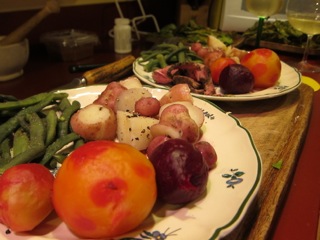
Our Labor Day weekend eased with the transition from summer’s carefree existence to work. The days were 10+ days with blue skies, daily swims in Lobster Cove’s crystal clear waters, cooking meals from the harvest from our garden (leeks, beets, onions, potatoes, tomatoes, bok choi,chard, peppers, fresh herbs), fresh eggs from Tessa’s chickens and offerings from our local farmstand. Life is very good.chives IMG_4584_2

I am knitting an aran cardigan. The long vacation days helped me to make good progress. Although for me knitting is usually a winter activity I discovered that I can do it just as well without a fire and a good movie. A good (audible) book, a foggy day or a warm evening are also good conditions for knitting. Even though my travel schedule kicks in shortly, I am sure the cardigan will be done by the first snowfall.

While knitting I have listened to some great books, All The Light We Cannot See, Behind the Beautiful Forevers, The Red Badge of Courage, A Marriage of Opposites, The Boys in the Boat. I so admire the authors of these books. My friend Edith is also an author, in the ‘cozy mystery’ genre. She cranks out book after book, on her 11th or 12th now I believe, after she decided that writing was her passion. I started one book for adults, a very long time ago in a moment of inspiration. It never got beyond chapter one. And then there is the children’s book Sita and I are dreaming about. It has been languishing for more than a decade, even though the story is done. But the illustrations, the most important part of a children’s book, are missing. Sita being a working mom of two kids tends to get in the way. We may need to wait until her kids don’t need her attention all the time.

Needs and wants

We realized early on that our ‘three generation’ days in the Camelot cabin are gone. We have to find something next year that we all fit in with more ease and where Faro doesn’t have to sleep in a tent on the porch. We explored, without much enthusiasm, some other options on the internet and by phone but came up short either on price, number of rooms or the presence of pets.

We made a list of the criteria for the ideal summer cottage and discovered that our house in Lobster Cove filled all the criteria except the one that it wasn’t a summer cottage. But we counted our blessings anyways. We left our vacation cottage to go to our year round home knowing it was actually better than a vacation cottage, on the water, with a yard, enough bedrooms, friendly to dogs, requires no travel and the rent is already paid. But it is home, there is internet and phone service and there are always chores to do.

In the mood for making more lists I listed the criteria for a great family, for a great husband and a good job. I am doing pretty well on those criteria right now; I have few needs and the ‘wants’ were put into perspective by this exercise.


September 2015
M T W T F S S
 123456
78910111213
14151617181920
21222324252627
282930  

Categories

Blog Stats

  • 136,980 hits

Enter your email address to follow this blog and receive notifications of new posts by email.

Join 76 other subscribers