Archive for June, 2016

Eater’s digest

My brief vacation in Holland was nearing its end. I drove back to the center of Holland to my professor brother and experienced typical Holland weather: sun, rain, hard rain, light rain, sun, endlessly repeating itself in short cycles. There is an app that many Dutch people have on their phones. It is called ‘’buienalarm’ which means ‘rain shower alert.’ It is a handy app when you live in the lowlands.

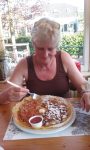
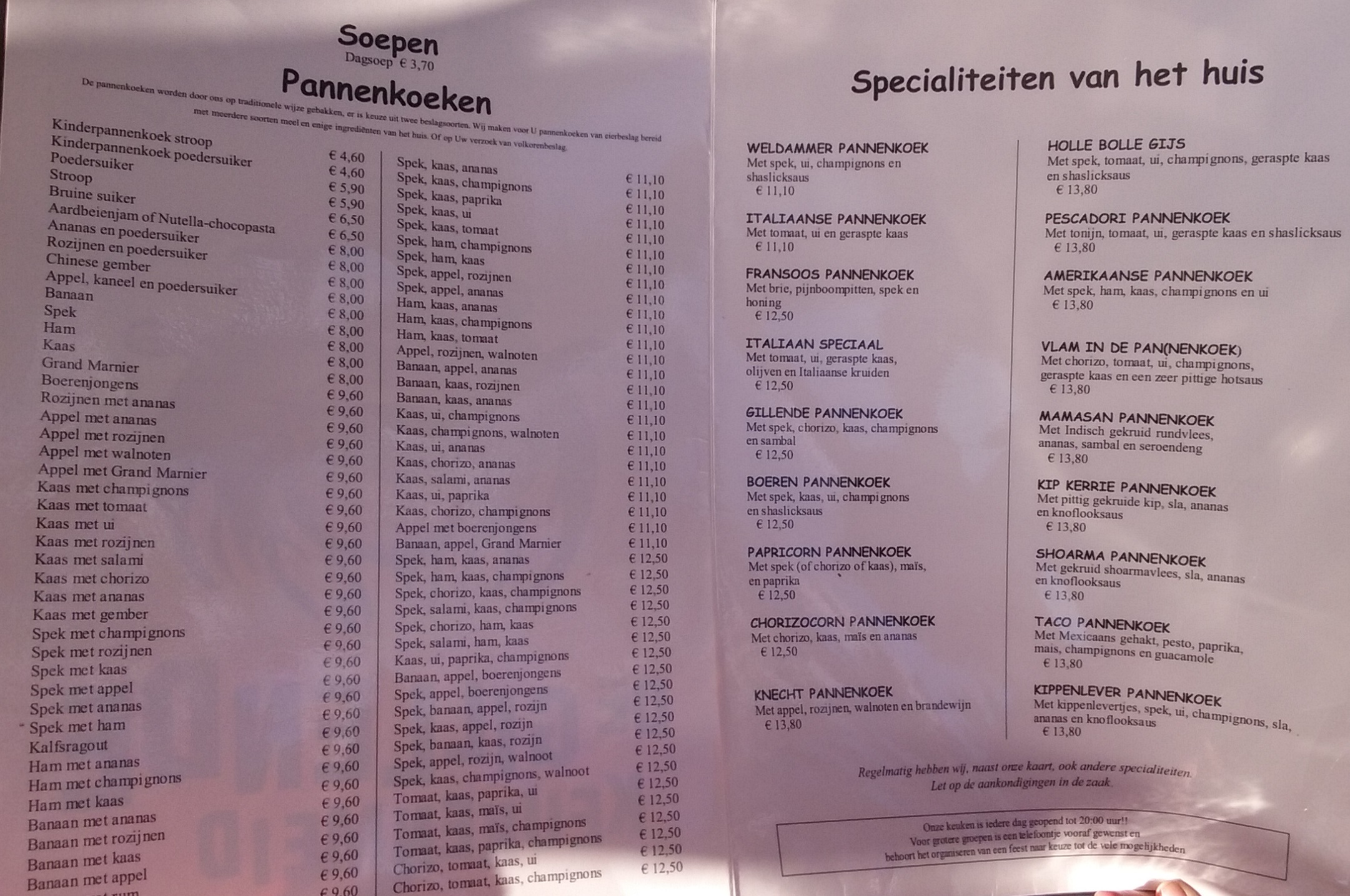
I managed to squeeze into my short Sunday afternoon: a visit (in the rain) to Amersfoort centre, eating a new haring by the tail, accompanied by a ‘zure bom’ (sour bomb, a large sweet pickle) and a large pancake at a traditional pancake restaurant. In Holland pancakes are eaten for dinner not breakfast, and come with just about any topping you can imagine. I had two halve pancakes (this for people who cannot make up their mind): one half was called ‘the shrieking pancake’ (chorizo, bacon, cheese, mushrooms and sambal oelek) and the other half was called the farmer’s hand and included apple, raisins, walnuts and brandy. The two halves made for a whole pancake that took me till next morning to digest.

I took my brother to Schiphol the next morning, both as good company during the crowded commute into western Holland where most of the jobs are, and as a guide through the unfamiliar network of highways. At Schiphol he took the train to his office in Amsterdam and I handed in my rental car and spent the next few hours waiting for the delayed flight back to Boston. I decided once more that an upgrade was worth the money and the miles and got seat 2A which made the return trip quite pleasant.


pannekoeken1

pannekoeken2

?

pannekoeken3

?

?

?


Nostalgia

On Sunday mornings most of not-church-going Holland is asleep. With a borrowed bike from a neighbor we biked into the quiet city of Emmen, hoping that the gate to the old abandoned zoo would be open, but it was not. Nothing was open. My friend called someone she works with as a volunteer and asked if she could come by for a visit. Unlike the rest of Emmen the couple was awake, and to my surprise, elderly. We had coffee and talked about religion, mostly or exactly because they have turned away from religion. And here I sat with a nice Muslim girl who volunteers through a Humanistic Society. In Holland everything is possible. I had a lovely time getting to know this active and activist couple in their 80s who had become friends of this young Afghan woman – they are part of a network that she had created around herself to help with a difficult transition. I was proud of my fellow Dutchmen and women.

We left to find the gates to the old zoo open. The new zoo is now a little outside the town, rechristened WildPark and based on the American model of a zoo with a whole lot else to do, hoping to attract crowds from all over Western Europe. This poor city, in economic decline, could use a few visitors with money to spend.

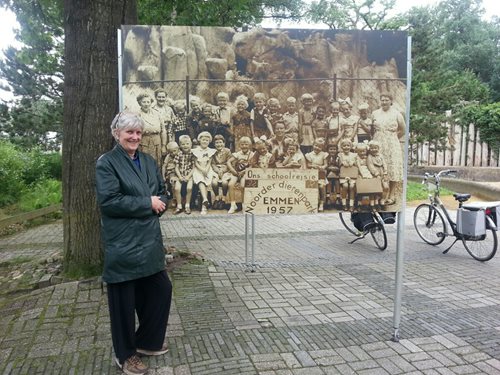
We peddled around the sad old zoo that was the destination of countless school trips in the 50s and 60s. I posed in front of a large photo of a class with their teachers made in 1957. It could have been my class. I have a picture just like that. Of course for us in the west the Northern Zoo was too far away – we went to Artis, Amsterdam’s city zoo, or maybe to Rotterdam’s zoo although that one was already too far away.

emmen-zoo

We biked along the meandering paths, past empty spaces that once housed monkeys, elephants, giraffes, bears, and other exotic beasts that are now, presumably, roaming more or less wild in the new park.

Dutch Siberia

Saturday morning I drove across Holland to a part of my country I barely know. Along the way I recognized towns from the old yellow and green maps that hung in our elementary school rooms, with red squares for cities and red circles for towns. There were no names on the map. We were supposed to know the names. And here they were, Hogeveen, Ommen, Emmen, Ter Apel.  The province of Drente was never a destination; a quick drive-through on my way to Groningen when I had a lover there, eons ago.

This time I would be visiting a young woman who I worked with in Afghanistan. A set of circumstances that are hard to fathom landed her in Emmen three years ago, after an arranged marriage with an Afghan man who had lived there for some time. In those three years she has learned to speak Dutch so well that we no longer converse in English, as we used to do in Kabul.

It is Ramadan, but her God in Holland is more tolerant than the one in Afghanistan. They are not fasting. She no longer wears a headcover and she rides a bike. She also works as a volunteer for a humanistic society. Her life in Holland is as opposite to her life in Kabul as one could imagine. She is happy with the freedoms but sad to be so far away from her family.

After an Italian lunch (go figure) we drove further north to a prison museum that has received much attention lately because of a book I happened to have picked up at Amsterdam airport sometime in May and had finished by the time I landed at Logan. The book describes a series of misguided attempts in the 19th century to reform poor and homeless people. Some of the author’s ancestors had been caught in that net. The “colony” was set up in what was then referred to as Dutch Siberia. That is where we were heading. I had to see this place.

The old colony houses are still there and later real prisons were added. We took a tour of the prison that only recently closed and the stories about prison entrance and daily life would be sufficient to deter anyone from committing a crime.

The area is no longer a Siberia though many houses were for sale – the economy is not good here. The old houses have slogans on their gables that harken back to the ideology that produced the colonies first and then the prisons, as the former were pretty much prisons – easy to get in but hard to get out. The slogans read ‘Rust roest’ (rest rusts), ‘Arbeid adelt’ (work makes you noble) reminding me of the Babson Bolders in Gloucester (Be clean, Be out of debt).

We drove back in the pouring rain, passing endless fields of soaked campers who had streamed to Assen by the thousands to watch the annual motor races.

Back in Emmen we had a ncie Afghan meal and caught up on not having seen each other for many years. We skyped with her sister in Kabul, another colleague in Amman and Axel in the US.

Inaugural

I arrived early in the morning in Amsterdam, got my rental car and drove to a hotel in Leiden where I claimed my nearly free night from booking our hotels in Southeast Asia through Hotels.com. Today was the Inaugural Address of my little brother as Full professor in Law at this oldest of all universities in Holland. All my siblings, their spouses and several of their kids had converged onto Leiden, not only to witness this amazing achievement but also to celebrate the 100th anniversary of our father’s birthday on the 23rd of June in 1916.

I found familiar faces sitting on a terrace across from the old Leiden University building, waiting for the ceremonies to start. It was a beautiful sunny day with Leiden at its best.

We filed into a special room in the old academy building from where we could see a closed on a TV screen the official welcome of my brother into the elite community of full professors. We all learned about what was on his CV, pages and pages, things I didn’t know about and we were all very proud. After that we proceeded to the old auditorium with its creaking floors, wooden benches and very high pulpit (much like a church) already filled with his current and past colleagues, professors, students and friends. It was all very formal and laden with tradition, with professors in full black robes filing in and sitting in the side pews. I should probably have known the title of the chief black robe but can’t remember. He is the one who holds an enormous silver staff which is put in a holder next to the pulpit and heads the line of professors in and out.

The nearly one hour speech was mostly about dilemmas and challenges in private and corporate law that many of us know little about. The room perked up when he gave some examples of how we as humans, even if we have studied Law, are full of biases that get in the way of objective conclusions when judgments are made. He referred to the Twelve Angry Men film as illustration and made public his own internal reasoning about seeing someone yawn, check a phone or close his eyes in the audience. I felt a surge of energy and recognition around me. We had talked about him weaving this into his speech while I was in Cape Town and I was happy to see how well he’d done this and the effect it had.

Mining the wisdom in groups

The last days of my stay in Madagascar I tried to figure out how to be of use to my colleagues who were preoccupied with their annual workplan preparation for which they ‘retreat.’  I figured that the most I would able to get was a 2 hour meeting – this is what I asked for, on my last day of work, and this is what I got.

It is hard for experts to not give advice; after all this is what they are trained to do. But it is difficult for people, especially those with little of the experts’ sophisticated knowledge, to find their own solutions and voice – given the structure of the conversations as they happen now.

I run into this phenomenon over and over bit at home and abroad as I teach colleagues to be more like coaches: hold the judgment and hold the advice. Coaching is the new buzzword and it is practiced in a thousand ways, but little I would actually call coaching. What I see and hear is mostly the wrapping of advice into closed questions.

Philosophically and intellectually the concept of coaching appeals to my colleagues. It is after all implied in our organization’s use of Lao Tsu’s quote (“…when all is done the people will say we did it ourselves…”). But when it comes to practice it becomes another thing altogether. How can you find ‘wisdom’ in a group of people when you don’t think there is any wisdom? When you know they have had little formal education and know not a fraction of the the knowledge you have?

After countless training workshops, the leading men in Madagascar’s health system have decided there is too much training and an alternative has been found, as health centers are closed because the chief is at a training – and sometimes this means people die.

The proposed alternative have many names: supportive supervision, group supervision, coaching, etc.  In order to avoid that these are old wines in new bottles, the key actors have to make a mental shift that would make possible the sustainable behavior changes they are looking for.

I demonstrated two methods for getting a group of people to share their wisdom and experience, and learn from each other, using their own experience. I then introduced my colleagues to a few more practical concepts regarding group dynamics based on the work of David Kantor – a family therapist turned organization dynamics guru whose Structural Dynamics approach appeals to me, who thought one day I would become a family therapist  but ended up as an organizational psychologist.

I took them a few levels down from what they already know (and teach) about group dynamics, based on Kantor’s Reading The Room, and saw, what the French call so nicely ‘declics’ (aha’s) going off in their heads.

And then I headed back to my hotel to pack, take care of  loose strings, write reports, and try to get upgrades, the latter unsuccessful.


Second shift

On Monday I shifted from attention from my colleague and her team whose work targets the highest levels of government to my colleagues in the bilateral project that focuses its attention at the base of the health pyramid. I received a briefing about how things are done and what needed to be improved.

In the afternoon I had to excuse myself for a courtesy visit to the highest health chief (below the minister), who turned out not to be there. The team I had coached the previous week was now meeting without me and busy preparing their coaching visits and the next workshop in the leadership development program. They invited me to wait for the next official in line who was happy to receive us. While waiting to be called in his office I observed my team in action and noticed good energy – something promising had been set in motion during the previous week.

Done with our various meetings we all went out to a fish restaurant, with me and my colleague K who is in charge of managing relationships, money and deliverables of our Madagascar work. We were treated as the guests of honor.  I had just learned about the size of the servings at this place. They are so large that with the 8 of us we only needed to order for two dishes: enormous plates with all sorts of fish and roasted vegetables. We drank Malagasy wine produced by a Chinese company and toasted on leadership in the health sector. And then we talked about what was going on in the world with Trump and Orlando on the forefront. When we landed on the topic of homosexuality we cut the conversation short as we could tell our colleagues were baffled by same sex marriages. I told them most Americans were too, not all that long ago, and clearly some still are. After that we returned to safer topics.

A new appointment had been made for my courtesy visit for the end of the workday on Tuesday – this meant another trip into town (not so bad), and worse, back out of town which was very, very bad because of roads blocked off for the 10 day long independence day celebrations which strangles all movement by car. Leaving at 4PM, I returned back to my side of town at 8PM to meet up with the woman who used to oversee a project I worked on decades ago, out of her USAID Washington office, but now an independent contractor. We tripped down memory lane over lychee martinis and Chinese food.

Chocolate massage

I finally had my long awaited chocolate massage. First there was a ‘gommage du corps,’ a body scrub. I was scrubbed with a mixture of large sugar crystals, honey and lemon. Honey because, according to my masseuse, it is good for the skin, especially la peau mûr (literally: ripe skin), the sugar crystals for the scrubbing and the lemon for ‘dé-tâcher,’ or taking the spots out (what spots?). If I had curled up in a teacup and you added hot water I would have been a nice healthy drink. I was all sticky and smelling like lemon meringue pie. If there had been ants or bees in the room I would have been a lost cause. This was phase one – ending with a shower after which my skin was soft like a baby’s.

Phase two was the chocolate massage itself. I had had some expectation that I would be massaged with cocoa butter but it was so much better than that. At the end, when I looked in the mirror, I had the skin color of a Malgache. The massage oil was mixed with ‘pralines,’ the kind of chocolate that one buys for a loved one on Valentine’s Day. It was a delicious multi-sensory experience. I was sorry to have to wash the chocolate oil of my body. If I had gone out on the street looking as I did people would have thought I had a terrible disease and was drugging myself with chocolate. The final part was a facial cleaning, a face cream – no chocolate on the head – and a head massage. All this for 45 dollars!

And then reality kicked in – paying the bill and finding out that the little snacks I had been eating, the water I had been drinking, were not complementary like they are in most hotels nowadays; they were outrageously priced which dampened my very positive experience of the hotel a bit. I probably should have checked Tripadvisor as I am sure someone else may have posted a warning, and if not, I will.

The taxi that took me to my new hotel was old, very old. I asked the driver who barely spoke French how old his Renault 4 was. He mumbled a very high number. It may have rolled out of the factory around the same time as our R4 in Senegal, nearly 40 years ago, which was already second or third hand by then.

Because the suitcase took the backseat, there is not much of a trunk in a R4, I had to sit in the front with barely a barrier between me and any obstacles we might hit. No safety belts of course and not much of anything, which is why these cars last so long. They are so simple that anything can be repaired with a screwdriver, wire, tape or crazy glue. The liquids to keep the car running, other than gas (which will be bought with the fare I pay), are stacked next to the driver in plastic containers. He had to move them to let me in. There were no adjustments to the seat (anymore). I squeezed in and held my handbag tightly in front of me by way of another useless buffer with the world outside.

And now I am in my tiny room of the Ibis hotel near our office. I can walk to work tomorrow, to start my last assignment of this trip. Here, away from the crowded and narrow up-and-down streets of Tana ville it is calm. Everyone is in church or sleeping off their hangover from the partying last night.

Tourisme

It is rare that I play the tourist during my travelling weekends but today I did with two colleagues. We visited two sites that sell Malgache handicrafts: semi-precious stones worked in a variety of ways, including jewelry and the ubiquitous solitaire sets, raffia turned into bags, sacks, animals, place-mats and whatnots, raw silk scarves, embroidered children’s clothes, table cloths, vanilla, spices, natural soaps and a variety of objects made out of woods or tin cans (coca cola, Heineken, etc). These include tiny 2Chevaux, R4-Ls and R4-camionettes, my first car. I got myself a scarf as it is still winter here, some soaps, wild pepper and a few dresses for babygirls.

The 10 day period to celebrate independence started earlier this week and roads have been blocked off which has made the already terrible traffic jams even more insufferable. We met up at Chocolatier Robert, the famous Malgache chocolate maker, from where we went on foot and joined ever growing crowds. Tiny ferris wheels and merry go rounds were set up for the small ones and there was singing and dancing and eating.  I was told that later in the day and night there will be more drinking and consumption of forbidden substances and that it is better to stay far away. I had now intent to join that crowd.

It is funny that we are constantly warned about being in crowds (because of the pickpockets) and here we were with our local colleague in a big crowd that stretched as far as the eye could see. So we clutched our bags tightly under our arms and walked on. Taxis refused to take us because we’d be standing still most of the time.

We left the crowd to enter the quiet haven of the beautiful old train station – a weird experience because in my book train stations are where the crowds are. But not here, as there are no more passenger trains (I was told, though Tripadvisor told me differently). The small boutiques that have moved into the beautifully restored building sell for prices no ordinary Malgache can afford, luxury items made from the same raw materials as in the handicraft markets, but a few steps up (and no haggling).

We talked about the challenges we face in our work of leadership development, here and elsewhere, over coffee in a lovely adjacent restaurant that had the air of being the old station waiting room; the toilets were an attraction all by themselves, as one has to enter a very old train car parked on the platform in the back; a train car that dates from the 1800s.

Indulgences

The weekend has now started, after we concluded the first part of my assignment. It is the first evening that I don’t have to do anything. Of course I could start writing my report but decided it could wait. I booked a table in Tripadvisor’s number 3 restaurant of Tana (KuDeTa), recommended by my ICRC friends. I had my second order of ‘foie gras’ (duck liver pate) of today and the fifth since I arrived in Madagascar. I know it is very unhealthy, but it is so very delicious. I rationalize my choices by telling myself I only eat it once in a blue moon.

I also indulge in chocolate, the very dark stuff; my only lapse in my no sugar diet. Madagascar chocolate is possibly the best in the world.

One other treat is a visit to the spa that is part of the hotel. Within hours of checking into I received a call from the spa manager to suggest that I needed a massage. How did she know? I decided I needed a massage every other day. Given the prices of such services, I could even have a massage every day.

On Sunday morning, before I move out, I am going to combine two of my favorite things here (not the foie gras) and have a very long (90 minutes) ‘massage au chocolat.’ I can’t quite imagine what that would be like. I doubt I will be dipped in chocolate like a strawberry but I am sure I will smell nice afterwards.

Jamming

We have nearly come to the end of our intense week of getting the team ready to conduct the second phase of this somewhat rushed leadership development program; rushed because we have just started the series of workshops and the project ends in a few months.

After our Monday meeting at the MSH office we met the next few days at the Institut National de la Sante Publique et Communautaire (INSPC), an model of elegant French colonial architecture that housed the faculty of medicine during colonial times. It is still used to teach the next generation of public health professionals.

I had selected a hotel in the center of Antananarivo (Tana) to be closer to where our counterparts live and work. But it turned out to be a bad decision. As the crow flies, my hotel and INSPC are very close but every night it would take me a full hour to make the trip back to my hotel, probably less than a couple of kilometers, if that. Walking would have taken 20 minutes (there are shortcuts, steep stone stairs straight up the hills), but my colleagues wouldn’t hear of it – too risky, too many pickpockets. They wouldn’t even let me take a taxi, to save our drivers the slow ride into the city. Everyone is very protective of me.

Antananarivo is built on hills, with narrow streets snaking up and down these hills, most one way. Traffic jams are a fact of life and everyone complains about it (for decades already) but nothing seemed to have changed for the better since I was first here more than 20 years ago. Since then more people and more cars have arrived on the scene, some two-way streets have been made one way and the standstills continue.

Rush hour is continuous with peaks at the start and end of the workday. Today was market day and the traffic gets worse, which I didn’t think was possible. In 10 days it will be the national holiday and whole streets have already been blocked off and podiums installed for various ‘manifestations.’ Things are impossible, but here people shrug it off. They are used to this. I suppose one has no choice.


June 2016
M T W T F S S
 12345
6789101112
13141516171819
20212223242526
27282930  

Categories

Blog Stats

  • 136,982 hits

Enter your email address to follow this blog and receive notifications of new posts by email.

Join 76 other subscribers