Archive for March, 2017

memories unearthed

Over dumplings and noodles we counted our blessings, my friend A and I, after visiting the Henryk Ross exhibit at the Museum of Fine Arts in Boston, memory unearthed. On view are more than two hundred photographs, buried and then unearthed after many years, of life in the second largest Jewish ghetto in German-occupied Europe. They were unauthorized pictures of daily life in the ghetto from 1940-1945. They are views of cruelty, suffering and resilience, familiar no doubt to Syrian refugees but unfathomable to us living in peace and comfort.

I was struck by how many people smiled when it seems there was little to smile about. There are the last glimpses of people marching towards their deaths. Only a few hundred survived from the hundreds of thousands that were forcefully resettled there and then deported. That the photographer and his wife survived is a wonder. A videotaped interview with them at the start of the exhibit left me in awe about the courage they took so that we now can remember. If you live near Boston, make sure you see it.

New beginnings

Spring is always a time of new beginnings, even if the weather keeps teasing us with temperatures going up and then down again. I have always liked how the Persian calendar starts the new year on March 21, with its Naw Roz  (New Day) celebrations. It passed us by this year, except for the many Naw Roz wishes exchanged on Facebook.

At MSH it is springtime as well. We have a new CEO. The first encounters have been wonderful and hope giving, in sync with the ice melting in our yard and the sprouting of garlic.

We are gearing up for our yearly Easter celebration at our house to remember the good things that happened around Easter.  With my travel schedule these celebrations are not always easy to schedule so we take Easter broadly, anytime between Easter celebrations from the west and from the east. They happen to fall on the same date this time, and it looks as if I am around. Invitations are still in the conceptual stage.

My travel schedule has been light and so we have taken advantage of my presence here by seeing our kids and grandkids as often as we can.  Sita and kids picked me up from the airport when I returned from Holland on the 13th, given me at least a few hours of quality time with Faro and Saffi. We learned that Faro has been accepted in the Chinese charter school in Hadley; Sita and Jim are deliberating whether to claim his spot or not. I already have a fantasy of going to a Chinese restaurant and Faro ordering for us in Chinese!

Last weekend we visited Tessa and Steve. We saw the hole in the roof made by the tree that tipped over their bedroom. No one was hurt but the damage is considerable. We also saw the new puppy that brings the number of dogs in their house to three. The older dogs were not very happy with the intruder, a bit like I remember Faro responding to his new sister, hoping she would go away.

We visited the Currier museum in Manchester (NH) and its Deep Cuts Exhibit showing what is possible with paper and scissors. Many pieces were statements about something not right in the world.  One can say a lot with a piece of paper and a pair of scissors. It does require that one has a lot of time on one’s hands, patience, sharp embroidery scissors, a steady hand and excellent eyesight. Axel thought some of these pieces were veering into OCD.

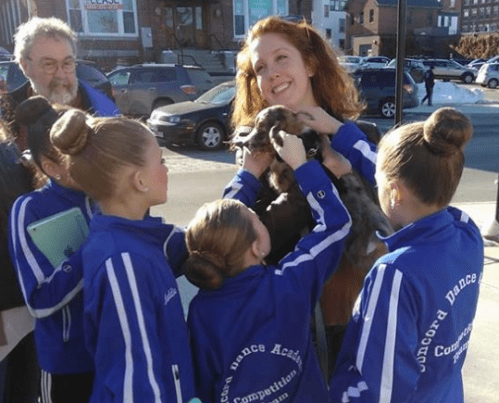
Afterwards we strolled along the main street of Manchester, given the puppy its first experience of a city. There was much to see and smell. A dance competition let out and the street was overtaken by various pods of young girls with their hair tightly pulled up into a bun, heavily made up and wearing their various team jackets. The combination of these girls and the puppy slowed down our progress considerably. Tessa patiently explained to each new group the brand (Australian shepherd and something else) and name of the puppy (Hazelnut), triggering tons of oohs and aahs and requests to pet.

Puppy love

Spring and election fever

We celebrated my brother’s 70th birthday a day before the actual day, with his sons, another brother, two sisters in law and a newcomer to the family, little Willem, my niece’s child, just 8 months old.

Holland was also in election frenzy mode. The elections will be held in a few days, on March 15. There are some 20 parties vying for seats in parliament, and those with the largest number of seats can expect a role in a coalition government. Unlike the US, there is no ‘winners take all.’

The Dutch passport holders in my family have arranged for others in Holland to vote on our behalf. I generally don’t follow Dutch (or European) politics all that much but it is kind of interesting these days with Trump wannabees doing amazingly well in Holland and France.

There are so many choices who to vote for. There is a party for animals (huh?), a party for people over 50, there is a ‘pirate party,’ (huh?) a party for people not voting (huh?) and a party of people voting. And then there are of course the old stalwarts: the old democrats my mother used to be active in, the Christian democrats, the Labor Party (mighty when I lived in Holland, shriveled up now), the Socialists, the Reformed Dutch Church party, Green Left and more.  I think our votes will either go to D66, an alternative democratic party that was founded when I still lived in Holland (in 1966) or Green left, a Bernie Sander’s kind of party that follows his tactics, campaigning America style.

There is of course the Geert Wilders party which has gotten very big, possibly the one with the most or second largest number of predicted seats. Wilders’ Free Holland Party follows in Trump’s shoes and wants to make Holland lily white again. A lot of people think this is great, even the husband of an Afghan friend of mine, a Muslim who arrived decades ago. They are like the Trump supporters, children or grandchildren of immigrants from a previous wave who feel that the new immigrants just have it too easy and should be deported, spoilers rather than contributors.

Spring fever was also apparent everywhere – the sun was shining; the crocuses and even some daffodils were in full bloom, blooming in large swatches of purple, white and yellow on green fields. People were out walking and running or cleaning their yards. Garden furniture was brought out of their winter storage places. We sat outside in the sun, drinking endless cups of tea and talking about all the things that tie us together. On days like this I miss being with my family in Holland.
Sixty-ish

The last afternoon in Abidjan I checked out a new ‘residence,’ because all the previous places we stayed were not good value for money. But this one was. I had a ‘studio americain’  which was more than good value for money. The place is near the office. There is an American dinner (the O’burger) and a patisserie around the corner. It also has things I never use such as a swimming pool, workout room. The best feature is the terrace on the 7th floor from where one can observe traffic jams in all directions, while sipping a dark rum or a ‘sex on the beach’ cocktail, underneath an artificial cherry tree which has blossoms that light up once the sun goes down (it does require electricity).

I finished my reports and packed up for our return trip to Paris first. The driver had called an hour before our agreed upon departure time that he was already waiting for us below. What he did not say is that he was waiting for us at the Ibis hotel that is on the other side of town. This we discovered when we were ready to go and he was not there. The mix up had us arrive at the airport a little later than we had planned, just about exactly the same time that all the other 1000 passengers arrived to fly to points north and east.

The plane was full again with babies; maybe they were the same babies as on the way out. Some slept, some cried and some did a bit of both. We left late which made for a mad dash to catch my flight to Amsterdam, requiring endless long walkways, a shuttle, check points and other obstacles.

I did not want to miss the flight since I had paid 140 Euro for a B-class upgrade, seduced by the words “offre spécial.” I thought it was special indeed; imagine that, an upgrade from Abidjan to Amsterdam for only 140 Euro! It was early in the morning, my brain not fully awake and my ignoring my intuition saying “too good to be true!”

It was of course. The upgrade I had just purchased was only for the 50 minute flight to Amsterdam. I got to the gate just when it was closing, the last person on board. I collapsed in my chair, a regular economy seat but with a guaranteed empty seat between me and the person at the window. The economy row in back of me also had only two people with one empty seat between them. And so there was nothing else to do then to enjoy my 140 Euro breakfast: a sliver of salmon, two pieces of (nice) cheese, a croissant with “fresh Brittany butter” and raspberry jam in its own little jar, a few spoonful’s of something in between yogurt and crème fraiche and a cup of coffee. I enjoyed every little bite and licked my fingers to not miss anything of my most expensive breakfast ever (the Meridien hotel in Dubai comes in second with a 75 dollar breakfast but it had a lot more going for it).

And then I was in Holland again. I took the train to my brother’s house, just in time to see him spent his last two days as someone who can still say he is in his sixties.

Le kilo

The 500-page French-language instruction manual for our leadership program is called ‘le kilo’ here in Cote d’Ivoire. It was a comment I believe I made three years ago when we started and I apologized for the hefty tome that we handed out to the would-be facilitators. We laughed about it. Now it has become simply a reference to the instruction guide; people use it with a straight face, no longer a joke, just a word for a thing. I had to laugh when, during the practicum, someone said, they didn’t use their ‘kilo.’ An outsider would not  understand what this referred  to.  One of the slogans in my current coaching course is ‘Words mean worlds.’ Indeed.

We had a full day of practicum sessions yesterday. Because the group is so large we have split in two. I am observing one region in one room and my counterpart is observing the other region in the room with the race track table.

The two regions are represented by, respectively, 8 and 6 district teams. The plan is that these district representatives, who are themselves participants in regional leadership training that is far advanced, take the program one level down. After this training each district team will conduct the leadership development program in their districts, much like the ones we observed last week in western Cote d’Ivoire.

The practice sessions I observed took place in a small room with four air conditioners that did not work very well. It was hot and humid, and in the afternoon, when the hot sun tried to get through the curtains and everyone was busy digesting a heavy lunch, the teams struggled. But this is the reality they will be operating in when they go back: seeing the participants in the program they will lead after lunch in rooms that won’t be as fancy as this one, which by the way is not all that fancy.

Measuring success

One of my monitoring/evaluation (M&E) colleagues has challenged me some time ago to explain what exactly happens when the teams in our leadership development programs (LDPs) show ‘leadership’ and improve whatever it is they want to improve. What’s in that black box we call ‘transformation?’ I had already formulated some thoughts that take into account everything I am learning about the brain but this remains guess work, not the kind of reasoning that our M&E colleagues would find acceptable.

Getting hard data about transformation in the social sciences is not easy. I actually thought it was impossible until I read Sandy Pentland’s The New Science of Building Great Teams (HBR April 2012, reprint number: R1204C). The article describes fascinating research at MIT’s Human Dynamics lab about measuring what makes teams effective and high performing using metrics of success as indicators.

Sandy (whose real name is Alex Paul) and his team of researchers created electronic badges full of sensors for people to wear at work for weeks on end. These badges produced thousands of data points; measuring tone of voice, acts of verbal and non-verbal communication, proximity to others, etc.  Using the data thus produced, over a period of several weeks, they were able to say exactly what distinguished the teams that did well (as measured by their indicator of success) and teams that did not.

We won’t be able to repeat the high-tech approach of the MIT team in Africa quite yet but we can ride on their coat tails by using their conclusions: three factors seemed to make a difference:  energy (which we have to eyeball but they could actually measure), engagement (the number of verbal exchanges between team members, both in one-on-one settings and in group settings) and exploration (the number of exchanges with members from other teams).

The winning formula is thus: energetic action to move towards the desired result (as opposed to passively waiting for higher ups to solve problems), engagement with each other in frequent conversation, working on a task together, asking for ideas, perspectives (as opposed to retreating to one’s office or computer and trying to solve problems on their own without asking for input from others) and exploration (going outside one’s own ‘tribe’ to listen to other parts of the organization, reading about what others are doing, soliciting advice from experts in other domains (as opposed to staying in one’s own small circle of familiar contacts, one’s bubble).

After reading about the MIT work I realized that our intuitions were not that far off the mark. Listening to our trained facilitators here in Cote d’Ivoire, these are exactly the things they mention when we ask them ‘what changed?” Their responses are consistent: “I used not to work with others as a team before; I did things on my own. Now we talk more with each other about the work, we get input from people we never asked input from, we even work with people from other ministries or other parts of the health system.”

A few of my colleagues will remember what happened in Egypt in the early 2000s when we first tested our approach to leadership development which became our ‘’LDP’.  There is a video (Seeds of Success) on YouTube about this experience. You can see people talk about their transformation. Viewing it again through MIT’s new 3 ‘E’ lens, I am excited, seeing energy, engagement and exploration. They were all there, and I knew it intuitively, now supported by the MIT Human Dynamics lab’s Big Data.

Harvest time

I have a different role now in this kind of ‘technical’ work as we call it at MSH. In the past I would be busy 15 hours a day, thinking, planning, goading, negotiating, giving feedback, preparing. But now all this is done by others. I have handed over the baton and it has been carried around the block several times, without me lifting a finger or a foot.

I had not thought a lot about this but this is of course how it should be: working oneself out of a job. What I also had not realized that moving further away from the action (on the balcony as Ron Heifetz would say) allows one to reflect while taking in a much bigger landscape.

And reflecting I do. I have time to read and reflect and connect. I have time for slow conversations with people, driven by curiosity rather than some force outside me that wants answers. I love it.

In short succession I wrote 3 blogs for my own page on our intranet. I have no idea who will read it, I have a just a handful of followers, but it doesn’t matter. It’s like a storage place for ‘aha’s or ‘déclics’ as the French call it. I will post some here as well. Stay tuned.

Marvel

Monday morning we had a brief meeting with the project director who just returned from his vacation, about our adventures in western Cote d’Ivoire. I produced a slide show with the main observations, mostly good. I congratulated him and his team on what they have created in that part of Cote d’Ivoire that is often peripheral to where the action is.

My colleague R. treated us to a wonderful lunch: grilled fish, a paste made from plantains and Atieke, two local starches. The paste looks a bit like playdoh but tastes better. The sauce was made from the peanuts we bought on Sunday. It is a little spicy, like the Indonesian satay sauce, and very filling. Because of that it is usually eaten at home,  at lunch or breakfast time but not at night.

And then we took to the road again, this time closer by, to a town called Adzope, just 100 km north of Abidjan. It took us a small two hours. We arrived at the ‘luxe’ hotel where we launched the very first workshop of the leadership development program in May 2014. This is why am I am here: to observe our leadership development program that has been cascaded down. Now third and fourth generations of trainers are preparing the next generation to take the lessons even closer to the base. I kind of lost track of the many generations and branches that emerged from that first leadership development program all those years ago.

Once again, probably because of my white hair, I got the royal suite. It is called the ‘Suite Merveille’ (wonder or marvel suite), where I stayed last time as well. It has a bath with the same faucet arrangement I marveled (indeed) about when I was here last: the faucet doesn’t extend all the way inside the edge of the tub and thus, when the water is turned on, it splashes in all directions except into the tub. No one seems to have bothered to change the arrangement. This is Africa, improvisation in the face of adversity to the Nth degree, even when this adversity seems to me such an easy thing to change. “Ahh, c’est la vie!”

We are in the same heavily draped room with an enormous, un-moveable boardroom table that looks like a race track – an elongated oval with a space in the middle. It occupies a good part of the room. It sits about 35 to 40 people around. But we are 50. Away from the table is a second row, consisting of well-worn auditorium chairs with small writing tablets hidden in the arm rests.

I remember the panic when I saw this room three years ago. It is so completely contrary to what I then thought we needed (and could not do without). Now, 3 years later I don’t panic anymore. I know the process carries itself even if the space is unsuitable. It is no longer my problem (ah the joys of ageing!) and the facilitators can draw on their own experience to make the space work, as we did last time. They remembered, placing extra chairs on the inside of the oval, making small group work possible.

Room with a view

I had asked for a nice room with a view, which is what I got but not in the way I had expected. The view was an enormous tree, close to my window. At first I was annoyed because it was actually blocking my view, until I noticed movement. On closer look the tree was full of bats. These are, I believe, the fruit bats. They used to live all over Plateau in the tall trees that used to stand everywhere. They would leave their guano on the cars of all the people that work here, until someone in the government thought it was best to cut the trees. But clearly this tree was spared and some of the homeless bats moved in.

It is like a nightmare to peek between the leaves and see fat bodies wriggling while hanging down. They wriggle to get as much shade as possible. I see large bats the size of kittens and their offspring, the size of hamsters and mice.

And then, as if by order from above, they swarm, even though it is not yet dark, about an hour before sunset. They rise from the tree, circle it, thousands of them, looking like a swarm of birds, and then, as quickly as they appear they are gone, God knows where, to catch their daily meal.

I remember watching these bats from the terrace of the Grand Hotel in Niamey decades ago. I realized this was a ritual that was eons old. No hacking of trees could stop it. I am sure people have even used chemicals. They are a sturdy lot and their offspring will go on living in trees and hunting at night, long after we are gone.

And so, I had been given after all, a room with a view.

Ride and rest

After another long day of riding in a car we arrived at Abidjan at the end of Saturday afternoon. I finished one book and two electronic jigsaw puzzle which helped pass the time. The landscape consist mostly of green foliage, a 1000 shades of green and the grey ribbon of the road, interrupted here and there by dusty villages and people carrying stuff or waiting for something. It’s kind of boring if you have seen it before. What killed the boredom was a stop in a cocoa plantation, where the farmer hid from us for a bit before he dared come out. Two white women are not a common appearance between the leafy cocoa trees.

For lunch we stopped again in Yamoussoukro. Our Ivorian colleagues tried hard to get us the peanut dish that B, my co-traveler from the office in Medford, likes so much. Apparently it is a dish that is eaten at home and not commonly in a restaurant.

We had transferred our reservation from the guesthouse of our first night here to a hotel, preferring a place with a restaurant and, in particular, a salad bar. The fancy hotels here aren’t actually all that fancy, but it would be for two nights. We ended up in the Ibis which is getting a one star review from me on trip advisor as does certainly not provide the value one would expect of a 130-dollars-a-night lodging.

  1. went out for dinner and karaoke and dancing with a colleague who hails from the country where she was, only very recently, a Peace Corps Volunteer. I had dinner at the hotel and went to bed. Sometimes the age differences are a little too obvious.

On Sunday we each went off in different directions. B. accompanied a colleague to church while I slept in and worked. She then went off to buy clothes for a tailoring project while I went off with my ‘sister’ R. to shop for beer and wine for our next hotel stay. We have stayed there before and we know the restaurant is pretty useless there. We would eat juicy ripe mangoes and drink local beer for dinner each night as the restaurant was pretty useless with a waitress not all that interested in serving anyone.

We both had home-made lunched and napped at the hotel before meeting up to review the progress of my report to the project director. He has just returned from vacation and we will see him only briefly before heading out to a small town (Adzope) not too far from Abidjan. When the week is over we will go straight to the airport to catch our flight to Paris, unless the AF strike that is being prepared reaches into Africa.


March 2017
M T W T F S S
 12345
6789101112
13141516171819
20212223242526
2728293031  

Categories

Blog Stats

  • 136,980 hits

Enter your email address to follow this blog and receive notifications of new posts by email.

Join 76 other subscribers