Archive for May, 2019

Coming together

For someone raised on a diet of languages (6) in high school and then further nourished on behavioral (Pavlovian & Skinnerian) psychology in university, the recent advances in neuroscience and epigenetics has led me through some spectacular French doors into a landscape that rivals Versailles. Not a professional landscaper or neuroscientist, I am wowed by the beauty of what I see, by the surprises when I stumble on a new perspective, without understanding the intricate and unimaginable complexity of what went into the creation of all this wonder, our neural system. 

My newly acquired academic credentials, if they can be called such, come from webinars, online courses, MOOCs and books. I have become an avid student of everything that sheds light on the complex and often hard to understand behavior of people. Why do people do things that create exactly the consequences they don’t want? Why, when they know what is good and not good for them, do they postpone action that would lead to better health, more joy and more love in their lives? 

Life is made up of cycles, and I find myself cycling back to things I had to read in university. The fights between Freudians and Kleinians in mid 20thcentury London seemed of little import at the time. Having been brought up, after WWII, in a pretty harmonious family, with parents who loved each other deeply, how could I relate to childhood abandonment theories, trauma and such? Now I feel drawn back to the readings that meant so little to me, and which I now realize are classics because of what they brought to the surface. That what happens early in children’s life becomes a driving force (for good or bad) in that child’s adult life. 

What’s puzzling to me now is why I picked psychology when I knew so little about it, had no self-awareness and knew only two psychologists. These were the father and mother of my classmate Edith in grade school. Her mother was a child therapist and had an office (at home) full of toys, doll houses, lots of dolls. When I first laid eyes on that office I said to myself, that looks like a fun job. I want to be like that. Even though, at 13, I had no idea what psychology and therapy were all about.  Edith’s father was an industrial psychologist with an office next door. His office was a typical office with a conference table and lots of binders and folders and books. I think I may have seen it once and never returned as it was boring to a 13 year old. Now 54 years later I am struck by the merger I am finding myself in the middle of: the merger between understanding a child’s early life experience and how these then play out in and out of the office. Edith’s parents influenced me deeply. Edith herself went into a direction that had nothing to do with what her parents did. She studied potatoes.
Futuring

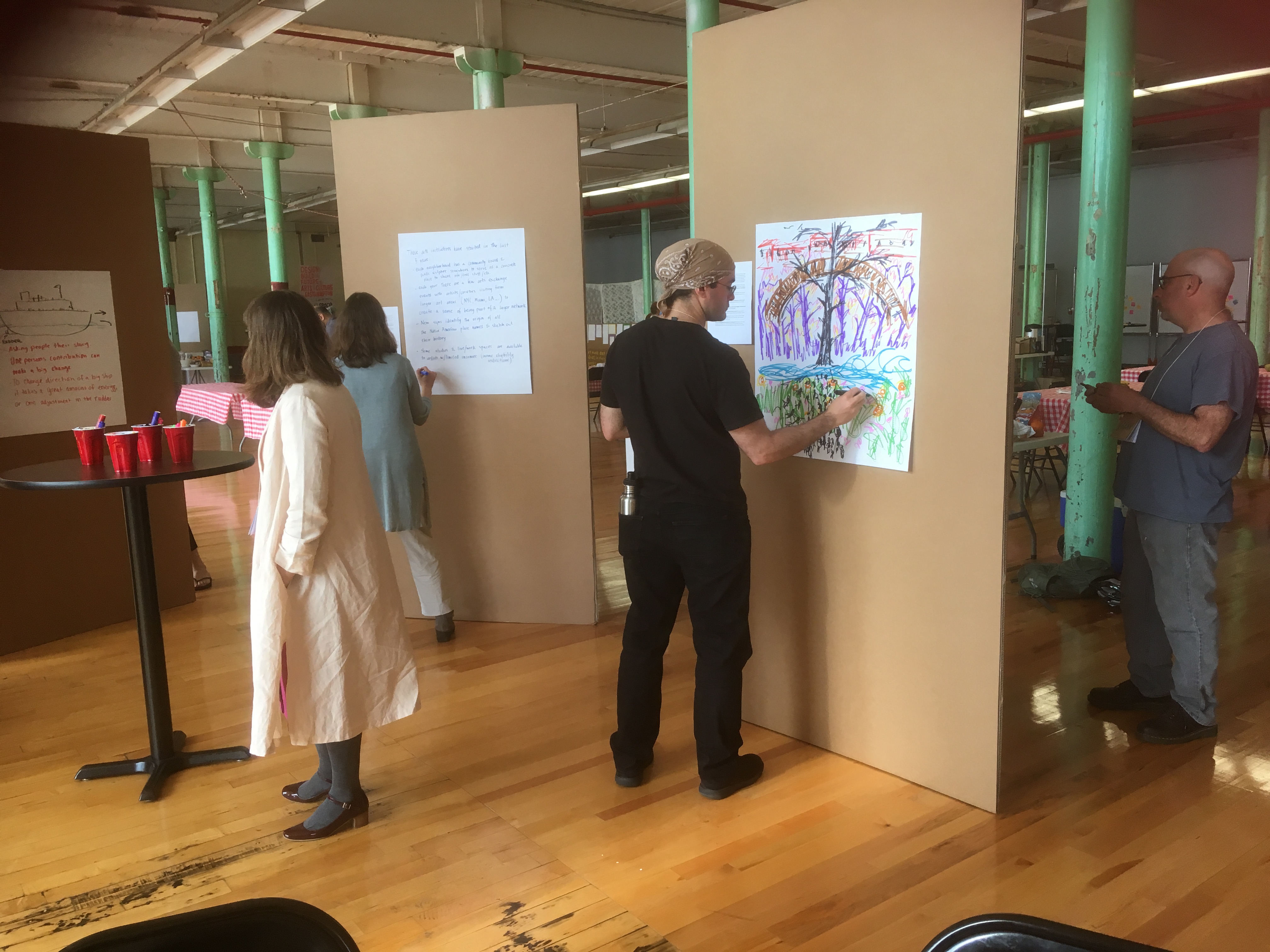
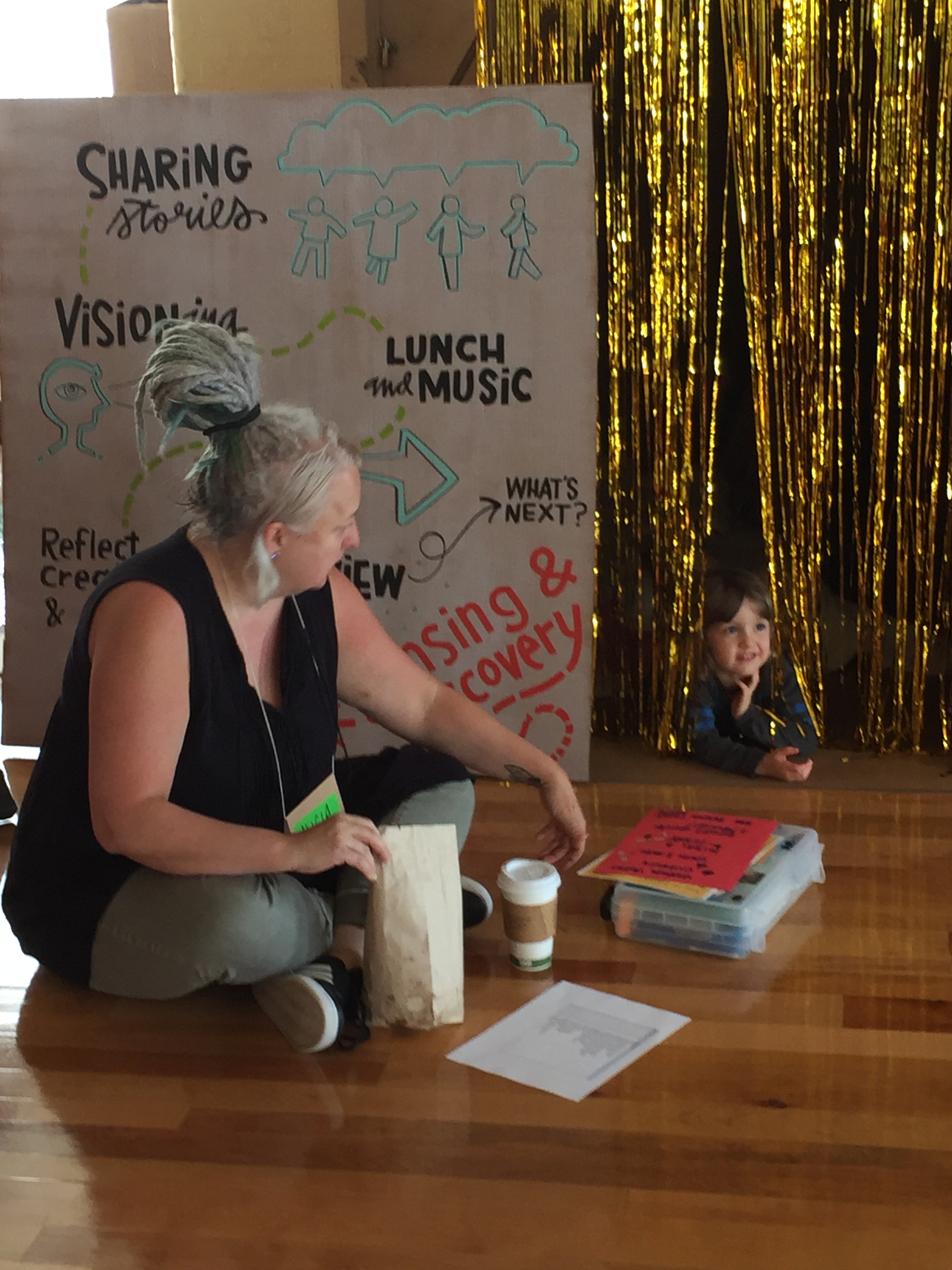
This weekend Axel an I served as crew to an event that Sita organized in Easthampton – a small grant she got from the planning department, with a focus on arts and culture. The Easthampton Futures project kicked off on Saturday with a daylong event that focused on discovery and sensemaking. It was the first of three such events that eventually will move towards people to action to tackle the usual tensions an competing agendas that, if not addressed, can tear a community apart.  

Sita has two qualities I admire, qualities that I recognize from my earlier event design and planning days, but Sita has taken them to new heights. In this day and age where everything has a price, usually one we can hardly afford, Sita mobilizes (human) resources by simply holding a vision in front of them: what if we could mobilize the community (in which she lives) to be intentional about managing the changes that people are seeing and often feel helpless about.

Members of the work crew traveled from wide and far to be part of this event – I believe only one  was actually being paid – the rest of us were volunteers, many not even living in Easthampton. What bound us together was the experience that we wanted to have – to be part of this, learn from Sita (yes, we are now learning from our kids), and meet the most interesting people.

There was an inordinate amount of work to do, starting early on Friday morning. Large (8×4 ft) triangular pillars of card board needed to be constructed, furniture and plants brought down from Sita’s artspace on the 2ndfloor of the old mill building. There were nametag/booklets with quotes to be assembled, a registration system devised, signage, activity instructions, a separate children’s area cordoned off with ropes and blankets and much more. Sita’s husband Jim created the most amazing small retreat places, a pyramid and a Buckminster Fuller dome, all made entirely out of cardboard and held together with binder clips and tape. Lamb skins on the ground made for a comfy time out from all the togetherness.

What Sita is doing is co-creating with others and prototyping ways to hold communities together – it’s a very challenging thing to do – as there are such distances, between old and young, people who struggle and those who thrive, old timers and newcomers, artists and non-artists, renters and landlords. I remember a town nearby where most of the houses were boarded up, business had left or failed, and artists could afford to live – decades later these this is a fancy place to live. A two-bedroom condo costs up from half a million. The town of Easthampton wants to avoid that, preserve what is special and recognize that change is inevitable, but if managed, can be harnessed for good. We will go back in 2 weeks for the second phase of this project. I don’t think I can ever sit through a conference where there are more than 100 power points  slides in one day – and people passively watching rather than talking with each other. That is not what the world needs these days.


May 2019
M T W T F S S
 12345
6789101112
13141516171819
20212223242526
2728293031  

Categories

Blog Stats

  • 136,980 hits

Enter your email address to follow this blog and receive notifications of new posts by email.

Join 76 other subscribers