Archive for December 18th, 2019

Checking off boxes

Having completed our work in Lucknow on Tuesday we had all of Wednesday to do whatever we wanted.  Our plane back to Pune was not leaving until late on Wednesday. There were a few things we wanted to do, some boxes to check off: there was the sightseeing box, a shopping box and a food box.

For the sightseeing we chose to go to a Mughal complex, the Bara Imambara It is an impressive complex of poorly maintained buildings. It is monumental and elaborate. We dawdled for a while in the outer courtyard because my friends felt that me having to pay ten times as much as them to enter was exorbitant. I didnt mind, I am used to paying a lot more than locals. I think it is fair to charge foreign tourists more.

I cut the knot of indecision by saying I wanted to see this Labyrinth that was part of the structure. We learned later from our guide that the labyrinth was not intentionally made as a labyrinth but rather a construction side effect.

First, we had to take our shoes off to get inside the building where tickets were sold. It was cold, overcast and the stone floors were hard on our feet, and by extension, all the other lower body parts attached to my feet. 

A short stocky men approached is and began to guide us, without asking if we even wanted him, but it was good as he told us things we couldn’t have guessed. The ground floor has three giant and very high-ceilinged halls: the Chinese Hall, the Persian Hall and the Indian Hall. Each had a different decoration on the ceiling, geometric three-dimensional designs that, according to our guide, represented Chinese plates in the Chinese Hall, something else in the Persian Hall (the biggest of the three) and a melon in the Indian Hall. The now black and white decorations were at some time gold and silver but, according to our guide, ‘the Britishers’ had taken all that away. 

Small openings high below the ceiling betrayed that there were people up there, and thus ways to get there. Those were openings along some of the labyrinthian corridors in back of the walls. If I had known how many steps up and down on cold hard floors we’d have to navigate I would probably not have entered. By the time I realized this it was too late, and we were high up ducking our heads, going up small steps, around corners, and down, occasionally passing the openings we had seen from below. These openings were large enough for an adult to get through and tumble down 5 stories – no barriers to hold anyone back. By the time we got down I needed a hot bath and a massage – but then there was more, our guide insisted, and we saw more extraordinary architectural features that allowed those on the inside to spy on those outside, unnoticed; and more steps up and down but now with our shoes on.

Outside the entire complex were lots of auto- and horse-drawn rickshaws to take tourists to ‘chickan’ factories – this is a special kind of embroidery made on men’s and women’s clothing for which Lucknow is famous. An unhappy looking horse took us up to one of these production places where an equally unhappy looking woman showed us how she did the embroidery. We did the thing the Dutch are famous for, of ‘kijken, niet kopen’ (looking, not buying).

The driver took us along a few more Mughal buildings, among them the Darwaza Rumi, two enormous gateways on both sides of a long avenue.  By now our guide was gone and what there was to know had to be obtained from the internet. There were many more buildings with intricate architectural flourishes. These building too were unhappy looking, taken over by squatters and vegetation.
Thumbs up

We went to Lucknow to show our wares. We did that today. Our proposal now may have some more hands to push it along. 

Much like at the university last week, now too we were dealing with a lot of moving parts, VUCA time again: until we started we did not quite know who was going to be in the room, other than that we’d have elected and career professionals in the room, an uncommon combination. We didn’t know when we would actually be able to start and how much time we had.

The participants to this experiment, acknowledged as such at the highest levels of the department, had come by car from Agra, a three and a half drive through the fog. Some arrived earlier than others, so we had a conversation about expectations. Most told us they were summoned, leaving real expectations to our imagination.

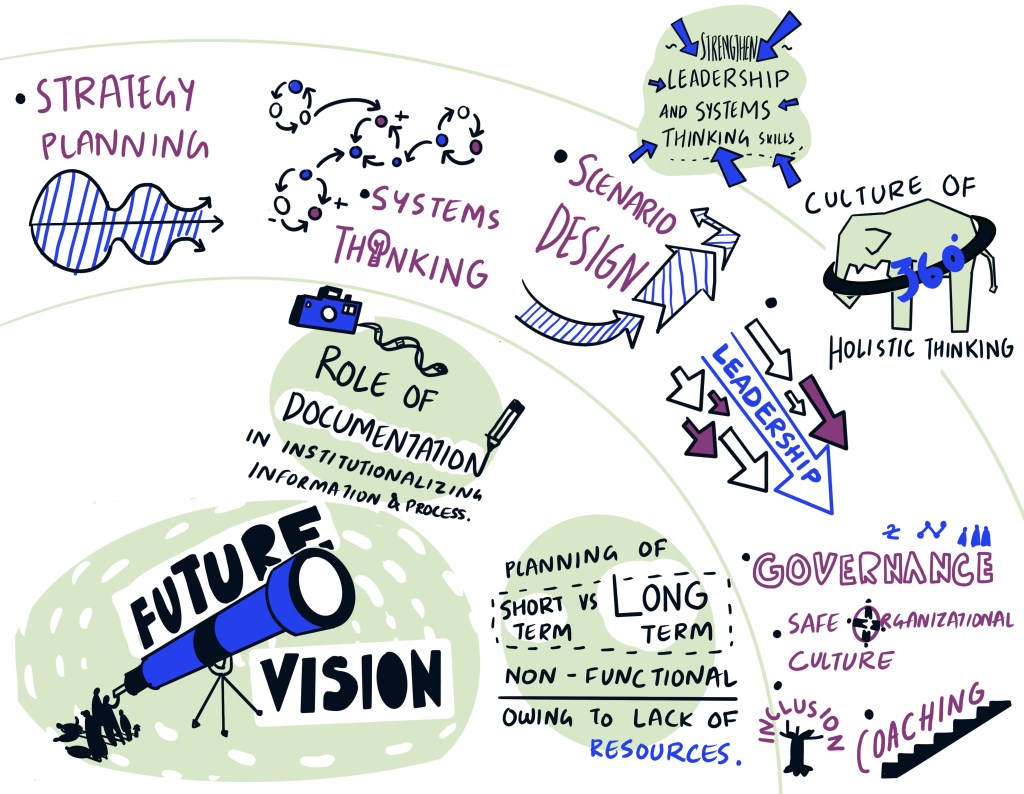
We had asked a graphic artists who we had put on our bid, whether he could create four visuals that represented four buckets of findings that we created out of the raw interview data from Ghaziabad. We told him we couldn’t pay him, and that it was an investment, just like all of us have been investing in this proposal. He did a superb and JIT job.

The morning we arrived in Lucknow, after our sleepless night, R scouted around to find a printshop nearby. They printed the four images on flipchart size (A1) boards. These we then used as small group  conversation starters. We did this for two reasons: one to find out whether the challenges and skill sets that were relevant in one municipality would resonate with elected and selected officials in another. The other reason was to show people a way of interacting with each other to make sense of ‘data’ – the things we had learned in Ghaziabad.

I am happy to say there were no PPTs, even though the conference room was superbly set up for that (a giant screen and all the cables built in) and everyone expected them. Instead we asked for a whiteboard to take notes. There was none when we arrived, but now there is a whiteboard screwed into the wall of one of the department’s brandnew conference rooms.

The day before the event we prepared and iterated several possible designs for an unknown number of participants, unknown starting time and unknown length of the session. My team mates made it clear that, no matter what, I had to establish my credibility first. They are my cultural interpreters so I listen seriously to what they say when it comes to culture and habits. Of course, we are taking some liberties with what people expect and are used to (like PPTs and sitting down all the time). After all, we are challenging the status quo and in particular habits that get in the way of UP reaching its very ambitious goals.

And so I did establish my credentials, helped by our client who introduced me and mentioned the various countries I had worked (including Nepal). I think that helped too.

I shared some of the latest trends and concepts and approaches in leadership and management development, drawing heavily on all the things I have learned from my subscription to WBECS since I left MSH. Then my team mates took over and led conversations, in two parallel small groups, focused on the information in the visuals. All this was done in Hindi. It was clear from the beginning that our program is going to have to be done in Hindi – some people were comfortable in English but most were not. Conversations in Hindi were so much more animated than in English. That evening I downloaded the Hindi program in Duolingo on my phone.

Although the session we had designed veered significantly from what actually happened yesterday, our plan turned out to be robust – we had focused on the outcome we were after, rather than a blow by blow time chart. We wanted to give people a taste of how we do capacity building and collaborative planning and problem solving. We wanted people to leave feeling hungry for more of what we had to offer (this they did). We also wanted to validate the challenges and skills sets we had identified as critical (they were).

We ended the two hour session with lunch. After a family photo in the enormous courtyard of the brand-new building, everyone was ushered into the office of the principal secretary of the department. Our client had decided it was good to work the iron while it was hot and have the participants provided immediate feedback to the man at the top.  We were asked to join (after they had discussed we know not what) and I gave a brief overview of our approach and philosophy. As we were told before we arrived, the PS would give us 15 minutes. It was like clockwork. Something really remarkable is going on here that is very different from the well worn stories people tell about Indian government bureaucracy.

We understood that the feedback would essentially open or close the door to our proposal that is currently lingering somewhere. In our final debrief with our client it was clear that we had the thumbs up. It is true that we had been a little concerned when some of the (more powerful) participants had said we hadn’t given them any solutions, only focused on problems. Our client told them, with a wink and a twinkle in her eye, that this had not been the intent of the session and, in order to get to solutions, the department would have to pay us. And this is where we took our leave. We’ll be in touch, she said.

We celebrated the efforts and good vibes of the day in restaurant that served Babur’s food. It was as if I was back in Afghanistan, except for the Indian rum (Old Monk) that accompanied my meal.


December 2019
M T W T F S S
 1
2345678
9101112131415
16171819202122
23242526272829
3031  

Categories

Blog Stats

  • 136,982 hits

Enter your email address to follow this blog and receive notifications of new posts by email.

Join 76 other subscribers