Archive for the 'Herat' Category

Touchdown

All of yesterday and today I had Carmen, Christi and Amy on my mind, my young colleagues who perished in the Kam Air flight from Herat on its way to Kabul. That was exactly five years ago.

So far we have had almost nonstop clear blue skies since I moved here but now it is suddenly winter, with cold temperatures and snow and a sky full of clouds.

Everyone here is thinking about that fateful trip and it was my luck to find myself in Herat wanting to go back to Kabul on a snowy day. While we were waiting at the airport in Herat we received calls from several people who were concerned about us coming back into Kabul given the inclement weather and the nasty memory of 5 years ago.

We were four in Herat, one booked on the Pamir flight and the rest of us on the UN flight. Contrary to expectations and track record, the Pamir flight arrived and left on time. All of us were asked to reconsider flying to Kabul.

We decided to wait for the incoming flight and see what the pilot had to say. In the meantime the Pamir flight left and landed safely an hour later. Our wait for the delayed UN flight felt a little bit like a wait at the dentist for a root canal treatment.

We decided to rely on the judgment of the UN flight pilot and his co-pilot – assuming, right or wrongly, that the call whether to fly to Kabul or not would not be lightly made. All the UN terminals are full of posters stressing that safety is their first and foremost concern.

And so we left about 3 hours late in a very small twin prop. All through the flight I tried not to think about the flight five years ago that followed the same route. To keep my head cool I concentrated on my knitting and knitted as if my life depended on it.

The flight at high altitude was smooth and easy. I wasn’t worried about the cruising part of the flight as the skies are clear and there are no mountain tops up there. But the moment we started to descent into total whiteness my knuckles turned white. My last experience of total whiteness, when leaving Kabul on April 10, 2008, came back with a vengeance. That was the flight that nearly ended badly as well on the side of one of the mountains surrounding Kabul. All the cells of my body remembered.

It took a long time before we cleared the clouds and I could see the ground. To my great relief I noticed that we had already passed the mountains and were in the ‘bowl’ that holds Kabul, with the landing strip in sight.

It’s funny how flying in weather that wasn’t even bad by US standards, doesn’t faze me at all back home but here it is different. I think there were a lot of al-hamdu-lillahs or whatever the equivalent is in the four or five language spoken by my fellow passengers when we touched down. It’s great to be back home in muddy Kabul!
Trim tab

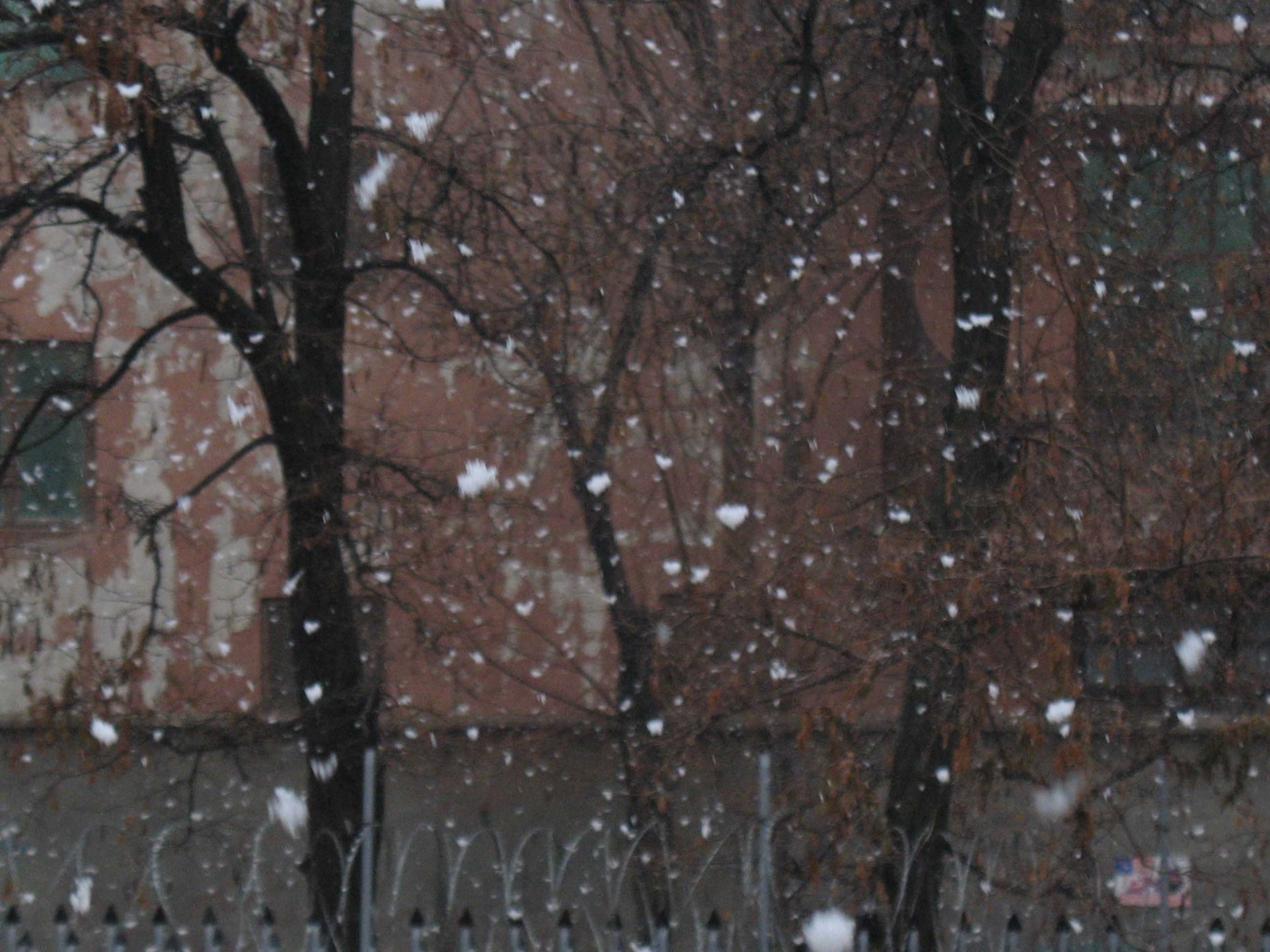
The predicted snow showed up in Kabul, not Herat. Axel took a picture out of our bathroom window (one of the few we can actually open on the mountains side), and concluded these were the biggest snowflakes he had ever seen.

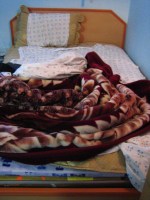
I had another uncomfortable night under the 30 pound blanket and with the tiny sheets. In the morning I told the hotel management that this was the only hotel, over 3 dollar a night, I had ever stayed in where you had to make your own bed. I also requested to not replace my towel everyday which comes also wrapped in plastic with a tiny pink shampoo bottle that shay Ivan and a piece of soap that is wrapped in Chinese characters.

I explained that many hotels in the world are trying to be a little greener by not washing everything every day and I told them about the little cards that one finds in hotel bathrooms that say: towel on the ground means clean towel; towel on the rack means keep it another day.

They thanked me profusely for the feedback and promised they would take care of my requests. But when I returned to the hotel in the afternoon it appeared that only part of the message was received: They had left me my old towel (no new Ivan bottle or soap packet) and they also left me my tiny sheet which I found re-folded and put on top of the Chinese blanket. I got to make my bed by myself again. I gave up.

Our planned after action review got off to a very slow start today. Our guard noticed that with the provincial health chief called to Kabul yersterday afternoon for business everything became a little slack in the office. People showed up late (apparently a meeting by some other US funded agency that pays ‘sitting fees’ was more attractive), then they took about an hour to organize themselves to sit down, and just when everyone was seated someone reminded the group that someone’s nephew had died and they all got up again to offer the family their condolences. And so we didn’t start until about 20 minutes past 11 AM for the 2 hour session.

I used the waiting time to study my Dari lessons with our guard who kept given me the answers for the ‘fill in the blank’ exercises. This is how I was able to do my homework and have it instantly corrected as well. It was a very good use of my tiproductive morning.

While we waited I also learned more about how change comes to this country: very, very slowly. My colleagues sometimes get a little discouraged about how hard it is to change people’s work habits. I used the image of an oil tanker and how you can’t change its direction directly but have to use the trim tab and push it in the direction that seems counter intuitive.

Here the intuitive mode is changing people by punishing them for undesired behavior. The problem is that it doesn’t work because if you punish someone with connections (and everyone has connections) you can expect a phone call from someone more powerful than you who will remind you that you don’t have any power and please undo the punishment. Fear of consequences is what keeps things the same. This is what we, who are tasked to be change agents, are up against. And so I keep thinking ‘trim tab, trim tab, trim tab.’

Sober

My boss left at the end of the morning, after an inspiring speech that illustrated something about the kind of leadership we are encouraging: making a connection between the village women, men and children who need medical care and all the conceptual and analytical work, the planning and organizing that sometimes seems so remote from all that.

Sara left with him and both are now safely are back in Kabul. Part of me wanted to go with them but duty keeps me here. The intense Dari immersion continues but it’s not enough for me to follow closely the discussions and understand the reporting out. I couldn’t tell much about the quality of the reports and the underlying reasoning and so I kept quiet. I am always a few sentences behind when someone translates and few people can do this.

In between translations I did some house cleaning of my mailbox, reading stuff saved for later and tried to keep my feet warm by rubbing them under the table. While it is nice and warm outside, on this inside of this marble and stone building it is kind of clammy, a cold that gets in your bones.

Outside spring is not only in the air; new grass is covering the hills with a thin green veil and the gardeners were already busy preparing beds for planting. Still, snow is predicted for tomorrow.

I was asked to close the four day event with a final speech which I needed to improvise on the spot. Luckily, while one sentence was being translated I was able to think up my next sentence.

After lunch the participants in the event from the other provinces were taken on a tour of Herat and I joined the ride. We paid a visit to Ismael Khan’s Jihad museum that I had already visited last October, then by night.

Last time I had labeled it a monument that celebrated war but now I saw it differently as I watched the Afghans intently stare at scenes and speak in muted tones to one another. It is not an abstract thing for them and they recognize names and dates and faces. I kept wanting to ask them, where were you when all this was happening in Herat, but decided not to.

I kept looking at a small replica of a traditional village house where the roof had been blown in and the adult-size dolls were all crumpled under the debris while an infant was sleeping peacefully in its crib – a yaatim, I learned, an orphan. I calculated that the real life model for this baby would now be about 16 years old now. Would he be full of revenge or dead already?

We visited the site of the Jihad House high on the hill with its unwelcoming blue glass mirror windows (no entry) and surveyed what may have been a battle field. Driving back to the main road we passed much war debris: rusted tanks in various states of dismantlement.

At the main road we passed the Five Star Hotel where the US consulate had just settled in when a mortar destroyed part of the 4th and 5th floor. There is still a gaping hole. It is a miracle no one was killed, the mortar hit the staircase, right in between the guest rooms.

We visited two more sites, one a shrine of a famous poet, surrounded by white marble graves and another of a spiritual leader whose name I name I can’t remember. Next to the shrine, in its enclosed yard, is a gravel patch with a narrow marble slap.

Legend has it that if you place your head on the stone, pray, fold your arms, you will roll towards the edges of the flat surface as if you are rolling down a steep hill. Under loud and irreverent laughter several of our group tried this, most without success, until some elder called our party to order and all the doctors became quiet like a bunch of reprimanded boys in class.

They were living right up to the stereotype that western-clad and educated men are breaking with tradition and are doing things that are bad for Afghanistan. This tension runs like a deep fissure through this country.

At the second shrine several male and female beggars showed the really desperate side of this society. I usually don’t give money to beggars but the sight was so sorry I couldn’t stop the impulse. I was immediately reminded that the men were heroine users and would use my 10 Afs to by one fifth of their next hit. This is the dilemma of giving to beggar: you care enough so that you can’t say ‘I don’t care what they do with the money.’

Daylong Dari

We followed the visiting teams from the five other provinces (Jawzjan, Takhar, Badakhshan, Ghazni and Kabul) on their field trip to see how indicators for health services get collected and analyzed. Sara went with one group to a comprehensive health center (CHC) and I with the other to the District Hospital that is run by the Danish-Afghanistan Committee. Even if I had not known where the funding came from I could have figured it out from the small sketches of Copenhagen’s inner harbor and a rustic scene with a farmer.

Everywhere in the hospital I saw signs of our leadership program that has taken root here: it has led to team work where none existed before, joint and very systematic analyses of challenges and root causes and an abundance of graphs showing improvements over baselines taken months if not years ago.

I am told I am seeing some very successful students from the leadership program who have now become champions themselves. I watched the hospital director behave in ways that I don’t usually see in societies that are as hierarchical and gendered as Afghanistan. The director mostly listened and let his young female staff explain their vision, challenges and the graphs on the walls.

I used the time to sit with the women and ask what number baby they had in their arms – I can have such simple conversations in Dari now – and learned that many were baby number 2 (to women looking like small girls themselves) or baby nr. 9 or 10 to women who looked older than me but probably weren’t. I am now addressed as bibi-jon which is an endearing word for older women (dear granny). None believed I had no grandchildren.

One of these leadership champions, a young doctor working in another district was kidnapped two weeks ago and a ransom of 200.000 dollars demanded by the thugs who took him away from his family (under the guise of a medical emergency). About a year ago I handed this same doctor a poster which he had earned for his extraordinary work. Some people think that government officials are in on the plot – this is what President Karzai has to root out; but in the meantime there is the dilemma – nearby family want to pay of course as non payment may mean instant death. Who can afford this kind of money even in the US? And so family and friends go into debt from which there is no recovery. And payment of course means the crime gets repeated.

After lunch our guard Amidullah took Sara and me on a tour of Herat, first to the cistern that is an old architectural wonder with an enormous domed ceiling that has no support beams or anything like that – just bricks, each row slightly off center but not enough to collapse the dome.

After this we saw the gigantic minarets, 5 are still standing despite the many wars that have ravaged this city over hundreds of years. I couldn’t help consider these spires testimonials to the Y chromosome – they are rather phallic from a distance and still so close up.

While Sara went to see a colleague from her previous work life for dinner I joined a group of about 12 men, several of whom I didn’t know, all doctors, at the house of one of our Kabul staff who happened to attend to his sick mom. I was let in past the curtained off inner room to watch the cooking and preparation of the meal while mom was sitting coughing in a corner, another sick child near her and a bunch of sisters and wives were cooking a spectacular meal.

When the meal was served all the women scurried away, even sick grandma and I was once again with the men. We ate our meals in silence while watching a program about the production of Christmas ornaments somewhere in the US: blond women of a certain age delicately painting US Air force bomber planes on frosted glass balls with tiny paint brushes. When it was dessert time we were watching elephant polo in Nepal. I couldn’t have made it up if I had tried.

Sitting cross legged on thin mattresses for the duration of the meal is a bit of agony for me, especially when hemmed in by both sides. I was very grateful when the meal was over and we could return to the formal guest room with its western furniture. I watched with some jealousy how everyone, old and young, rose from their folded up position with great ease – I had to unfold myself very slowly and trying not to show any wincing. After that more tea, more nuts, more dried fruit and more Dari immersion until I anounced that my hard disk was full and I couolnd’t take in any more Dari. It was one very long Dari lesson today.

Sheet challenge

We always stay in the same hotel in Herat, a blue-glassed architectural-eyesore high rise that stands out in the neighborhood like a sore thumb. But the staff is nice and stable – each time I arrive here I see the same people and am greeted with more enthusiasm than the previous stay. We are practically old friends now.

The rooms are spacious and comfortable; now with the armoire I can actually hang my clothes. That the armoire is put right in front of the desk which has now become unusable is a minor irritation. It’s not that there weren’t any other places to put it and I try to imagine the reasoning that placed it in the most inconvenient spot.

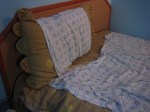
The one thing that is a major irritation is the sheet arrangement. The bottom sheet of the bed is put on the mattress like a table cloth that is too small, it doesn’t cover the surface and edges of the mattress remain uncovered (who else slept on this I wondered). The sheet is more the size of a crib sheet than the full-size it should be. The rest of the bedding is do-it-yourself: a plastic bag on top of the bed has another sheet of the same size that therefore also cannot be tucked in. And finally there is the 15 kilo Chinese blanket that lies folded next to the plastic-wrapped top sheet at the foot of the bed.

Unlike the sheets, the blanket is made for a king size bed. It size and weight make it impossible to unfold with my one good arm as it is too heavy for my (still) injured and weak-muscled right arm. After trying for a while to spread the 15 kilo of dead weight over a slithering piece of cloth I gave up and slept in a jumble of mostly blanket and a little bit of sheet that’s always in the wrong place.

The label on the blanket says ‘handwash in warm water only’ and a stern warning to not dry clean. Given its dry weight I cannot imagine a human being hand washing this behemoth blanket (wringing not allowed luckily) and so I assume this blanket doesn’t get washed very much (this only bothers me the first night).

The pillow is another issue, a decorative affair with little things sewn around the edges that look like the ears on Halloween animal outfits. It too has only a sliver of a sheet wrapped around it by way of pillow case but ‘case’ is the wrong word as there is no encasing. Would they wash the decorative case after each use? I hate to ask because I can sort of predict the answer.

All of this is of course only a problem on the first night. After that I adapt and prove once more that we humans are, among many other things, endlessly adaptable and able to lower our standards if there are no obvious and immediate other options. It’s called accommodation, and probably a good thing.

Third time Herat

We left early for the airport, the UNAMA part of the airport, a separate small building that has its own entrance (please unload your weapons in this box), its own fleet of planes and its own tiny business center and canteen. If it was a commercial enterprise it would be broke by now but the Canadians and Japanese are keeping the fleet in the air and we help a bit by paying insanely high airfares, for extra safety and reliability.

Security at the airport was ratcheted up to a level I had not seen before. For the first time our car was not allowed to enter the airport grounds and Sara and I walk the distance that we are usually driven. We didn’t mind because we don’t get much of a chance to walk. We passed the women’s checkpoint where bored female employees watched a grainy TV screen, drinking tea and chatting.

They gave us a cursory pat down and resumed their talking. As we discovered later all this extra security was because the Afghan president was flying someplace (this also caused a three hour delay in our departure but we didn’t know that at the time).

We passed through the parking lot C that, as Sara noticed, doesn’t have any signs to say it is C. People just know, just as people know that behind it is parking lot B, also without signage. We walked through the small building with snack shops and coffee places (not like Starbucks, this is Nescafe land, there is no critical mass of demanding coffee drinkers here). Finally our office guard was blocked from further accompanying us and we were on our own until my boss joined us some time later.

We didn’t arrive in Herat until 2 PM even though the flight is barely 2 hours and we started our journey at 7:30 AM.

Sara may have expected people with guns trying to ambush us on the airport road (such things sometimes happen as Steve had told her not realizing that this kind of information makes people nervous). Instead we watched an entire planeload of new army recruits empty out of the airport – mostly young boys walking three abreast with nervous smiles on their facing. Each three-some was holding hands, while marching someplace in a slightly disorderly way as only new recruits can get away with, under the stern gaze of their trainers. It would have been cute if it wasn’t for the fact that they were about to be turned into men-in-uniforms-with-guns.

Our guard, who had flown ahead of us, waited for us at the airport and took us to the provincial health office, built by the Italian PRT (=military) and opened in October 2009 when I came here first.
This is my third visit to Herat since I arrived in Afghanistan at the end of September. My Dari lessons are paying off; I can follow a lot more than 2 months ago although I am still far away from participating in Dari. I am frantically thumbed through my Dari-English dictionary to find words (or rather sounds) that I heard repeatedly. That is how I discovered that ‘to choose’ in Dari is, literally, to make happy. Huh?

At the hotel I noticed that the rooms are now equipped with an armoire, a piece of furniture that had been missing on my previous trips – everything was hung on an elongated hat rack. Now I have hangers. They clearly do listen to their customers.

I thawed my frozen feet in the tiny bath tub and then watched Bollywood soap operas until dinner time. They are love dramas and some play out in halls that look like the Afghan wedding halls. Now I understand where the Afghan wedding hall fad comes from. The funny thing is that the Indian wedding hall is full of women and men together, the women rather exposed in comparison to their Afghan sisters (arms, midriff, ankles, neck, cleavage)

Security lunch and Swiss cheese

The guard assigned to us is Amid Allah, or Amid Jan as we call him more affectionally. He is a wonderful caring man who looks after us foreigners. Every time we leave someplace he comes over to check whether I have my camera, my phone etc. Last night he gave me a tin with traditional Herati sweets. I dutifully declined three times and then took the gift when he insisted.

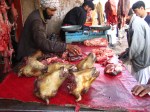
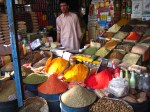
This morning he took me on a walking tour of Herat: we went to the old citadel which was closed, so we walked around it and to the mosque. For this we walked along endless small shops, a photograper’s paradise.

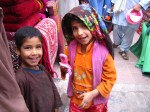
It was so wonderful to be able to walk around freely and poke my nose in all sorts of shops and exchange greetings with people. I did not feel threatened at any time, so many smiles and invitations to take pictures and walk into shops. I think the Heratis are as curious about me as I am about them.

At one point we even took a taxi, something we are not allowed to do in Kabul. The driver played Badakhsan traditional music which I recognize from having played it for hours during my trip in 2002. My guard is also from that part of the country and he grinned from ear to ear. Listening to one’s own music can make you happy that way.

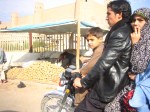
I had my camera on all the time, clicking away as I saw one wonderful scene after another. People here mostly don’t mind having their picture taken. Occasionally a middle-aged bearded man says no, but that is rare. I do ask each time if it is OK to take a picture and most people grin and pose. A picture is called ‘aks’ in Dari, reminding me of my honey each time.

Around noontime we made our way to the airport. My male colleagues had to stand in line for each subsequent check point but I breezed through them with great ease. There are so few female travelers, may be one for each 20 or 30 males that there are rarely lines.

At one of the checkpoints for females I found three of the ladies sitting around the table where one is supposed to open one’s luggage. But there was no room as they were having lunch. It smelled delicious and I said in my best Dari that the smells made me hungry, at which I was promptly invited to sit down and eat with them; to hell with luggage checks!

Once again the security arrangements were like Swiss cheese. No one ever asked me for an ID. Last names and birthdates don’t really exist in traditional Afghanistan, which is why you will see that many Afghans are born on January 1 of a year that, given their appearance, is a good estimate of their age.

Identity cards are not used either, only by those who work for expat organizations or who travel abroad. You can make a serious looking ID card in the market and make up any information that is printed on the card; add a fake leather holder and a lanyard and you have an identity that looks official.

In between check in and luggage drop off there is plenty of time and opportunity to slip something bad in a piece of luggage and then leave the airport grounds unobtrusively. And of course, from an American point of view, nearly all of one’s fellow passengers look like the 9/11 hijackers. If the same cast of characters were to board a domestic flight in the US they would all receive extra special screening treatment. Everything is relative and contextual.

We left only one hour late and for 70 dollars (330 dollar less than the UN flight -one way) we made it in record time to Kabul, one hour in the air; with the UN flight, during my last trip, the same trip took an entire day. Granted, it was crowded in the plane, with no legroom and nothing served except water, but for one hour that is manageable. It took us more than that time to get from the airport to our guesthouse even though it is Jama’a today, a day of rest. Not for us as the weekend is essentially over.

Pilgrim shots

I watched Hillary call the bad people in Pakistan names (cowards) while drinking something that comes out a can that looks like a real beer but it is actually 0.0% alcohol Bavaria brewed lemon malt beer. It is not bad when you have forgotten what real beer tastes like.

Last evening I watched endless reruns of the bomb blast in Peshawar and the attack on the UN Guesthouse in Kabul while answering emails inquiring about my safety from concerned friends from all over the world. I try to explain that there are many guesthouses in Kabul, more than there are hotels, and that Kabul is a big city and that we live far from where most of the foreigners live; but I do understand the concern and I am grateful for all the good vibes and prayers that are sent our way.

In the meantime Axel’s sewer project has hit a snag which may mean a delay in his arrival, which would have to be at least a week’s delay because of the run-off lockdown. We are receiving instructions from our security men to lay low and refrain from our weekly Chicken street outing; even our walk around the highschool is cancelled. Maybe this is a signal that I should finally try the elliptical in our house or go for a rowing visit to house nr 26.

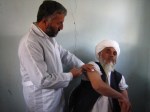
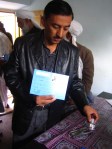
Half way through the morning I went to take pictures of the hajjis receiving the seasonal flu vaccines at a local mosque. The vaccines have been donated by the American people and arrived at the right place and the right time thanks to many sleepless nights, thousands of phone calls and emails and much sweat and tears from many of my colleagues. My guide was the vaccination chief at the regional health office and he introduced me left and right to bearded men, sometimes introducing them as ‘he used to be a talib!’ and then everyone grinned. I would have loved to find out why the change of heart and label but my Dari is not good enough for such conversations and their English wasn’t either.

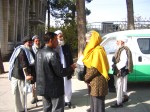
At the end of my visit to the mosque I was formally thanked on behalf of the Afghan people by an impeccably dressed religious official who, I was told later, was an official in the provincial health office at the time of the taliban.

Later one of our participants in the workshop told me how you could get your fingers or even your head cut off if the taliban police found you in the possession of a pen drive, as this meant you had a computer and that was of course a machine invented by the devil. He would hide his pendrive in the ashtray in the arm rest of his seat on the bus and pray that they would not find it.

It is hard to imagine that this was no so long ago and it is always surprising how people tell stories about the taliban as if that period was just one big joke. It seems that for my colleagues here taliban means ‘incompetent fanatics’ and sometimes I detect a hint of compassion, as if these poor sods didn’t know any better.

I had lunch again with the only other female in the room; women don’t seem to be able to eat together with men. We occupy her husband’s office and unpack the many wrappings our lunch comes in, always the same: naan (flatbread), a small plastic container with raw vegetables with a packet with low fat mayonaise on top, a plastic spoon, fork, and straw wrapped inside two tissue papers and a plastic sleeve, a plastic container with white rice, some saffron rice mixed in and tiny red berries that i am told are hard to find and good for lowering cholesterol. The last container has a big chunk of mutton, bone and fat included.

We returned early to our hotel because it is Thursday and people go home for the weekend. I came home to a hotel on back-up power which meant I had to get my mail sitting in the lobby. I sat right behind Murad from Jalalabad who was talking on Skype with his fiancée in Pakistan. I could look right over his shoulder into a living room somewhere in Pakistan where he fiancée was sitting next to, presumably, her sister and her mother lying on a mattress in the back, all very intimate, the women only half veiled.

I asked Murad if he could interrupt his video call for a brief moment so I could download my mail and he immediately obliged. As it turned out he also works for a USAID project and pursues similar objectives as we do, except he does procurement, a very tricky field, full of mines as one can expect here. He told me he missed he fiancee so much, emphasizing the ‘so’ so very much that I did not dare to download all my mail for fear of separating these lovebirds.

Tonight we will go out across the street again for dinner in the restaurant with the carpets on the grass and eat kebabs with sabzy (cooked greens) and drink the fermented yoghurt, imagining it is beer.

Bleak and colorful

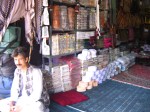
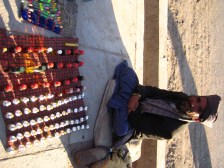
Our workshop venue is in between the TB ward, the infectious diseases ward and the mortuary, so it may be more dangerous here than in Kabul where gunmen created mayhem and death. Dangers are lurking everywhere in this country, but then, amazing and wonderful things are also staring at you at every street corner – a grandpa climbing over a walk to fetch his little grand or great-granddaughter; and the ancient looking seller of mysterious perfumes sitting by the side of the road. I showed him the picture that I took of him and his wares. He looked at the small display on my camera and I wondered what he thought. Magic? Weird foreigneress?Misc 095

I am watching the group process that is created by my colleague. I don’t quite agree with his approach and we skirmish a bit on how to proceed. He’s impatient, as most foreign fly-in consultants are because their time frame is short. Now that I live here I see things differently. I try to get people in the habit of reflecting on what they are doing, seeing the big picture, how does what they do fit into the larger whole – because that sort of reflection is not happening. Everyone is so focused on small tasks. People are engaged with the individual trees and losing sight of the woods as a result. Every new consultant brings in new assignments that may look large and important to them, but in the greater scheme of things produce yet another set of tasks that suck up attention and energy.

We recognize that we have a fundamental philosophical difference about how people learn. My colleague thinks people learn from working on their own and then have their work product critically reviewed in plenary to correct errors and deepen the reasoning. I believe in coaching people in the intimacy of their small work group so that what the groups finally present in plenary is the best possible product. I wonder if this is the kind of philosophical difference that cannot be bridged with compelling arguments.

After lunch I asked to be taken on a tour of the hospital to get some pictures of healthcare in action. It is a regional hospital and people come from all over. I followed the man in charge of the cold chain, I call him Mr. Cool Man but he doesn’t understand that that is funny. He keeps correcting me, emphasizing that he is Mr. Cold Chain man. He is very serious about being addressed with the right title.

We first went to the first aid section where a doctor and a male nurse attended to patients that walked in or were carried in. They were all pleased to pose. I asked if I could take pictures of the patients, victims and families. My security guard and Mr. Cold Chain shrugged but I insisted they ask. No one seemed to mind and most posed with big smiles, except those who were crying or suffering or simply too ill to respond. Occasionally a woman steps out of my picture frame and covers her head. I am surprised that not all women do that. There are discarded burqas, scarves and abayas all over the place. The clothes that the women wear underneath their wraps are exposed in all their wonderful colors.

After we checked in with our Kabul based colleagues to find out what was rumor and what was fact about the early morning attacks, we, the two foreigners only, are ordered back to our hotel at 3 PM. I am both touched about the concern for our well being and annoyed that we have to leave the group. Luckily our Afghan colleagues are allowed to stay and we know the work is in good hands with them.

Sita’s birthday

Once more we are staying in the Nazary hotel that was designed by people who have a very different idea of what hotel room should be like than I do. The bathroom is designed for small people, much smaller than the average Afghan or American. I think the Chinese were in on this deal. The bathroom has a callipgraphy still life design and stickers on everything indicate the manufacturer in Chinese characters.

There is no place to put clothes, only a coatbandi, as the Afghans call the ubiquitous multi-knobbed coat racks. That and the beautiful Herat carpet ar the only non Chinese things in the room. The mattress is hard as a plank and has a sheet put on top of it that is too small to tuck in. The bed is not made up and I wonder what the idea is of the small sheet that is folded on top and that looks like a johnny. Am I supposed to wrap it around me? A clean johhny sheet is put on the bed each night, wrapped in plastic.

The Chinese blanket has the weight of the lead aprons that the X-ray technicians use. I cannot pull the blanket over me because it requires two strong arms and shoulders; with my still inflamed right arm and shoulder I cannot do this. It is good that it is not very cold yet in Herat, so I manage sleeping rolled up in my sheet-johnny.

Our workshop is held in the vaccination training room of the EPI program. Instead of posters, all the vaccine-related information deemed important for trainees is painted on the wall, permanently affixed in bright colors, including a map of Western Afghanistan. All the lettering is in Dari so I am perfecting my reading skills while discussions happen around me that I cannot follow.

We sit on plastic chairs that still have the manufacturer’s plastic protective wrapping around them, half peeled. I cannot help myself peeling the plastic off even further until I encounter a piece of old scotch tape that has melded into the chair’s metal armrests.

At the end of the workshop we check out the cold room to see if the boxes that we sent at great cost to Afghanistan to protect international travelers from seasonal flu had arrived. They had. That required a victory picture. This took some explaining as the employee did not understand Churchill’s victory sign; if I had held up a Kalashnikov with one arm he might have understood better. But I did get the picture with a somewhat tentative V and a puzzled look.Misc 090

Our security man allowed us to walk back to the hotel across the hospital grounds, an untold freedom. One of my colleagues showed us around telling stories about the time he was a student doctor there; stories about the Taliban waking up students with sticks at 3 AM if they weren’t praying; the removal of the women’s recovery ward from the operating theatre to separate the sexes – this meant that women coming out of surgery had to be wheeled in mid winter on gurneys over uneven ground – it was not uncommon for them to slide off the gurney; and then the bearded men slipping into the nurses quarters at night when no one was looking.

For dinner we walked across the street to a restaurant that presented itself as a small store front. But once inside the store opened in the back to a grassy courtyard with carpets spread out on the lush green grass and amidst rose bushes. It was nearly surreal, seeing groups of men here, a family there, sitting cross legged on the carpets eating kebabs and drinking fermented yoghurt, the closest to alcohol we have had. We asked for chairs and a table, to spare our knees that aren’t used to eating on carpets. All this on a mild autumn night on Sita’s 29th birthday.


December 2025
M T W T F S S
1234567
891011121314
15161718192021
22232425262728
293031  

Categories

Blog Stats

  • 136,982 hits

Enter your email address to follow this blog and receive notifications of new posts by email.

Join 76 other subscribers