Archive for the 'Herat' Category


Natural resource

To catch a 7 AM plane I had to get up in the middle of the night. I had set my alarm for 3:30, was picked up an hour later and from then on it was endless waiting. Waiting at checkpoints, or waiting for my male colleagues who had their bodies and luggage checked at various points, all in the dark because the electricity was out.

At this early hour female guards cannot be on the job because it would require that they travel in the dark and that is not allowed. Between the electricity outage and the absence of females at the checkpoints, the security arrangements were like Swiss cheese: full of holes.

I killed the hours of waiting by working on my Dari homework and learning some new words. I learned among other things that a wise old man, someone with much gravitas as we would call him, is called a cooked man in Dari. IN return, my Afghan colleagues thought that the expression ‘he travels light,’ referring to our guard, was odd – languages are funny that way.

By the time we had inched our way to the beginning of the runway, about three quarters of a regular workday had passed and our 7 o’clock plane finally took to the skies at 10 AM. We flew the Afghan version of the now defunct People’s Express, a no frills airline company called Pamir Airways. To fly this carrier, as opposed to the UN flight, you have to have an enormous dose of patience and you get nothing to eat, just a cup of water.

We spent nearly an hour on the taxiway, moving a little and then standing still for 15 minutes. There is only 1 runway at Kabul International Airport and between the many military and unmarked planes there is much coming and going, at a ratio of at least 3 coming for every one going.

During out one hour on the taxiway the passengers, nearly all men, started to get a little unruly; and here, unruly bearded and turbaned men are a little scary – luckily there are no arms allowed on the plane. People were talking on their cell phones and walking back and forth as if we were boarding and the flight attendants did not seem to care much.

Occasionally people pushed their call buttons and some heated discussions would ensue while everyone and their brother would get in on the conversation, interrupting my cat naps. I could understand a word here and there but it wasn’t difficult to figure out what they were talking about. It was a rather lively ride up to the start of the runway. Luckily there was also much laughing and that put my mind at rest.

I sat next to a young female lawyer who works with an NGO that has taken on the impossible task of defending the rights of women in Kandahar. She spoke to me in her best English and told me the most incredible stories about life of a 20-year old, unmarried Afghan lawyer who defends the underdog in one of Afghanistan’s most conservative areas.

I soon learned that she had never lost a case of her 258 taken on so far. She is independent, that is, not living with her father or brothers and has no husband, and might never get one as she probably scares the shit out of bearded men who beat or cheat on their wives. I gather from her stories that she is quickly becoming the bane of existence of men who abuse, rape, abduct, cheat or otherwise treat women badly. I asked her how she could live in a place where men so despise women and where her life is all the time in danger. She gave me a big smile and said, if they want to kill me, let them, I am here to help the women and I will never give up.

She pleads her cases in court from the anonymity of the burka. Still, I wondered, with such a dangerous profession, “don’t people know who you are?” They do of course and she knows that if there are people who want to get rid of her they can easily do this but she is unfazed. She is careful tough and does not have a business card or an email address. Everything is done by phone, the gadget practically attached to her ear. I am thinking of Sita and Tessa at 20 – such a different life.

Shabbana’s biggest wish is to go to the bazaar and buy herself some new shoes but she can’t do this, not even in relative free Herat or Kabul, not without her mother or father. She sighed, “I have so many wishes,” but then she smiled and said, “may be one day they will come true,” followed by the predictable Incha’allah.

I asked her if she voted and will vote again, something that is, for a woman in Kandahar, an act of unimaginable bravery. But she is not afraid. After she tells me about men who got their inked fingers hacked off I ask how she manages that. She wore gloves for a week, she said matter-of-factly and will do so again.

I had so many questions, I would have liked to fly for hours more. Being a mother myself of young women I wondered what her mother thought about her dangerous vocation and place of residence. “She cried each time I would visit,’” Shabanna told me. But the mother is also proud of her : in primary school at 2, secondary school at 13 and university at 16, becoming a lawyer at 19, I can see why her mother is proud. The whole country should be proud. How’s that for a natural resource for Afghanistan?
Back

The training program that we finalized on Friday was supposed to start at 8 AM. When we left the restaurant last night everyone was told to show up at the health center at 8. But at 8 AM very few of the participants were ready to even leave the hotel, some just coming down for breakfast. It was Afghan, not American time I figured. Most men were still walking around on the ubiquitous plastic slippers that are standard equipment, even in our guesthouse; Afghan indoor shoes.

I, always on Dutch time, was ready long before the others and way too early. I ended up hanging out in the lobby for hours, engaging then with this then with that Afghan gentleman, each one doing his best to either speak English or teach me Farsi. They call it Farsi here because we are only 150 km away from the border with Iran.

Iran’s influence is palpable; not only in the white on black or grey print chadoors that women wear when not in burkas but also, I am told, in the undermining of nascent businesses that are trying to survive on the outskirts of Herat. Many have already closed their doors because of security concerns, kidnappings and other acts of sabotage. My colleagues have no doubt about who is behind this. ‘Why?’ I ask. Are they afraid of the competition?

Another bad guy was killed, the son-in-law of the bad guy who was killed when we arrived; I offered to take the team to Kandahar and see if I could magically make this happen again, orchestrating the forces from the universe to kill one bad guy on my arrival and another on my departure day.

The tension between greed or blatant self interest and enlightened stewardship of resources is a constant one in this country. Islam has something to say about it but it is of course not practiced by the people who make the news; much like the basic tenets of Christianity, in the societies I know, have little to do with the actual behavior of its most notorious citizens. In that sense both religions appear to be more aspirational than normative.

I finally gave up the practice of walking to my fifth floor (10 stairs) rather than taking the lift, because of stomach troubles that required a quick escape to a private bathroom as the lobby toilet is for both sexes, which here means men. And like men’s bathrooms everywhere they are wet, dirty and stink.

The elevator appears to be made in Japan. While ascending or descending I listen to Flamenco music and when the door opens the recorded voice of a Japanese lady announces the arrival at my floor, in Dari that sounds like Japanese. The music stops abruptly when I open the door and starts after it closes.

I learn that the UN flight that is supposed to bring us back to Kabul will depart a few hours earlier than we expected. As a result we hastily say goodbye at the provincial health office before the session has even opened. That was just as well since somehow the careful design was combined with another event about polio and countless participants had arrived expecting something else.

I told the team we would call them later to hear how everything went and what they learned. I think in the end they will do what they had planned from the beginning, something loose and unstructured with flexible beginning and ending times resulting in everyone having a good time but dubious results.

When we arrive at the airport we discover that our plane hasn’t even departed Kabul, two hours away. I don’t understand the UN flight schedule as it seems rather loose to my untrained eye. I wonder how people plan their travels. Apparently routes change easily, with planes landing at or overflying airports based on considerations other than what’s in the schedule.

Our Thursday flight to Herat was supposed to go via Bamiyan but an hour into the flight it was clear we were flying directly to Herat. Now I am not sure how we will fly, some people mention Kandahar. In the end we sit for hours on uncomfortable baby blue plastic chairs in a special room for UN passengers. For lunch there are chips, sandwiches with contents of unknown origin that I decline, and little Turkish cakes with pictures on the wrapping that have nothing to do with either the color or texture of the real thing inside.

A bunch of foreigners who are travelling with us show up with several boxes of great looking pizza which they eat, within smelling distance, for lunch. They clearly have connections with the Italian PRT, whose barracks are right next to the terminal. The water we buy in the little shop also comes from Italy and we wonder whether we are buying stolen (leaked) good.

Finally we board our DeHavilland Dash 8 Combi, a small two propeller plane that is supported, according to placards displayed prominently in the front of the plane, by the governments of Japan and Canada. The two flags look nice side by side with their red centers: one a sun and the other a maple leaf.

Everything in this country that runs or works for the common good is supported by one foreign government or another, openly; everything that does not work towards the common good is also supported by foreign governments, neighbors or world powers who have a deep stake in regional or international geopolitical games that few really understand; none of this is posted on placards, but everyone knows.

We land in Bamiyan on a gravel strip and I can see the former Buddha alcoves without their occupants. I am glad I saw what was supposed to be in there 31 years ago and the memories remain vivid in spite of what I see, or rather not see, now.

When we circle back up to altitude to cross increasingly high mountains the canned safety announcements are repeated again for the new passengers; always in two languages even though there is no French speaker on board. It’s a Canadian plane and the two languages remain programmed into system since Canada pays part of the bill.

Back in Kabul I join Azmah who has just arrived from Pakistan, also on a UN flight. She is as part of the large stream of consultants that is coming in now that the elections have faded into the past and the future and MSH has lifted travel restrictions for consultants.

I find my room just as I left it except that my bed is made and my laundry is neatly folded on my bed. It’s nice to be home again in my temporary quarters. I treat myself to a pretend beer to celebrate a first successful and safe trip out into the field, as we call it.

Duelling calls

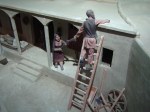
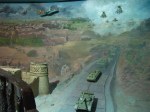
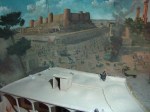
The slightly out of sync calls to morning prayer of the many mosques around our hotel stand in sharp contrast with the very synchronized call to war as depicted in a museum entirely dedicated to the Jihad against the infidel Russians. Its center piece is a diorama populated by quarter sized puppets, tanks and planes in holy combat.

The provincial health director had arranged a private, behind the scenes, visit to the jihad museum that is not open to the public yet. The painters and model makers where still at work when we showed up after dark. But to me it looked ready for the public.

The entrance hall consists of display cases full of guns (Russian), more guns (British), landmines, grenades, etc. It so turned me off that it took much mental energy to follow the group as it stopped at every case. All the men (once again I was the only female) were fascinated with all the toys and were busy snapping pictures in spite of the signs forbidding this.

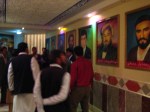
We were taken through a long hallway with bigger than life-sized portraits of all the commanders who had died at the hands of the Russians. They looked attractive, with soft features, but I know none of them were angels, especially if they decided you were their enemy, whatever the color of your uniform.

Suddenly a sound box was activated with the loud and grating sounds of bombing and fighting; it got louder as we emerged in an enormous domed space with a walkway at the bottom and a staircase to the top where you had a 360 degree view of the onslaught of war, its perpetrators and its victims.

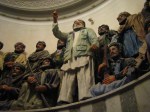
As we walked up the spiraling stair case 30 or so near life size figures of all the commanders crouched above us, led by Ismail Khan, the commander/warlord from here in whose office I sat earlier in the day. With an arm pointed forward he reminded me images I had seen as a child of Moses, leading his people to a better future that remains elusive.

All the men were having pictures taken off themselves in front of the havoc and destruction while I noticed how quickly I got de-sensitized to the battle field and battle noises around me. With my white veil-like scarf I looked rather incongruous in this testosterone-loaded environment, like an angel of some sort.

On another floor glas cases showed us postcards, military snapshots and official photos, even family snapshots, and pictures (sometimes Polaroid photos), dramatically arranged, of fighters in hospital beds with bandages or missing limbs.

A side door took us into the museum’s resource center that was turned into a dining room with platters heaped with fruit (oranges, grapes, bananas, appled, figs) on the tables and dainty English style tea cups filled with green tea. All of this was arranged for us by the local shura, a traditional deliberative and decision making body.

By now my head was spinning with all the Dari I had been immersed in all day and my body was tired from everything. Still, the day was not over. After we said our thank yous and goodbyes we boarded our SUVs and drove up a dirt road that took us to the Thousand and One Night restaurant overlooking the brightly lit city of Herat. Another offering of friendship and support, although this one was paid for by us I suspect.

Raised platforms with carpets were lined up outside (too chilly) and inside; I was glad most of my companions decided to sit on chairs around a large table (my poor knees), although some preferred the traditional seating. Once more we were served a huge meal with much meat, rice and yoghurt; and once more everyone rattled along in Dari but now I gave up learning as I was too tired.

By the time we returned to the hotel it was nearly bedtime but there was more work to be done; USAID had asked us to translated the speeches from the governor, the minister and the health director which had all been given in Dari. I was called in to fix the English of the translators.

All of these impressions balled together into a vivid dream in which a man was ready to die until he had a reason to live again. In my dream I had something to do with his transformation. My calling here?

Without a hitch

Hundreds of people had been and continued to be mobilized for the official opening of the Provincial Health Learning Center in Herat: to lay carpets, clean windows, set up tables and chairs, feed us, protect us, and follow the script. That everything went off without a hitch and within schedule is a wonder considering what it takes to get the US ambassador, the minister of health, and the governor altogether in one place for exactly 60 minutes, not shorter and not longer.

Everything had been scripted into the smallest details – a manifestation of America’s position on one of Geert Hofstede’s dimensions of cultural differences (Uncertainty Avoidance ) which happens to be on the opposite end of where Afghanistan sits. Pulling the event off with the most senior people from both governments, simultaneously, and without having to revert to a plan B or C was a feat beyond a feat.

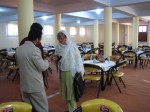
Our first stop in the morning was the basement where the echo chamber of yesterday was transformed into a pleasant carpeted hall with round tables and comfortable chairs and large fruit platters as center pieces. We were all given our badges which meant we were ‘screened.’ I was given two: Mrs. Salivia and Dr. Salivia. I wore the Mrs. badge which I handed in at the end of the day and kept the Dr. one.

My boss and the provincial health director went to the airport to receive the guests and I joined them at the Governor’s palace. We were let into an enormous room that could house several African villages, including livestock. The governor sat at one side of the enormous room, Tara, representing our funder, and I were seated on another side and some of the provincial health directors across from us. This was, I assumed, the same place where one of the more famous (or infamous, depending on your point of view) Afghan warlords held court until he was promoted to his current government post of minister.

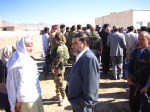
Under the sharp and trigger-ready eye of at least five truckfulls of soldiers, we raced at high speed along cleared road towards a dusty open space at the edge of town with more soldiers than I could shake a stick at; all standing with their backs to their high level protégés and scanning the perimeter for undesirable elements. I managed to stay outside the guarded circle as that seemed safer to me (but then, what do I know). It felt all very sweet and friendly if you could mentally remove the soldiers from view.

From there we raced back to the health office where the minister was received in the training room and given a briefing about the things that will happen in the learning center. There were more speeches, all in Dari, and a certificate ceremony, rewarding the office staff for the learning center that, as far as I know, is still only a concept.

Then we drove off again to have lunch at the Municipal Five Star Hotel that cleverly included the hotel rating system in its name. It is a fancy place where everyone and his brother (and a handful of sisters as well) showed up to have lunch with us (I am sure we will pay the bill), including tons of soldiers and police when suddenly the minister and the governor showed up, to our surprise. The governor had not been invited to the US ambassador’s lunch at the PRT. Although the minister was invited there, he could hardly leave the governor to lunch at his own place with all these notables in town, and so he took him along to our lunch place in the Five Star Hotel. And when the minister and governor show up you have automatically five pick-up trucks with machine guns and armed soldiers.

It was (is) all such a perfect example of the Y-chromosome out of control, all these guys with fast SUVs , guns and walkie-talkies, sunglasses and uniforms; a little boy’s dream come true – many little boys’ dreams come true.

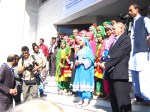
After lunch we raced back again to be at our stations at 1:30 exact, according to the script. Everyone stayed on script. On cue the ambassador and governor and minister appeared all in their separate and highly armed SUVs followed by men with sunglasses and wires coming out of their ears. All of them were welcomed by the cutest little girls in bright costumes singing something about peace that brought all the old warhorses to tears.

Inside the speechifying started on time and ended on time even though several of the people went beyond their 5 minutes. The American ambassador was last and started his speech in Dari which got him a big applause. My colleague was annoyed about the translation of the rest of his (English) speech into Dari, saying it was atrocious but only he seemed to mind.

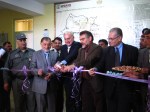
A quick mini tour, a ribbons cutting that was ingenuous in that 3 people got to cut before the ribbon fell to the ground and then the Americans left in a hurry; their plane has to be back on the ground in Kabul before dark; then the governor left and finally the minister, leaving us with an enormous mess of a traffic jam.

After we high-fived each other I was whisked off to the maternity to see the handy work of my Afghan leadership developers, impressive indeed. I would have liked to stay a little longer and meet some of the women on the wards with their newborns but the bazaar would close and that too was on the program, a whirlwind tour and a stop at a few dusty stores with even more dusty treasures.

Then it hit me that I am living here now and Axel is coming and we can come back here again. Sometimes I have to pinch myself to make sure it is true. Contrary to public opinion in the US, I consider myself very lucky indeed to have landed this job here. I love it.

Naan

Sometimes one posting a day is not enough to capture all my experiences here.

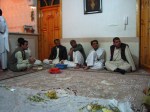
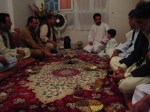
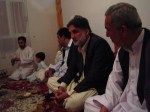
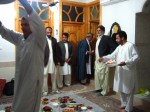
For dinner we were invited by our staff member here in Herat who assists the provincial health office. Several of our other provincial colleagues had arrived from Ghazni, Jawzjan, Faryab, Tahar and Kabul, plus the head of the PLO which here means provincial liaison office. All the men were dressed in traditional garb, the PLO chief wore the kind of dress we associate with Karzai but without the hat.

As the only woman I was ushered into the house first and was shown to the bedroom where the hostess had retreated. Even though she is a doctor, the traditional segregation of sexes is still alive and well here; women simply do not mix with male visitors. I was given the choice to stay with her or join the men in another room. Feeling a little guilty about abandoning my own sex, I opted for the company of men. After all these are the people I work with.

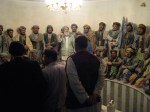
We sat on the kind of cushions that I want to put in our new living room, snacking on various nuts and raisins while drinking cup after cup of green tea. The conversation was in Dari with occasional translation. I did catch the word Taliban from time to time; they were talking about the clash between government and the anti government forces last night – it appears that the government did the killing rather than the Arabs. I guess this is a good thing if killing can ever be good.

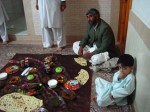
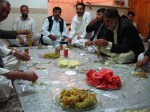
After an hour, just when my knees started to hurt rather badly we were invited into the living room where plastic table cloths had been spread out on the ground and covered with dishes of various meats, vegetables, enormous piles of rice and traditional bread (naan). Our security guard got up first and, in one quick motion, retrieved his gun from under the cushion and stuck it under his long tunic. I must say that I found that a little disturbing even though that gun is supposed to protect us. I am not in Kansas anymore.

Scripted

A big bad man was killed last night near the Herat airport. Allegedly he was responsible for much of the latest spate of mischief here. I was told that my new presence here had brought good luck; people seem to be happy he is gone. I hope that no one else thinks I have anything to do with the act.

I discovered that this luck I have supposedly brought is not necessarily good and might actually be very bad. It all depends on who killed him. Arabs were on his case because he tried to contain them, said one of my colleagues. Arabs here are the real bad guys, so if they killed him it means they are no longer contained and things may get worse. On the other hand if he was killed by government or international forces, then it is indeed good news. But even then, I assume, given his association with one of the more powerful warlords in this area, the story is far from over.

Unfazed everyone is going ahead with the preparations for the high-power visit tomorrow. We patiently answer calls that now come in nearly every 15 minutes to make sure there are no surprises. This is of course a tall order in this country but we do our very best. As the only non-Afghan and only American citizen on the team here, I received a special call to keep my eyes open and do whatever I can to make sure everyone follows the script, so carefully prepared over the last week.

It gets a little absurd at times. The provincial health director had asked school girls to sing a peace song at the entrance on the steps leading into the building. Panic on our side since it wasn’t in the script. With the risk of upsetting the entire apple cart we informed our contact on the US side and patiently answered all questions related to where these girls would be (inside or outside the compound), when and how many. At least we did not have to sing the song through our cell phones. It’s in Dari so we won’t understand what they will really be singing anyways. It may well be the Afghan version of Mary had a little lamb.

When we arrived at the provincial health office the provincial director informed us that the minister had asked him whether he could speak last, a spot already reserved for the US ambassador. Since they are friends we suggested that the minister and the ambassador talk this out between themselves and then decide. Frankly, we don’t care who ends the series of speeches but we do care about the response we’d get if we were to change the order.

There are rumors that the provincial government might be changed tomorrow. Since the governor will receive the Excellencies at the airport and deliver a speech at the event, everything is likely to be cancelled. Such a cancellation would be the fourth time of this very event in as many months, but never this late in the game. I do hope the decision will bemade before 5:30 tomorrow morning when the ambassador boards his US government jet in Kabul with his entourage.

Unfazed by this rumor (a very common occurrence here), we continue our preparations. Countless people were mobilized on their precious day off to prepare the event. In the morning after greeting everyone, we inspected the basement of the new building where the opening speeches will be given for exactly 50 minutes.

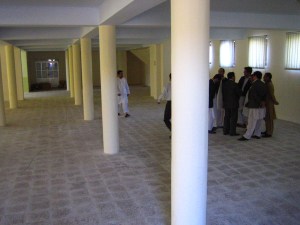
It is an enormous bare space, tiled and with large pillars in the middle. Herat 022There is nothing to dampen the sounds from ricocheting around the room, no carpets, no draperies. Even our small group talking was an afront on the senses. When I mentioned this, the word carpet started to show up in the Dari exchanges around me and I instantly regretted having made this comment. I know who will be asked to pay for the carpets. I tried to withdraw my words but they are like flies, once flown off you cannot retrieve them.

Outside, large bulky couches were piling up. These are for the Excellencies who will be seated facing the rest of us. They will be addressed and addressing us from a side podium. After the festivities are over everyone will head towards the stairs to the ground floor, cut the ribbon (which, I was told was already cut once half a year ago by the builders and funder, the Italian government) and tour the still pristine building before heading back, exactly 50 minutes after the start of the opening ceremony, to the airport. I can’t imagine this will go according to script, especially the 5 minute speeches from Excellencies who usually talk a little longer.

After the protocol and seating arrangements had been resolved I headed upstairs to focus on something of much more interest to me: the actual learning sessions that are supposed to take place in this center in the near future. I had designed a session without powerpoints. Since powerpoints is the predominant delivery mechanism for just about anything I could see everything thinking (how can we have a session without them?).

Once I had explained the process everyone got excited. They divided the facilitation and preparation tasks between themselves and essentially my job was done. My only role now is to provide feedback at the end of the session, if so requested. Everything will be done in Dari so I can only judge success by looking at people’s participation and levels of energy. In the meantime I am studying Dari like crazy so I can at least understand what the conversations are about. I am making progress by the day as I find myself in company that constantly speaks Dari; total immersion indeed.


December 2025
M T W T F S S
1234567
891011121314
15161718192021
22232425262728
293031  

Categories

Blog Stats

  • 136,136 hits

Enter your email address to follow this blog and receive notifications of new posts by email.

Join 76 other subscribers