Life for anyone poor, men, women and children, is fragile. As we walked through the recycling section of the Dharavi slums, where we saw only men, we followed the various steps of the plastic recycling business (plastic gets picked apart and sorted, then pulverized, then washed, then dried and then sold). Pay rises from the first step to the last. I don’t know if there is a career path but I expect many don’t live long enough. Life expectancy is low and sanitary conditions are poor or non-existent. General working condition would not pass the OHSA test: sharp edges as plastic is separated from non plastic material, sound overload from the antiquated cutting machines, fumes, live wires dangling everywhere and sewage sludge underfoot. Protection against those hazards depends entirely on the benevolence of the owner or boss.
As for kids, I suspect neonatal, infant and under five mortality is high. Hundreds of kids ran barefoot across playfields (rubble-strewn lots) that we’d consider a health hazard.
But women are vulnerable no matter where they were born or to whom they were born.
One night I watched the local evening news showing crowds of angry women, fists in the air. I guessed they were protesting the slow response of the courts to a series of rapes; a most recent one even making the news on NPR the day before I left: a young vet, in her early 20s, had her moped tires punctured and was raped and then burned by four youngsters. Newspapers are full of reports of rapes and gruesome murders – often perpetrated by people close to the deceased in response to some insult or injustice (perceived or real). This one caused a media frenzy (like the one some years ago when a young woman was gang raped on a bus), probably because she was ‘one of us,’ that is, the educated elite. This made the crime seem more serious than the 1000s of similar gruesome events that are happening daily in places where the elites never come or never heard of.
People take justice into their own hands because they are frustrated with the courts. When judicial procedures are cumbersome or courts overloaded (or corrupt or incompetent) and trust in the legal system is low, that’s how justice is done. The four perpetrators of this latest gang rape were shot by the police before they were even indicted. And the crowds cheered.
I am now in the area in Mumbai (New Mumbai) where there are lots of engineers. I gather it is a desirable place to establish headquarters. I can tell from the many 4 and 5 star hotels in the neighborhood. There is less traffic, it’s more open/less crowded than in Mumbai proper. There are shopping malls for, what I imagine, the young and monied educated elites like to have close by. It’s a modern side of Mumbai. Reliance, the big company that appears to have its fingers in countless economic ventures has its corporate HQ here. I am going to have lunch there tomorrow, with my Indian team mates and one of their clients. I am being presented as one of them.
The hotel is not quite the Holiday Inn. It has fewer stars than the international business hotel chains in the area. But it will do for one night, and the price is right. It also has a spa with reasonable prices. I got talked into an immediate massage by the owner of the ‘Pink Door Spa’ who told me excitedly that she is going to start a branch in Manhattan (there are relatives to implement this ambition).
She recommended I wait with dinner (not good to be massaged on a full stomach), and talked me into a 60 minute Lomi-Lomi massage. Lomi-Lomi would relieve my tension and bad feelings. How did she know about my bad feelings about the motor cycle tour operator I wondered, and then handed over my credit card. I got an immediate 15% off, without asking. I think Mondays maybe slow days.
I can’t tell one massage apart from another, and sometimes wonder whether the masseuses can either, as the massages all seem rather similar. Except, that is, for the one where one is bathed in at least 2 liters of oil or have a slow drip-drip of oil on one’s forehead.
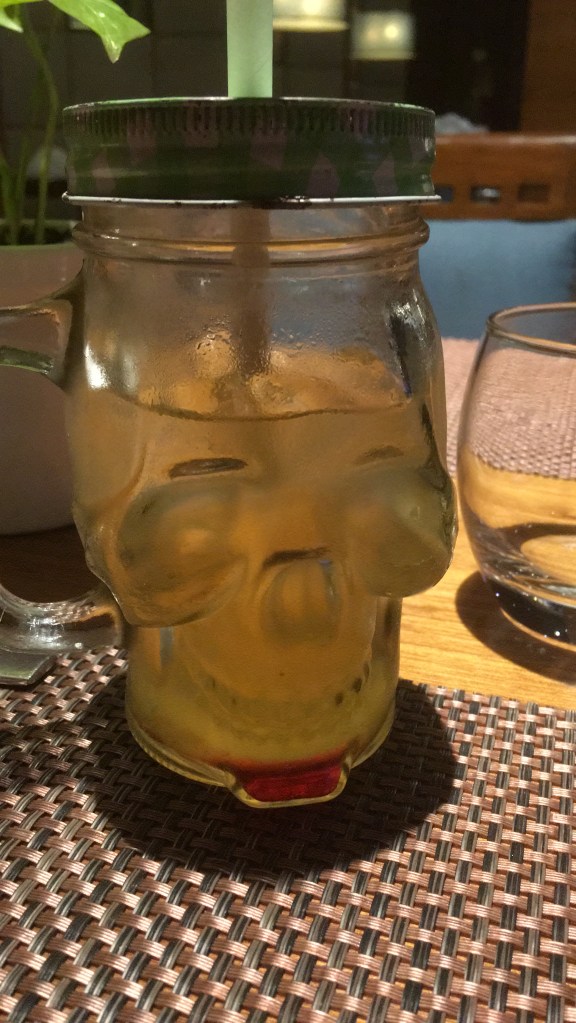
After my massage and the recommended glass of water and cup of green tea (“you will feel hungry by then!”) and not knowing the neighborhood, I opted for an in-house dinner. In a fit of ‘I earned this’ I ordered a cocktail, the only one without syrup or sugar. It was served in a skull shaped glass (or is it a dog?) with a rusty screw cap and a paper straw through a hole in the cap. It tasted like really bad medicine. I did not earn that, but by now I had spent my alcohol money.
The hotel’s main dining room’s claim to fame is fish and is named accordingly: “Something Fishy.” But there was nothing fishy about the restaurant. I had my best meal yet: two giant tandoori baked prawns and a garlic naan that did its name honor. I think I am going to be sweating garlic from all my pores for days.
When I walked into the restaurant the waiter to guest ratio was about 10 (waiters) to 2 (guest, myself included). After a while more guests came in, and more waiters too. I settled into a warm corner in the over-cooled dining room. From my corner perch I had a good view of the comings and goings of waiters and staff.
Decades ago, with an MSH colleague, since deceased, we played a game in a restaurant in Lesotho: spinning yarns about the other guests. We giggled until we were red in the face. I had so much fun spinning these yarns, partially because I was taught to never to judge people on their appearance – which is of course what we did, unapologetically. It felt rather naughty and irreverent. Although it is more fun to do this with someone else it’s still a great pastime when dining alone. On my right was a dour looking German or Swiss guy (an engineer no doubt) who washed down his meal with only one beer (Swiss then?), hardly ever looking up from his smart phone. No desert. Then entered a group of 4 middle-aged paunchy Indians and one young Anglo-Saxon. Everyone drank whisky on ice, except the young man who drank German beer; once I heard him speak I settled on the Saxon part – a German engineer, just out of school (although when he smiled he looked older, maybe 35).
I made him to be on his first trip to India, and watched how he related to his Indian table mates. At first, he was quiet but after two beers he was gesticulating wildly with his hands. I imagined he was telling what the Indian engineers needed to do to solve a sticky engineering problem. The Indians watched him politely, smiled now and then and stirred the ice cubes in their whiskeys. They were going to pay the bill, and they were here forever (unless they were going to emigrate to the US).
Watching the imagined drama being played out at this table reminded me of one of my many sins – talking too much about what I (thought I) knew to be true. I did not always read the signs of polite listening very well. I know a bit more now (I’d like to think). Although I will be presented as a wise expert coming from far away (some of it true), I will have to walk a fine line between the wise, the expert and the novice (on India certainly) . I brought Ed Schein’s Humble Inquiry to remind me about curiosity and not knowing.
After the long walk over uneven terrain yesterday, I returned to the hotel tired and sore. It was a good time to check out the spa and see if there was such a thing as a foot massage. There was no such thing but a ‘leg fatique remover’ seemed even better. It was as if the masseuse knew about all my joint problems and muscle tightness in my lower body, pressing in the right places, and finishing up with a bonus shoulders and neck massage. I came out feeling ‘relieved of my leg fatique’ and ready for a treat in the Saptami restaurant which served me a great breakfast in the morning. For the evening meal, I read in the elevator, loyal IHG customers would get a 25% discount. This amounted, essentially, to a free local beer and the remainder vanished after tips.
Back to my room I packed and set my alarm for (too) early so that I would be ready in case the motor cycle guide showed up at 7:30AM. It turned out I could have slept in as I learned he wouldn’t show up until 2PM. So much for an ‘full-day’ motor tour of the city.
I now had time to go for a swim in a large infinity pool on the roof. If it wasn’t for the enormous metropole surrounding us, as far as the eye could see, one would have thought to be on an exotic beach, complete with palm trees. I shared the pool with a flock of pigeons who must have adapted to sipping chlorine water as they flew to and from the pool with great vigor. They have taken up residency in a corner of the pool (not in the water) and didn’t budge when I swam towards them. This is clearly their pool but it didn’t look messy as one would expect. I assume someone must be cleaning their habitat frequently.
In the end the motor guide showed up at 3PM (still for a full-day city tour), so I canceled and had a bit of a shouting match with two rude company officials who blamed the miscommunication on me and the Holiday Inn and thus refused a refund. In return I crafted a rather unflattering review on Trip Advisor, serves them right! I was disappointed though, not only did I not have the city tour, I also wasted most of the day waiting for my guide.
I got an Uber driver who regaled me with stories about being in a call center (for Delta no less) and who may well be a more dependable tour guide when I get back, albeit it not on a motor cycle (my Indian friends did not like that idea anyways). I am now in my not so fancy but comfortable hotel in New Mumbai, close to the Reliance HQ where we will have a lunch meeting tomorrow. How well that meeting goes will determine whether I will be back here next month.
From slum dwellers to the Mumbai elite in less than an hour. They may not be the crazy rich Asians but wealth was most visibly on display by wedding guests at my hotel.
Whether rich or poor, it’s the wedding season. If it is anything like in Afghanistan (which I suspect it is), people will pull out all the stops, even when they have none to pull out. They will go into heavy debt to put on an impressive display, both in terms of clothing and food.
The people who celebrate their wedding at the Holiday Inn are, I presume, from the upper middle and lower upper classes. The women’s gowns are spectacular with lots of gold thread, silk in the most vibrant colors. The men are dressed in beautifully embroidered long shirts, long jackets and kaftans with headdresses that remind one of peacocks. If in Africa the women’s headdresses are most spectacular, especially in Nigeria; here it is the men that display their beauty (and wealth?) on their heads. I could just camp out in the lobby and watch the parade of beautiful people for hours.
But weddings are for everyone. Stages and festive lights strung between houses and trees can be seen (and heard) everywhere, including on streets, with drummers and dancers (stopping the already snarled traffic). From my fourth floor hotel room I can see a wedding celebration in full swing right now, just a few blocks away, with people parading onto the stage for picture taking, quite similar to the wedding rituals in Kabul.
I was reminded of the most spectacular wedding I have ever participated in, which happened to also be in India and which I wrote about on my blog more than 8 years ago.
Tomorrow I will have to move out of this wonderful hotel as no standard rooms are available and I am not willing to pay the hefty cost of a deluxe room. I will move to a more affordable hotel in Navi (new) Mumbai where I will meet my Indian team mates for a meeting at one of their clients on Tuesday morning. But first my motor tour of the city tomorrow morning.
Where to start, with my Mumbai impressions? After a magnificent breakfast I sorted out phone arrangements and organized a taxi to the meeting place, which the taxi driver found after a few phone calls with the tour operator. “Where you see a bunch of foreigners in front of the station, that’s us.” Indeed. I was early and had a coffee and pakora at the Café Coffee Day where, indeed, some foreigners were also waiting for the tour to start: a young Swiss couple, just out of high school, on their way home from a 3 months tour of Asia, a Chinese and Basque yoga trainee (“we have to sit cross legged all day and focus on our breathing, this is our first day free!”). I detected little enthusiasm for the course, which is still to continue for a bit. A second group emerged from the train, a Dutch couple and a man from northern India. The tour operator split us in two groups, the young people went off with one guide and I was in the ‘more mature’ group, which was nice as it included the Dutch.
Our guide, Sabina, hailed from the slum herself. She had finished her ‘guide training’ just 3 months ago. She had lots of data about the slum at her fingertips (size, occupancy, surface as well as health, legal, political and economic data). We saw the places where more than a billion dollars yearly gets made from recycling plastic, textile scraps, and soaps (yes, from the hotels!) and where breads are baked, leather processed and clay is turned into stoneware in various sizes. All the work is done in tiny holes in the wall, on roofs and in between houses when there is any ‘in between’ to spare.
We walked through the narrow (2 feet wide) alleyways known from the movie ‘Slumdog millionaire’ through which the kids run as they outwit the police. Being taller than the kids and not as good on my feet, it was a challenge to duck the live electrical wires above us and the open sewers below us, not always well covered. We learned about the legality of homes built before 1995, and then again, before 2017. Whatever is being built now is illegal. We wondered where one could possibly build more houses? Dharavi is full I’d say: 869,565 people per square mile (compare to about 26,000 in New York City), crammed into a space about two-thirds that of New York City’s Central Park.
The government has built high rises to get people out of the slum but people prefer to stay where they are. One high rise on the edge of the slum was built only 15 years ago. I guessed it was multiple of that. Public housing has a bad name just about everywhere I have seen it. Cheap materials are used for the apartments that cannot be sold on the open market. It makes one a cynic. On Thursday I am a guest lecturer at the MIT Peace University in Pune, which trains future politicians – Maybe I’ll ask the cynical question there.
After the easy-peasy in and out of South Africa, entering Mumbai from the air was more challenging. It seemed that all the jumbos of the world arrived at the same time. Thousands of travelers streamed in from all corners of the world into a gigantic hall. Advertisements along the long walk from the plane to the hall indicated that India plans to be one of the three most wanted tourist destinations in the next 5 years or so. If India is serious about this, it will have to up its game on immigration.
Half the immigration booths were unoccupied. There was massive confusion about what kind of line was for what kind of visa (electronic or not). Some people waited in one line for an hour to be told to start anew in another line. I spotted a line for ‘babe in arms/seniors’ and quickly shifted to that line, which still had me waiting for an hour, but it was faster than the line for everyone else, which moved at a snail’s pace. Next time I will ask for a wheelchair. That was the shortest line.
A gentleman in front of me (also a senior), with an American passport but from here, explained to me in broken English that in India you are a senior when you turn 60. I was well into seniordom and in the right lane.
I had met a young man while waiting to board in Boston who was also on his way to Mumbai, his hometown, for a holiday with his family. Since we left Boston late I didn’t have much time to chat with him in Amsterdam, and then found him again waiting for his luggage. He gave me some pointers on ATMs and taxis and then we parted company.
Once out into the arrival hall everyone wanted my dollars. I picked a forex counter at random and asked for the rate. This was negotiable and depended on how many dollars I wanted to change which is understandable since they take a hefty commision. I had been advised to change a little as the rates and commissions are pretty bad. In spite of the exhortations to change at least 500 dollars and get a rate fairly close to the official exchange rate, I went for the lower amount.
Next challenge was a taxi. Here too was much competition among the taxi booking kiosks. Again, I picked one at random. My taxi was tiny and rickety and the driver spoke only rudimentary English but he got me and my luggage safely to the hotel at 2:30 AM.
Mombai in the middle of the night is busy. People are populating restaurants, doing road construction, and just hang out, as if sleep is optional, at least sleep when it is dark.
I am glad I booked at the Holiday Inn because the brand is consistent and dependable. It is part of the International Hotel Group of which I have a loyalty number. It hasn’t gotten me much in terms of free nights but in Nairobi it admitted me to the club level on the top floor of the Intercon and access to a lounge that was much like an airport lounge (free drinks, free food). Here in Mumbai, once my number was entered he pushed a little flag with the company logo across the counter. It read ‘thank you for being a loyal customer.’ He also said it. After the Nairobi experience this was a little disappointing. I didn’t even get to keep the little flag on its tiny wooden pedestal.
Since I have two days here I booked two tours on Trip Advisor. One is this afternoon, a ‘Dharavi tour and street art walk.’ Dharavi is the biggest slum in Mumbai I am told by my friends in Pune. For tomorrow I booked a motorcycle tour of the city which had good reviews and will ensure that I am not stuck in traffic all the time. A report is to follow tomorrow night.
Now I have to figure out how to get to the departure point for this afternoon’s tour, which has sentences like ‘to check if you are in the right spot, verify that V-Jai Restaurant and Bakery is opposite and Cafe Coffee Day is diagonally opposite.’ I have had such an experience once, some place in this part of the world, where I walked three times following written directions, each time returning to my hotel with a question mark, and finally being accompanied by someone from the hotel. I won’t have this luxury today. Fingers crossed.
I don’t use Facebook much these days. I learned about all the devious ways that people with bad intentions ingratiate themselves with us first, so we share their posts and then the algorithms kick in. No more sharing or liking posts I don’t know the provenance of. I now mostly use FB to tell people where I am headed next in case someone I know is there too.
Such was the case during our South Africa trip. I was alerted by the daughter of good friends that her parents were in their South African home near Cape Town. A short side trip to Cape Town was already in our plans, after I finished my work, and this was even better.
We were picked up at the airport and taken on a tour. First to a lovely restaurant built around trees with a wonderful view of pristine beaches and the ocean with it’s cold water coming all the way from the Antarctica. We then drove the famous Chapman’s Peak road going north along the water’s edge and watching the Fynbos in all of its spring glory. At a pull-out overlooking HoutBay the second bottle of wine was brought out and we sipped a pink bubbly watching the bay and listening to stories about why it was called that way, and about Fynbos and about all sorts of other fascinating things to know about this part of the world.
Our friends know much about the history, fauna and flora of the Cape area which added a lot to the experience of driving northeast from Cape Town. We traversed the mountains through a tunnel and thought about the people with their covered wagons looking for a way over. The descent in the valley was our first peak at the ubiquitous vineyards, planted all these hundreds of years ago by people with a vision and a great tolerance for risk. Many of them my people (with Dutch DNA) as one of my colleagues said – stubborn like the Dutch, God-fearing and thumbing their noses at officialdom.
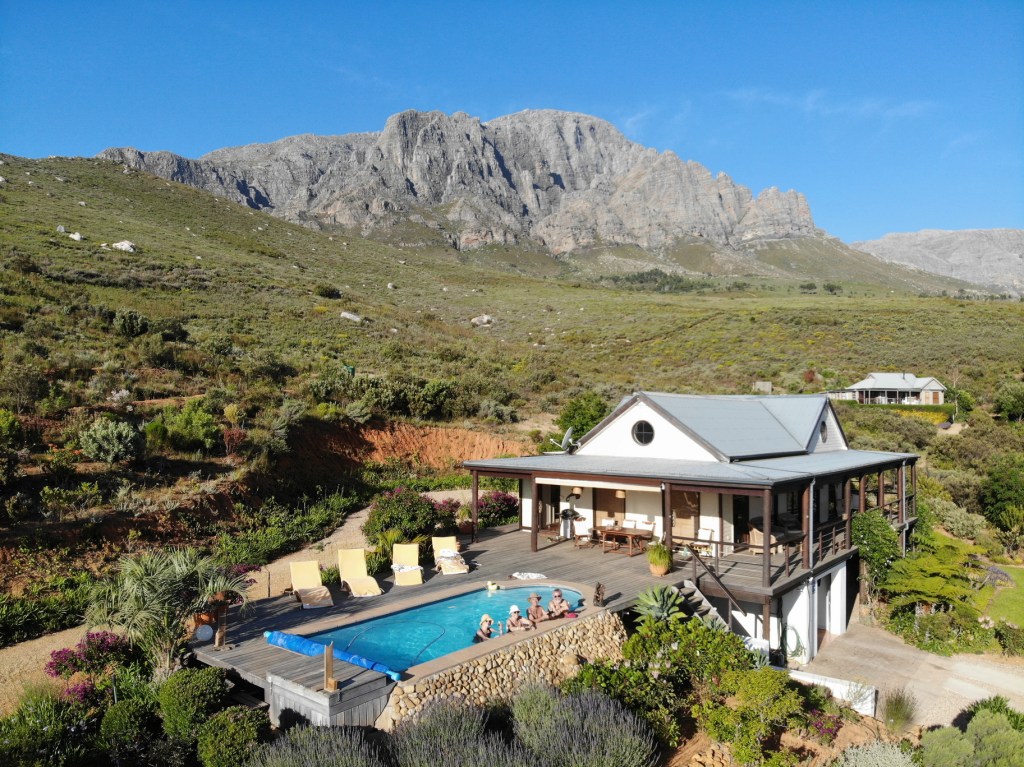
We spent three days at our friends’ lovely house they built on the side of a hill overlooking, far in the distance, the vibrant green of vineyards in spring and the scraggly mountains behind and in front of them – giving them two amazing views a day of the sun coming up over and then setting behind the mountains in a burst of pink, rose, mauve, orange, and purple sunrises and sunsets.
And then there were always the best wines, which they know a lot about and are rather picky about. A cellar full of bottles for everyday and special occasions, a swimming pool to cool off in at the end of a warm and dusty day. Again, with wine: a glass of cool rosé, a rosé pool party, with a small drone taking pictures of us in our bliss.We are heading home for Thanksgiving in a day, spending our last night on the continent in a hipster Cape Town hotel. There is much to be grateful about.
The ideas I read about in the plane to South Africa worked themselves nicely into a series of just-in-time agendas that came together, as I had asked the universe to do. We talked, we simulated, we extracted lessons during a variety of exercises that one can never do at work. I got to know people better, and they me; there is more trust now, which helps. People are more willing to make a trust fall alongside me.
While I was at work Axel explored Jo’burg, the art scene, musea and places to eat and have coffee. He had to figure out the transportation system and was warned many times (don’t go there by bus, don’t walk here, to get too close to the train station in an Uber, etc.). We are grateful that, back home, we are living in a place that does not require gates, razor wire, double locks, and so many warnings about safety.
With Christmas coming up (preceded by Black Friday, successfully copied here), people need lots of money. We got scammed at the ATM which allowed the scammer to buy something at Gadgets for 700 USD, probably a drone. Luckily my bank in the US is reimbursing me for the loss. Bad luck for me (at least at the moment, being scammed is a very unpleasant experience as I felt so stupid) and good luck for the guy who is now bringing back something amazing to his family. Although grateful that, in the end, the loss is not mine. When I came for my new bank card, the ATM folks at the bank told me that they were amazed this was only the first time for me, as they know about my travels (which I call in before each trip to alert them).
Coming home to our apartment at the end of the day, Axel directed us to yet another great restaurant and selected our wine. I am used to come to my hotel room tired and hungry and either ordering room service or sit by myself in a nearby restaurant, and maybe ordering one glass of wine. This was so much better. I think I can get used to hin traveling with me, at least to places like South Africa.
This is probably the last trip of the year, unless I decide to accompany Sita and Axel to Paris early December for a meeting of the Valueweb that both are members of. Or I go to Holland to visit my Irish twin brother who has been fighting multiple staph infections in a hospital in Holland. Or I go to India to visit my team in Gujarat to play and work a little, and keep pushing the string that is our proposal for working with the department of urban development in UP. All sorts of possibilities!
Yesterday (today? Last night?) we arrived in Jo’burg after the now familiar long flight from Atlanta. Aside from a few minor zigzags halfway through the trip, smack in the middle of the vast Atlantic ocean due to string headwinds, the flight was smooth. I had requested an upgrade to B-class but didn’t get it and so I folded myself in Delta Comfort seat 33D, next to a nice young man from Virginia who sets up call centers in South Africa (yes, he had seen ‘Outsource’). We chatted for a couple of hundred miles and then he fell asleep and I did not.
Axel sat 6 rows behind me on the other side of the plane and lucked out – an empty seat between him and a young man by the window who slept the whole way huddled over his tray table.
I read one book and then listened to another by the same author who I had just gotten to know trough a webinar on Thursday. Her approach (Cy Wakeman’s reality-based leadership), smashed a good part of my collection of taken-for-granted management and leadership beliefs. I loved her challenges to conventional wisdom, especially since they are backed up by research and resonated with my experiences, especially my recent facilitation experience in South Africa. It was a timely discovery as my proposed design got kind of thrown out the window and I found myself traveling to South Africa with empty hands/head as to what I was going to do.
I am slated to facilitate 5 retreats this week, three half day retreats and two whole days. The first one is on Monday and will be more of a design conversation as there is no agenda – only a list of topics. Searching for some way to turn the list of topics into a coherent agenda, the universe came to my rescue and put Cy Wakeman on my path. I will propose her ideas and see where we go from there. It’s a journey. I may propose a road trip as the central metaphor for all of the retreats this week.
We landed in summer (85F), 7 hours ahead of the wintry cold day of departure. In the olden days this would have been a change of enormous proportions (imagine a 6 week voyage over stormy seas and no land in sight for weeks on end). But now it’s a cinch and we take it all in stride. It’s an important perspective to hold as we will be talking a lot about change this week (but not about change management, as that is one of the concepts that I have now jettisoned).
We are lodged in a low rise apartment complex that is around the corner of a number of restaurants, their terraces filled with people enjoying wine and good food. Axel is in heaven: good wine and a nice steak with Malagasy pepper sauce. I was also in heaven with a well prepared steak tartare and a nice glass of South African Sauvignon blanc, something we rarely get in the US where New Zealand dominates that Sauvignon. Although very tired (and alcohol not usually a good idea), we ordered the most expensive bottle of red wine (US$20), thinking we would each have a glass and then take the bottle home. We ended up drinking the whole thing, managed to walk in a straight line to our apartment, just meters away. And then I collapsed, to wake up in the middle of the night and write.
During the 7 hour (day) flight to Boston I passed the time doing one electronic jigsaw puzzle with 1024 pieces. It takes me about 8 hours to do such a puzzle. I can do the puzzle while also watching things on the screen in front of me if the audio is more compelling than the visuals.
I stopped watching movies as they are either violent or stupid. Of course, I cannot entirely escape the violence as it is flickering on countless screens within my field of vision. I watch documentaries, about anything.
I had four to choose from and watched them all: one about blockchains and how they make those in control of money flows nervous, but also how UNICEF and WFP are using blockchains to help refugees and displaced persons. I still don’t really understand the whole idea of blockchains and crypto currencies but was happy to see examples of how they are being used for good. Then I watched a documentary about whiskey (‘Scotch’). I learned that there are 50 year old whiskeys sold in handblown bottles for 10,000 pounds or more. It must be the Crazy Rich Asians that buy these things. I thought paying 80 dollars for a bottle of whiskey at the Edinburgh airport tax free shop was ridiculous.
Then I watched a wonderful documentary about the late Toni Morrison which made me want to read all of her books; and finally, the best of all the documentaries (and one I could give full attention to because my puzzle was done), was about Luciano Pavarotti.
With operas in my head I landed in Boston. Axel picked me up and we headed to the new Whole Foods Market in Beverly. The contrast with Niger was rather stark: abundance versus the basics – the check-out bill was too. Back home it was Axel who took a nap while I unpacked and did the laundry.
The Pavarotti music (La Boheme) still lodged in my brain, my eye was directed to an ad for a concert that same very night (and only that night) in Newburyport with a professional vocal ensemble (Skylark) that would be performing Rachmaninoff’s Vespers. October 25 thus became a very long day, as we went to this extraordinary performance. I wouldn’t have missed it for the world.


 Sylvia's Journal
Recent Comments