Archive for the 'On the road' Category


Pleasant surprises

In Boston, when you ask about the weather, you are supposed to say, “wait a minute.’’ But here in Scotland we learn what fast changing weather really means. Boston, and New England, have rather stable weather patterns compared to here.  You can literally have all seasons in one hour. A day in Glasgow required layers: a tank top for when the sun is out, a cardigan for when the sun disappears behind dark clouds which can come out of nowhere, a rain jacket for when it starts to sprinkle and an umbrella and more serious rain jacket  (a Mackinosh) when all hell breaks loose. No snow and sleet yet.

After my haircut and Axel’s nap we sauntered around the neighborhood of the hotel – which is visibly influenced by Mackintosh, all art nouveau and decently priced as well. Again, the staff is from other continents – it appears that Scots either cannot or want not work in the hospitality industry.

We found a lunch place that advertises its offerings accompanied by data on calories and proteins and such. We could have known since it is called Kcal. The name seemed rather boring or scientific but the menu was wonderful. It clearly catered to the young and health conscious working people employed in the neighborhood. Since I am not checking on weight these two weeks, we ate, as we do all the time, with abandon.

We sorted out the bus system and made our way to see various Mackintosh legacies – first The Lighthouse. We clambered all 500 or so steps to the top of the Lighthouse to survey the city scape of Glasgow. A friend had told us that Glasgow was industrial, awful, grimy, ugly. And besides it rains there all the time.  It is probably good to go to a place with no expectations at all. It led to some pleasant surprises.

Our second Mackintosh stop was the Hunterian Art Gallery to admire the family home of the MacDonald/Mackinstoshes that has been re-assembled inside the gallery. We arrived rather late in the day, just an hour before closing. 

After the Mackinosh’s house, we had just enough time to admire the many fabulous life size portraits of women painted by Whistler. The women in these portraits are truly ‘magnifique.’ I wished they’d been exhibited all by themselves against a white background.

Much like the fishmonger in Portobello, closing up time means turning the key and stepping out of the building. Thus, preparations for closing start long before the actual closing time.  By the time we were ushered out by a gaggle of museum employees hovering by the exit door the toilets were already locked. 

We ended our day in a pub, where else, me sampling another interesting whiskey and Axel a pint. Across the street we noticed a fish restaurant and, as by invisible threads, were drawn there. More oysters, more salmon,  and a gin tonic sampling a few more of Scotland’s great gins.  We think Glasgow is a cool place to visit and two days is much too short.
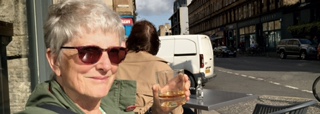
A good hair day

We are in Glasgow now. We took the slow train by mistake. The trip took 45  minutes longer than the express but it turned out to be a good thing, as sometimes happens with mistakes, because several thing happened that would not have happened otherwise (synchronicity I guess). One: we had a delightful chat with the conductress who had little to do since few people got on in Edinburgh and those that did, got off in small villages along the route. Two: we had a table and four seats to ourselves for the whole trip – which took place during the morning rush hour.  

Three: upon arrival at the impressive Glasgow central station, we had a chance encounter with a foodie guide who pointed us to the best coffee place in Glasgow. Four: we arrived at the hotel before normal check out time, yet there was already a room ready for us to move in when we had expected to just store our backpacks. This meant that Axel could take a nap while I went out to find a hairdresser to cut away some of my locks which were getting too heavy and too wingy.

We had passed by several hair salons on our way to the hotel and I picked one I could look into and that appeared quiet enough to take a walk-in. The sticker price was a little high but when the maestro himself checked out my head and hair and said he could cut it in such a way that it would last for 2 months, the price became very reasonable. 

All along the walls were pictures of the maestro himself with various famous people, including Bill Clinton (though he confessed he had not actually cut his hair). He set to work on my hair as if a painter in front of a blank canvass. We chatted about white/grey hairs and the wisdom of grey hairs – though he said he had encountered many grey-haired people who were not wise at all. His own hair was totally white, but it turned out to be dyed because his grey/white hairs were not thick like mine and had become transparent. Although he was nearing retirement age he said he loved his work and would not stop until he couldn’t work anymore. He said his haircut was going to make me look younger, and was that OK?

When he was done with his artistry (an artist he was indeed), he gave me a kiss on the cheek and his wife took my 65 pounds. Upon leaving the hair salon, with a bounce in my step because I was so much lighter, the sun came out and shone on my new coiffure. Seeing sun in Glasgow is, we were told, a very unusual thing.

With a lighter head could enjoy
Tallisker whiskey on Argyle Street in Glasgow so much more

A day of rest

We are getting used to ‘overcast with sprinkles.’ It’s actually quite like being in Holland. It was a perfect day for planning our next moves. We organized our visit to Glasgow and in doing so found a wonderful blog. We learned about the 10 must see Charles Rennie Mackintosh sites which Axel duly noted in his little book of important things. 

We badly needed a day without walking to give our sore ankles and legs a day off. It meant Epsom salt foot baths, and leg massages (self and other). We therefore drove rather than walked the short distance to the train station to collect our tickets from a machine. The short drive through quiet streets also gave Axel a bit more time to get used to where the gears are (especially the reverse) before we embark on our long trip north to see my friend from long ago who lives near St. Andrews. 

After we picked up our tickets at the train station (by now it was well into the afternoon) we  settled into our favorite café on the Promenade where the wait staff is recognizing us. We were introduced to the only real Scot on the staff (everyone else, including the owner are from other continents). When we told him about our adventure to North Berwick he corrected our pronunciation of the town’s name: there is no ‘w’ in there at all,  it’s ‘berrick’ with lovely soft lilting ‘r’s. 

I sampled the most local hamburger on the menu: a patty of beef topped by a patty of haggis topped by Scottish cheddar (an obvious sign that I stopped worrying about weight), washed away with a pint of local beer.  A great combo!

While Axel kept his seat dry during a series of sprinkles, sketching and watching the activities on the beach, I walked up to High Street to get our dinner at the fishmonger’s. It is the first time we are eating in. We have been very true to our intention to spend all the money we saved (by home swapping and using frequent flyer miles) on eating out. Our fast increasing Amex balance is proof.

When I returned to the seaside it was the cocktail hour. We sampled two varieties of gin, diluted by tonic. There seems to be a huge marketing effort to lure people away from whiskey to gin. One bar we visited had a sign that said ‘Unlearn Whiskey’ with a few gin suggestions underneath.

Back home we chatted by phone and facetime with our British friends from those momentous days long ago in Beirut. There were others in that small community of foreigners who we knew, though didn’t stay in touch with. Some were accidental reporters, others professionals whose voices we still hear now and then on the news. We learned that two of them live nearby, one in Edinburgh and one in Glasgow. Suddenly one more week doesn’t seem all that long anymore.

A south coast outing

We are one week into our Scottish holiday, which means we are halfway. Days always go by faster after the halfway point.  We now actually have to schedule things as opposed to simply doing nothing till midday and then scrambling.

There are several visits on our program: a couple more musea in Edinburgh,  a visit to Glasgow, primarily to see Charles Rennie Mackintosh’ work for ourselves, and then a bunch of people: our artist friend Robin who we met through a common friend back home, our new Quaker friends, and a friend from third grade who I haven’t seen in nearly 50 years.

Yesterday was the first full day of blue sky. We took the car. This convenience comes with the exchange (freeing up more money to use for food!). We traveled south to North Berwick, not to be confused with traveling north to South Berwick which is in Maine, USA.

Despite having driven cars with automatic transmissions for decades, it took us no time to activate the old muscle memory for a stick shift. The driving on the wrong side of the road took a little more getting used to, but we have done it before. It’s easier when there is other traffic, one simply follows. It is a little bit trickier when you are alone on the road and there are cars parked with their noses in the wrong direction. This has occasionally fooled me.  We took turns driving and navgating.

North Berwick, we learned from several plaques placed around the beach area, was called the Biarritz of the North, a popular destination for Edinburghers during the European interbellum years. A few traces from that time are still there.  There were also people living here hundreds of years ago.  One of the places was a pilgrimage site, among other things to enhance the chances of getting pregnant. It worked, said one plaque. It must have, we concluded.

When you enter North Berwick’s Scottish Seabird Centre you could be fooled into thinking it is just a fundraising ploy to get you to buy lunch and trinkets.  After a thorough search of the premises we found, in a poorly lit corner, a set of stairs going down to the actual center. We were greeted by a screeching bird when we stepped on a wired stair tread. This must be to announce the rare visitor to the young naturalist who happily took our money.  We get a discount because we are old (it’s called a concession here, presumably a concession to our seniority). 

Having no other cash register duties, we benefitted from her considerable knowledge about the seabirds that are nesting on the volcanic islands in front of the coast. On one such rock several 100s of thousands of Northern Gannets (the biggest in the world!) are nesting.

Wired cameras are set up on several of the volcanic outcroppings. You can zoom in and out and change the angle of the camera so you can see, on big screens, what the gannets, puffins and other seabirds are up to.  

From a distance it looks like the Gannet rock (Bass Rock) is covered in snow, but when you zoom in the whiteness is explained: all bird and all poop. It wasn’t always white. Our guide showed us pictures from earlier days. Now that the birds are no longer hunted, there are too many. It’s just like New York City, or Lagos, Bangladesh or Shanghai. In one of the views we could see that personal space is jealously guarded – encroach at your own risk – you can get a good lashing or a bite in the neck. 

We ended our beach day with another dinner splurge – a seafood platter for two. In the US we avoid seafood platters since they are always stacked with fried things, dripping with fat. Not here. Like our first seafood platter on the Leith Waterfront, this one too was stacked with identifiable, healthy and colorful things: lobster, mussels, smoked salmon, crab and salad greens.

A sunny Sunday

We finally visited one of Edinburgh’s biggest tourist attractions, the Castle. The fog over our understanding of what the fighting was all about is lifting: the castle of course, but more importantly its riches: immeasurable riches, those already in hand (the Honours, the name given to the Royal Paraphernalia) and riches to be had from all the lands and the taxpayers living off it and any other loot available to the winners. 

We had also been curious about The Stone, the place on which Scottish kings had been crowned for hundreds of years and which the English had kept until not very long ago. Both the Honours and the Stone are back inside the castle after being lost or carted off to England, centuries ago. We lined up with people from all over the world and waited patiently to have a fleeting glimpse of the these symbols of royalty, encased in glass in a tiny windowless room with metal doors of the bank vault type, impregnable and unstealable.

There must have been thousands of people traipsing up and down pathways and worming their way through narrow entrances into small rooms not made for such crowds. Although the audio guide told us we were in for a good 3 hours, we decided not to stay that long as the crowds were getting to us.

We returned to the café to have our smoked salmon for lunch. The Quakers who had gone to the later meeting as well streamed out just as we were served our lunch and bloody maries (Mary’s?)

[Sidebar: I had wondered whether the drink was named after Mary Queen of Scotts, because of her bloody death but later learned from Wikipedia (right or wrong) that it was named after the Tudor Mary because of all the bloodshed she caused.]

We chatted some more with our new friends, making firmer commitments this time.

We finished our lunch just in time to catch the start of the Carnival Parade on the Mound below us. The sun came out (and miraculously stayed out for the rest of the day) doing justice to all the glitter and colors. At least three quarters of the parade was made up of Asian groups, some dancing (the Chinese and Thai) and some not (the Nepali and the Tibetans and their supporters) but everyone was making music on drums, with bells, with trumpets.  Unlike the more serious Carnival Parades I have seen in other parts of the world, this was more of a home-made one and for that very reason very charming.

From the frivolous and the raucous we went to the hushed rooms in the National Gallery since we were standing right in front of it. We admired many great portraits and landscapes until my legs said ‘enough!’ It was the cocktail hour anyway. We landed in an old pub and had our pints. I also sampled a whiskey and learned, from a friendly Polish bartender, how to drink it properly: a drop of water trasnferred via straw from a water glass to the bottom of the whiskey glass. This apparently creates a chemical reaction that enhances the drink (and who figured that out I wondered). Axel’s mother splashed her whiskey with water, doing it all wrong all her life!

I pitied the bartenders being inside on such a lovely day but they didn’t want my pity as they thought it was much too warm. It seems that Poles and Scotts alike think that 65F is warm enough. It must have been in the mid seventies on the terrace outside, lovely!

We finished our day with a bus ride to the Leith waterfront and splurged again on a seafood extravaganza: oysters, mussels, salmon, crab and shrimp, all locally sourced.

New F/friends

I thought it would be interesting to see what an Edinburgh Quaker Meeting for worship would be like. We had looked up where the Quakers congregate and decided to set the alarm very early so we could attend the early meeting at 9:30.  We set it even earlier than necessary so we could have a coffee before retreating in silence.

The Quakers we know are, in general, not great dressers. They don’t put on a clean starched shirt or a dress, but we didn’t know and so we did. That turned out to be unnecessary. None of the women, we discovered, wore dresses or skirts, even the most grey-haired ones.

Since Quakers originated in this part of the world, in the mid 1600s,  Quaker Houses are often in the older parts of towns. The Edinburgh Meeting House is a majestic old building in the Old Town. As it so happened, the coffee we had planned to drink was being served right next door in Scotts Café. We settled into our seats on the veranda high over Victoria Street, sipping cappuccino (served again by Poles) and waiting to see who would open the door of the Meeting House. 

On the door a copper plaque said that worship services start at 11, and here we were at 9. We were already planning a second breakfast (eggs benedict with salmon) when the door was opened. As it turned out, Edinburgh Quakers are given a choice of how much of their precious Sunday they want to give up. If you worship at 9:30 you are home (assuming you live in the city) at 10:30-ish. But if you worship at 11, you probably won’t be home until 1PM because the time for worship is longer (one full hour) and soup is served afterwards leaving much more time for ‘fellowship.’

We were greeted by Mike the manager who explained everything about the two meeting times and sent us up several flights of stairs to the top floor.  There we sat in silence for 45 minutes, scattered across a very large room that could hold many more than the 10 of us. In spite of the overcast sky, light streamed in through large windows from three sides, high above the hustle and bustle of tourists making their way to Edinburgh Castle.  

At the coffee hour, in between the early and the later meeting, we met with our fellow Quakers. When we were ushered out, not willing to spend another hour in silence, Axel had practically arranged another house swap,  and we had invites to one home, a coffee in another later this week and a garden party.  The welcome was very warm and we may well return next week, now as old f(F)riends.

Dog-friendly

Because we started the day so late, by the time we were done with Holyrood everything was closing, except of course the pubs and the restaurants. The free concerts were breaking up and wherever we went stages and market stands were being dismantled. The good thing was that the rain never came and the sun was out. We sat for a while on a small grassy hill overlooking the Grassmarket with some 50 other people who were not waiting for anything, just having a good time talking with each other and drinking their beers out of plastic cups.

We took the bus back to Portobello and had a meal in the quirky Espy restaurant on the promenade where we had our first meal the day we arrived. We sat in the dog friendly section of the restaurant and were served by the American wife of the Australian waiter we met the first time there. Dogs were everywhere, something Boards of Health in our neck of the woods would definitely not approve of. I sent a picture to Tessa – she’d like this place. Dogs were even stretching out on couches. A sign warned owners that only well behaved dogs were allowed in: no barking, no biting and no humping.  

Unlike in Manchester, dogs are allowed on the beach here, presumably all year round. In Manchester by the sea dogs are not allowed on the beach between May and October for obvious reasons – our beaches are small, narrow and thus crowded in summer compared to the very long and wide beach here. Not allowing dogs in the restaurant would limit patronage. Staff served small liver cakes and bowls of water to the pooches alongside the meals ordered by their owners. 

By the time we had finished our meal the temperature had dropped to 59 degrees (F) and a strong wind gusted along the beach. People were dressed in woolen hats, boots and down coats – none of which he had with us. Axel always says there is no such thing as bad weather, only inappropriate clothing, how true! We shivered as we walked back to the bus stop rather than walking the last mile home. We are on a summer holiday but this felt like fall. I checked the temperature back home: 77F and sunny. I wondered what the winters must be like here.  Back at the house we filled the bathtub with very hot water to get our temperatures up and relax our tired legs.

History lessons

Today was for history. We had intended to rise early and get as much bang for the many bucks we paid for the tourist hop on and off buses. Alas, we didn’t get out of the house until past 12 and the ticket expired at 3:45 PM. We just got in a tour of the old city, see the Grassmarket with the free part of the Jazz Festival in full swing (3 different stages, one at each end and one in the middle). I wished I had been more forceful about getting off – it was after all a hop on/off bus, but Axel prevailed and I waffled, so we ended up at the palace of Holyrood while the sun was trying to get out from behind the thick cloud cover. Rain was predicted at 4PM and I figured that at 2PM we should be listening to jazz ‘en plein air.’ But we didn’t. A mistake.

An excellent audioguide took us from room to room and explained what we saw before us. We were reminded off our tour through Versailles where the sequence of rooms also led, eventually, to the monarch’s bedroom where a few very important people could see him going to bed and waking up. What a strange arrangement this now seems to us. 

We tried to keep track of all the Davids and Charleses and Jameses, Stuarts and Tudors, but the (en)tangled history of the English and Scotts remains hard for us to get our heads around. This evening, when I read the history section in one of the guide books I understood my confusion: James VI and James I are one and the same person (as are James VII and James II), the higher number is what he was for the Scotts and the lower one what the English called him. I also learned more about the intertwining of the Stuarts and Tudors, who was catholic and who was protestant, the Hanoverians, the Jacobites, and who was angry about what with whom, etc. 

We keep finding it strange, now being a tad more familiar with the history of both countries, that they are together. To me Scotland and England seem two very different countries. How a monarch who resides most of the time in one country can show up one week a year (and for special occasions) in Edinburgh and be the people’s monarch here, strikes me as odd, unless you call both countries together the United Kingdom. But shouldn’t kingdom be plural then?

Pounds and pounds and pounds

There are many meanings of the word pound. They are all part of our Scottish experience: the money, a measure of weight (these two related of course) and the manner in which rain sometimes comes down. I’ll explain.

We start each day late, catching up on sleep I suppose, but also because we are on a steep and tiring learning curve regarding getting around Edinburgh on not too much money.  We want to spend our money on food, not transport. Our first mistake was to pay nearly 4 pound Sterling (per person) for a train ride into Edinburgh which turned out to be the next stop, five minutes after getting on. 

The parking attendant at the local supermarket is giving us advice on getting around for as little money as possible, very Scottish of course. He offered to give us his cell phone number but I can hardly understand him when face to face so I declined before Axel could say yes.  He told us we should have asked him about the train (a rip off, said with a hard rolling ‘r’). The bus system is excellent and easy if you have the right apps, difficult when you don’t have that nor exact change and a dour bus driver to boot.  It took some time to get all the verifications completed for our online registrations but now I can simply show my electronic ticket to the bus driver, and check out where to get on what bus via my phone. 

Yesterday we visited the  Royal Botanical Gardens (nearly everything on the ‘have-to-see list has the adjective ‘royal’ attached to it). We were lucky because the sun was shining during most of our visit, and even when it was not, it was dry. When we boarded the bus to the next attraction it started to rain. First a sprinkle and then a downpour that lasted throughout dinner and during our mad dash to get to the bus to take us home. 

We picked an indoor attraction to stay (mostly) out of the rain: a visit to the Royal Britannica. The ship has been retired here (berthed being the opposite of birthed) and been pressed into tourist duty.

Axel was most impressed by the picture of the Review of the entire Royal fleet in 1953 (imagine that, all of the ships around the entire world being summoned to this review – the empire unguarded!). The bedrooms were surprisingly simple and basic – the royals’ (separate) bedrooms resembling more a 3 star hotel room than a royal suite.

I kept trying to imagine life on the ship with the royals on board, helped a bit by the many pictures of family members smiling at the camera. I am not sure it was actually a very happy place.  The ship must have been yet another gilded cage, with several hundred people around to serve their every wish and watch over them, no picking your nose without anyone noticing! 

Despite the relative simplicity of the personal quarters (except for the state dining room), the ship is a relic of a bygone era, a time when excessive spending and showing their wealth was what royals did.

I suppose the major means of transportation is now the Royal Airplane, which cannot take on all that silver and crystal, the 5 tons of personal items, food and drink -to feed hundreds for at least a month-, and the royal means of transport (Rolls and Jeeps). I also believe that such display of wealth is no longer cool, at least not in this part of the world. Nor is the display of gifts that required rare species of animals to die or give up body parts and paying respect to dignitaries whose wealth came partially or wholly from destroying these animals’ natural habitat.

By the time we reached the fourth of the five levels – the ground level where the Royal Rolls and the Royal speedboat are parked – it was raining cats and dogs. We skipped the last stop (the engine room) to catch a bus back to the center.

Since we had not spent any money on flying (Delta miles) and lodging (Home Exchange), we decided to ignore the prices on the menu of the seafood tapas place (The White Horse) – yes, click on it and see for yourself). We splurged on exquisite oysters, sampling three Scottish and one Irish variety , scallops, smoked salmon, and razor clams, seaweed salad and white wine (the latter recommended by our Polish waiter).

We briefly discussed Brexit with the waiter who doesn’t think it (Brexit) is going to happen – I suppose this is a matter of self-preservation. He told us that if EU citizens become foreigners, the hospitality sector will find itself very short handed. So far most of our waiters have come from the mainland.

Because we have reserved most of our money for food I am steadily gaining weight – I know this because there is a scale in the house. It is not surprising because nearly everything we eat and drink here is of very high caloric content. And since my daily exercise regimen has stopped altogether (walking doesn’t get the job done), I am afraid I will come back with a lot of extra pounds, these not of the Sterling kind.

Redhead capital

Axel is in ancestral lands. I am in the neighborhood of mine, now buried deep beneath the North Sea but that was thousands of years ago. Axel’s link with Scotland is closer. His maternal grandfather was a red-haired Scott who passed that gene to his mom (recessive) who passed it to him (red beard only) who passed it to Tessa with her copper tresses.

We expected to see many redheads when we first arrived on Tuesday but we saw none. We started to count. By the end of Tuesday, when we tumbled exhausted in our bed, the tally was only 1. By then, all we had seen was the airport and the Portobello section of Edinburgh.

On Wednesday we continued the count as we made our way in to Edinburgh. During those moments that the sun shines, the redheads stand out. Our lunch waitress was red. By the time we were done with lunch we had counted about 15 redheads who had passed us as we were sitting in one of the rare moments of sun on an outside terrace. Once we started walking around we stopped counting because they were everywhere. 

Our waitress told us that 34% of Scotts have red hair. It turns out she got that slightly wrong:  DNA research on the British isles, and particularly the south east of Scotland, has found that about 40% of the population has the gene for red hair, though  that doesn’t mean they have it.  The numbers of actual red heads differ. There is a lot of boasting between Ireland and Scotland about who has the most redheads – one or the other claims to have 10% of the population, the loser with only 6%. A quick search on Google however,  indicates that most agree that Edinburgh is the red head capital of the world. 


December 2025
M T W T F S S
1234567
891011121314
15161718192021
22232425262728
293031  

Categories

Blog Stats

  • 136,984 hits

Enter your email address to follow this blog and receive notifications of new posts by email.

Join 76 other subscribers