Senior official are very busy here. Yet they will spend hours each week sitting around conference tables waiting for their peers or bosses to arrive. They use the time for small talk, maybe some coordinating and communicating, and I am sure some complaining but I would have to speak a lot better Dari to confirm that. No one checks their watches as we westerners would have done.
I use the waiting time to learn a few more words and try out my Dari on one of the non-English speaking office staff. When I ask for tea and it doesn’t come, I know I need to work on my pronunciation. When it finally comes it is like I passed the orals (with a tangible reward for it).
One of the department heads indicates that he is too busy to attend this meeting and should have sent his deputy. I tell him that I would like him to stay at least for the visioning part. He says that he already has a vision. We spend the next three hours in conversation about the challenges and dilemmas for people at the top. We have a long discussion about power and then they draw their vision, a few under protest. The vision drawings, when put next to each other, produce a fairly complete picture of what the directorate is striving to accomplish. People smile. It is more compelling that the very abstract and boring language that they started with.
The morning serves as a diagnostic for me and as a mirror for the the chief and his department heads. The people who said they would leave because they were too busy for this meeting stayed. I consider this a victory. We don’t get the entire agenda finished and I am not clear how and when to continue our conversation since my departure is in sight. It is now abundantly clear that I cannot do this work if I zip in and out for two weeks every six months.
I ask if I can sit in on the team’s next staff meeting on Sunday. This would provide me with another opportunity to see how they work together and possibly continue our conversation of today. Now that the group has a vision, the next step will be to find out what blocks them from this vision or keeps them stuck in a place they want to leave.
In the afternoon I facilitate another conversation with the technical advisors from the project who will soon leave their comfortable offices at the MSH office and move in with their counterparts in the ministry. It’s a complex undertaking with many unresolved issues, dilemmas, worries and fears. None of their bosses are around, intentionally. The discussions are earnest and frank. It is clear that much needs to be ironed out before the move can actually take place.
When most people have left, Steve and MP congregate in my temporary office. We talk about what we did today in between yawns. It is time to go home, the weekend has started. Only Dr. Ali stays behind to participate in the worldwide staff meeting in Cambridge where it is 9 in the morning. I had hoped to follow it from the guesthouse but never get the audio right and while messing around with it miss the entire presentation from my colleagues back home I had looked forward to.
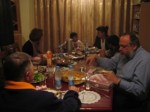
Dinner is another slow and wonderful affair with many stories and Janneke’s home cooked nasi goring to complement all the other dishes made by the cook today and yesterday’s leftovers. We have food aplenty.
It’s now the equivalent of Saturday night and so we plan to watch a movie but can’t figure out the video, so we watch the news about Pakistan and Western Afghanistan. As the crow flies these two places that are near but I look at the news as if I am in the US.


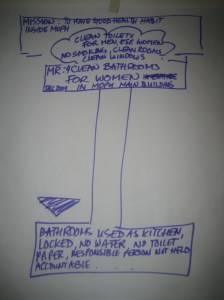 I challenge the two young women trainers to take the lead on this initiative. At first they say it cannot be done and I question them about stopping before they have even started. Everyone gets very busy telling me why it is ludicrous to even try. It’s a perfect set up for talking about leadership. People do want to be leaders but they don’t want to change things, or don’t think they can. We use the challenge model tool that we are teaching to everyone here.
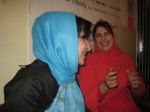 They discover more mistakes in the Dari flipcharts they prepared and giggle some more. I admire their resilience – they are pioneers for their sex. I ask a male colleague who has been observing with me, and occasionally translating, how big a barrier these women are trying to break through. He tells me proudly that having younger women teach older and senior males is OK in his department. It is quite an accomplishment considering that only a decade ago this would have been unthinkable.
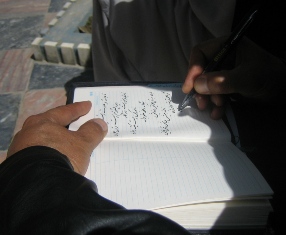 On our way out of the ministry we run into a man who is the son of a famous Afghan poet, and the brother of another, both named Mushda. We ask him about a poem that we can use in the sessions with the senior leaders that will help raise spirits and speak of unity and collaboration. He immediately starts to pen, in beautiful handwriting, in Ali’s diary, a poem that his father wrote 50 years ago about unity between Sunni and Shiites, between Pasthuns and Hazaras. As we walk out of the heavily barricaded ministry compound onto the street I ponder this extraordinary encounter with poetry right in the middle of the ministry’s flowering courtyard.
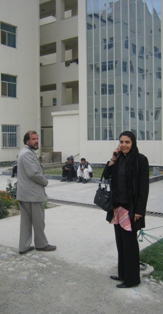 Zelaikha lives in a high rise complex that is visible for miles – several multistory apartments with a bright red roof on top amidst colorless one story mud brick hovels built by people coming in to the city from the rural areas. Eventually these mud brick dwellings will be demolished and the people pushed further out onto the slopes of surrounding mountains, to make place for more of the high rises.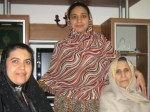










 Sylvia's Journal
Recent Comments