Archive for the 'On the road' Category


Ready or not

More drawn out meals yesterday but more working too; our two days of forced staying at home are over. I produce two designs for the retreat that starts today, or is supposed to start. I am ready for surprises; in fact, I expect them. For one I have had no contact with the team we are supposed to facilitate and have therefore been guessing what people want, both as a process and outcome. And then of course we have no idea whether we will have two days and that the right people will show up.

For lunch we go to the nearby French bakery. It is run by a French couple; the man is a former oil rig engineer turned baker and the woman, whose name is, fittingly, Ariana, a former teacher and administrator. They have been in Afghanistan since 2000 and worked at various NGOs before deciding it was time to start their own (Le Pelican). They combine the art of making French breads, pastries (‘tartes’), croissants and quiches with the education of Hazara children who used to be scrounging around for scraps of food in garbage pails.

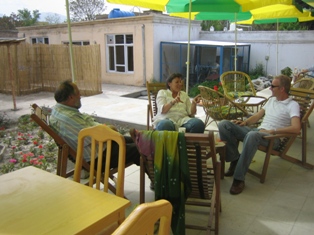
The place is lovely: a garden full of flowering geraniums, and various sitting areas, places for dining as well as comfortable lounge chairs around low tables – the kind that invite staying the whole afternoon with coffee or tea and a good book. The café serves breakfast and lunch, fresh juices and bakery goods that make you think you are in France. kbl_french-bakery

We enjoy a delicious lunch of quiches, a feta pie, an omelet, croissants, and coffee with a giant meringue for dessert. The food is served by teenage boys in a striped peach colored vest over a white starched shirt with a bow tie, speaking impeccable English as he takes our orders, brings our food and clears the dishes.

On the wall inside the café are pictures of the baker-husband with his young apprentices. It’s the perfect combination: eating well and doing good at the same time since the income from the café gets plowed back into the organization that educates over a hundred Hazara boys and girls in morning and afternoon sessions.

After lunch I sit on my balcony and produce a watercolor painting of the otherwise ugly Guesthouse One across the yard while listening to choral music from Brahms. My amateur water color sketch makes the place look better than it is – probably because of the splashes of light green to capture the budding trees and the grape leaves that have just started to come out of the ancient looking grape vine stock. The famous Afghan roses are not yet out but buds are visible. I think they will pop open when I leave.

For dinner we finish the last leftover dishes and I create a salad out of the last veggies that have not rotted yet. Tomorrow the cook will come and we can start afresh. We eat our meals sitting around the TV so we can follow the swine flu story and I am wondering when Afghanistan will show up on the color coded map. We watch another WHO press conference. MP is chomping at the bit -she wants to be out there in Mexico, investigating.

Homebound 1

Yesterday was the first of our two days of being grounded at the guesthouse. It’s kind of nice; no alarm clock, no hurried breakfast. Instead we have a long drawn out meal; MP, and myself in our jammies, Hans and Steve already dressed. It is like Sunday back home. No hurry, nowhere to go. We all do have work to do and we are all procrastinating – we spin out our breakfast as long as we can.

Swine flu is the first topic we tackle. MP’s eyes light up – as an infectious diseases specialist this is what she’s here for in this world: to combat microscopic enemies and keep them away from us fragile humans. She is a fount of knowledge, using words I don’t understand. Steve and she speak a kind of coded language. I interrupt them all the time for explanations. What’s a secondary infection? What do the letters H and N stand for? How bad are things in Mexico? (Bad). What does that mean for the rest of the world? How to handle a swine flu emergency in Afghanistan where the population is prone to pneumococcal infections? What to do about our staff? Hans and I are the non medics and we listen with awe while Steve and MP talk about things we know nothing about.

MP treats us to a blow by blow account (as well as a video later in the day) of the sexual deviance of her two small lovebirds Una and Diego. The female doesn’t want anything to do with male and so he humps a towel on the towel rack instead. The female lays (unfertilized) eggs by the dozen which is also not right in addition to not being good for her health. After observing MP with her two lovebirds for awhile the vet concluded that the female wants MP in her nest, not the more species-appropriate Diego.

After this topic we talk about something lighter, religion, for the remainder of the breakfast. Eventually we start to feel guilty about not working. MP procrastinates a little longer by doing the dishes, as our household help is not coming today, doing everyone a favor. I procrastinate a little longer by surfing, facebooking, twittering and checking mails until I can no longer postpone serious thinking about the design of the next event that starts on Wednesday morning, an intervention with another general directorate team.

Lunch is an equally drawn out affair and we tackle the countless leftover dishes in the two refrigerators. After lunch we all work some more until it is the cocktail hour. We follow the swine flu story and watch the WHO press conference on BBC. More questions, more answers leading to more questions.

It occurs to me that the team building with the senior leadership team might be most useful if it is done around the task of preparing for the swine flu epidemic that is likely to touch every part of the world where there is an airport (rather than swine) and will eventually arrive at Kabul International airport as carry on. The fact that MP was in Mexico only a month ago is a case in point; luckily she’s not feverish or coughing and we are grateful for that.

The teambuilding events with the general directorates provide a rare opportunity to have the top movers and shakers together in one room. They can work as a team to develop strategies, see interdependencies and assign accountabilities for how to deal with the flu when it hits here, and then each department head can push marching orders down the chain of command. Collectively they have authority over significant parts of the health system and can order it to do this or that. Having the time (2 days) to think it through is an unusual luxury. I make the proposal per email to the key decision makers and await a reaction.

I use the rest of the afternoon for writing assignments and my annual performance self assessment. The latter I do reluctantly, and with a cranky edge as my supervisor Alison describes it. She returns it with some comments and suggests that I sit on it for awhile until I am in a more positive mood about my headquarters. Good idea!

After a dinner where MP and I finish the wine and the four of us try to finish a few more of the leftover dishes, we watch an Oscar Wilde movie, a chick flick (A Good Woman) that we women understand better than the men. After that everyone wants something with more action and select Raiders of the Lost Ark, the movie with the snake pit that I don’t ever need to see again; I retire across the grassy courtyard to my lonely quarters in guesthouse zero, postponing my bedtime until I can’t keep my eyes open any longer.

Good grief

I dreamt that I was up against organizational rules and being choked by an unsympathetic bureaucracy in a deeply disempowering way, leaving me feeling utterly demotivated and ready to quit. The rules were silly, cooked up by someone who had no idea what they were talking about, yet enforced as if the future of the company depended on their rigid implementation. My noncompliance became a disciplinary issue and eventually a fight. But I did find some kindred spirits, ready to fight back.

I know exactly what the dream was all about. It was a continuation of a talk that Maria Pia and I had last night about travel – a topic that is, for us frequent travelers, a source of endless stories; nice stories, horror stories and causes of great grief. I Iearned that other travelers have come here on tickets that can be upgraded or changed in ways my deeply discounted ticket cannot. The tickets were more expensive, sometimes more than three times as expensive – and sometimes they are issued directly in business class. How that is possible appears to depend more on people and their attitudes than on company policy.

The conversation turned my disappointment about not being able to route myself back through Beirut, to be there with Sita (since I am practically flying over her head), into anger. I think if someone had offered me a job right then and there I would have taken it. It is the inequities that bother me – if everyone is told to fly on the cheapest ticket, I would be at peace with it. But I learn that this is not the case.

Enough of this self pity. Yesterday was an exhausting but satisfying day. We did manage to have a significant number of people from the policy and planning general directorate in the room. Of course we women were outnumbered by a factor of four – but this is to be expected; especially in a directorate that has a lot of powerful departments that each handle enormous amounts of money (grants, construction, finance, etc.)

Despite the usual assurances that the event could be facilitated in English (people at this level are expected to speak English with ease), we quickly fell into Dari when I noticed that the conversations were more spirited in Dari than in English. This meant that my colleague was facilitating and I watched over our emergent and fluid design from the sidelines, sometimes whispering suggestions in his ear about what to do next. I prefer to ‘dance’ with the participants directly instead of being a choreographer, but until I master the language, that is the role I have to play.

The design was derived from a medical model: diagnostics to see how the circulatory and other organizational systems were functioning. Although we had hoped to get to at least a shared vision, the diagnostic took the entire morning. It was the first time ever they were sitting together like that and talking about their work, their accountabilities, their collaboration and their mandates.

My colleague did his job as facilitator as well as an insider (= Afghan) can do (this means he cannot question and push back in ways I can do, as a naive outsider). He asked the two young female doctor/trainers to contribute bits and pieces here and there that warmed my heart. When the third female, a recently hired female doctor who will advise the chief, and who is used to run an entire organization, was asked to take flipcharts home to type them up I intervened and pushed the task back to the chief, for his assistant to do. I don’t think he was happy. We have had one other female advisor placed with a government department and she was quickly turned into a secretary. If she doesn’t watch out, the same fate awaits her.

Despite assurances that the team was willing to work through lunch, once lunch was served the work was done. We tried to resuscitate the lethargic body after lunch but soon realized it was in vain, the energy gone and life intruding again. To our great delight the group had found the exercise useful enough that they wanted another session before I leave. That was better feedback than any verbal comments on the session.

This is a group of people (men) that is pulled in all directions and super busy. That we found a slot of 3 hours that (most) everyone can attend is a miracle. The only regret was that several of the department heads were absent, having sent their deputies or other underlings instead. I hope we created enough of a buzz that they’ll show up next time.

Suddenly I was pulled out by my colleague who practically dragged me to a large hall, rushing over so we could be present at a graduation ceremony. What I learned along the way is that a group of 250 public health students had gathered in the large auditorium of the ministry to receive their diplomas. What I had not realized (and no one told me) is that they had wanted us to be there at the ceremony and speak and that they had dragged out the ceremony, waiting for us for a long time – while I was eating my lunch, oblivious that around the corner these 250+ people were waiting. As we entered the auditorium I asked Ali whether I was expected to do anything (like a speech) – hoping I was not. But when I was whisked to the front stage and given a microphone, I knew.

I wondered what it was like to be a celebrity and always having to give such impromptu speeches and concluded that the worst part was speaking to people I had no relationship with; a few would be OK but 250?

Since they had learned about leadership and management I was presented as the guru from the US and had to improvise a speech befitting a guru. Once again, I wished I could have thrown in some Dari, but I am not there yet. Besides, I am discovering over and over that when I pronounce the words, thinking I say them exactly like an Afghan, they don’t understand and look at me blankly until I show them the words – then they say, ‘oh, you mean…?’ (saying what I think is exactly what I said); so better not getting into such an awkward situation.

And now a full two days of staying home.
Easing in

My first day of work is a half day. Saturday is a work day for the government but not for my colleagues. Since their counterparts are in the government they often do end up working 6 days a week.

My colleague picks me at my guesthouse and we drive across town to pick up his boss before heading to the Ministry of Health. Security is enhanced and people can no longer walk into the place unhampered. Sandwiched in between my male Afghan colleagues I walk right past the guards who stop us to check my bag. They let me pass through when one of my colleagues said that I was not with Al Quaida. I must have looked like a low risk between the countless turbaned Afghans who would all have been frisked had this been an American public building.

We meet with our counterparts of the Institute of Public Health who had signed up for several virtual courses which I am asked to explain. I do not know the particular course they signed up for and that starts next week but tell them about our virtual courses in general, with the message to over-communicate rather than under-communicate with the facilitators, having been a facilitator with a few too many under-communicating teams in the past.

Next stop is the institute for health sciences where paramedical, nurses and midwives learn their trade. I did not expect to see so few women in an institute that trains students for what I consider female professions. But I could have known. We see a few young female students at the end of our visit. I am told that now it is 100% better than at the Taliban time when of course there were no women at all in the building. There are jokes made about that time but I cannot understand them and no one translates.

We meet with senior faculty to talk about introducing or strengthening management and leadership as topics in the curriculum. It is entirely neglected in the midwifery curriculum because of the haste to churn out large numbers of midwives and to cut the program from 3 to 2 years. Whatever little there was of management preparation (and they do have to manage once on the job) was considered a luxury that could be discarded. Yet when I query them about their own clinical experience they all have stories about costly mistakes that were made because they weren’t prepared for the management and leadership tasks on the job.

The meeting is entirely in Dari and reminds me of the need to learn that language, even though it is kind of a long shot, given how infrequently and briefly I am here. Yet, every new word I learn contributes to my understanding which is now entirely dependent on translations from my colleagues. Their short translations don’t match the discussions in length and I have no idea whether I am given a summary or a commentary.

Ali buys me a small notebook to put down the words I am learning from listening and asking him when I hear a word repeatedly (shagerd = student, nars = nurse; qabela = midwife). It is a little plastic covered booklet with a large feather on top and part of a poem by Thomas Gent (1828): “The beauteous yesterday is fading away light a blushed twilight. Though nothing can bring back the hours of sweet treasured past. I will grieve not but rather find splendor in the memories.” I wonder who decided to print that poem on this booklet in this place. There are no spelling errors in the text and so I conclude it cannot possibly come from China. A local product from a designer with literary aspirations perhaps?

On our way home I am invited to lunch at the boss’ house but when he checks with his womenfolk no one is prepared for such a spontaneous visit by a foreigner. He tells the driver to turn around and takse us to a fast food restaurant, despite my protestations. He orders me a fried chicken leg with fries, to take home for lunch. The rest of the afternoon I catch up on mail, chat with my housemates and start to think through possible designs for tomorrow when one of the director generals with his direct reports (we think) awaits us to deliver on expectations that are far from clear (on all sides).

Towards dinner time Maria Pia opens a bottle of wine; an alcohol-containing present for Steve that goes the way all his other alcoholic presents went (this is the problem when you share a home with transients like us). It is an untold luxury in a place I associate with sobriety. While we sip our wine she treats Hans and me to many stories about the time she was working at Logan airport as Massachusetts first defense against viruses that come in on planes in dead or feverish people, and/or in live or dead animals. She talks about her colleagues from immigration, agriculture and customs and border patrol. They are from very different professional tribes, thrown together in an uneasy alliance with the creation of Homeland Security. I see a book on the horizon.

Booms and bubbles

I had a good night sleep, needing to be woken up by my alarm, not like yesterday at 5 AM by a loud ‘kaboom.’ It was what is called a ‘satchel’ bomb thrown from a vehicle into the police station near the Russian embassy, about one kilometer from the office; far enough to leave us alone but close enough to rattle the glass, loose in its window panes.

Locals seemed not too disturbed about the bomb. A few policemen died since it was too early for the general public to be out (and Friday). I was thinking of those policemen and their families last night – no bedtime for them. I guess if you live in a place where bombs are not that unusual the only thing that counts is that you are safe and no one you knew got hurt.

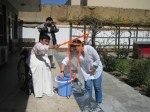
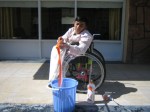
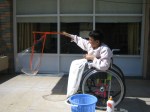
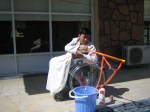
We tried out the bubblething I brought form the US and experimented with the local dish soap, the quantities of starch and baking powder, as per instructions in the accompanying bubblething book. At first we were not very successful – soapy foam everywhere but bubbles that popped prematurely. But everyone got the idea and Said worked at his skill.

We went to the German school, a Friday morning tradition to let foreigners out of their confined spaces, to walk around the tracks and get some exercise. You do have to duck once in awhile to avoid the Frisbees that whizz by at high speed from the competing Frisbee teams. We parked Said in the shade and he and Wafa watched the foreigners enjoying themselves in physical activity. This included the unusual sight of women in shorts and T-shirts.

After our walk we split up, Maria Pia and her friends went back home and the rest of us went for an outing on Chicken Street where I got the rugs Sita had requested. This required sitting on the ground in a small shop and looking at hundreds of rugs being unfolded. I think my lungs are now full of dust mites from all over Central Asia. How to bring the rugs back is not clear yet – they are slightly heavier and larger than I had realized.

We were joined by a group of women who are here to study ways in which the DOD, USAID and other US government agencies can work better together to improve the health of the population. One of them was our USAID counterpart in the early 90s – the best we ever had. I had not seen her in 15 years. It was a wonderful reunion.

I found another brand of local dishwashing detergent in a small supermarket and hope I found the best brand for Afghan bubbles. For lunch Steve took us to a local restaurant in downtown Kabul. We had manto, a local ravioli, yogurt and pumpkin dish, spinach, pilaf and goat knuckles – accompanied by the Afghan equivalent of lassie and yogurt served in small plastic Mountain Dew cups with plastic Chinese soup spoons.

The rest of the beautiful spring afternoon we experimented with our bubblething and Said actually got some really good ones that lasted for a few second. The new soap is better and the Afghans in our household can now say the word for dishwashing detergent in English (‘dish soup’) while I can say it in Dari (moyazarfshui). But is is not quite as good as Joy (the recommended brand for the US) would have been and we could not replicate the bubbles on the photos in the book. The bubblewand left this morning to go back north with Said so he can practice. We’ll see him again next weekend and I hope to see the results of all that.

Guests 3,4 and 5

The flight to Kabul is half full. I study my Dari lessons. I am at page 40 of about three hundred and fifty pages. I only recognize a word or two when the flight attendant tells us we are nearing Kabul. This is going to take a long time with these shorts bouts of immersion twice a year.

The descent into Kabul is always a little tense for me as it brings up my frightening departure, now a year ago. We circle and zigzag through openings into the mountain range; snow clad mountains on one side and down slopes and valleys with a thin veneer of spring green on the other.

I am met by staff from MSH and welcomed like a sister or auntie. It feels a bit like coming home. I am lodged at guesthouse zero again and try out another room, this one with a shower that is both warm and has some power. No one is home yet as the work day is not quite over. I learn that Kabul city now has electricity 24 hours a day; it explains why it feels different here now – without the sound and soot of generators humming from 5 AM until 10 PM.

Steve is still in Guesthouse 1 and has signed on for another year. He has bought more stuff since I last saw him, slowly moving the contents of the Chicken Street shops to his temporary lodgings. His rugs now also decorate the guesthouse across the yard, where I stay. The two guesthouses remain ugly but the wall hangings and carpets are attractive cover-ups.

Later Maria Pia returns from work with Hans, a compatriot who lives in Namibia. Hans is an architect and knows a lot about creating natural ventilation that is so important in TB wards. It is usually done mechanically using air conditioning that is both expensive to install and to maintain. A series of unexpected opportunities and chance encounters have changed his career as an architect in ways he could not have imagined. He started in a regular commercial firm in Germany and then Luxemburg, well off and successful at the young age of 28 when he tired of that life and applied for a job with a firm in Namibia.

Not even a graduate from a school of architecture (he finished a midlevel vocational study) he has now become one of the world’s authorities on low cost building adaptations for facilities that take in TB patients. It is new territory for both architects and TB doctors and he is as excited as a kid in a candy store. He was asked by a Harvard medical school professor to give a lecture about his specialty to some 40 people from all over the world. He is still pinching himself about this; something he couldn’t have dreamed up in is former life. We talk for hours in a combination of Dutch and English.

In the meantime Maria Pia’s guests have arrived; Said, who is somewhere between 11 and 13 years, who first lost his mom to TB and shortly afterwards got paralyzed because he was in the wrong place when an RPG hit the roof of his dad’s house, about 6 years ago. Since then he has spent half of his life in hospitals (first in Afghanistan, then in neighboring countries for over a year). It is hard to imagine a 6 year old going through this series of traumatic events on his own. He would be a perfect subject for a study on resilience. You could not guess any of this when you see him sitting perfectly content in his small wheel chair, babbling away in the English that was taught to him wile in the hospital. he sounds just like my former colleague and friend Miho from Japan which makes me wonder whether his teacher was from Japan.

Presumably there is a father someplace, a commander, but the boy claims he doesn’t have one. He does have a friend, Wafa, who was initially hired by his dad to look for a few days after Said while at the hospital. After sleeping in the hospital’s basement for a over a year, dad never showed up again, then was hired by the hospital to make himself useful as a cleaner as there was nowhere for the boy to go. Wafa became something like a surrogate dad. Said was finally ousted from the hospital (this is not an orphanage) and thanks to his own wits secured a room in a small clinic at the edge of the hsopital grounds where he has lived with Wafa fro the last year. But they will have to move from there sometime soon.

Said and Wafa travelled down from the northeast to stay with us for a few days. Maria Pia opened a suitcase full of gifts: a Rosetta Stone level one English course, an external hard drive, Charlie and the chocolate factory and other films to lure him away from the violent movies he tends to watch. For Wafa she brought shoes and a Steripen, a new LL Bean product that sterilizes contaminated water by stirring it with a UV wand. We try the pen out on bottled water that doesn’t need it. It’s high tech in any surrounding and will be even more so when it is taken back to its destination in Afghanistan’s northeastern country side.

Said goes to school and is doing well, at the top of his class. His ability to speak English while not in an English speaking country puts my feeble attempts at studying Dari to shame. From time to time he translates for Wafa whose doe snot speak English and cannot write or read – the two complement each other nicely and have bonded strongly over the years.  He has offered to give me some Dari lessons tomorrow and started with teaching me to say goodnight when I retired. Tomorrow I plan to demonstrate the giant bubblething that I brought for the guys in the office. I think I found a better destination than my doctor colleagues from the capacity building team.

Biding time

I am biding my time at Terminal 2 of Dubai’s airport. In back of me a group of men is sitting, spellbound, around a dark skinned bearded gentleman who is giving the equivalent of a Bible lesson. One of his 10 disciples is asleep but the others are eagerly listening. There is talk about dark and light stones, and a ring that protects travelers to ‘strange’ places. They are, I presume, on their way to Mecca.

The teacher speaks without taking a break for the entire time I am waiting to board (about 2 hours). He admits not to know Arabic, but speaks nevertheless in a mixture of English and Arabic . I can follow his lecture fairly well. It is part history lesson, part religious class and part storytelling, mysterious, miraculous and always about the truth. Sometimes he is deadly serious, sometimes laughing and always the ultimate authority on whatever he says. No one contradicts or questions him.

I learn that angels always obey and that one should have a little water and a small breakfast – nothing like what they serve at the Meridien hotel – before doing whatever they are going to do. He likens it to being like a sick child. There is much about ritual, purification and absolute belief, not requiring proof, just faith. One of the young men is particularly eager and engaged and receives special recognition from the teacher (you are a strong one!). He grins and bends forward even more, showing off what he knows.

Later he changes from teaching to self disclosure and telling his life story. He loses nearly half of his disciples but it is infinitely more interesting than his lecturing. The man is a book to be written. I learn that he is from Trinidad, and only a recent Moslem, more Moslem than Moslems, a converted Catholic. He tells about a friend he hung out with, a pot smoker, at the time of Woodstock (no signs of recognition on the face of his young followers – they have no idea). The friend, uninsured, got throat cancer and died despite his family spending 200.000 dollars on treatment. Ever the religious teacher he stresses the moral of that story: security can only be gotten from God, not from health insurance, money or the police. He is free-associating – the word police triggers a memory of his being arrested in Egypt by the secret police who followed him to mosques, thinking he was a Southern Sudanese (he could have been) planning some fundamentalist mischief.

I tire from listening to him and get myself a cup of freshly squeezed pomegranate juice for what might be a day’s wages or more for a Bangladeshi construction worker. I top it off with a macchiato from a Starbuck’s wannabe, making it two days of earnings for the said worker.

Most of the women waiting to board planes are clad in black formless gowns although a few have adorned their gown with colorful enhancements, like embroidered geometric shapes in bright colors or pastel ribbons. If they are not busy with looking after small children they are reading their holy books or staring into space. Several of the women, mostly the older ones but a few young ones as well, wear a burnished copper contraption on their head that covers their cheeks and eyebrows. I can’t see a purpose for it other than making it impossible to slap them in the face. I would love to sit with one of them and ask them a thousand questions but I don’t have the guts (and probably miss the language skills as well).

Familiar

The longest part of the trip is now behind me. I had a good night sleep in Dubai. Arriving in (or departing from) Dubai is starting to get familiar: this is my 7th stop in this city since November 2008. Still, it remains a strange place. Of all the places I have visited in my life this one has the most white SUVs per square inch. It also has the most spotless white-clad men I have ever seen; I have always wondered whether their secret is simply changing clothes a lot. Women, in their black dresses, are at an advantage, for once.

The flight from Amsterdam was full of business men, some with their wives, from all over western Europe, not just Dutch. Apparently Dubai’s economy has not collapsed. It is also a tourist attraction – why is a mystery – and a party place. A group of young women with T-shirts that said something about a ‘hen party’ for someone named Fi on their chests and backs, spent a long time at the cash machine in Dubai’s arrival hall. I guess they plan to have fun and can afford it.

Despite the full flight I was lucky that the seat beside me remained empty. I was so tired that I had fantasies of spreading out on the ground or doubling over on the two seats but in the end managed to sleep, fitfully, in my seat between meal services.

I was greeted outside my hotel as if I was royalty, and then escorted to my room. Check in was done unobtrusively, as if there was no money involved in this transaction (which of course there is, lots of it). The room had a basket of fruit waiting for me as well as an espresso machine and a shower with water coming at you from every direction (this required a sharp mind to understand).

There was too much stuff to explore in this executive suite that I am upgraded to, that I stayed up longer than was good for me. It was such a shame to go straight to bed and not enjoy, even for a brief moment, these luxuries that stand in such sharp contrast to what awaits me in Kabul.

This morning’s breakfast buffet was a multicultural one: French, Korean, Indonesian, Arabic and then the usual stuff. I went for Arabic: various cheeses with olives, hummus. It was just the breakfast we had talked about during our Saudi dinner in Cambridge, last Monday, now worlds away. And now on to Kabul. 

Running home

I thought Sweden had laid claim to the colors blue and yellow – but all the jerseys I see say ‘Boston Marathon 2009.’ I am flying to Amsterdam with many winners, some the world’s best who are going home to Addis or Nairobi, and some who achieved their own personal best. There are a few who wear their medals around their neck, others are still in their running shoes. Many are travelling with proud significant others, including kids, who cheered. I see more women than men who are recognizable as marathon runners, although many others, not in gear, also look trim and fit; this plane load has very few of the usual obese Americans.

Northwest has moved in with Delta – its looks like absorption rather than a merger. I see only Delta uniforms, Delta logos and wonder about the nice Northwest people who used to check me in, serve me – did they simply change uniform or were they laid off?

Axel brings me to Logan and we miss the nice dinner we used to have at terminal E – it was part of the parting, the treat of a last dinner together. At terminal A, Delta’s home, there is no restaurant for people who are not passengers, only one Au Bon Pain. It is dirty and serves nothing of interest to us. Axel is very affected by this change and I see him walk away with droopy shoulders. When he is out of sight and we are done waving goodbye we talk on the phone for awhile longer. He said the goodbye hit him harder this time. We wonder whether it is the missing restaurant. We could arrive earlier and have dinner at one of the airport hotels. Next time.

I am in the Delta lounge, waiting for our call. I am surrounded by suits, a few women, runners, but mostly suits; a man with high blood pressure makes an aggressive call to an underling back wherever his office is to do things the underling finds difficult or uninteresting. The boss is persistent and speaks louder as the clock ticks towards our departure. There is an urgency in his voice (‘I have no time!’). I am glad I don’t work for a company that ends in –ex or –co, even though it might give me business class travel.

Sita is going to Beirut on the 8th of May before going to Amman. That is the day that I am flying over Beirut from Dubai to Amsterdam. It gives me an idea, but how to make it work. I travel on such cheap tickets that any change requires change fees of hundreds of dollars. Still, I am going to explore this. I bet I could fly to Amsterdam and get a miles roundtrip ticket to Beirut and hang out with her for a few days before resuming my trip home, on the hallowed grounds that saw Axel and me turning into a couple, now 30 years ago.

I sleep fitfully in small chunks throughout the flight. I watched the Benjamin Button film without sound because I wanted to sleep. This makes it a very confusing movie – even more so when you miss whole segments while asleep. The only thing I got was that the main character got younger and younger and it had something to do with a clock going backward.

Sietske picked me up for a brief layover at her house where everything is in bloom. There are freshly laid eggs from her chicken. While she checks out a Polish couple who are going to clean her house, I get to write my blog and take pictures of the cherry tree in full bloom with petals blowing covering everything like pink snow. Sietske feed the potbelly pigs and alets them loose in the yard. If she gives them enough food they will not uproot the bulbs and perennials. They are like hippos, but not dangerous.

We go for a walk with her old dog Trouve who reminds me of Axel in the way he is distracted by every interesting thing (for the dog it is smells) on his path. It’s a slow walk which gives me extra time to enjoy the flowers, fully leafed out trees and the geese, ducks and other water fowl with their darling babies.

Front row

You never want to sit in the front row of coach class on a Boeing 757 because that’s where all the babies hang out. On the last leg of my journey home I sat about five rows behind the baby-cry-symphony. A little too close but not as bad as the two people without babies who were seated right in the middle of them. They must have done something very bad in an earlier life, or may be the week before. They were surrounded by exhausted Indian families with fidgety babies and toddlers, screaming at the top of their lungs. Their pitches were all slightly different and my neighbor remarked that we better learn to appreciate this particular type music.

The kids were also wriggling like pollywogs, kicking anyone sitting near, with their parents bearing the brunt, but also these two hapless travelers who ended up on each side. The parents looked battered and resigned. They had already travelled on a night flight from New Delhi and had probably given up spending any more mental or physical energy on their offspring for the remainder of the journey.

The flight crew was in a bad mood that showed up in a passive aggressive sort of way, accompanied by barked orders – that included the angry waving of the exit strategy maps in our faces and asking us whether we had any questions. No one dared to ask anything.

Maybe they were annoyed by the babies; or, because it was lousy weather in Holland, they didn’t get to see the tulips in the sun perhaps. Or because of the ways in which people put their hand luggage in the bins – it never ceases to amaze me the stupidity with which this is done. A bag that’s in diagonally is pushed and pushed straight back – of course it doesn’t give and you can see the grey cells not working. For that reason alone I could never be a flight attendant. And while some people are fighting with their bags to make them fit, other people come in with enormous suitcases on rollers and look expectantly up for places to put them. And the flight attendants don’t even bother to hide their exasperation.

But the flights were all full and they may be attending passengers a while longer. The financial crisis must be ending or the prices of tickets have gone so far down that now anyone can afford to travel; all the flights home were filled to the last seat and my neighbors were all too large for their seats, spilling out of theirs into mine. Northwest has cut cost on their beverages services and now also suppressed the tiny pretzel packs at least for the first round. I suppose it adds up to a huge savings worldwide.

Within minutes after landing I was out in the open air, with my hand luggage only – an advantage of the really short trips and of arriving in the middle of the morning when no other long haul flights come in. Axel was waiting for me and whisked me home. I invited him to spend the 75% of yesterday’s Accra per diem on a nice lunch in Gloucester’s Latitude 43. We ordered some spectacular three-dimenisonal Fusion dishes, each a piece of art in its own right, a seaweed salad in shades of lavender, turquoise, light and dark green with a purple sauce.

After lunch we visited the Cape Ann Historical Museum, me for the first time and Axel after a hiatus of 20 years. ‘Shame on you,’ said board member and across-the-cove-neighbor Bill. He showed us a Fitz Hugh Lane painting of particular interest. He explained how it showed the really old Gloucester, before it turned outward to the sea. The house in the picture is being restored now. It used to be on the Annisquam river, inhabited in its original state (i.e. no indoor plumbing) without interruption for over 200 years by the same family until the government took it by eminent domain in the 40s to make way for a road.

We stayed in the museum until it closed as there was much to see. This included a delightful photo exhibit on a year in the life of 1975 Gloucester by Gloucester Times photographer Charlie Lowe.

That was enough activity at the end of a 18 hour trip. A cup of tea, a hot bubble bath, and an early turn-in completed this rather long day. It’s good to be home and back with my man.


March 2026
M T W T F S S
 1
2345678
9101112131415
16171819202122
23242526272829
3031  

Categories

Blog Stats

  • 140,096 hits

Recent Comments

Olya's avatarOlya on Cuts
Olya Duzey's avatarOlya Duzey on The surgeon’s helpers
svriesendorp's avatarsvriesendorp on Safe in my cocoon
Lucy Mize's avatarLucy Mize on Safe in my cocoon
Spoozhmay's avatarSpoozhmay on Transition

Enter your email address to follow this blog and receive notifications of new posts by email.

Join 78 other subscribers