Archive for the 'On the road' Category


Three in a row

I was given a tri-fold on expensive paper and with a fancy design that did not quite work. It looked more like a computer punch card. Of course the person who designed this card was probably born long after punch cards disappeared. I was asked to answer the questions and tell the marketing department about the quality of my very short stay in the hotel. It included items such as ‘How would you describe your experience in the elevator while going to your hotel room?’ with two blank lines for my concise answer. I was also asked whether I had noticed a change in the lobby environment between night and day and what my impression was of the scent in the entrance. Nothing was left out, even the art on the room key was pointed out to me; what was my impression? The whole thing was about how the hotel had affected my senses. Business schools and sales gurus have been telling us for years that selling services was all about ‘the experience’ that a company triggers in its customers. It finally trickled down into the evaluation forms (no longer called evaluation forms but comment cards.)

At midnight I was zipped to the airport in a chauffeured limo with the young desk clerk accompanying me in the passenger seat and me sitting in the back. That deserved a big tip of course which comes in handy with the Eid holiday I am sure.

Unlike Terminal 3, the departure hall for all the non-Emirate long haul flights was filled with people, albeit it mostly non-Moslems I suspect. The Moslem world, at least those who can afford to, is staying put and celebrating, especially that late into the night. The flight departed at 2 AM.

Although the plane was not as empty as my flight from Dhaka I did not need to share my row of three seats with anyone else so I stretched out and slept the entire trip (6 hours), waking up somewhere over Eastern Holland when breakfast was served.

One row in back of me were the two Dutch participants who I had met during the conference and who had disappeared on the last day. As it turned out they had, with other visitors from their project, driven all the way to Chittagong, a journey of several thousand kilometers.

Their project trains traditional village doctors in recognizing signs of mental illness and they visited a few en route and opened a training center. She wore two shiny pretend (she hoped) gold bangles that were pressed on to her friends after she had admired them on a newlywed’s arm. She was still annoyed with herself to have made such a stupid remark. You have to watch out what you admire. I think I have made that mistake a few times as well and ended up with stuff I actually did not really like. It is of course a trap set by being dishonest.

And now, onwards to home.

In transit

I drove to the airport with Lakshmi whose inspired talk about microfinance and health had moved me. We had one last chance to talk about her work and what she was taking back from the conference. She was in the first cohort of students produced by the James P. Grant School of Public Health and is like a calling card for the school. If that is what they produce, then it seems like a good choice if you want to learn about public health leadership – a perfect continuation of the work of the person the school is named after.

At the airport I found out that our plane was two hours late. Grameen has installed free internet kiosks grameen_internetin the departure area for travelers. This helped to kill time. I struck up a conversation with Thierry who sounded like an Englishman but was actually French and an owner of a garment factory that produces high end men’s slacks. I am invited to visit the factory next time I make it to Bangladesh. In return I invited him to the US to find out that Dallas and Hawaii, the only places he knows, are not that representative of the United States. By the time we left we had become good friends and I knew all about his family.

The plane was nearly empty because of Eid el Adha, the big Moslem holiday that commemorates the willingness of Abraham to sacrifice his son as an act of obedience to God. Everyone who returned to his or her family for the festivities had already done so; it’s not like Thanksgiving with much last minute travel. In Dubai people have been holidaying since December 2, when I passed through on my way to Dhaka. Then it was the UAE’s national holiday. Work here will not resume until the 14th, which makes this a 12-day holiday; a good time to travel through here.

On the plane from Dhaka to Dubai I sat next to a family of 5 from Myanmar that was part of a group of 7 other families being resettled from a refugee camp in Bangladesh where they had lived for the last 17 years. The father’s English was good enough to make it possible to have a conversation. I had so many questions. All the fathers in the group carried a large plastic bag that had IOM (International Organization for Migration) stamped on it in three languages. Presumably it contained their migration papers and what looked like X-rays, I suppose to show they are free of TB, much like what I remember carrying with me when I entered the USA as an immigrant, exactly 27 years ago.

The father had escaped as a 13 year old boy from Myanmar with his family in a boat and landed in one of the many refugee camps in Bangladesh – maybe the one where Sayeed’s company runs soap, biogas or other factories on behalf of various agencies that serve the enormous refugee population, camps holding as many as 30.000 people. I asked him what life was like in the camp. He said it was boring as they were not allowed to work for an income, some inane rule that serves some purpose I cannot imagine. Sayeed had mentioned this too.

The families are being resettled in Manchester UK and he enthusiastically talked about Manchester United; needless to say, he was a big football (soccer) fan. Apparently that was one thing they did do in the camps. He also started learning English some 2 years ago, when his resettlement was decided. It took that long to get to this moment. He had clearly been prepared for the flight because he knew to ask for baby food, diapers, blankets, bottles, etc. He traveled with his wife and three children, a boy of 1 who looked like he was six months, a boy of 5 who looked like he was three and a girl of 8 who looked like she was five. “No more,” he said with a big grin, “family planning.” Sadly the grandparents were left behind in the camp. I have a feeling they’ll stay there until they die. I imagined the heart wrenching farewells.

Emirates takes good care of its smallest passengers. A flight attendant went around taking polaroid pictures of the children and their families. She also doled out many presents, coloring books, color pencils, adorable stuffed animal hand puppets and all sorts of goodies for the adults as well (toothpaste sets, razor sets, playing cards). The refugee family took everything with some reluctance and then wanted to return everything to the crew after we landed. In the end they left everything on their chairs when they exited the plane. I could not imagine why but maybe it is like too much food for someone who has been starving.

And then, shifting gears, I arrived back at the brand new Terminal 3 of Dubai airport that is made for the kind of traffic one expects for the Olympics. On the first day of Eid it was deserted with lots of bored people sitting at various help desks sending phone messages to, presumably, other bored people elsewhere in the terminal or city.

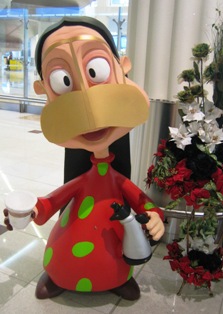
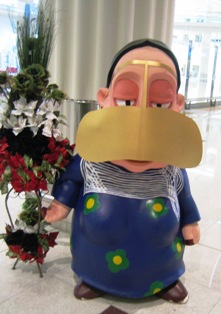
One is welcomed by two very odd life sized puppets of women that I cannot figure out. At first I thought they had large bandaids in front of their noses and mouths and it was some sort of advertisement. Upon closer examination these appeared to be the metal contraptions that some women wear. I remember seeing a few older women with these when I traveled through here a month ago. I wasn’t sure then and still are not sure exactly what the purpose is of those things, if not some sort of silencer of women’s voices; or is it to keep the sand from entering mouth or nose? dubaigirl11dubaigirl21
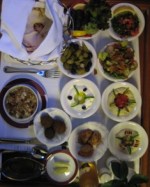
A short drive took me to the Meridien airport hotel in Dubai where I was upgraded to superdeluxe status with bowing people as if I was royalty: fruit platters, an enormous room and an entire espresso machine, invitations to free alcohol and finger foods later this afternoon (unless I want to have the 120 dollar late nigh bubbly dinner with unlimited drinks and fancy buffet – I declined). Instead I treated myself to a mini mezze, minimezzecorona and umm ali desert while watching Al Gore updating his incovenient truth with the latest scientifc discoveries – in a constant repeating loop, I suppose to make sure I get the gloomy message and jump into action.
Catch up

My last day in Dhaka was low key. It started with a last breakfast with my Nepali friends who left for Kathmandu in the morning. Ellen, who is from Holland and who I found again on Facebook after having lost her for awhile after she exchanged Tanzania for Park Slope now lives in Dhaka where her husband is the UNFPA rep. We had coffee and caught up with each other and talked about how to raise Dutch girls who have never lived in Holland. She has two little ones. I brought her drop and a chocolate letter (E of course) to remind her of home.

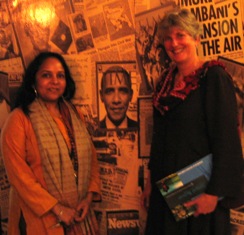
Next stop was the School of Public Health, housed in BRAC University where Bangladesh is preparing some of its future social scientists, computer engineers, businessmen and English teachers. I finally was introduced to the faculty I had heard so much about a few weeks ago in Kabul when Jon was telling me all about this place. I met a few Americans, one an intern from GWU who said her goodbyes after 4 months of fieldwork and another American MPH student about to graduate in a couple of weeks. Everyone was very enthusiastic about their experiences in this place of learning. After a very British fish-and-chips lunch at the Newsroom cafe with Sabina and Lauren sab_svI returned home to sort through my stack of business cards and start preparing for my return home.
Sayeed picked me up for dinner and took me to a Korean restaurant which instantly flooded me with memories of my many trips here with Ann over 10 years ago. I remembered Sayeed taking us out to a Korean restaurant then as well. We agreed that Ann was hovering around us even though she is far away in Newton. We had much catching up to do since we had not seen much of each other except some fleeting moments in Cambridge and Kabul; and, as he always does, Sayeed gave me his own familiar and contrary views on BRAC, development, and NGOs, before showing me pictures on his iPhone of his new daughter-in-law and his grown up daughters who are living in the US and UK. The wedding is in three weeks and I was invited to witness this multi-day traditional event. It would have been fun but it is time to go home.

Firsts and seconds

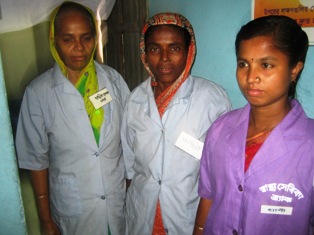
After an early breakfast and many goodbyes, yesterday morning, we distributed ourselves over several small buses that took us to the various field visit sites, some rural, some urban. I joined the Dhaka urban maternal and neonatal child health group. We visited the Corail slum area to see BRAC’s birthing huts, a program that provides very basic facility-based delivery care to some 700 women through traditional midwives supported by a community health volunteer and an upward chain of increasingly trained healthcare workers. It’s still a pilot project but the results are promising.

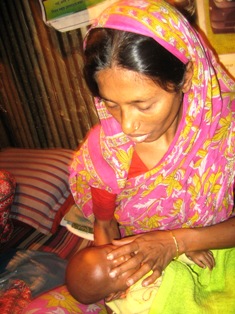
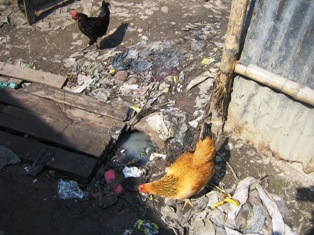
bracutbsWe met some of the traditional urban midwives, community health workers; saw a bunch at the conclusion of their training, and some of the BRAC program staff responsible for services to the 10.000 households that live in this one of several Dhaka slums. BRAC program coordinators took us through small passage ways, over scary looking open gutters into compounds and even houses (smaller than my king size bed in the BRAC Inn) where we met with brand new moms, or very pregnant ones and thanked our lucky stars that we were born on the right side of the tracks.brac_gutternewmom
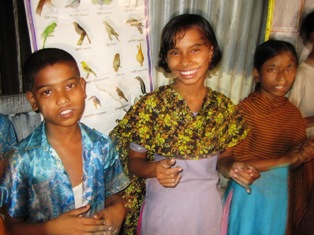
Everyone, kids, women and men alike asked to have their picture taken and grinned with delight upon seeing their picture on the camera screen. This is probably why so many annual reports and pamphlets from international health organizations have pictures from this part of the world on their covers. We also met with a member of a microfinance group and visited a BRAC school, where the students welcomed us in beautiful English, danced and sang and asked for nonstop picture taking. All the kids told us their name, then each mentioned a country of the world and then what they wanted to become. One girl wanted to become a pilot and so, naturally, we posed for a picture together. bracschoolpilotShe promised to write me when she entered pilot school – which will be some ten years from now. In between the acts we practiced writing our names, they writing mine in English script, me writing mine in Bangla, no small feat for either any one of us.

All the urban Dhaka groups met for lunch at the BRAC Inn before swarming out over Dhaka in various directions to go shopping, which is part of any conference experience in the world; the people from far away go to the handicraft places while the people from the region go to the discount designer wear market places. In Dhaka this means to the factory outlets where seconds from the countless factories that produce for the US and European clothing markets are sold. A bunch of us went to Aarong, BRAC’s upscale clothing, linens and handicraft chain of stores to buy our Christmas gifts and for me to get some new Shalwar Kamees dresses, handy for future trips to Afghanistan, Pakistan, India and Bangladesh.

For dinner I met up with my Nepali friends, one old, one new, and Pedro a computer engineer from Cuba who is awaiting his return to Nepal, pining for a beer and some proper nightlife and his girl friend. When he returns next month they plan to start a Salsa dance academy in parallel to a computer engineering business. “You see,” he explained to me, “in Cuba engineers also do salsa, we develop both of these sides of ourselves.” But a drink surely helps. He ordered coffee and the rest of us drank water and toasted each other and pretended all were cold beers; just a few more days for me and an entire month for Pedro (for visa reasons he has to wait until 2009 before he can enter Nepal again).
I stayed up very late delighted with my private and fast internet connection, cleaning out my mailbox while watching a rerun of Jaws, without the music of course, but still putting my fingers in my ears when I knew what the music was doing (doodoodoodoodoodoodoodoo).

And now on to the last part of my assignment and check out how the faculty at BRAC’s School of Public Health teaches new professionals how to manage and lead the way to significant impact, like their mother institution has done for more than 30 years.

On the shape of hidden fish

I tried to find the fish
Below the surface
Of the dark waters of the pond
Sometimes I saw their lips
Coming up for air
And I thought of the things
Everyone talks about

I watch their lips and search
For what’s below the waterline
Glimpses, vague outlines
And then suddenly
I am showered with
bubbles everywhere,
Like effervescent tablets
in a glass of water

as I listen to Laksmi’s passion
breathing life into her people,
her acts of generosity
Breathing life into is
What it means to inspire

Breathless I listen to Afsana,
Rajani, Tina, Neela, Lynne
Carmen, Anna, Carole, Susan
I have a weakness for strong women
I find so many here
No nothing wrong with the men
But scaling up with heart and care
Needs strong women

Awed by our hosts
Who are flawless in my mind,
A royal welcome at the airport
Whisked safely past potholes and
Frightening oncoming traffic
In the dark, delivered
Safely in this paradise
BRAC taking us in as family

I came with hand luggage only
But now the suitcase doesn’t close
So full of new connections
The weight of countless business cards
Heavy and light ideas
Jumbled together
To sort out during days of travel back

And knowing much better now
The shape of the hidden fish

Rajendrapur, December 5, 2008

Truthtelling

By the time of our closing session yesterday, our ranks were reduced by about 50%. Everyday people are peeling off and flying out to places far and near. We listened to an excellent synthesis done by someone whose ancestors came from Lebanon. He did a great job acknowledging individual contributions to his distillation of key lessons; one of those was the absence of presentations about failures. It’s a nice idea, and everyone nodded hard, but I can’t imagine anyone being willing to present their failures in public like that.

I did my presentation in the early morning and asked the audience to tell me whether they always wash their hands after going to the bathroom (the entire 26 seconds recommended), whether they smoke, wear a seatbelt, plan their family, practice safe sex and delegate. I also asked them to be truthful in their responses. Some were and some were not. I knew that some were lying because research in the US (done in bathrooms at selected airports) has revealed that only a small percentage of men wash their hands – in the conference room the percentage was outside that range but the key point was made: there is a huge gap between knowledge and action. The lonely smoker acknowledged that he knew smoking was not good for his health…and yet.

The presentation was well received, but then all presentations were well received. Conferences are not great places for truth telling. Truth telling doesn’t start until people feel safe and connected, which is just about starting to happen, but we are done now. That is always the case with three day conferences, except maybe with OBTC, where some of us have known each other for decades now.
The dinner was organized outside next to the pond from where our fish came from. I wrote a poem about those fish (“The hidden shapes of fish”) which I read later on our talent show evening. Dinner was another fabulous example of Bangla cuisine. This time I ate with my hands, even the soupy dhal. A few brave souls stepped up to the podium, for our talent show and broke out in more or less spontaneous song and dance (the latter not entirely voluntary). We were treated to modern Bangla love songs, English love songs, a WWII Christmas song, and even a long jiddish joke directly from New York. I read my poem which emerged only minutes before dinner started. In between our acts were professional dancers showing a variety of traditional dances, instruments and songs.

And then there were the goodbyes from the people who will not accompany us on the fieldtrip today because they live here or they have done this before. Most of the Indians are going back to Delhi or wherever they live. I had not followed the news about India and was told that the terrorists had done/were planning air raids on Delhi’s airport – it sounded very frightening. But when I went on the internet to read the India Times I could not find anything about this. I suppose this is how rumors are created. But I was happy to be traveling back through Dubai and not Delhi, even though I would have liked to visit with Nathalie for a day. That will now have to wait.

Effervescence

In the mornings some of us meet in the computer room in the hope that we can catch a small window of low use and fast(er) connections. I managed to get my blog posted just in time and then the window closed. Under these circumstances ‘internetting’ is actually a social or meditative activity with so much waiting for pages to load that one can either strike up a conversation with one’s neighbor or stare at the flickering screen and meditate on the meaning of life (or the joy of this or that).

There is much mention of poor management and lack of leadership as determinants of scaling up success or failure and I wished I could make another presentation, about how we teach management and leadership, as opposed to the change presentation that I do on behalf of a consortium I feel little ownership of.

Although I sat through another 12 or so powerpoints yesterday, I am increasingly humbled and impressed by the depth of knowledge, the passion and the long experience of the people in the room. We are slowly beginning to become a community, find out who is who and does what just when the end of the conference comes into view. There are so many people I want to talk with, get to know but there is not much of a common area, no places to just sit and talk besides classrooms and dining hall. In addition, the schedule is quite full and follows a classic conference model; after dinner all the locals go home. As a result the networking opportunities are limited to breaks and mealtimes. There can only be four people at each dining room table; if you come late it’s the luck of the draw who will be your table mates. I end up sitting a lot with the few Africans – mostly from Tanzania; I do feel more of an affinity with them than I do with the many Asians and the couple of Latin Americans. With a few exceptions from the US, Canada, UK, the handful of participants from Latin America and Africa, none from the Arab world, this is mostly a subcontinent affair – a part of the world I don’t know all that well. There is an effervescence of this group that I usually don’t encounter in Africa, effervescence being the only word I can think of to describe the enthusiasm, openness, creativity, drive and bubblyness of the participants from India, Pakistan and Bangladesh I have encountered here.

It is impossible to sit down and talk with the people I want to talk with about the second objective of my visit here which is about how to insert/improve the teaching management and leadership in public health educaction; the faculty of BRAC’s school of public health have been key organizers of the conference and are, rightly so, entirely absorbed by the event and the opportunities it presents them for making new connections, strengthening others and survey the state of the art in scaling up health programs.

There is much to learn for our project which has a ‘scaling up’ mandate. I wished I had some of my colleagues here – taking so much in by oneself is a bit daunting and I am not entirely confident I can absorb all the things I hear, let alone transmit key points. And each time I hear someone present either about BRAC or from BRAC my admiration for this organization increases. It feels a bit odd to come all the way from the US to explore the teaching of management and leadership in a place that is a prime example of superb management and leadership. To what degree we are dealing here with leadership of the ‘born leader’ variety is not clear. Where we may be of some assistance is the challenge of ‘growing leaders’ when natural talent is either in short supply or undetected.

Gingertea

It’s a birthday present I never want to have again: I sat through about 14 power point presentations while trying to suppress what was probably an allergic reaction to the pollen that is visible on the pond. A nice waiter who saw me run out of the conference room repeatedly, red in the face, half choking, took pity on me. He asked my permission to make me a local brew that would take care of my problem: black tea with sugar, ginger strips and 4 cardamom pods. I had two glasses and from then on I called him doctor Kalam which got many giggles from the other waiters. It sort of worked and calmed down my irritated throat, besides tasting very nice.

I discovered several people who fondly remembered this and that MSH colleague and I could fill them in on as much as 5 years or more of missed history. I also found a compatriot (from the motherland) who is a psychiatrist working on the hidden and mostly unexplored issue of mental health in Bangladesh. Our last speaker of the day enlightened us further on the complexity of trying to scale up mental health care in this society. Just seeing the many dimensions laid out was good to produce a mild level of stress in anyone called to do something about it. The plan is to train village doctors according to an algorithm that is described in the book ‘Where there is no psychiatrist.’ If this was posed as a question the answer would be ‘everywhere’ since there are practically none outside Dhaka, and only very few inside.

We are secluded from the world in the conference center, far from the maddening Dhaka crowds and in the presence of lovely singing birds (most of the day but especially in the early morning) and trees full of screeching bats (at dusk), a pond from where some of our food comes from (we are told you can keep what you catch but you have to do it with your hands) and a pavilion jutting out into/over the pond as I remember from movies about the good old days of British India.

There is also an internet center with 10 seats and excruciatingly slow and old computers, but then again, it is more than I expected and we are connected after all. Just no pictures for now. I will add these later – they would overtax the system and my patience.

Cinch

The trip from Dubai to Dhaka was a cinch after having already covered the distance between Boston and Dubai. I travelled surrounded by a large family of Bangladeshis returning from a shopping trip in Dubai. If you live in this part of the world and you have money, apparently that is where you go. The family occupied about a quarter of all the business class seats and included several fat little boys – the kind I remember from Lebanon – little princes I don’t find all that adorable but they make their moms smile no matter how obnoxious they are. At Dhaka airport the family was met by an official with an official looking tag on a lanyard around his neck. I assumed they were either related to the Emirates station manager or it was a quid pro quo for a Biman Airlines official. It was a happy crowd that walked away with the gentleman, holding hands and swinging their large and full shopping bags.

I was met before immigration by a man with two stripe epaulets who looked like an airline pilot holding a sign that said BRAC conference rather than my name. He did not speak any English of significance and so I followed him silently. He did take me right past the long line of people waiting to get their passport stamped, straight to the front of the line marked ‘crew.’ That got me into Bangladesh in no time. It was then I realized I had forgotten to tell my Bangla friends I was coming. To remedy this and to get me set up for a work related phone call tomorrow night I got myself a simcard from the money I had leftover from my last trip here, some 9 years ago, 500 Taka, which was still good money after all those years.

I met Anna who also came from the US for the conference. We will be roommates. Anna lives in DC but is a doctoral student at Harvard School of Public Health and presenting on her thesis which is about contracting for health services. We were driven to the conference center, about one hour out of Dhaka. By the time we got on the road it was 9 PM and dark and, supposedly, after rush hour (though rush enough for me).

The trip to the conference center was a little scary with most cars driving on the wrong side, which is the ride side here (left) but some driving on the wrong side for Bangladesh which would be the right side for me – I tried not to look too much at the oncoming traffic, especially when the headlights seemed to be coming straight at us. That, not bombs in hotels, is the true occupational hazard for my line of work. The driver of our little minibus was expert at swinging out of the way, sometimes off the pavement, to avoid the headlights that did not swerve back at the last minute. I gave him a heartfelt ‘donabad’ when we arrived at the center in one piece.
We were received at the center like long lost cousins, with several short men swarming around us handing us our nametags, a conference back and getting us to our rooms, then dinner. The dorms we are sleeping in are laid out around two low pools connected by a little bridge. I hope the water is treated to repel mosquitoes. I am in that part of the world and was stung already at the airport. I am glad I remembered the malaria prophylaxis although I forgot the mosquito repellent.

Our room is sparse and functional with a small desk with two chairs, two cubbyholes for our clothes and two narrow twin beds. I am back in economy class. We will be here for four nights and four days, of which this first one is a special one, my 57th birthday, on which I find myself alive and well.

Blue carpet

I learned from Dubai TV that the US is now officially in recession and caught up with the news of the day – International AIDS Day no less – from my multi-pillowed bed in a luxurious Dubai hotel, while eating complimentary chocolates and dates for breakfast.

KLM, true to its reputation, delivered me right on time to Dubai where we were welcomed by white clad men and black clad women wearing the kinds of scarves you see at soccer games in Europe, except the people pictured on the scarves were the UAE’s rulers rather than sports heroes. I arrived on their national holiday which is spread out over several days. The private sector, I learned from the newspaper has a mandated three day holiday because of this. With next week’s Eid El Adha, this makes for a very relaxed start of December if you work here.

I was chauffeured to my hotel by a Pakistani taxi driver who once lived in Cambridge with his Harvard-educated scientist wife (they divorced since). He congratulated me with my new president and showed that he followed the cabinet making closely. He thought Hillary was good a choice. He was at loss about what to make of the Mumbai massacres. The taxi driver who returned me to the airport this morning was from India. His English was not very good and he answered all my questions, including the open ended ones with a wobble of his head and a happy ‘yes Madam.’

Luck had it that the only seats available on the flight to Dhaka were business class and so I got to check out how Emirates deals with its business class passengers. The terminal has a separate entrance and a large reserved area of the terminal building for first and business class passengers that looks like the entrance of a high end luxury hotel. You really get a feel for the riches of a nation when there are more check-in counters for first class passengers alone than all the check-in counters for any airline at Logan. Between first and business class check in (red carpet and blue carpet) there were 36 counters. The business class lounge, separate from first class, is the size of the entire Logan terminal E with wireless internet, two restaurants, a cafe/snack bar, a fully stocked bar, a day spa, hotel rooms, showers, and, best of all, the most electrical outlets per square inch than I have seen anywhere else in the world. There is a separate first class lounge and I can’t imagine how that one can top this. I am enjoying the luxury while it lasts, as it will stop when I land in Dhaka tonight and return to the real world. I think I will treat myself to a glass of chilled Veuve Clicquot and a Lebanese mezze with the compliments of Emirates Airlines.


May 2026
M T W T F S S
 123
45678910
11121314151617
18192021222324
25262728293031

Categories

Blog Stats

  • 141,177 hits

Recent Comments

Edith Maxwell's avatarEdith Maxwell on Boosted out
Sallie Craig Huber's avatarSallie Craig Huber on Rays for real
Lucy's avatarLucy on Probabilities
Olya's avatarOlya on Cuts
Olya Duzey's avatarOlya Duzey on The surgeon’s helpers

Enter your email address to follow this blog and receive notifications of new posts by email.

Join 78 other subscribers