It has been a little over five weeks that I completed the 4 weeks of daily radiation. After my last treatment on May 12 and ringing the big bronze ships’s bell, to the applause of all the other cancer patients waiting for their turn, I thought I was done. The nurse had told me to keep babying my left breast with hydrating cream for awhile longer. In the coming weeks I could expect (more) tiredness and some of the same very short zings I had experienced now and then during the treatments. She assured me that the whole radiation phase would most likely be behind me in 2 to 4 weeks.
I kept describing to my friends and family that the radiation had been easy. Compared to other people’s stories I hear on a breast cancer support group Zoom call I join periodically, I seem to be the lucky one. But the thought that I could close the radiation chapter of my cancer journey by mid June, turned out to be wrong. One woman on the call earlier this week said the after effects of her radiation treatment lasted 4 months. Of course our experiences are all very different, but that comment gave me pause.
I now suspect that the radiation has compromised my immunity – how could it not have! I caught laryngitis several weeks ago, a rare occurrence for me. My voice is not quite back where it was before. My yoga friend Ann called my low croaky voice sexy. I didn’t feel that way. I also have had several moments where I suddenly felt as if I am a deflating balloon which makes me want to nap. For the energizer bunny I am, this experience is new to me. I have never been good at napping, but now I cannot help myself. I canceled a few events where I had to be around a bunch of people in a social setting. The thought itself tired me out.
The next part of my cancer journey started last week with an old cancer workhorse, the pill Tamoxifen. It is an estrogen blocker that stops the hormone from signaling cancer cells to grow and multiply. Although not usually prescribed for post-menopausal women, it also maintains bone density which is an important benefit because of my osteoporosis. Another class of pills to prevent recurrence & growth of cancer cells, Aromatase Inhibitors, confusingly called AI, does not, which is why my oncologist and I choose Tamoxifen. At this moment I don’t know what the side effects will be of this new pill added to my daily pill collection. I will be on it for the next 5 years. I will be nearing 80 by then and keep my fingers crossed that the cancer will be gone for good, entirely and distantly in the rearview mirror.
Posts Tagged 'breast-cancer'
Radiation, not quite in the rearview mirror
Published June 19, 2026 Uncategorized Leave a CommentTags: breast-cancer, radiation, tamoxifen
Last week I completed my radiation treatments. The last four were called ‘boosts.’ It means the radiation beam is focused sharply on the place where the cancer cells had congregated before they were scooped out. And so now, after a month, I am done with the mid-daily routine of driving to the shopping center where the clinic is located.
To enter the clinic one has to make one’s way through a tangle of wheelchairs filled with sick and handicapped people, and their attendants – and a coming and going of special vans or cars for people who can no longer travel on their own. If you want to get a glimpse of how corporate America has made us sick, this is the place to see the consequences of greed, loose oversight and the power of lobbying.
Once past the wheelchair tangle I turn left to the cancer center which celebrates the person who paid for it in large letters. I walk by the first front desk which is for the people who are here for chemo. The ladies by the second front desk knew me after week one. They probably put a check mark next to my name. I turn right twice and select a johnny from a a small armoire next to two bathrooms, remove everything above the waist and put my clothes in a locker, one of the two with a key. The others don’t even have a door. With my blue johnny loosely tied around my waist I sit down in the tiny waiting room with a large in-your-face TV on the wall that is hard to ignore and blaring loud. There is a remote but I don’t use it because other people who are here for their treatments seem to like it. On a small side table sits a 500 piece puzzle of lobster buoys. Only the edges are done. I love such a challenging puzzle but my wait time is usually short – they run a tight ship here – and I get to find a only few matches. When I am back the next day the puzzle is often in disarray, and my progress wiped out, edges are broken up and pieces scattered again. It is a never ending puzzle, just like the cancers that are being treated here.
One of the radiation nurse/technicians calls me in with a big smile. The staff are lovely. Now I have my own routine: I turn on my audio book which comes in through my hearing devices. I take my johnny off – there is no place for modesty here – and, bare-breasted – climb on the table which is set up with molded foam forms so that I am just in the right position. Green cross hairs on either side of me makes sure the beam is focused precisely. There is some tugging and pushing until I am in place. The nurses disappear into an adjacent room to monitor the procedure. I cannot see much of what happens next since I am lying tilted to my left side, the affected breast dangling below the table and the other smooched out of the way. I can see part of the mechanics as they move in and out of my field of vision, and hear the sounds of their beaming and moving as background to my book. It takes about 15 minutes except that one time that the system crashed and they had to reboot and I ended up with a crick in my neck after 30 minutes, but I made good progress with the audiobook.
On my last visit a woman of about my age was struggling to figure out the routine. Somehow she had not been taught the steps: find your johnny, opening in the front, put your clothes away, wait to be called. She emerged from the bathroom with the wrong johnny, the opening in the back exposing her skinny backside. I helped her and we started to talk. It was her first treatment – also breast cancer. She was only allowed 5 treatments by the insurance company. I suspect that too can be chalked up to the same causes that creates the wheelchair tangle.
After the last treatment is done one is allowed to ring the large bronze ship’s bell. A nurse checked me out, reminded me that the effects of the treatments may continue for several weeks and that I should continue to moisturize my now sunburned left breast. After that she accompanied me to the bell and took a picture.
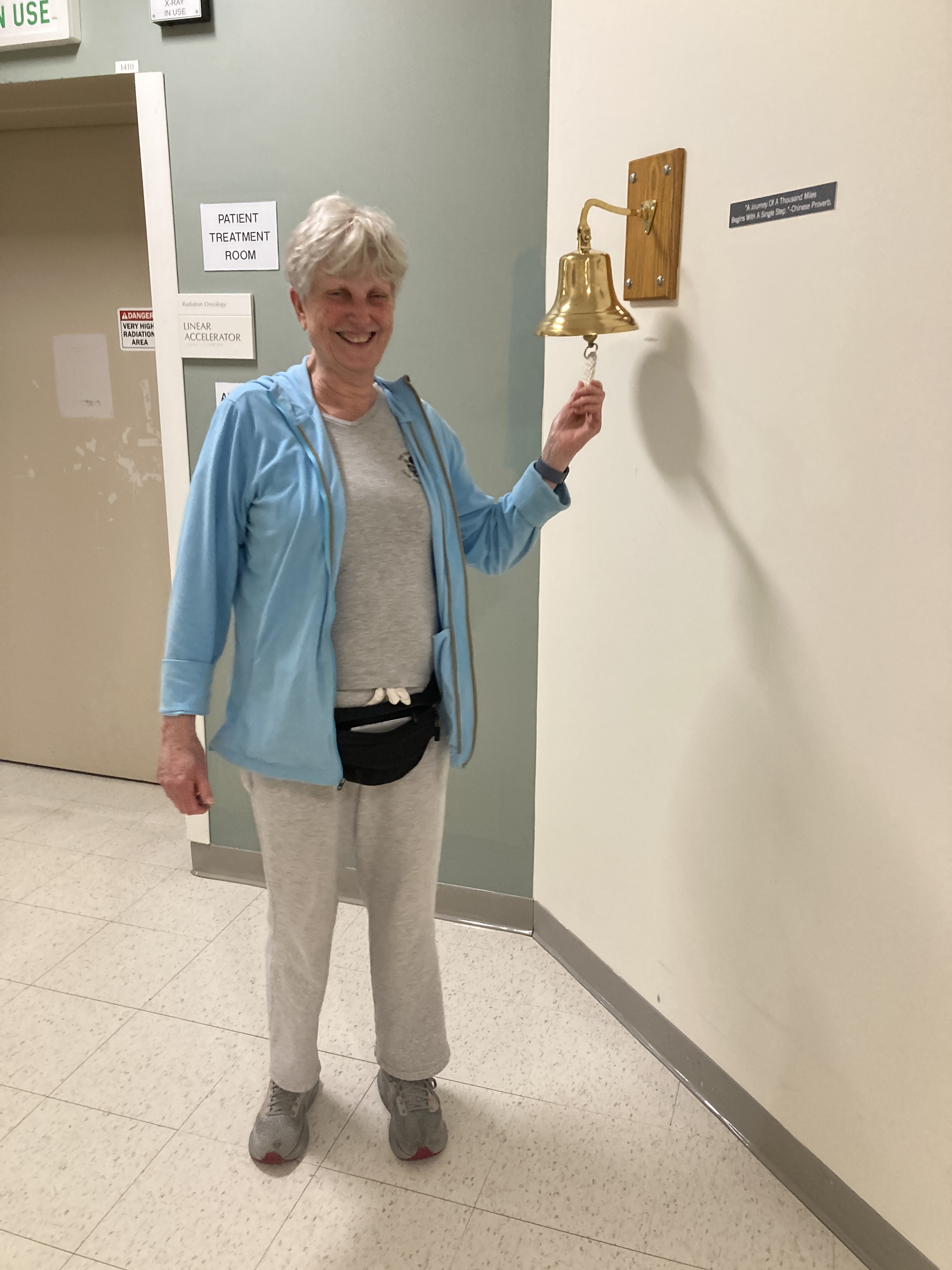
The next step starts tomorrow with a visit to the medical oncologist about which pills to take for the next 5 years to minimize the chance of recurrence (it is already in the low single digits): tamoxifen or one of the aromatase inhibitors which are, confusingly these days, called AI. I asked the other AI (claude.ai) for advice on what to ask the doctor and what he (it) thought about the pros and cons of the two different types of medicines that starve cancer cells from the estrogen that encourages their growth. Although I won’t know for sure until the next mammogram whether I am now cancer free, I assume I am.
Probabilities
Published April 8, 2026 Uncategorized 1 CommentTags: breast-cancer, hormone-therapy, radiation
I have now completed all the consultations and collected the expert opinions of the members of my care team. It does not quite feel like a team in my experience of what teamness is all about. It seems more like a collection of busy individual specialists who can all open my dossier from their computer and see the same data and talk about me from time to time. Apparently this ‘team’ met in mid March, after the lumpectomy, presumably on a Zoom call, and came to the unanimous conclusion that radiation was called for. Unfortunately, the medical oncologist we consulted earlier this week, had not been in on that conversations about my situation and had his doubts about the conclusion, leaving me with doubts.
I was able to get a phone consult on short notice – the radiation treatment starts next week, so that was important – with the radiation oncologist and laid out my doubts in the form of questions which she answered to my satisfaction. It’s been a bit of whiplash, yes to radiation, no to hormone therapy, no to radiation, yes to hormone treatment, or yes or no to both. It is all about probabilities, calculations that are difficult to make by someone who is not up to date on the research and remembers nothing about the Intro to Probability Statistics course that I took some 50 years ago. As I am wading into this very complex universe of the cancer cell, I am told about probabilities of recurrence. It may be local recurrence, a cancer cell left in the breast that starts to multiply, and/or a different cancer that develops spontaneously, like my breast cancer did for who knows what reason, elsewhere in my body. The radiation would take care of missed cancer cells in my left breast and the hormone treatment would make sure that any similar type of cancer would not receive sustenance any longer from certain hormones.
I have found, and in one case been told, that everyone stays in his or her lane: the breast surgeon cuts, the radiation oncologist radiates and the medical oncologist prescribes pills or infusions. Sometimes the lanes ran in parallel and sometimes one or two lanes veer off. So here I stand, looking ahead. I think it is going to be parallel roads for the next month until the radiation is done and that road veers off; after that I will stay on the hormone road for many years to come, which hormone is yet to be determined, that too is mighty difficult to decide.
Rays, early dinners and no visits in the evening
Published April 1, 2026 Uncategorized Leave a CommentTags: breast-cancer, radiation
A friend of mine called me radiant when she saw me recently, in spite of my recent health challenges. Since I am going to have to start radiation treatment soon it made me reflect on the words that suggest I am emitting rays. Soon these rays will not only come from me but also from a machine. It is hard to switch my mind from radiation being harmful to being a cure. Apparently there is a minuscule chance of the radiation treatment creating, rather than curing cancer. Lawyers here tell doctors that they have to tell you about even the tiniest risks of a treatment.
Yesterday I met with the radiation oncologist. She is a young woman (most of our healthcare providers these days seem to be younger than our children). When I saw her name I asked whether she was from Nigeria. Yes, she was. We talked about my many visits to Nigeria to help Nigerian colleagues improve the performance of their local health systems. I told her that of all the countries I have visited in Africa, Nigeria was to me the most exotic, most colorful and most fascinating. She doesn’t get to hear such compliments much. For many Americans Nigeria evokes images of con men trying to get your bank account and social security numbers.
I had imagined that during our consultation she would go over the many reports and then tell me that she didn’t think I would need radiation. After all, the reports had been negative: a tiny lump of lobular cancer cells (stage 1) – now removed; the oncotype report that put it at number 8 on a 100 point scale (very low risk), and the fact that no cancer cells had traveled to my lymph nodes and that the margins were clear. Instead I learned that although the margins were clear, the space between the cluster of cancer cells and the posterior wall of where the cancer was located was not as large as it should be. It was an unpleasant surprise that changed my mind about radiation.
And so I will be starting my radiation treatment soon. From April 14 on I will present myself every (work) day until May 14 to the radiation center of the Lahey Clinic in Peabody to receive the rays that are expected to kill any remaining cancer cells that may still be present. They will prep me for that in a simulation (a ‘sim’) treatment next week. This is when they will make tiny tattoo marks to help focus the beam of rays and set up the equipment. I am told to expect a bit of sunburn and fatigue. “You will want to go to bed earlier,” she told me. I replied that I already go to bed very early, around 8PM. “Well, then you will want to go to bed around 7PM.” I sometimes already do that. So, until mid sometime mid to late May it will be ‘early dinners and no visits in the evening.’
Forced Leisure
Published March 20, 2026 Uncategorized Leave a CommentTags: body-ills, breast-cancer
For two weeks I had been anxiously awaiting the report from the pathology lab to learn whether any cancer cells had escaped into the lymph nodes and whether the margins from the excavated lump were clean. Yesterday I found out: the lab report was negative. In this case the word negative was good. It meant that no cells had travelled outside the lump. How this will affect the treatment plan I have yet to find out when I meet with the oncologist and radiation oncologist. Our medical professions have mushroomed into so many specialities and subspecialties that the surgeon who did the excision did just that. When I saw her yesterday she declined any comment about next steps, other than that I would receive a call from these specialists. I received no answer to my nervous question about chemotherapy. If it wasn’t for the infected scars and the considerable amount of fluid that she had to drain from them, and sending a prescription for antibiotics to the pharmacy, I would have been in and out of her office in minutes. At least she had something to do for her pay. Hopefully in 6 months when I am summoned back to her office (is that really needed?) I expected I will be in and out in minutes because her handiwork will be close to invisible.
Although happy about the lab results, the infection has been draining me – apparently I did not rest my traumatized body the way I should have. True, a week after surgery, I did carry a load of firewood into the house, I carried and moved boxes that were probably too heavy and I did go this past week, 2 weeks after surgery, to yoga and pilates as I had understood I could. I had been anxiously awaiting to resume my other exercise classes, the aqua bike and spinning classes. Now I am told to wait another 2 weeks.
My body has absorbed the upsets, disappointments and trauma in various ways: my foot problems, now including plantar fasciitis, were most likely a result of the Tai Chi retreat during which I was on my feet, practicing QiGong and Tai Chi for 7 hours a day, 6 days in a row. Then back in the US where flu and cold viruses were circulating widely, I eventually got into their paths. And then the surgery and the preparations for it: the insertion of a magseed and radioisotope in my breast, then the cutting and chafing of the scars under my arm and too many needle sticks to list. Enough already my body yelled, be quiet, be still. But I did not sit still – idleness is not my thing. And now it is payback time. Forced rest. This reminds me of one of my favorite poems about rest, written by the South African activist & poet Benjamin MoLoise, a brilliant soul, silenced by his government in 1985:
In our whole life’s melody the music is broken off here and there by rests. / And we foolishly think we have come to the end of the tune. / God sends us a time of forced leisure, sickness, disappointed plans, frustrated efforts, /and makes a sudden pause in the choral hymn of our lives. / And we lament that our voices must be silent. / Our part missing in the music that goes up to the Creator from the world.


Recent Comments