Archive for the 'On the road' Category


Décollage

A night full of dreams that were dense and a bit somber. I think they were that way because I am a little bit anxious about today. It is all one big experiment yet I am supposed to know what I am doing. I do in some ways and I don’t in others. I have no idea how well our hosts today are prepared for this unusual kind of visit, a learning visit rather than an inspection visit. There is no model for this. People understand it intellectually but will they get it in the heat of the moment? I will be going to a small NGO called Lumière Action with only two other people. We have asked to accompany some of their field workers. More about that tomorrow.

I stayed up late last night in the hotel’s lounge because that’s where I can get the wireless, not in my room. It is already more than I had expected so I am grateful for this service that would have been inconceivable when I was last in Cote d’Ivoire, 15 years ago; especially in a three star hotel outside the capital city.
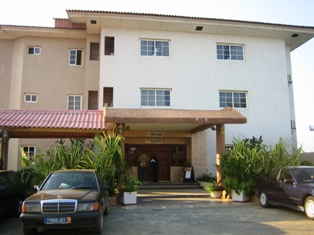
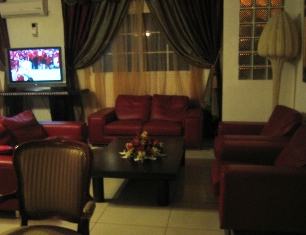
I was alone in the lobby lounge that is made to look like a living room with a large plasma TV that is permanently on, showing one American movie after another, with mouths that speak English while the words come out French. The films are of the action type genre that I can only tolerate when doing something else or on a plane with the sound turned off. When it gets really late the X-Files come on; also dubbed in French. The only other person watching was the receptionist. I suppose it is one way to pass the lonely evening in the empty lobby.

A small gadget mounted on the wall puffs out, at set intervals, a tiny cloud of some chemical compound meant to make the room smell ‘fresh.’ The smell is strong and overpowering, especially since the thing puffs rather frequently. I believe these gadgets are meant for bathrooms, but here someone had a bright idea. This morning I discover the same gadget is mounted on the wall of our conference room. It makes a soft squeaky sound each time it releases a puff; it continues to catch me by surprise, and then I remember.

We started the workshop in a rather tentative way. Only one third of the invited members and their alternates were in the room at the appointed time after lunch. Right there we had the entire ‘problematique’ of a voluntary body before our eyes; if you want to test it, start on a Sunday afternoon, during school vacation, in a place 40 km away on a congested road that makes the distance appear twice as long. It is actually amazing that we had about half the people in the room by the time we ended the day, and all but 5 at night time.

Launching a workshop is like taking a plane up into the air. You have to get to a certain speed and get the weight and balances organized right. You can calculate much of this in advance (and you should); you have to trim the plane just right, all the while watching the various instruments that provide information you need to take into account. And then there are those things you cannot change such as wind and temperature but you better be prepared to adjust your wings.

That is exactly what we did. Oumar and I were well prepared and we adjusted our program when it became clear it needed adjustments, given who had shown up, or rather how many had not. Oumar, in his masterful way, used the example of this adjustment to teach our local counterparts a few lessons about leadership on the fly.

One of the members of the CCM was also a student in the last of MSH’s publicly offered leadership course that I taught in Dakar in 2001 with Bula-Bula from the DRC, one of Francophone Africa’s all time master trainers. We co-facilitated many workshops in the 1990s. But Bula did not take good care of himself (leadership lesson #1: Stay alive!) and died of a heart attack quite suddenly and much too early. I sometimes think that Oumar channels Bula.

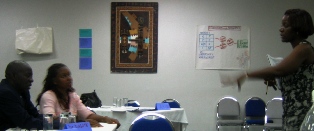
For dinner we went to the same place as yesterday but this time with an order placed ahead of time; it was waiting for us on the table. Back at the hotel, close to 10 PM, we found our local counterparts fully engaged in practicing their session of tomorrow, as we had suggested. I realized that I had overestimated the skill level of at least one so the practice was important. We spent the next hour coaching, practicing, more coaching and slipping in a few tidbits about adult education that were missing. I am encouraged by their engagement and enthusiasm. This includes Flore the local MSH admin assistant who is giddy with excitement about her good luck to be allowed to attend the workshop. I think I see a budding facilitator and coach. While Oumar and I were having dinner she replaced us, without being asked, as audience for our practicing colleagues. She gave them feedback and support that was much appreciated and very perceptive. Sometimes talent hides in surprising places.
Fishy

I found a surprising message in my mailbox on one of the many social networking sites I subscribe to. A boyfriend from my early teens found me on the internet. He is now the chief of Schiphol’s freight services. Our meeting place will be obvious, if not in the air, then on the ground. We have not seen each other for more than 40 years.

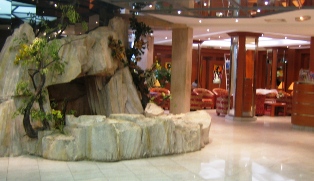
We left our hotel in Abidjan yesterday and drove to Bassam. While I was waiting for Oumar to check out I took some pictures of the lobby, a special request from Sita who thinks my blog should have more pictures. I went all out.

When you enter the hotel the first person (thing?) you encounter is a large seated statue of a local king in traditional garb. To me he looks like a Ghanaian king the way he is dressed with his Kente cloth and all the gold(paint), but then again, the Ghanaians and Ivoirians are cousins, if not brothers.

The king sits with his back to a large waterfall sculpted out of cement, plastic vines and leaves that blocks the lobby off from the street and fills one side of it. On the left of the entrance all the chairs are bunched together to make room for the ceiling painter. This made it a little harder to get a good view of the wall decorations, pictures of shiny and slippery beauties that, I presume, are intended to lighten up the experience of meeting with a business partner in a hotel lobby.

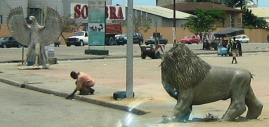
On our way out of town we passed by a roundabout that I had noticed earlier because of the two huge cement statues of an eagle and a lion. They stand by the side of the road, rather forlorn, as if waiting to be put in a more fitting place, or returned to where they were taken from. The lion needs some repairs as its head has been cut off. The eagle is intact and spreading its wings as if to fly away. I asked Alphonse how come the lion was damaged and the eagle was not? He did not know.

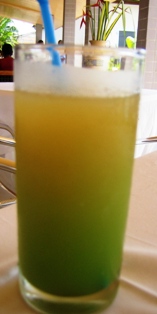
After driving past countless little beach restaurants, all equally inviting but all ignored, we arrived in Bassam at lunchtime. We had to ditch our plans to go to one of the beach places in order to honor our commitment to the rest of our facilitation team of starting our work at 2 PM. And so we settled in the hotel’s open air dining area, next to a noisy and splashy swimming pool full of teens and preteens. We assumed we could eat quickly and start on time. We did not. Lunch took an hour of preparation (grilled chicken and fries). We ordered our drinks, ginger juice, going for the least chemically enhanced drink we could find on the menu. It was served in two tones: green at the bottom and yellow at the top. We asked about the green and were told ‘c’est pour decoration.’ We asked for an undecorated drink.

Sometimes it is good that time is so very elastic here, since our co-facilitators were not quite on schedule, if there is such a thing. One showed up five hours after the appointed time. I watched Oumar use this as a teaching moment (‘How long have you known about this assignment? You know, being a facilitator has certain implications…’) He did it with grace and great care. We’ll see how this team will evolve; for now calling us a team is either premature or an article of faith. This is going to be as just-in-time as it can get, since the program starts today after lunch.

We met the president of the CCM who is a retired professor and gave him the design and our intentions in a nutshell. We were doing this in the hotel lobby where a huge plasma screen TV is permanently turned on (as it is now while I am writing, the X-files). I always find it hard to engage with people who are watching TV during the conversation but no one else seemed to be bothered and there were signs that people were indeed listening.

As far as the field visits are concerned, everything is extremely sketchy but no one seems to worry, so I don’t either. It certainly will be an adventure from a design and facilitation point of view. My past experience was in South Africa which had none of the protocol requirements and no outsiders handing out money to pay for this or that. Interestingly, when talking with people in private here they dismiss the protocol as something that isn’t really necessary but collectively everyone agrees it is important. This is the power of myth-making at work; only interesting if you can observe it at arm’s length but a pain in neck when you’re in it yourself.

For dinner we drove in a noisy diesel Mercedes to a maquis hardly recognizable from the outside but well known by our local hosts. The notion of serving a customer with speed and grace was entirely unknown to the two sullen waitresses who seemed just as happy to see us go. We nearly did go when over an hour later we still had not seen any food. When it finally arrived we had two types of fish, aloko (fried plantain), rice and atieke. This time I believe a few uninvited guests slipped in along with the food, judged by the gurgling sounds coming from my stomach last night, but luckily gone this morning.

Miracles

Oumar and I are used to hear the word miracle. That we are both here working together is the big miracle; that we got the boxes with books out of customs, in less than 24 hours after they left Lagos is another miracle, minor but a miracle nevertheless. The boxes looked tired and have been resting in Alphonse’s car every since.

A meeting was called at 10 with a few officials from various agencies to explain that the field visits we had planned for the participants were not the usual inspection visits. It was a last minute meeting and we eventually met with one person representing each of the three diseases of the Global Fund (AIDS, Malaria, TB). An official letter had been sent earlier announcing the visit in the way this is usually done, under the seal of the minister of health. Such announcements to officials lower down the hierarchy traditionally mean that important people come to inspect and you drop everything to make the best possible impression.

That we wanted none of that on Monday needed to be communicated quickly and convincingly, by people who themselves had no frame of reference for what we had in mind. Oumar explained and did a good job. People got excited when they realized that this was a ‘learning’ visit rather than an inspection, supervision or needs assessment visit. The mental model for a site visit includes people sitting around a table and looking at documents, listening to a chief speaking or watching a carefully crafted PowerPoint; it is about one way information, and questioning to find fault or weaknesses. The ones I have participated in were often stiff, formal and hollow with a lot of superficial politeness and subservient behavior from those at the bottom. The hierarchical distances are enormous. Our wanting to change this in one visit is maybe a little preposterous. But, on an intellectual level, everyone loves the idea because it has at least the promise of closing a bunch of gaps.

We explained that we want people to follow their curiosity. Again, another nice idea, and very appealing, but given the way things are it is a tall order, incomprehensible to some. Curiosity and the art of asking good questions have been carefully excised from children at a young age. The teacher is the one who asks questions, not the child; expecting adults to follow their curiosity is asking for another miracle.

Recognizing that it takes two to tango, we promised that we would take care of preparing the visitors if they could take care of preparing the hosts. And with those promises made we ended the meeting on a high note.

It is challenging to work with counterparts on something that is called by the same name (a workshop, a field visit) but has totally different connotations. This is where faith comes in: our counterparts have to trust us enough that nothing untoward will happen that will damage their reputations or careers. And we have to trust that the learning will happen even if the design has some rough edges and the execution will be less than perfect.

At lunch time we were taken to a large, partially open air restaurant called ‘Le combatant.’ It is squished in between the heavily fortified embassies of what used to be the USA’s and France and behind a statue of an ‘ancien combatant,’ of one of the two world wars that hapless Africans were forced to fight on behalf of their European masters. We avoid the western restaurants and prefer those where local food is served. Once again we got plenty of that: two kinds of fish, one in an eggplant sauce and the other in one of my favorite sauces (stew is more like it) called ‘sauce feuille’ which contained, in addition to cooked greens, all sorts of other surprises, including shrimp, crab, fish and agouti (also called bushmeat, an animal that resembles a large rat). The sauces are eaten over rice or atieke, a couscous-like substance made from manioc.

In the afternoon we finalized all that needed to be copied and returned to the hotel rather late. For dinner we took a taxi to a quartier called Cocodie and ended up in a patisserie. This was not what we were looking for but since we let taxi drivers take us places they like, it is one of the risks we take. There weren’t any local dishes and most were deserts, as one would expect in a salon de the. Oumar ordered a mushroom pizza from which he removed all mushrooms and I had a bunch of nems (spring rolls) and crabs hidden in something deep-fried. Aside from hamburgers the non sweet choices were limited. I did sample the main event, a crepe au chocolat, accompanied by a perfect ‘petit café.’

Back in the hotel it was time to relax. I discovered a new solitaire game in the Air France plane on my way over here. It is called Shanghai and it is played with Mahjong stones. I found a better version on the internet and got hooked until about 2 AM, an obsessive streak I have in common with my sister and can only indulge in on trips.

I dreamed of needing to catch a KLM plane and wanting to fly with Axel and Tessa but could only find their luggage and no one to help me make the change. When I realized they were on another plane I ran to get on at the last minute but could not catch it. It was one of these leaden legs dreams. I knew where it came from. I tried to change my ticket to go home earlier since I did not think I needed to stay until the 13th but it could not be done.

A way with boxes

On a continent where most of the people have little money and live at great risk with very little protection I always wonder why the majority of large buildings in the center of its capital cities are occupied either by banks or insurance companies. Whose money and who is insured, one wonders. The place around our hotel is awash with banks and insurance companies.

We started yesterday with a visit to our MSH colleagues who have an office on the outskirts of Abidjan. We are much indebted to them since they are making all the logistical arrangements for our adventure here. It is always nice to meet far-flung members of our extended MSH family. Alphonse the driver who picked me up at the airport has been assigned to drive us around. He is very helpful in showing us what is where, where to eat and what’s happening on the political scene. After one day in Abidjan I told him I saw no signs of this being a danger post; for that I have to go north, he said, adding that even there it is calm right now.

Some two weeks ago we had shipped 3 boxes containing some 50 copies of our leadership book to Abidjan via DHL to be handed out to the workshop participants. Since no one here had seen the boxes we tracked them down on the DHL website and discovered they were in Nigeria. They have been on an interesting world tour: picked up at our office on the 29th of August, shipped via Ohio and Florida to San Jose in Costa Rica where DHL realized, 4 days ago, that the boxes were shipped to the wrong place. Since then the boxes have been in Panama City, Caracas, Barbados, London, and Brussels before landing in Nigeria. According to DHL they left the Lagos DHL office at 5 PM local time yesterday. With any luck they arrive today in Abidjan but that’s only half the challenge. Getting boxes out of customs can be a huge undertaking, especially when you are in a hurry. I am not counting on seeing our shipment any time soon.

After our visit to the MSH office we returned to town and set up our computers in the conference room of the CCM in the center of town. To get to the CCM’s floor you can take a tiny elevator that has no lights. Once the door closes you are in the dark and can only hope that the electricity does not go out. If that were the case for any length of time it would lead to a slow and somber (dark) suffocating death, I imagined. After one trip up I decided to take the stairs, also in the dark, but less constraining and good for digesting the heavy (starchy) meals that are common in this part of the world.

For lunch we went to an abandoned hotel which has a working restaurant on the top floor. You had to know it to find it. It would have been the last place I would have looked for a restaurant. The tiny restaurant, without windows and with hard slatted chairs did not look very inviting. But appearances are misleading. I had my first sampling of Cote d’Ivoire’s famous cuisine: a piece of fish in an eggplant sauce with rice; slightly spicy and delicious. For Oumar who comes from the Sahel, this place has it all: the sea and forest for fish, fowl, fruits and vegetables in abundance.

After lunch we worked with the administrator of the CCM, which included some teaching right there and then by Oumar. Oumar is an exceptionally gifted teacher and a serious and conscientious worker. He knows where Africans stumble and confronts people, gently, where most other Africans I have worked with would not dare to. He runs the show and I am there to support him; I am not sure he needs much support but we enjoy working together and besides it is fun to see him in his element, as a trainer/facilitator.

For dinner we went to a small roadside restaurant in Treichville, a part of the city on the other side of the lagoon where there is life after 5 PM. The Plateau section of town, where our hotel is located, empties out at 5 PM when all the offices close; it becomes a ghost town. We took a taxi with an angry driver; Oumar, always the teacher, tried to teach him about customer service (not a bad idea given the unemployment and the glut of taxis here) but he wouldn’t listen and deposited us angrily at a main artery after having gone through several red lights and taken the reserved bus lane, driving faster than prudent; as accident survivors we were a bit sensitive to his driving style (‘doucement, doucement s’il te plait’) but this only made him angrier.

We talked more about our respective accidents, which would have been boring to anyone else, while we ate our Kedjénou and I had a beer twice the size of a normal beer (‘plus petite, ce n’est pas la peine, said the waitress). On the way back we had another taxi adventure. This time the driver was more congenial and willing to be taught to stop at a red light. I don’t think it will stick but at least he was willing to please us for the duration of our ride.

Landed

I am waiting for the ‘technicien’ which is what you need here to connect to the internet. The best signals on the wireless list come from Standard Bank next door, especially the one for the CEO but of course they are locked. While I am waiting and writing I watch a French program that is entitled ‘people in bathing suits aren’t necessarily stupid.’ What I see does not match the title.

I arrived in Abidjan while it was still light but by the time my suitcase arrived, in the very last batch, it was dark. Alphone the MSH driver was waiting for me. It is always nice not to have to hassle with taxis after a long flight and seeing someone waving a piece of paper with your name on it in the packed arrival hall. The ‘rentree (des classes)’ in the Francophone world does not happen until the middle of September. This explains why there were so many children on the plane. Their presence made the wait for my suitcase easier. I marveled at their ability to have fun with whatever was at hand. I was totally absorbed by two 5 year old boys who commented on every suitcase going by. One of them had a well-used stuffed lion who he would deposit in between the suitcases, to be picked up a few meters further by his buddy, both squealing with laughter.

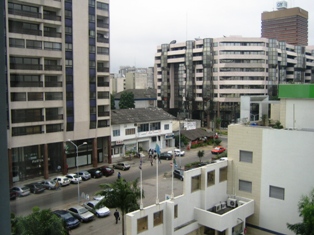
Downtown was empty, at 7 PM, which is unusual for an African city. Large concrete barrages, no longer in use, were shoved to the side around some of the banks. According to Alphonse everything is being rebuilt and repaired and things have been calm for a long time. It looked that way. In daylight there are few signs of the destruction, which acoording to Alphonse wasn’t so bad here on the Plateau part of Abidjan. ‘Wait until you see the destruction in the countryside,’ he added. This is what I see from my windows. The view is that of a hundred other African downtowns.

In the hotel I called Oumar. He was a slimmer version of the Oumar I remembered, slimmer and taller as if he had been stretched lengthwise. He was in a horrendous car accident in Kindia in Guinea some two years ago. No one thought he would survive but he did. He had none of the insurance cushions we had, nor the support of his employer (the government of Guinea) as I did. But the things we learned from our respective accidents were quite similar, about community and support networks and the taking and giving of support.

And after that I fell into a dream-filled sleep of 10 uninterrupted hours.

Half way

I used the morning of my first post vacation workday to check out the global fund website and download several documents about the Country Coordinating Mechanisms (CCM) by which the Global Fund for AIDS, TB and Malaria (GFATM) assures local ownership of interventions; reading for later, to pass the time in transit. I finished packing, filling my suitcase up with French books that had been culled from my library earlier this week, to leave behind with my colleagues in Abidjan. It produced a rather heavy suitcase.

Then it was off to the doctor. I arrived with my list of body parts to be discussed. After we had ticked each one off, I was hardly any wiser. I had some X-rays made of my sacrum and small toes to rule out any mechanical failures but we both knew that these would be unlikely. The doctor’s order is to continue with the physical therapy, do another round of acupuncture for my sacroiliac joint or go straight for the cortisone injection, get a second ankle opinion and set a date for the carpal tunnel repair surgery. This fall is going to have nearly as many interactions with the healthcare system as last fall.

On my way home from the doctor’s office I picked up some nice gentlemen who were out for a walk on this beautiful day, heading exactly in the same direction as I was (Joe and Axel). Joe took us out to lunch on the way to the airport and they both delivered me to Air France in time for them to squeeze in a visit to the ICA before closing time at 5:00 PM.

The flight to Paris is short, a mere 6 hours. By the time dinner is served you are already halfway there. I had a very short postprandial nap, too short, and woke up to see Indiana Jones, up to his neck in quicksand, refusing to pull himself out by way of a huge python. He is so not my favorite character; after I saw him in a snake pit in his first movie I have refused to see any new IJ movies; and now this, waking up to the only snake scene in the entire movie; my luck.

I tried to get back to sleep by listening to my meditation tapes which always put me to sleep before track one is finished; but not this time.

I arrived at an empty AF terminal E, was bussed to terminal C and found my way to the lounge which is the only thing that makes a 7-hour wait at CDG bearable. It is a reward for frequent flying and, counterproductively of course, for the huge ecological footprint I am making in the process. Tessa had me do a survey on the internet to ‘measure’ my carbon footprint some years ago, before the word was common currency. According to the not so scientific calculations my high-flying lifestyle required about 9 planets. Should I change jobs?

I showered, served myself a nice French breakfast including pain au chocolat, and am now ready to start reading and familiarize myself with my client. If all goes well, the next entry will be from Abidjan.

Parting

It’s another dreary day in Atlanta. Hurricane Faye is still hovering over the southeastern states. We are leaving in a few hours to go fly back to Boston and hopefully resume the glorious late summer we left behind on Saturday.

The service for Linda was attended by many, pressed together under a tent in a beautiful park near her home in the Candler area of Atlanta. We were greeted by a blue grass band, the same that played at Erik’s funeral 18 months ago. Music was a big part of their lives; I learned that Linda had a beautiful voice and frequently performed in public with her dad when she was in her late teens.

Outside the tent swarms of butterflies and an occasional hummingbird were trying to get our attention; passing messages from the other side, I imagined, about beauty, caring, nature, transformation and joy, all words that had some connection to Linda. Her children spoke, with great difficulty – grief and words hardly go together – about what it had been like to have her as a mother, recounting moving and funny episodes of their lives with her. We sang Alice Krauss’ Fly Away through our tears and then watched a slide show of Linda’s life amidst all those who were near and dear to her, some sitting with us under the tent, others long gone.

And then came the saddest part of a funeral, the parting of the guests, family and friends. Death and funerals are of course about departing. The run up to the service takes and brings so much attention that the raw grief about the loss is held at bay; but when the departing starts and all is over and the ‘new life without’ has started, then large waves of sadness come rolling in from all sides. At least that is what I imagine for those in whose lives Linda played a big role.

We rejoined a few at the parental home, now without parents, with piles of papers, bills, possessions, unfinished business and a thousand reminders of them; a house and a household that had gotten little attention, as all was focused on Linda in her dying days. Axel was so overwhelmed by it that he left the house to simply be in the gardens, once beautiful but now utterly neglected because of the drama that had played out inside over the last few months.

We said our goodbyes and went back to our hotel for a nap. Although we spent much time searching the internet for dining and movies in Atlanta, we ended up at a local strip mall Thai restaurant, and watching a rerun of an inspector Linley on TV, which we remembered more and more as it neared its dramatic ending.

Happysad

We are in Atlanta now. We arrived last night and made it just in time to the restaurant where everyone had gathered for dinner, to see the bills being paid; we ended up eating leftovers at the house where everyone, family and friends, gathered around Ingrid and Todd, leftovers themselves now that both their parents have passed away; a house full of memories of Linda and Erik. The last time we were here we had come to bury Erik, less than 2 years ago; now it was their mother. It was nearly the same crowd that had come together the night before for a communal dinner of remembrances and reconnections.

Before we left for Logan airport we made a cameo appearance at the Magnuson family reunion which, in true Magnuson fashion, got off to a slow start. This meant we got to see only a very small percentage of the relatives, including Sita and Jim who arrived when we left. We were sad to leave and Axel had a particularly bad time, being torn between relatives in Gloucester and Atlanta; the Gloucester reunion a happy event in glorious weather, the Atlanta event a sad one in rain and overcast skies, caused by the latest hurricane to touch the South East. A death in the family can be like a hurricane in its devastation.

Small Point Trilogy – part three – Clams

Today is our last morning in Maine of this vacation. It is a still and cold morning, the air is crystal clear after yesterday’s winds and rains, and it feels like fall. Fall comes early in Maine and I believe it has arrived. People are leaving, summer houses are cleaned out, students go back to school, all the traditional summer activities have been played out, the play, barley bright, the tea party with the handwritten invitation. Andrew left last night with the kitties so no one is meowing or wanting attention of me and I can sit here and write in peace. Only the cat hair on my computer is there to remind me of them.

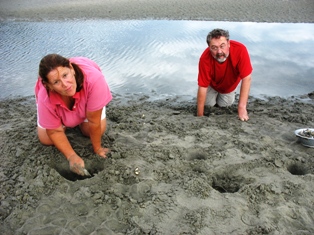
Yesterday started with sun at low tide and an ominous cloud deck in the south that eventually brought us wind and rain. But that was later. We clammed in the early morning sun. It was my first serious attempt at clamming. When Axel asked where the rakes were KB clawed her fingers, indicating they would have to do the raking. I got injured on clam number 3 when I sliced the top of my finger on its sharp edges; this left me a one-handed clammer for the rest of our outing but that did not slow me down. We produced enough clams to provide lunch to five people. The thrill of the hunt got a hold on Axel. Once he got his technique perfected it was hard getting him up to go home. He would spot the unmistaken hiding place of the clam (a tiny hole in the sand) and was back on his knees, digging again, shouting from time to time, “got yah” as he pulled out another clam; “one more,” he pleaded, over and over again. We had to drag him away.

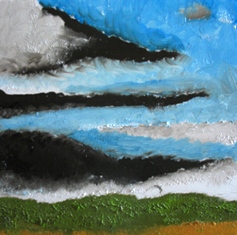
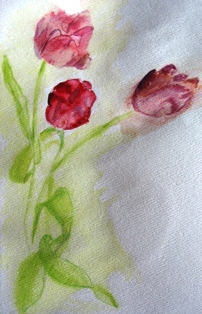
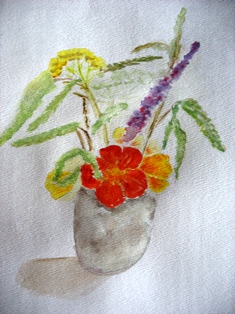
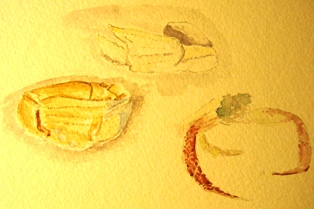
When we arrived home, the clouds moved in. Wind and rain kept us inside for the rest of the morning and most of the afternoon. In between visiting relatives (the place is awash in relatives of our hosts) we kept busy with indoor activities, water colors for me and oil painting for Axel. I tried to recall my lessons on mixing colors and dragged up what I remembered with the help of a book and then through trial and error. I rediscovered that French aquamarine is grainy and leaves an edge while cadmium red or yellow does not. I had not painted in a long time and realized again how much fun it is. I only like to paint objects, alone or together as a still life; land or seascapes, no matter how breathtaking, frustrate me. On our walks I would look for interesting colors and shapes to find them in abundance: dried seaweed, shells, stones, shellfish remains, flowers; when you look for inspiration it is everywhere in the most ordinary places.

Later in the afternoon the clouds had gone and the sun sparkled on the water again, leading us out on another walk to another point. We followed a path that provided more abundance, this time of huckleberries, blackberries and the most stunning views which we took in listening to more stories about days gone by, family celebrations, tragedies and the simple life.

Evening brought more relatives who helped us clean out the refrigerator. We said our goodbyes to Andrew who needed to get back to work, and the kitties and settled around the big hearth with a roaring fire for more conversation. I took up my knitting, which is nearly a reflex when it is cold and joined the others in front of a fire with intense conversations going on to my left and to my right. I was happy as a clam (even though the real clams had come to an unhappy ending, alas!),

Small Point Trilogy – part two – Warm

Today it is Tuesday morning, August 19. When I started my computer this morning to write, a reminder popped up. It said: vacation. As if I might forget!

I woke up from a dream that had me back in a leg cast. First I was in a wheelchair but I forgot it someplace and a nice gentleman came to my rescue with crutches and accompanied me to a hospital that was without power. During a rare moment when power returned we took the elevator up to a floor with cancer patients and premature babies. It made my handicap feel very insignificant. The rest of the dream had vanished by the time I started writing.

We are living entirely by the tides; a sharp contrast with the life back home that is controlled by the clock. I have not worn my watch since we got here. It is lying uselessly on my bedside table. I will put it back on when it is time to go home, which is, much too soon, tomorrow already.

This morning the Cambodian cat is sitting by my side, wanting attention. She too has a motor that roars as she purrs like there is no tomorrow. She is skinny with a black and fox red fur that makes her look more like a wild animal. Her orange coated sister must have gone out hunting; she’s nowhere in sight. This is a good thing, writing with two purring machines that try to walk over my keyboard and rubbing my screen would have been a bit much.

I woke up at my usual time, the crack of dawn, an hour before dead low tide when we will go on a clamming expedition. We had planned to do that yesterday but not everyone was up. Axel slept in and we felt no need to wake him. Instead Katie Blair and I sat on the deck overseeing the sweep of the bay and the cloudless sky. It was a 10 plus day and we spent it entirely outdoors. A long walk to one of the many points, along a path cut through lush poison ivy interspersed with ripe blackberries on each side. I was the mosquito attractor and allowed the others to have a free ride; still it was wonderful. We sat overlooking the ocean and listened to Katy Blair explaining family relationships and landholdings, and when we had enough of those (there is no end to these stories), she told us classroom stories about children with Asperger or underdeveloped sensory nerve endings. Since we are reading much about brains and nerves, these stories are fascinating to us; beside, KB is a gifted story teller.

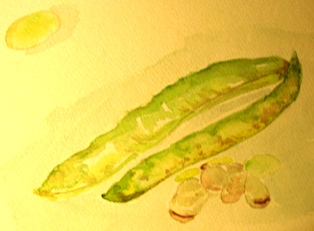
I collected crab remains that the sea gulls had left on the rocks. I was looking for shapes and colors that made them good objects for my water color painting, anticipating this activity with great joy later in the day. They were added to the fava beans, the raw beans, the cooked beans and the pods which were also waiting to be water colored. I fell for the many shades of green which I hoped to re-create. I brought the instructions from my water color mixing class, a skill I once possessed but have lost since.

The day slowly unfolded; a post-walk swim, a late lunch consisting of cold soups; a boat ride on the other side of the peninsula in white-capped waters and stiff winds that we had been unaware of in our lee-side hideaway; another walk on the beach, and finally the long awaited water coloring; and the day was still not over. We started cooking at 8 PM, a large wild salmon with the new potatoes and various grilled vegetables. Dinner too was a long and drawn out affair, as the entire day had been. But when dinner was over I had nothing left in me. I don’t even remember putting my head on my pillow.


May 2026
M T W T F S S
 123
45678910
11121314151617
18192021222324
25262728293031

Categories

Blog Stats

  • 141,177 hits

Recent Comments

Edith Maxwell's avatarEdith Maxwell on Boosted out
Sallie Craig Huber's avatarSallie Craig Huber on Rays for real
Lucy's avatarLucy on Probabilities
Olya's avatarOlya on Cuts
Olya Duzey's avatarOlya Duzey on The surgeon’s helpers

Enter your email address to follow this blog and receive notifications of new posts by email.

Join 78 other subscribers