Archive for the 'On the road' Category


Final touches

A large billboard on the main drag advertises for ‘the best Ethiopian restaurant in North America.’ For this you have to travel to either Washington D.C. or to Baltimore. It seems a bit far when you are in Addis and hungry.

May 1 is a holiday. Nevertheless Tae, Hailu and I worked hard on putting the final pieces together for our ‘inception’ workshop tomorrow. The intent is to make a good case of why managing and leading is a skill that people who manage health programs ought to have. It seems so obvious but it is not.

I spent an hour each with the various members of our just-in-time facilitator team to rehearse their part in the workshop. Everyone will get to be the lead facilitator on one activity. Some people are a bit worried about this but how else to pass the baton to a local team?

I also tested out the Ethiopian music I donwloaded from the internet on my new colleagues. It turned out I stumbled upon the Ethiopian Cliff Richard and other musicians who had their peak in the 60s and 70s but are still well loved, especially by people with grey hair like me.

Tae and I went to see the workshop room in the Yoly hotel. The hotel felt more down to earth, more connected to Ethiopia than my Luxury Collection La-La Land Hotel that could have been anywhere in the world. So I changed hotels. Now I have a very large room that includes a kitchen, a balcony, and comes with permanent access to the internet, all for a much lower price. I can look into houses and yards that tell me I am in Ethiopia. My colleague Bannet, who is our project’s director, warned me that I am on the edge of the red light district. I reassured him that I usually don’t wander around at night in cities I don’t know. Nightlife, as seen from my balcony was active but did not interfere with my sleep.

Tae and I had lunch in a small café and I learned from her about the traditional coffee ceremony where, while the beans are roasted, a basket of popcorn is passed around. Then the aromatic beans are passed around like a smudge stick, the coffee brewed and served, sweet and strong, to be drunk in three small cup servings. Axel would like this place. Of course he expects I bring back some beans.

On the eve of the workshop I relaxed and ordered room service from the Italian restaurant below, wild mushroom ravioli and Tiramisu (the Italian influence is noticeable). I watched the National Geographic Channel which airs, every hour, an advertisement for a special next week with the words ‘Fasten your seatbelts for Air Crash Investigation.’ It shows images of terror-stricken passengers in airplanes that are crashing or exploding; my kind of documentary! Minutes later another advertisement says that donkeys and mules cause more accidents than airplane crashes. That ad was illustrated with a donkey kicking a pile of watermelons which rolled down a cobbled street and killed an old lady doing her marketing. Should I be relieved?

There was more good stuff on TV. A program about Dubai’s artifical island group (The World) showed how white-clad oil cheiks and Dutch engineers combine resources and ingenuity to do the impossible at unimaginable costs for the world’s richest people. It makes you wonder about our priorities. We could do a lot of other things with that kind of ingenuity and those resources in my line of work. At least it shows that, if we put our minds to it, everything is possible after all.
Music

If I would have forgotten that it was our queen’s birthday yesterday the gentleman with his orange tie and the woman with her orange shawl at his side, dropped off by a KLM car, would have reminded me. They arrived at the Sheraton to celebrate the event in style and partake, no doubt, in the herring and bitterballen (a small round croquet) flown in with me from Amsterdam. I missed the event. There was clearly no search of the guest register for Dutch nationals. They wouldn’t have found me since I am here under the American flag.

I was woken up from a dream or dreams that included a rowdy group of young men messing up an artist studio and a little child that was given the ride of a lifetime by a bunch of whales tossing it around like a beach ball. It was a happy sort of tossing, not as scary as it sounds now in daylight. What woke me up sounded first like a small kitten in pain which turned out to be a bird that perched outside my open door, singing something very sad in a whiny sort of chirp.

They say in Ethiopia that a visitor who brings rain brings luck. The rains started yesterday and I walk around with a halo. I met my Ethiopian colleagues as well as two from Boston. A small group of potential facilitators was brought together when I insisted on being hooked up with local folks rather than doing the whole event on my own. I have gotten in the habit of doing this even though it does complicate matters. Today is a holiday and the workshop starts tomorrow. One by one they will come in today and give up part of their holiday to prepare with me for their role.

I have inquired about Ethiopian music, something I know nothing about. During the workshop I would like to play the kind of music that people here love to hear. It is hard for me to gauge what is cool and what is not. I downloaded some Ethiopian music from the internet last night and will test it out today on my co-facilitators. I discovered that the golden age of Ehtiopian music was in the late 60s and early 70s. It is a wonderful collection of a mostly jazzy kind of music with titles I cannot pronounce. I can’t remember what was happening here then but suspect it was still during the days of the emperor.

I also searched the internet for more information about the AIDS commission here, its mission and vision, but I could not find it. We had a long conversation about what comes first, mission or vision. In my book it is mission but here, clearly, it is vision. That is going to create some anxiety which I will need to manage in ways that keeps everyone happy. There are so many models that trip over each other. Here I come with yet another.

Addis

Armed with my last Dutch purchase, vitamins for ‘zakenmensen’ (business people), I arrived in Addis in the dark, after a brief stopover in a very hazy, dusty and sandy Khartoum. Addis is new territory for me. Exactly 29 years ago I missed a chance to go here, from Dakar, and never forgot the disappointment, but here I am, finally.

I was greeted by several signs that either meant ‘Americans welcome’ or ‘we want to to be like America,’ or both. We passed the Denver Café, the Boston Day Spa, a large statue of liberty and something that looked like Starbucks, same typeface and colors, but with a different name. We passed more cafes; this is after all coffee land. From my shaded view through the tinted windows of the Sheraton shuttle I saw a city that looked like a mixture of America, India and Africa: shopping mall ads, beggars in rags and momuments to celebrate the ephemeral African Unity. My co-travellers in the van were sitting with their blackberries in attention, waiting for a signal which they may never get. Communication with the outside world is restricted. My CGNet program does not list Ethiopia. I could have left my Skype headset and cellphone at home. One way or another communications with the homefront will be expensive, a scarce resource.

I am in Addis’ fanciest hotel, according to blog entries in the Virtual Tourist. The concierge and his helpers wear hats, either Fedoras or Bowler hats or, in some cases, one that is a cross between the two. My room was not ready and I was parked in the heavily draped and carpeted lounge where a pianist who looked like Angela Davis played hotel music. A gaggle of young beautiful women was, I imagined, waiting for further instructions from their impresario.

My bathroom has a scale with a paper sheet taped to it with ‘ideal weight’ for ladies on one side and for gents on the other. I am 2 kilos over the top of the ideal range; the result, no doubt, of 3 days of unrestrained consumption in Holland; another objective for the next 9 days to get myself in shape for two more days of unrestrained consumption after landing in Amsterdam on the 9th and before heading back home on the 11th of May.

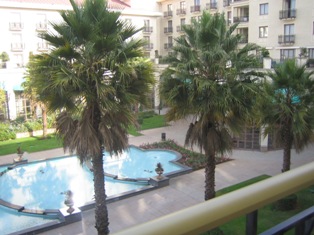
I had a hard time going to sleep. My room has a door that opens on a small balcony overlooking an idyllic scene of pools and palms, more idyllic at night than in daytime. I slept with the doors open, sung to sleep by crickets, the sound of small waves (the pool?) and the faint barkings of dogs faraway; nothing that told me I was in the middle of a big African city.

Herring and fries

I woke up from a dream (or dreams) that had my ex in it and various sinister figures with bad intentions. Anxiety dreams perhaps now that I am to throw myself int the arms of Africa again? I am certainly not looking forward to the long trip down south, interrupted in Khartoum before I land in Addis in the evening. It is now 6 AM. This will be a long day.

Our short vacation together in Holland went too fast. Two full unprogrammed days seemed endless, from the distance of time. But once started, they passed by quickly. Although I woke early on Monday morning, Axel did not and so, after breakfast I went back to bed for a bit and then it was suddenly noon. We had set as our destination for the day the center of Haarlem where, as I had assumed, we would find the weekly market with its cheese stalls, warm ‘stroopwafels,’ home-cooked Indonesian food and a place to eat herring or fries (Flamish, not French) in a pointy bag, or both.

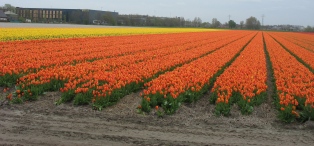
We meandered northwest to Haarlem through the tulipfields which are always amazing, no matter how often I have seen then. They grow on the sandy soil right in back of the dunes. Axel noticed that the soil is really sandy, grey-colored like you would find it in the woods on Cape Cod, and that is was therefore no surprise that our tulips in Manchester don’t do so well, as they are planted in very rich dark soil.

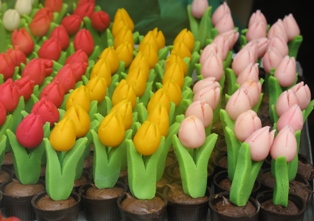
The market was not there. Instead there was a midway complete with merry-go-around, bumper cars, shooting galleries and some scary thing with two arms that held people like a giant and took them on a wild right high in the air, upside down and then down again. There was a lot of screaming and it made me dizzy just to look at it. We did find the herring, the fries, and even a large piece of apple pie with whipped cream. It was lunch and part of dinner. We even found edible tulip fields in a pastry shop.

In the evening we drove back to Jan and Louise in Hilversum to pick up Jan’s car which he so generously loaned to Axel for the duration of his stay. The mother of the bride from yesterday’s dream showed up, by chance, and we had another wonderful evening and once again came home late. But not too late for a small glass of California wine with Piet, our host, who we still only see occasionally.

The itinerary of stuff

Sietske and Piet have one of those coffee machines that requires only the pushing of a small foil disc into a slot to produce a steaming cup of coffee in seconds. Drinking too much coffee is very easy this way. Axel reacts badly to too much coffee (caffeine) but loves it too much. Lucky for him I fed the machine red foil discs which, I did not know, are the decaf ones.

I suspect we are both gaining weight. There is simply too much good food to eat. For me this is also about catching up on foods I miss in the USA such as raw herring, licorice and cheese. It is only partially about taste. Eating is a social activity suffused with memories and associations.

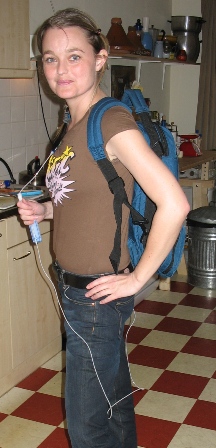
My niece Emily is not allowed to engage in this activity but is fed, instead, by a small pump that, over a period of 15 hours pumps about 3000 calories of a nutritious proto-porridge directly into her bloodstream. After the visiting nurse comes in at night to hook her up she walks around with a backpack that hides the large plastic bag and the pump. Only the thin tube that ends in a port below her right shoulder is visible. We were a little hesitant to show up for dinner but our timing was off and so that is exactly when we arrived.

She said she didn’t mind, while her mate Hicham cooked for us, happy to have eating companions. She sat with us at the table, sipping a small cup of bouillon, one thing she can eat in a more traditional way and claimed to enjoy seeing us eat; she even likes to cook for others these days and fantasizes about fresh asparagus and strawberries – but this may not be in the stars for her, at least not this year, she fears. One operation and a dose of good luck is what she needs before she can enjoy the things we take for granted.

I dreamt last night of travel again and of going to Ethiopia. My dreams usually contain very vivid images but this was a dream of a concept, an idea, a feeling rather than a view. The dream may well have been triggered by Emily’s brother Daan who is an artist and has a project, worldtravelcard, that maps the whereabouts of holders of 500 plastic cards he handed out a couple of years ago. The small blue cards look like credit cards. You log onto the site whenever you arrive at a new place with your exclusive card number that is yours as long as you keep the card in your possession. Card ownership is temporary; you are supposed to pass on the card to others who you meet along the way. It is a bit like the audio tapes or books that have numbers on them that hook into a website. You are to give the tapes or book away and the new (temporary) owner is supposed to register the book and then pass it on. This allows you to trace its itinerary. Both are products of our new borderless world but also of the ideal of shared resources; that notion appeals to me. It contrasts starkly with the idea of borderpatrols and fences that scream mine and thine. It is about the itinerary of stuff. Stuff has, of course, always traveled as you can see at flea markets, especially in cosmopolitan centers. But now we can actually follow the journey from place to place and from hand to hand (foot, eye, ear, mouth).

Branches

I was rudely woken up by a coughing fit that jerked me out of a dream in which I was just sprinkling rice on top of a bride. As usual, the dreams were rich and hard to reel back in once fully awake; faint traces of hard work and things not being what they seem to be. I’ll try to remember that.

I have slept, what we call in my native language, a hole into the day. It is noon time on Sunday. For the first time in weeks I have not a care in the world; nothing to complete, nowhere to go. I have not checked my email in nearly 48 hours. It feels wonderfully free. Now, more than 24 hours after our arrival we still haven’t seen our host Piet. He is biking on this gorgeous spring day. We communicate by leaving notes to each other on the kitchen counter.

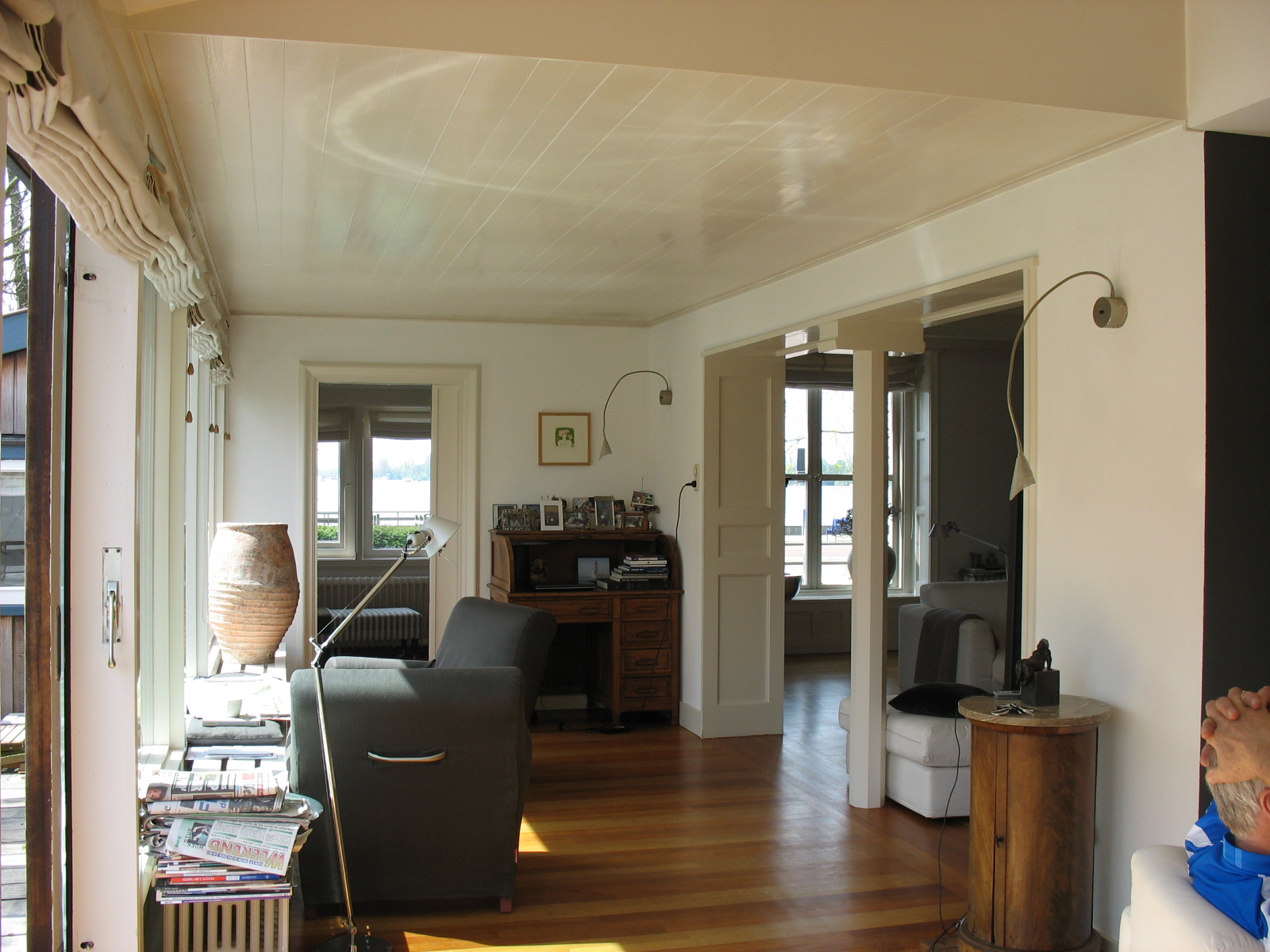
I am in a house where I have taken many of my MSH colleagues as we travel through Holland to faraway places. It’s a martha steward kind of house, beautifully decorated and everything matches, except when Sietske is away for awhile and Piet lives alone. Sietske would probably not tolerate the dirty coffee cups that are left here and there. But eventually everything is put away again; she has trained him well.

Outside the chickens make lots of noise. Later today I will go for a real egg hunt; fresh eggs for breakfast sounds very appealing. There are also two large pot belly pigs, rabbits, a cat, an a dog found on a highway in France, Trouve, but he is in his native land with Sietske, overseeing the remodeling of the vacation bungalow estate they own near St. Tropez.

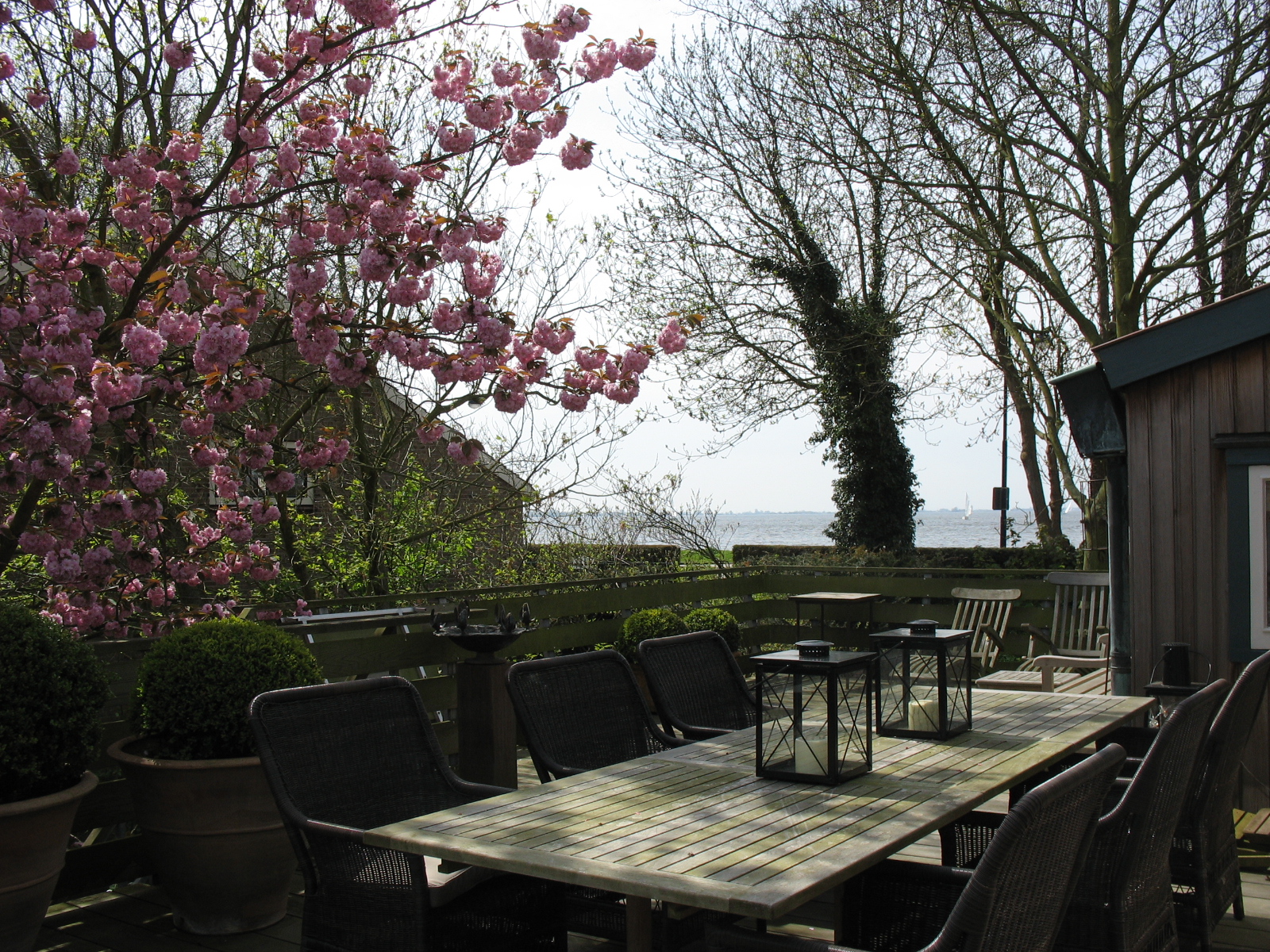
I am looking out over a large body of water with lots of sailboats. To my left is a huge Japanese cherry tree, the branches bending under a heavy load of pink blossoms. In this time of year Holland is at its best, flowers are everywhere.

Our family reunion took place in a restored barn of an old Dutch farm that lies in the small town of Lage Vuursche in the province of Utrecht. We parked our car outside the tall gates of one of the Queen’s palaces. Later we saw a man on a bicycle carrying a bouquet of flowers. He had a long conversation with the guard, who never took the flowers. We imagined he was arguing that he wanted to deliver the flowers himself to the queen. But she was not home. This is the week of Koninginnedag, April 30, something akin to our national holiday. It is actually her mother’s birthday. The current queen’s birthday is in January which is not a good time, weatherwise, for a party. The queen’s agenda this week is full of appearances to her people in tiny villages is in the far corners of her kingdom; it reeks of something medieval.

Axel will get to witness Koninginnedag. Some of our friends say he should go to Amsterdam, because it is a riot to be there on this day; others say this is exactly the reason why he should stay away as far as he can. When I was a child this day was the most exciting day of the year. There was no school. There were fairs with midways, cotton candy etc. In the morning any organized group in our town got to parade in front of the local notables. You were lucky if you got to parade in front of or in back of one of the local marching bands with their majoretts who twirled batons. I always paraded with the brownies, dressed to the nines in our brown and yellow uniforms, walking in perfect step. We had practiced for months in the woods for this event, left, right, left, right. For awhile my mother had a seat on the town council and she got to stand right next to the major. We have home movies where you see me wave to her, a big happy smile from a kid without front teeth; a stolen wave (not really allowed if you took parading serious). Ah, the power of belonging, importance, and organized togetherness; powerful stuff in a child’ life.

At the reunion we had the five branches of families that came forth from my great-grandparents’ five children. Each branch was identified by a colored ribbon; our’s, the grandchildren and great-grand-children of Ankie, was blue. Each branch had prepared a large poster with pictures that helped us see who fit where and how the small cousins I knew from my childhood had grown to be their parents, now the oldest generation with kids who have kids. The initiative for the event came from one of the oldest members of this tribe who decided they did not want everyone to meet only at funerals.

My greatgrandmother was an accomplished watercolorist and one of her great-grandsons had prepared a slideshow of her work. Lefthanded, she painted with both as, at that time, left handedness was something not acceptable in society and so most were forced to become righthanded, which gave these people two good hands, and a stutter sometimes.

I discovered there were also recordings of my grandmother speaking at some event. Imagine that, oma’s voice on MP3. All who want can get an email with the sound attached. Amazing.

The reunion was completed with the choice between a walk or mini-golf (or midget-golf as it is called in Dutch). Axel and I opted for the walk which turned out a challenge with the uneven terrain and our muscles getting increasingly sore (and now, the next morning we walk like crash victims again). Tea time was also time for farewells, and promises to meet again; this will be, in all likelihood, at a funeral again.

We walked across the main street of the cute village and found another terrace where Ankie, Michiel, Axel and I had a beer before we parted, they to Brussels and we on our way to our friends Jan and Louise who had just one day before become grandparents. We admired the baby pictures, the lovely new house in Hilversum and had a wonderful meal together. Just before we left we got to see pictures of a Philipino wedding in Singapore of a mutual friend. It may explain the dream about brides and rice, as there was another bride that day, the daughter of our friends Liesbeth and Rene. We drove home around 11 PM and tumbled into a deep sleep as soon as we hit the bed, around midnight. Our host was already sleeping.

Stranger at home

It was nice this time not to have to say goodbye to Axel at Logan airport and to go through security together for a change. It has been nearly two years since we last traveled together to Holland for the Vriesendorp family reunion. Now it is for a reunion of my maternal grandmother’s extended family. It was also nice not to have to worry about touching your neighbor when positioning your head for a try at sleeping. Not that it did any good; I think I slept less than I usually do.

As usual when I fly the Boston-Amsterdam route (or the return), someone else from MSH is in on board. This time it was Matt, on his way to our office in Dar es Salaam.

I had looked very much forward to the flight because it would be the first time in weeks that I could actually relax and read (for fun) rather than chipping away at my to-do list.

The virtual celebration that I had prepared for the course was well received. The best part was being copied on an email that circulated among the members of the first team that I had called to the front of our imaginary ballroom to accept the imaginary applause from the imaginary audience in honor of their very real accomplishments. Completing such a course for busy professionals is no mean feat. I totally get that. It was no mean feat for us facilitators either.

Yesterday was still a full day of work; cleaning out accumulated emails, responding to forgotten or postoned requests; there was another virtual event to close and one to attend, this time as a participant. OBTS had organized its third webinar, a one hour conversation with Bill Torbert from Boston College. He looks at leadership through a developmental lens which appeals greatly to the developmental psychologist that I am by training. Of the 20 people that attended there were three of us from MSH. I am not sure my colleagues enjoyed it as much as I did but it was worth a try to see if they would.

It is always a strange experience to enter Holland. I speak the language, I carry its nationality but it is not the Holland I left more than 30 years ago. “Count me the ways,” said Axel and I did, in my head. I am more of a stranger in this country of my birth than in my new adopted homeland.

We arrived at an empty house in Aalsmeer; Sietske is in France and Piet was in Amsterdam. The cat was there to greet us. We had some coffee and a few ‘boterhammen met kaas,’ bread with cheese before heading west out in our tiny rented car (a one size upgrade from what I had ordered – my big suitcase barely fit) to the middle of the country and meet the relatives, some I hardly remember, many I never met.

Dejavu

Familiar themes play like old tapes in my head. Jane Kenyon’s poem Otherwise popped up, I got out of bed/on two strong legs/It might have been /otherwise. Images keep coming back, like in July, and my stomach contracts involuntarily when I relive the swaying of the plane, the loud roar. I have been there before and my body remembers.

I had to talk with people badly but I was alone so I fired off random emails to just be in touch; once more an intuitive response to activate my support network. A few responded right away, these virtual hugs did the job. Somehow, being shaken up like that is easier to handle when others shake with you.

I could not sleep as I had planned and hoped; instead I kept re-reading my description of those few minutes of terror. I am not sure if the intent or effect was to take the emotional edge off it or to remind me that it really happened and I survived again. It felt a bit obsessive but I could not help myself. I used the fancy espresso machine in my room, over and over again; first coffee, then tea, and finally I had the eight dollar Foster beer. I took a very long hot bath and then watched a Dutch TV station util it was time to go.

Dubai airport is the opposite of Kabul airport. At Kabul airport there is a little shop that sells bags of nuts and dried fruits, rolls of biscuits, Arabic sweets and coffee and tea from thin paper cups. In Dubai you can buy anything your heart desires, from formula one cars to barbie clothes, as long as you have the money. It is a shopping frenzy that must be an eyesore to those inhabitants from the region who think the west is wicked. The shoppers are the passengers on some twenty long haul carriers that take off within hours of each other to all parts of the world. There were thousands of people, mountains of baggage and long lines everywhere. My Platinum Elite frequent flyer card is a godsend. It offers some respite from the lines and the hustle and bustle.

The flight was full and I could not get the upgrade I so badly wanted. I slept fitfully and watched a sweet Chinese movie that made me forget about bad things. In Amsterdam I called Axel to hear his voice and let him know I am nearly home.

As I am bracing for the last part of the trip my body is sending out signals that it needs some TLC. Axel has set up and appointment for me for massage later today and then I think I will return to Ruth next week for some remedial EMDR work, to bring everything back on an even keel.

I flew back with two MSH colleagues, Miho, who used to live in Kabul, and Yen, coming in from Addis and Nairobi also on their way home.

Close

We took off from Kabul airport in the rain and clouds. The Hindu Kush mountain range forms a bowl with Kabul at the bottom. It wasn’t great weather for flying but also nothing unusual for the pilots of the UN flight who shuttle between Dubai and Kabul year in year out (since 2002) several times a week. I thought a lot about my three colleagues who perished in a Kam Air plane that flew into the mountains as it approached Kabul, three years ago. I am acutely aware of the risks of flying in bad weather in the mountains. But I am also acutely aware of the thorough training that pilots receive and that dealing with emergencies is a big part of their training. So I settled in my seat with the intent to sleep all the way to Dubai. Little did I know that we were to need the pilot’s experience very soon.

Suddenly the plane started to shudder and bank first left then right, then left again. I felt the plane’s nose going down and I could sense that we were losing speed and altitude. The view from the window was solid white; we were still in the clouds. A loud roar coming from the back accompanied the shaking and banking of the plane. I don’t think I have ever prayed that hard in my life. I later understood from a veteran pilot sitting across the aisle that the plane went into a stall on its climbout over the mountain. In July my plane went into a stall which makes it uncontrollable and we crashed. Now we were over high mountains. Taking the nose down is only possible if you have enough clearance. I had no idea whether we did.

In my little Piper Warrior I had to practice stalls all the time and learn what to do. It is very simple, you put the nose down and gain enough speed to produce the necessary lift so you can pick up speed again and climb out. It becomes problematic when you cannot put the nose down. This happened in July. We were lucky to crash in a pond. I have never in my 30 years of flying around the world experienced a stall in a big jet. I knew that if our altitude was too low to clear the mountain we would not survive this stall. The passengers were all looking at each other in great fright and I kept thinking about Carmen, Cristy and Amy, wondering whether it had been like that during the final last minutes of their doomed flight. My body was preparing for a calamity (the body knows), with a surge of adrenaline and a fast heartbeat. It was nothing like the serenity of my last fall out of the sky. I wondered, would I be lucky, again, this time or would this be another one of those early morning calls to Jono, his third.

The whole thing lasted only a few minutes but it felt like an eternity. We saw the flight crew run to the back, I smelt gasoline and wondered wether the plane was dumping its fuel for an emergency landing (where? I wondered). And then the crew returned from the back of the plane with two thumbs up and smiles on their faces. From the hard to hear explanation over the intercom I heard something about ice and windsheer, a potentially fatal combination. Later the second pilot made the rounds, shaking hands with us. I asked him what really happened and that is when I found out that we just escaped what may well have been the same scenario that killed our three sisters. As the plane was climbing to clear the top of a mountain, wind surged over the mountain top and pushed the nose down; trying to bring it back up caused the stall. As I am writing this I realize how close a call it had been and that it was much worse than I had thought. In aviation this event is called an ‘incident’ which requires investigation. Why did the plane go in a stall and why was there so little clearance. The veteran pilot across the aisle who flies for USAID in Afghanistan is going to find out.

Although the second pilot, a Ghanaian, claimed that God, not the pilot had saved us, I knew that the pilot’s experience and strength to hold the controls, was an important part of our narrow escape.

Later I was asked to fill in a standard customer survey questionnaire about cleanliness and politeness of the crew and all that. I put a big line through the whole thing and wrote in the comment section that none of that actually mattered; the only thing that did matter today was the pilot’s skill and whether the aircraft was airworthy. That is really all I want from an airline. It is amazing how quick your priorities change. I learned that in July and I am reminded of it again.

The passengers bonded instantly as we recovered from our scare. In front of me sat an Ethiopian looking gentleman. I ask him if I had identified him correctly and the answer was yes. He was a USAID IT contractor from Ethiopia who was on his way home. I might see him in two weeks. When you have been scared to death together, you become instant friends.

With the adrenaline still coursing through my body I could no longer sleep and all my tiredness was gone. So I wrote; it helped to get some of the fright out of my system. Going to a hot flat place suddenly felt very attractive. And then there is that thought…. that someone is watching over me.

I shared a taxi to my hotel with two Brits, one military and one carpenter. Neither one had realized that we had just had a very close call. The military guy was not perturbed the way I was. I guess death is a professional hazard for him. The British taxpayer paid for the ride.

Slow Motion

I am at Kabul international airport. Everyting is in slow motion. That includes me, someone who is rarely in slow motion. All the adrenaline that had carried me through the last few weeks is gone. I feel totally drained and putting one foot in front of the other takes effort and concentration. I am looking forward to collapse in my seat of the UN plane that will take me to Dubai. But everyone else is also in slow motion too. This airport has nothing of the usual airport hustle and bustle. This is partially because only passengers are allowed even near the entrance hall to the aiport; and the people who facilitate their arrival and departure, up to a point. Those people have a special badge that opens gates and makes uniformed people step aside. My counterpart doesn’t have a badge like that and so he was turned away 100 m before the airport building, which is were we said our heartfelt goodbyes.

People also look a bit glum. Where I live that would be explained by the weather, it is gray, drizzly weather. But here such weather is a gift that may shorten the annual summer drought by a few days. I have a suspicion that people are glum because they are leaving Afghanistan. It is that kind of a place. You lose part of your heart here. I know no other place in the world where I have that feeling when I leave. From the outside you would expect people in the departure hall to be smiling because they are going home and leaving a dangerous place. But never have I felt threatened here. Instead of the bad and scary side of Afghanistan that is shown in the western media, I have seen people of all ages painstakingly putting one stone on the other to rebuild their country, or supporting those who do, with a smile and a great deal of commitment, patience and faith.

We women have our own security path from entrance to exit. I am constantly directed to tiny curtained spaces marked ‘females’ as if they are toilets. Inside, these spaces are about the size of a toilet.  Each time I am told to enter such a place (there are three from beginning to end) I feel like I am intruding on an intimate women’s party. Sometimes there are as many as three women packed into a space that barely holds us. Adding luggage gets tricky. They don’t speak a word of English; they are huddled together around a space heater and a water kettle with a giant and well-used rusty coil heating the water for tea. There is much smiling and a cursory review of my belongings. Last time I was here my scotch tape was taken way (Why? She demonstrates me taping someone’s mouth shut. Oh, I say without getting it, but I did not protest. I can live without scotch tape). The final body check is only for men, at the entrance to the tarmac. There are no women to check us females, so we get a free ride.

My luggage needs to be opened because the scanner noticed a stone. It was the map of Aghanistan made from various types of marble and lapis found here, a gift from the MSH team. A bit heavy to carry in my hand luggage I had stuck it in my checked bagage. They were looking for rubies, more precious stones than those. I was allowed to keep it.

In the waiting hall there are a handful of foreigners who also respected the 2-hour-before-check-in boarding convocation. Customs and immigration actually didn’t take all that long and I have plenty of time, especially when the plane is not showing up at the appointed hour.

There is Indian TV; a documentary about Indians (or maybe Pakistanis) playing marbles on a gutted dirt road. It reminds me of our schoolyard marble games where we would sit down on the concrete tiles with four small marbles or 1 large one sitting on a ridge between tiles, spread a few inches apart from each other and are legs creating a basin that would catch the incoming marbles that missed their mark. That would be our profit, the purpose of the game.We would advertise our wares by shouting at the top of our lungs what we had to offer, such as 4 from the 6th, which meant that anyone could try to hit one of our marbles from an imaginary line between the 6th and 7th tile. You could trump the competition by shouting 4 from the 5th which would bring in more traffic but also more chance of losing. We all took advantage of the little kids by telling them that they should put their marbles really close together, like a short wall. We would pretend it was more difficult, and then of course we had an easy hit and accumulated our wealth of marbles. I suspect all but the most intrepid and smartest kids had been victimized by this when we were young and naïve but then the tables turned when a new batch of credulous youngsters came in. It was a good preparation for the world of the grown up where things are not fair for those who are small and powerless. This is how school prepares us for life. Adults who are interfering with such behavior are not necessarily doing kids a favor. At school and in my (large) family I learned much about resilience and assertiveness that has helped me greatly in my adult life.


May 2026
M T W T F S S
 123
45678910
11121314151617
18192021222324
25262728293031

Categories

Blog Stats

  • 141,177 hits

Recent Comments

Edith Maxwell's avatarEdith Maxwell on Boosted out
Sallie Craig Huber's avatarSallie Craig Huber on Rays for real
Lucy's avatarLucy on Probabilities
Olya's avatarOlya on Cuts
Olya Duzey's avatarOlya Duzey on The surgeon’s helpers

Enter your email address to follow this blog and receive notifications of new posts by email.

Join 78 other subscribers