Archive for the 'Uncategorized' Category


Uptalk downtalk

We were like the black crow and the white pigeon from my recently completed Dari book, sitting across the table from each other. He, an adviser paid by a competing donor, an Afghan doctor (male) saying: “Everything is dirty, broken, polluted. Everyone is corrupt. No one cares. Nothing will come of this,” and then followed a list of problems without end.

He described a dark, dirty and debris-filled pool from which polluted rivers flowed. The pool represents senior leadership, an interesting image for me that tells something about what leadership means here: a reservoir from which flows death rather than life. I suppose it is an apt metaphor for Afghanistan. His question: “how can the people lower down, drinking from the polluted rivers, clean up the mess produced upstream?” The images from last night’s news about the toxic mud spill in Hungary flashed in front of my mind. He is right of course – he talks about how things are, not how they could be.

I interrupted him, “could you tell me about something that is good, that is working, people who care and who are honest?” It was as if I had not interrupted his list of problems, he picked it right up where he had left off and continued, until I interrupted him again, saying the same, and then it was his turn to say the same; two broken records.

It was as if we were each talking in our own little bubble, me with my ‘uptalk’ and he with his ‘downtalk,’ miles apart from each other. I couldn’t stand any longer to sit with him because every comment of despair and pessimism drained energy from the reservoir I have that allows me to be an optimist.

I tried to explain the impact his ‘downtalk’ had on me. He smiled and indicated he would try this ‘uptalk.’ But his next sentence started with, “you know, this is our problem…” I put my hand on his arm and told him, ‘no thank you, your problems are well advertised by a whole army of ‘downtalkers.’ This country is too full of them.

My colleague Ali is not like that. He is an ‘uptalker’ and he sees reasons for ‘uptalk’ everywhere. He takes the words out of my mouth and says them in Dari before I realize that he did. I contrast his approach to organizational change with that of the advisor who in essence does not seem to think change is possible. I try to imagine his advising but come up blank. Gripe sessions?
Toner

Because most of the training workshops are in the local language, and there are so many I couldn’t attend all, I have been rather disconnected from that what gives me life: helping people reflect on and better understand how their own behavior contributes to the status quo.

Being in this workshop for four days is reconnecting me to the core of what I am about. Even though my efforts to learn the language aren’t enough to let me follow the subtleties of the comments or questions from participants I can watch for the non verbal cues to tell me what is happening in the group and observe the kind of behavior that will get in the way of change.

There is much talk about ownership in my line of business, and in particular now in Afghanistan with the US Government’s policy of ‘Afghan First.’ But I see very little behavior, of participants and facilitators alike, in these kinds of workshops that will help develop a sense of ownership.

If you join a group to work on issue ‘x’ because you happened to be number 4 and the issue is discussed in group 4 then what responsibility do you have after you have delivered your workgroup’s flipchart with findings, suggestions, recommendations, or even an action plan? Instead of taking responsibility, as a number 4, I focus on being a good student and deliver a piece of work as per the teacher’s instructions, with the hope that the teacher will say that group #4 was the best.

This kind of group work is part of a workshop ritual that makes people proudly say their workshop is ‘participatory,’ an odd commentary on the concept of a workshop that comes from a tradition of lecturing. It’s self-delusional because the organizing team, the teachers or facilitators maintain responsibility for everything. When the participants go home and back to work the organizers/trainers/facilitators return to their office with rolls of flipcharts that will be typed up in due course (if they are at all) and, in the best of circumstances, appear as an annex to the workshop report that is produced – sometimes months later, if at all – because it is a deliverable. It’s my jaundiced view on workshops that comes from 30 plus years of workshopping or being workshopped.

This morning I saw and heard the reluctance of the participants to join a break-out group based on their expertise and/or enthusiasm for the four topics that had emerged as priorities. They ignored the lead facilitator’s prodding to do so and requested him to assign everyone to a group. This prompted me to talk about energy as our most precious resource and that it is their energy that will have to drive the change processes they say they want – not the production of a plan to please the facilitator (or me, the foreigner on the side).

I love to challenge people with the shocking statement that money is not our most precious resource. I always get a rise out of some of them when I say that. One rebutted me, saying, ‘but what about if I need to make copies and there is no toner?’ implying that the absence of toner would stop all efforts to improve on the status quo.

This time I did not have to engage with him on this very self-limiting view about resources; several other people came to my rescue with stories and arguments that showed how it is not the copy machine or the toner that will bring about change in Afghanistan.

On the sidelines

Today we started a four-day workshop with one of the general directorates. The purpose is to align everyone around a common understanding of where they need to focus their attention so that the entire team becomes more cohesive, more productive, and more together. The result we expect is a limited number of initiatives that will improve the general directorate’s performance.

All but one of the directors, each with two of their staff, showed up for this collective self-assessment that is spread out over four days. The event is done in Dari and I am sitting on the sidelines to make sure that our facilitators do a good job. I am looking at the level of energy, confusion, collaboration and the proportion of time that participants are actively engaged in solving their own problems. When something looks or feels different I ask for a translation to understand what is going one.

I quickly learned that there are sensitivities about speaking one’s mind. Some brave souls do it because they have been doing it for some time and discovered that their speaking out has a positive effect and did not get them fired. But many are not willing to speak out. There is an ex leader and a new leader (neither present) and much fear to offend one or the other when saying that something is deficient, missing or incorrect.

The subtleties in speech about these sorts of things escape me of course because everything is said in the local language. My colleague Ali is handling things well though. When I make a suggestion about something to say he tells me he already said it. And so I sat there at the sidelines marveling how my Afghan colleagues are running the show pretty much on their own.

During group work I studied flip charts with norms and expectations. This is the next frontier in my study of Dari: to be able to read handwriting. Later, back with my Dari teacher I started my first chapter book – a sort of graduation. It is a book about peace and in the first chapter I learned about all the bad things that happen when there is no peace. Beautiful watercolor paintings of devastation, hunger, poverty and illness accompany the text – I am after all still reading children’s books with lots of illustrations.

When I got home Vince had arrived from South Africa but his luggage had not. I first met Vince some 10 years ago when MSH had a project in South Africa’s Eastern Cape. We lived through some pretty intense group dynamics of his ministry team – then he was on the inside and I on the outside – now things are more or less reversed. He is our house guest for the next 10 days.

Big fish that go free

The US Government is trying to make it very hard for US tax dollars to slip into the hands of warlords, taliban and, of course, al qaida. Yet everyone knows that many millions of dollars have. The irony of our government measures is that it probably doesn’t affect these big and bad players all that much as there are, and always have been, clever ways to keep things opaque so one cannot get caught. When you are wealthy beyond wealthy you can always buy unscrupulous and clever lawyers and other people whose business it is to maximize money in the pockets of the one who employs them.

For us the measures complexify things enormously. We have to go to a special USG website and search for the name of a vendor, the one who provides our catered lunches at workshops, worth less than 5 dollars a head, or who fixes our hot water heater, sells us toilet paper or matchsticks. This to make sure the company or the individual is not on the ‘excluded list,’ and therefore a vendor we can do business with and pay, after services rendered, with US taxpayer dollars.

At our weekly staff meeting we were shown the website. We tried some searches and typed in the names of some of our Afghan colleagues; names that are the same or resemble those of people on the terrorist wanted lists. When the search came up empty we cheered because it meant the person (or company) is clean and we can hire and then pay them.

Back at her desk M. later typed in Osama’s name into the search engine. It produced a ‘0 results’ which, according to the explanations we received, means that we can do business with him. It’s like a special net that lets the big fish through but catches the little ones.

Pigeons and crows

Last night we had a long Skype chat with the newlyweds who had returned from their honeymoon. They were right there on our computer screen in our living room. Amazing!

This morning we played scrabble for nearly two hours, under blue skies and after our ritual Saturday morning green chili eggs. The game moved so slowly because we could only make very short and cheap words and so it took a long time before the letters were used up.

Axel is still trying to arrange his surgery in Dubai. That is going slowly as well. There are many pieces that have to fall in the right place: insurance, doctor’s visits, hotel, ticket, and getting permission from various people on this end to leave for a week or two.

I finished my Dari book about a pigeon and crow learning to live together with other birds (of a feather) in the forest. I learned a vocabulary that is quite relevant to Afghanistan: honesty, partisan, representative, judge, making a racket/noise/arguments (the crow) and peacefully teaching the next generation (the pigeon).

The black crow was the bad character in the story and the white pigeon the honest and ethical one. At the end of the book there are questions, like, whose side are you on? Of course you are supposed to say you are on the pigeon’s side because the pigeon is white (=good) and the crow is black (=bad). It is only because I didn’t know how to say pigeon poop (the reason I would opt for the crow) that I gave the right answer and the teacher nodded approvingly.

I met my new colleague Sally who joined our project for the last year to produce our stories, reports, and other writing pieces. We took her out for dinner at the Korean restaurant, one of the few eating establishments in our neighborhood. She is just what I hoped she would be and I am thrilled to have another woman on our senior team

Women’s day out

We had a busy social agenda today, starting with my usual massage while Axel had coffee with Peter in the Flower Street Café garden. It was a lovely warm fall day. I joined the two for another coffee and then stayed for lunch.

The next activity was a trip with some of my female colleagues, Afghan, American, Australian, to the women’s gardens which turned out to be closed this one day. The small women-run shops in front of the walled in garden were open however and hundreds of women covered just about every surface in front of the shops and on the small grassy spots between the shops. Most were eating with steaming plates of rice, bolani (fried dough with potatoes or chives inside) and kebabs. We were invited by each clump of women and children to share their meal.

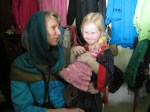
Chris’ 4-year old Kate, blond and pale-skinned, was a source of great excitement to the women who pinched her cheeks, touched her hair and made comments like ‘she made of glass.’ Everyone wanted to make pictures of her, this exotic child. Kate freaked out and hid behind her mother’s legs. She wanted to go.

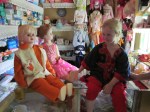
To offset the horror of being the center of attention for hundred of women and kids we bought her a towering and dusty fake Barbie with badly cut yellow hair and a dress made from fringed pink paper pasted on a cone that wrapped around her thin waist. Before our trip was over Barbie had lost her head and Kate chewed on the remaining stump of her neck. Most of the fringe had unraveled. It was good we delivered Kate home before her dress came undone and we’d have only a headless and naked pink Barbie left.

We all piled into the car to take us to Bagh-e-Bala, the park below the Intercon so we would have at least a visit to a garden. But Bagh-e-Bala is not a women’s place. In fact there are very few women. S and her sister came late and had to walk, without a male companion, to where we were – a very uncomfortable walk because neither men not women are used to this phenomenon. I felt bad I had not gone back to meet them. The things we take for granted elsewhere cannot be taken for granted here.

The caretaker of the little palace came out to greet me and let us all inside to climb to the top of the palace for the best view of Kabul. M’s husband joined us so we were not an all women group anymore that invited only stares from the many men sitting on platforms, smoking and drinking tea.

The next activity was the 2nd birthday party of SOLA. We had cake, kebabs, cookies, pomegranates and sung happy birthday. I met a few more students who will join my class next week. I am so happy to be part of this extraordinary group of young Afghan people. They are a source of inspiration and hope.

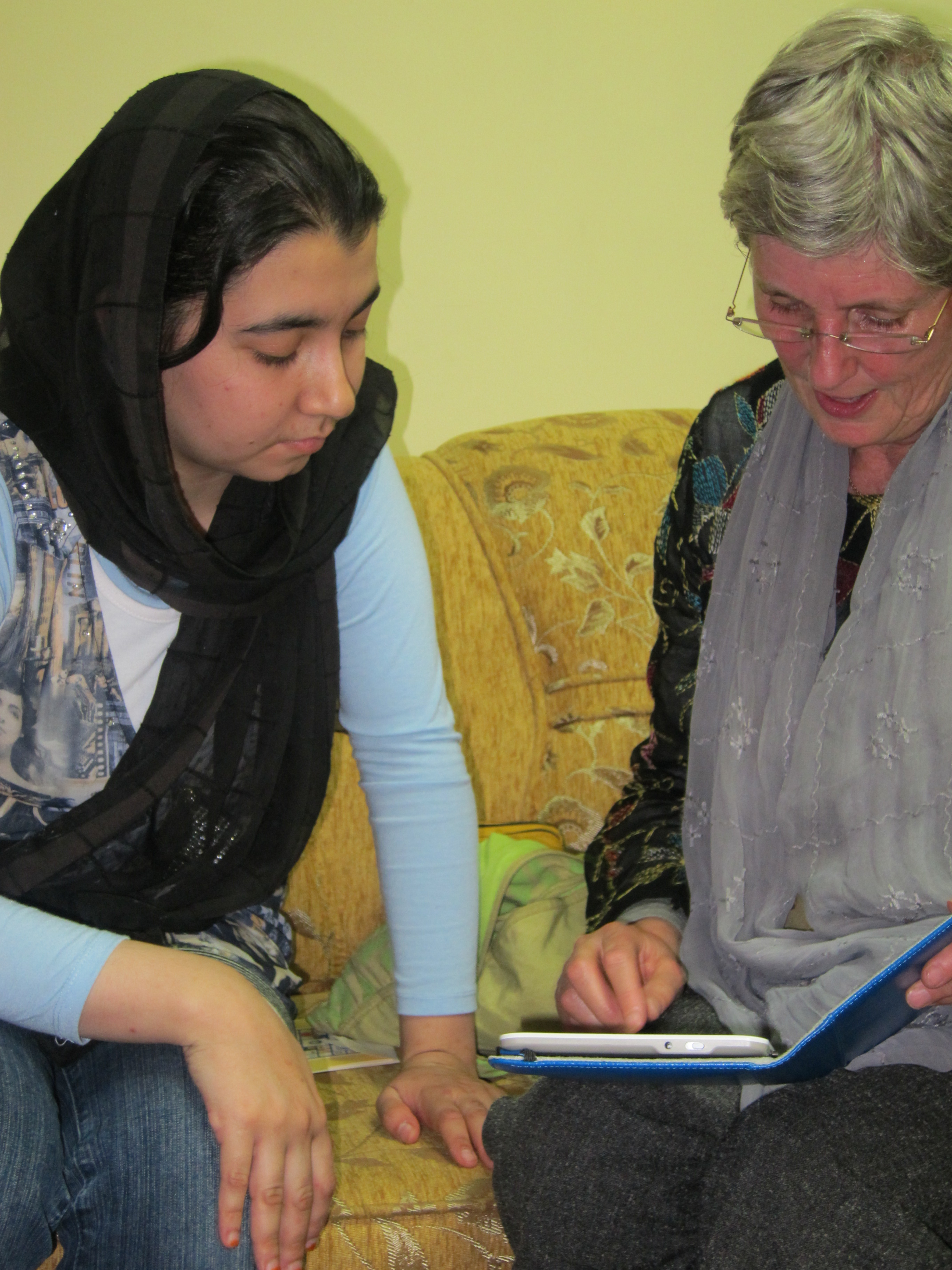
The final activity of the day was the delivery of the Kindle to Sonia. Sonia is a quick study and figured the Kindle out in no time. Her younger brother, her aunt and mother joined us in the fancy salon of her grandmother’s flat. We were served tea, cookies and then there was the expectation we would stay for dinner. But we explained that we were expecting a call from our daughter, the new bride, to hear about her honeymoon. We agreed we would meet again at our or their house for a meal sometime soon.

Inspirations and aspirations

Today was a day of inspiration. Chris and I had lunch in the women’s lunch room. We talked about organizing a children’s day and compared notes on the kind of games one would make available to kids on a day like that. As it turns out Afghans have something similar to apple bobbing, sack races and what we call in Dutch ‘koek happen’ (eating cookies dangling from a string with hands tied in the back). Chris knows of similar games in Australia. Funny how these things appear to be universal. How did that happen?

A new and long awaited staff member arrived today, Sally from Australia. She will be in charge of writing up our stories – something that we are not very good at, either because of poor English writing skills or because we have no time.

After work I went to the house of someone who worked in our predecessor project that ended in 2006 – but the house still carries his name. Now it’s the headquarters of the School of Leadership, Afghanistan (SOLA). From now on I will be teaching there on Thursdays, after my work day is over. Today was my first class.

My class follows Axel’s class. Two of his students are in both of our classes – a family affair. His class is large (12, boys and girls) will focus on English writing; mine, with only four girls today, will focus on English conversation. The late class is a little problematic for some girls because it gets dark early now but I cannot come earlier.

I started my class asking each girl to explain their name, both their family name and their given name; who gave it to them, what did the name mean. I learned something about Islamic history and Persian in the process. We talked about naming as an expression of vision, of a parent for a child. This led to a conversation about inspiration and aspiration: who inspires them and what they aspire to be. I am humbled by these girls who have not had an easy life – large families, little money and endless moving, from Afghanistan to Iran, then to Pakistan and back to Afghanistan.

Their homework for next week is to draw their vision and, before showing up in class, show their drawings to people who inspire them and can help them articulate their vision more, make them more compelling. One girl who wants to be president of Afghanistan said that people will laugh at her vision. I advised her to only show it to people who are supportive of her aspirations (two mothers, two sisters, a father) because those are the only people who really count.

On our way home I realized that this is one of the joys of working here – not anywhere else to be found: the opportunity to encourage young women who will help Afghanistan pull itself out of its mess to pursue their visions.

Introduction

Today I introduced Axel to the ministry of public health, referred to as the MOPH. He got to see the building, the garden, the EU container and meet several of the people I work with regularly. In the 9 months he has been here he never set foot inside the MOPH compound.

He accompanied several of us to a weekly consultative forum that brings together, on a weekly basis people in various functions who are trying to strengthen Afghanistan’s health system.

One of my staff spent a lot of time last year to look through the consultative group’s meeting minutes, covering 6 years, interview various stakeholders, and review the original and revised terms of reference. The resulting data was plotted on graphs and turned into percentages presenting a picture of this consultative body to itself that served as a starting point for a conversation about process and improvement.

There was much interest in this introspective meeting and more than the usual number of people showed up. The only group that was poorly represented was the government itself – not unusual and part of the problem we tried to address.

The irony is that these government officials are too busy for such meetings and thus the alignment between the various actors is weakened which then leads to calls for better communication and coordination. These are favorite and ubiquitous recommendations that can be found in any organizational assessment report anyplace in the world. Such recommendations are sufficiently vague that they don’t necessitate individual behavior change, even though that is exactly what is needed.

When I introduced Axel to MOPH colleagues there were, of course, many jokes about leading and following and Axel played the part as a faithful trailing spouse, which triggered more laughs. But then he was honored at the beginning of the meeting, introduced by the Director General as a honorary member of the consultative group and received a warm applause.

Stops and starts

After months of lingering, Ali and I are picking up the leadership and management work with senior government officials at the central level again. We, or rather I, had held out the last 9 months hoping that the minister would demand that all her senior staff become better managers and leaders, but she didn’t and without it we weren’t getting the kinds of commitments we needed to engage whole directorates in a four month long process.

But then senior leadership got reshuffled and suddenly there were opportunities for new beginnings, new senior leadership teams, the discovery of missing visions, misalignment. And so Ali and are now doing the rounds again among the director generals and finding a positive response. There will be action again, beginning next week. We will start with the curative medicine teams and help them look at their management systems that leave something to be desired. It will all be in Dari and I will follow from the sidelines.

Of course it is possible that with the new parliament, to be announced in the next few weeks if the calls for invalidating the results don’t bring everything to a halt, the acting minister may not be voted in for the second time. That would be her last chance because one cannot be voted on more than once by the same parliament. In that case the president has to appoint someone else. That will of course trigger a new reshuffling. Association with a replaced leader is a liability here.

The highs and lows that go with these stops and starts are part of the pattern of our life here. My mood fluctuates up and down along with these stops and starts.

I have noticed that my mood also fluctuates alongside the level of trust I experience here. There is the ‘being trusted’ and the ‘me trusting.’ The latter is a little murky. There is much gossip. Men engage in it as much as women do. People seem to love to talk negatively about each other and sometimes take me into their confidence. It is as if they want to help me decide who I should and who I should not trust. But I am a little wary of such storytelling because there are agendas, a settling of accounts, or less malignant, a way to lift oneself up above the others; none of it is helpful.

In my line of work it is better to start with the assumption that people are generally well intentioned, competent and honest. If I later find out I was wrong, so be it. It is better than the other way around. And so far I have not been all that much disappointed.

Kindling

Sonia’s and my life intersected less than a year ago. After months of trying Steve and I finally managed to visit her in her uncle’s apartment to determine, on request of a private Connecticut all girls school, whether Sonia would be able to enter 9th grade and whether her family supported her.

At the time we said yes to both questions but months later, when her attendance at the school and the coverage of all fees was secured, relatives of her father made it clear that if he were to send his daughter to America, they would excommunicate him from the family. I don’t know how that works but it was apparently enough of a threat that he withdraw his permission for her to go. That would have been this September. Everyone but Sonia was devastated; Sonia on the other hand was very pragmatic: if not this year then next.

We suspect that she sent her brother (who also goes to school in the US) as a messenger/missionary to the relatives in Ghazni and he turned them around. So now Sonia has received everyone’s blessing to go next September. The school was encouraged by this new twist and, I have been told, wove Sonia’s story in the speeches at the opening of the new school year. They also collected money and bought her a Kindle which they loaded with some 60 books.

Alison from DC carried the Kindle to Kabul and it is now sitting, all juiced up, in its bright blue leather case on my table. I have checked out its content. It is the candy store equivalent for books – the old classics, new fiction, probably a whole school year of reading, five Kindle pages of titles. The idea is that Sonia will be behind in some subjects, especially reading. Axel and I carried about 12 pounds of text books with us in June – math, French, algebra, science – for her to check out to see whether she is behind, on par or ahead. But in English and American literature the school assumed she is far behind. Hence the Kindle.

Of course Sonia has no idea what a Kindle is. I called her to tell her the gift had arrived. I asked if she knew what a Kindle was. “Sorry?” she asked, “could you repeat?” I then tried to explain what it is. The conversation went something like this.

Me: “It is an electronic book reader.”
She: “What? Come again?”
Me: “It is like a kind of computer that has at least 60 books inside it”
She: “Huh?” “There are 60 books, where?”
Me: “The books are electronic and inside the thing.”
She: …[Silence]. “Should I come to your house?”
Me: “No, I will come to your house and explain how it works.”
She: “Oh.”

The girl has no idea indeed and I have no idea on how to explain a Kindle. For many people in Afghanistan it is still hard, in spite of familiarity with computers, to grasp what the adjective ‘electronic’ does to the familiar things made of matter.

Sonia will SMS me when I can see her over the weekend. I can’t wait to see the reaction of the rest of the household. This kid is leapfrogging a whole family into the digital age.


March 2026
M T W T F S S
 1
2345678
9101112131415
16171819202122
23242526272829
3031  

Categories

Blog Stats

  • 140,229 hits

Recent Comments

Olya's avatarOlya on Cuts
Olya Duzey's avatarOlya Duzey on The surgeon’s helpers
svriesendorp's avatarsvriesendorp on Safe in my cocoon
Lucy Mize's avatarLucy Mize on Safe in my cocoon
Spoozhmay's avatarSpoozhmay on Transition

Enter your email address to follow this blog and receive notifications of new posts by email.

Join 78 other subscribers