Archive for the 'Uncategorized' Category


Applicants

Today I got a glimpse of the labor market here and how desperate it is. While our IT people tried to figure out why my mail program did not work (potentially a disaster of major proportions as it is our link with each other, far and near, for work and for family and friends) I leafed through the thick binder that our HR manager had deposited on my desk. It contained some 40 applications to a position for a leadership development manager I had posted. As it turned out the position is withdrawn but I was curious to see who had applied.

Of the 40 CVs two were misfiled and were for another position, one appeared much more appropriate for a position we are about to announce in our pharmaceutical unit, two or three were of people I knew and who are indeed potential, though not obvious, candidates. A few I marked as ‘potential’ though less so and I would want to check references first. All the rest where miles off base. I had asked for a leadership development manager but I got accountants, financial managers, IT managers, computer programmers, cardiologists, hygiene teachers, assistant orthopedic surgeons, military interpreters and professional experiences even further afield.

It felt as if some people automatically applied to any position they saw advertised that promised an interesting employer (we are), a reasonable salary (we pay OK) and potential for further development (sometimes). May be some were attracted by status (and international organization) or they had worked for our organization in its predecessor project (and thus knew all the above from personal experience). Sometimes the name of the position was typed in a blank spot in a form letter that had a different font and typeface. Some had no cover letter at all. Very few mentioned in their cover letter why their particular experience was relevant for the job. They mentioned it was relevant and he (all but one were men) was just what I was looking for, but not why.

The language in the cover letters was sometimes hyperbole, sometimes touching, sometimes full of clichés, I imagined copied from others or out of how-to books that were written in the previous century. I was looking for an organized person, a good English writer, yet several of the CVs were full of spelling mistakes and rather jarring in their presentation with a jumble of fonts, underlines, italics and font sizes.

I think I have spotted a business opportunity for entrepreneurial English majors: ‘We help you get a job: resume writing skills, interviewing skills, English writing skills.’ A well written resume, a good presentation and a confident interview will increase one’s chances a hundred-fold.
Clean and dirty hands

Axel found himself this morning running into one of many holy book-burning demonstrations that have attracted crowds in various parts of the country. It was a little unexpected, since we thought that the fire behind the protest had died down now that it is a non event. It was a bit unsettling, he emailed me later, to have been this close to such organized anger. The driver turned around and everything ended OK. Later things turned a little ugly and people (Afghans) got hurt because of an overzealous police force.

This morning I met with all my direct reports to find out which of the activities on my handover notes were completed, which were not, where things had stalled and what was new. I got an earful about the custom clearance obstacles for the pharmaceuticals which the friendly and generous people of the United States are donating to this country.

Much of the hassle is simply petty corruption, with various government workers delaying things until permits expire. This then creates new opportunities for getting some extra pocket money. The number of pieces of papers required to clear everything is dazzling. This is the small fry stuff that cannot be solved until people earn living wages. It’s not what makes the news headlines but it can create major headaches for people trying to follow the rules.

With hundreds of thousands of dollars in pharmaceutical products at stake, and by extension the health of the people for whom the products are destined, the job of freeing the drugs before they get too hot or too cold is tough. That we get everything cleared at all is a miracle. The cost is much shoe leather burned and interrupted days and nights when things need to be loaded on trucks or off trucks at a moment’s notice. I learn that, in the end, it is the relationships with the honest people in the various departments that save the day.

Back home after work I watched how the people of Afghanistan are being educated about the parliamentary elections. All the stops have been pulled out: elaborate skits, funny and serious, simulated election procedures, lectures for by men for men, by women for women, celebrities and kids pleading to do the right thing, even God is invoked to make these elections a success. In between the educational messages candidates pitch last minute pleas at undecided voters.

What’s problematic is that many candidates belong in prison; in this respect not much has changed since the 2005 elections when, according to AREU, a reputable local research organization, the winners included 40 commanders at the time associated with armed groups, 24 members of criminal gangs, 17 drug traffickers and 19 who then, and if they are running again presumably still, face serious allegations of war crimes and human rights violations. From what I hear around me this keeps people away from the polling stations. Why put a crook in parliament?

Axel reminded me that the earliest elections in the brand new US were probably not that different. Few candidates had clean hands. A democracy needs an educated electorate that can distinguish fact from fiction and recognize easy promises for what they are – educating the public took a few hundred years.

Itchy

Two of the five foreigners in our project our back – they are trickling back in. I was the first one; yesterday Douglas came back from a trip through China and a month at his home on the West Coast. At the beginning of next week two more will return. It is only after October 2 that we will all be back, converging on Afghanistan from Sierra Leone, Australia, US/East Coast and US/West Coast via China and India.

We started the new month, post Ramadan, with an Eid breakfast that reminded me of the first work day after New Year: there was much embracing, smiles, stories about the holidays and good wishes every which way. The only difference was that there was no hugging across gender lines and the weather was beautiful and warm.

Chairs and tables were set out under a bright blue sky. Breakfast consisted of sweet milky tea (reserved for special occasions), green grapes and cake. The only sour note was that all the women were missing. A few of them were pulled in halfway through the breakfast and after the words of thanks from our chief. The women received large boxes of cookies for their offices (no one else seemed to have received such gifts). Sometimes I don’t understand a thing.

The first day was much too long for a first day because of a – for us – late phone call with Boston. By then I was yawning so much that my participation was all but useless. I am jet lagged and responding to the thick layer of dust in the air with an allergic reaction that has left me sneezing and itchy-eyed. “It’s good to be back home” only applies partially to our life in Kabul.

Routines

Slowly we are picking up our routines again: Dari classes on Monday, exercising our lungs, already affected by the dust and going to bed at a reasonable hour. Vacation is over, not just for us but for everyone.

It was more of a work day than I had anticipated. I received a call from my boss to help out on the presentation a week from now by the Acting Minister at the Millenium Development Goals Summit that will take place in New York. The still in draft form powerpoint was large, as they are when people put full size pictures in them, and so it took a couple of hours before I had downloaded the enormous file.

My work was interrupted by Dari class. Axel cancelled his class because his back was hurting; we think it might have been the gin and vodka bottles that we crammed into already too heavy hand luggage. We got away with it then but apparently payback time waited until later.

I had brought my Dari teacher an English-Dari/Dari-English dictionary in the hope that she would be able to find the real English meaning of Dari words, rather than have me guess from her description of the word in Dari. I had guessed wrong many times in the past.

As I was working my way through Pinocchio in Dari there were many occasions to use the dictionary but I learned quickly that she’s not very good at using a dictionary. For me, using the dictionary to find the English meaning of a Dari word is difficult as I don’t know the ‘alfabah’ by heart yet and the sequencing of words is thus rather difficult. So I continue the guesswork.

Reading Pinocchio in Dari, even though I know the story, is difficult because of the many idiomatic constructions that don’t lend themselves to word by word translations. Still, after reading moral stories and fairytales for months now I am ready for something more adult. I gave my teacher an ‘Intermediate Dari’ book I had ordered from Amazon and brought back from the US. It has more adult content, phrases like, ‘he burned his books before he committed suicide.’ I asked her to review the first few chapters to see whether this can be my new text book.

We picked tomatoes and basil from our garden and Axel made the kind of tomato salad that we used to eat all through the summer in Manchester. I made a Lebanese zaatar bread roll to accompany our meal and we opened our last bottle of wine, a Ksara Rose that was left over from our previous Dubai visit. Because of the full hand luggage we were not able to add another bottle. So from now on we are relying on visitors.

Homesweetkabulhome

We are back home in Kabul. We flew back in a plane full of the usual muscular types who are employed in the security industry as well as reporters to tell the story of next week’s parliamentary elections and then sundry aid workers like us.

The city is even more plastered full of election posters than when we left. Whole buildings and parts of streets are hidden behind the gigantic posters. I wonder whether they will be taken down next week. It’s sort of annoying all these people staring at you with promises no one believes.

The weather upon our arrival was nice, a warm summer afternoon and the sky was relatively clear; we could see the mountains surrounding Kabul. The roads were still under construction as they have been since I arrived a year ago (same roads, presumably different construction companies) – even the temporary frenzy of road improvement for the Kabul Conference in July did not make all that much difference – to have expected any progress since we left two weeks ago was silly.

We have one more day of the Eid holiday which seems to last longer here than in the UAE where today was the last day. This gives us one more day to recover from the trip, put away our stuff and settle in for the next stretch of Kabul life.

Blast walls and carpets

Karzai really meant it when he said the concrete blast walls and road barriers had to go. This morning, on my way to my massage appointment, we passed several areas where the barriers had already been removed. The Serena Hotel looks decidedly naked as its natural entrance has become visible again. Another street has suddenly become twice as wide. It’s exciting to see more of the city and the removal of the walls makes the town just a tad more normal.

The ‘security chatter’ continued and we received an email from the US warden that all sorts of places we usually go to are off limits for US embassy people; we ‘other’ Americans were warned. What to do? Give up my Friday massage? I listen to our own security chief who is sufficiently connected to get prompt warnings. He is not holding us back. I heard our security systems described as ‘surfing’ – it is about listening to all the chatter and to circles inside the Afghan security forces and sliding along the airwaves. So far it has worked: not too tight, not too loose.

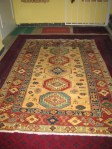
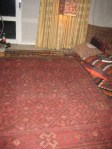
Axel picked me up at the spa and from there we headed to the carpet place where I had bought his birthday present, a kelim that neither of us liked after we had spread it out in the hallway and looked at it for a few days. So we went back to return it. Axel got to pick one for himself, something that looks more like a Yomut, the one we gave to our nephew Daan and his bride Jane for their wedding. Axel had to add some money in addition to the returned kelim as it was an old carpet and therefore more expensive.

Having finally bought his first carpet he got a taste for more. We drove to the place where he has been drooling over the same carpet for 6 months now and, against everyone’s admonishments, had not bought it. But I knew he dreamed about it and now he is earning his own money so he didn’t feel guilty about spending ours.

When we arrived at the shop the carpet was no longer hanging on the wall and his heart sank. Too late? But no, the shopkeeper remembered him and was able to locate the carpet in a pile of folded ones. He smiled and said, “you know this one was made for you!” Of course we all knew that. Axel didn’t even bargain, so happy was he to find it.

Handover

We had another nice dinner with Razia Jan and her always interesting circle of friends and relatives. This included an American who spoke perfectly Dutch. Although both his parents are Americans he grew up in Holland and went to school there. He is providing technical assistance to the Baghlan Cheese factory. As it turned out Axel had met him half a year ago at the (near) monthly Dutch embassy ‘borrel’ (cocktail hour/party).

Axel’s wedding outfit was ready. He did one other showing of the suit and looks quite smart. The shirt is dazzling white and therefore needs to be kept far away from catsup, tomato sauce and red wine. My wedding dress was done a week ago, only the dress for the day after the wedding still needs some tweaking and so we will see Razia jan once more before we leave.

On my last day at work we met, our nascent female leadership development team, Ali and myself, with two members of the Executive Board of the Afghan Midwives Association. We discussed the who, what, how, when and where of a leadership program that we will do with them for their provincial chapters and teams of midwives who work in several Kabul hospitals. It’s going to be one of those rare activities where women will predominate.

I used the rest of the day to complete all the tasks that remained on my to-do list, handed over my work to one of my staff who will be acting on my behalf and sent my handover notes to all the program managers. As a last step I activated the out-of-office assistant feature of MS Outlook that will alert every email sender that I am now officially on vacation. The first one and a half days of this vacation will be spent in Kabul over brunch, under the skillful masseuse’s hands and then we will start to pack.

The weather change (cool evenings) is for real we are told. We have crossed the mid-summer/early fall divide, much like in Massachusetts except maybe a few weeks earlier. It means we can turn the airco off at night and open the windows. This is a good thing except that we have to put up again with the incessant barking of dogs and other noises that are not very pleasant. It’s quite a racket outside our garden walls. We wonder why no one has pulled out their gun yet. Strychnine-laced chunks of meat are the preferred way I was told.

Insect girls

I spent all day cleaning papers off my table, taking care of loose ends, and composing my handover notes. I learned about procurement of medical equipment and how pharmaceuticals are managed – I am on a steep learning curve now that the pharmaceutical component of our project has moved into my portfolio – it is fascinating and gives me a completely different view on public health in a developing country.

I now realize how incomplete my understanding was of what it takes to deliver health care services. I wrote chapters and books about management and leadership, emphasizing the human element in health care delivery; now I am learning about the financial and logistics aspects I knew nothing about.

This afternoon the weather changed, rather suddenly. First came heavy clouds. I was happy that I had not been on the flight to Takhar Province with the minister. Flying into Kabul when a front is coming in, especially in a small plane, is not so much fun. Thunder and lightning followed, then heavy rains. The temperature dropped to a level more likely in November.

Here was yet another manifestation of altered weather patterns in the region. But unlike the catastrophic rains in China, Eastern Afghanistan and Pakistan, this was a good change for us and the farmers – relief from the heat and badly needed rains to keep the dust down and crops growing.

Things are a little tense in town; there is much security related chatter in the air and some foreigners are kept on a tight leash. This afternoon a class of girls in a school in Kabul was poisoned by someone who does not believe that girls should be in school. He fumigated the classroom with some chemical, insecticides are popular for this purpose (girl as insect). The entire class landed in the hospital.

In the evening we finally met Courtney’s wife Elaine, who was the one that connected us many months ago via my blog. We became friends with her husband, a Safi pilot and that is how I got to fly from Dubai to Kabul in the cockpit, an unforgettable experience.

Elaine arrived early August for a year in Kabul. She is teaching at the international school while her husband flies in and out of Kabul across the region and now also to Frankfurt.

We went out for dinner, the four of us, sitting outside in the lovely garden of the BBQ Tonight restaurant. Elaine and I kept warm, wrapping our scarves around us, something that would have been unimaginable a day ago.

Khak lungs

Countdown started awhile ago but now our departure is in sight, four more days. We checked our tickets, a complicated affair that required a long wait at the Safi offices in downtown Kabul, multiple emails and phone conversations to correct a double booking made three months ago, and two sets of award travel tickets, one from Delta and the other from Air France. I think we are traveling together unless I get an upgrade. Delta keeps sending upgrade certificates to me but I cannot use them because I am booked in the wrong fare class, at least for the next trip.

We learned from Axel’s local doctor that his general malaise, low energy, low appetite and respiratory problems are probably the result of ‘khak’ in his lungs. Khak means dust in Dari and Khakbad (dustwind) is the Afghan (and warm) equivalent of France’s Mistral and Senegal’s Harmattan. It is part of the occupational hazard of living here – the polluted and dusty air not only leaves a fine dust on every surface inside and out, it also coats our lungs. An X-ray, taken to rule out bronchitis or pneumonia, showed a thin white dusting at the bottom of his lungs. That is the ‘khak’ said the doctor, and it can be found in the lungs of almost everyone living here.

For Axel this stuff is causing bronchial spasms. He is taking some liquid that comes in the same bottle as the glycerin for the bubbles. We should be careful not to mistake one for the other. One learns to live with these respiratory problems as one learns to live with security threats. Still, compared to most of Afghanistan’s population, we live a life of luxury here.

We are also learning that Axel has to leave Afghanistan about every 2 months to get his hearing back; it is the same dust that coats the inside of his ears and messes up his hearing aids. The last month of our three-months tours I have to talk a little louder. Some people wonder why we put up with this. The answer is complicated and can be found in many of the last 325 posts on this blog.

Crossing lines

This morning about 30 of my colleagues showed up for a simulation exercise about working across cultures. I used a simulation called Ecotonos (authored by Dianne Hofner Saphiere, published by Intercultural Press). In the simulation there are three cultures, green, red and blue, each with a set of cultural norms and ways of being with others, different ideals of leadership and ways of doing work.

I had to change any norms that required people in one of the cultures to hug or touch because both men and women participated in the exercise and this is too strong a norm to change even temporarily.

We called the groups the sorkh culture, the abi culture and the sabs culture. The words mean, respectively, red, blue and green in Dari. People were randomly assigned to the groups.

The red group is preoccupied with time, speed, results, individualism, loudness and assertiveness that verges on aggressiveness; the blues are rational, distant, unemotional, planners, hierarchy conscious and obsessed with getting evidence before taking actions, they abhor touching; and finally the greens value harmony above all, live in a paternalistic culture with a father figure taking care of his people. Under his watchful eye they do everything together and like to be close to each other, like a family, even at work.

The same task is given to all (build a tower with certain specifications). After awhile we dispatched people from one culture to another as consultants, ready to lend their hands and expertise to the task at hand (‘we are here to help you.’). And with that we are off to the races.

The resulting dynamic nicely mimics what happens in real life, especially because feedback loops don’t exist when two or more cultures collide. The reds express the annoyance with anger and loud speaking; the greens pull closer together, excluding the newcomers while keeping a smile on their face and the blues abhor the emotions and chaos they produce, pulling back into their individual safe spaces. The misunderstandings and distractions from the task at hand are only funny because it is a simulated work environment. In real life these things happen also but then they are not funny.

The simulation produced its desired effect and led to some good insights, even though I didn’t get them all as everyone was speaking in Dari. The only thing that didn’t quite work was getting the women out of their traditional and subservient roles.

With hardly an exception they were not able to get into their new role and take on the characteristics of whichever culture they were placed in. For them behavior is so prescribed that stepping out of these roles, even if given permission, is probably too risky. And so the lesson I learned is that in this country, the simulation and possibly any experiential learning is best done in single sex groups. If I had thought about it more, I could have figured this out ahead of time.


March 2026
M T W T F S S
 1
2345678
9101112131415
16171819202122
23242526272829
3031  

Categories

Blog Stats

  • 140,230 hits

Recent Comments

Olya's avatarOlya on Cuts
Olya Duzey's avatarOlya Duzey on The surgeon’s helpers
svriesendorp's avatarsvriesendorp on Safe in my cocoon
Lucy Mize's avatarLucy Mize on Safe in my cocoon
Spoozhmay's avatarSpoozhmay on Transition

Enter your email address to follow this blog and receive notifications of new posts by email.

Join 78 other subscribers