Archive for the 'Uncategorized' Category


New year resolution

Now that I am not so busy anymore, picking up my writing seems doable again, a routine I must pick up like a (knitting) stitch that has fallen so far that is has created a ladder. This is the ladder I plan to climb up to the top again, to resume my knitting in the round.

I did get some nice yarn for Christmas from Sita, a Christmas that we celebrated on the 8th of January due to various omicron complications in overlapping pods.  I looked through my knitting books as if I was a cook looking for a great dish to cook – challenging but doable. I picked something that is doable when all is quiet, and you can count stitches without being distracted. But not doable if you have two dogs, two grandkids and 5 adults around you who are talking with each other, conversations I am interested in, or worse, asking me questions. I started about 10 times, each time unraveling the complex pattern and starting over again. 

And then, on the day everyone was leaving, I tripped over accumulated stuff in our small entrance hall, I fell and broke several small bones in my right (good) hand, where my 4th and 5th digits are connected to my hand. It’s called a ‘boxer’s fracture’ and is apparently a quite common hand injury – people either lash out to someone like a boxer would, or non-boxer’s trying to break a forward fall. 

So here I am, not being able to knit and with a right hand that cannot do everything it/I want(s) to do. Luckily it could have been worse, and I can use my right thumb, index and middle fingers, so typing is possible as well as picking up light things.

Spring forward

Last time I wrote was in May, after a very wet Memorial Day weekend when the mask mandate had been lifted and the people believed the pandemic was behind us. Visions of going back to normal were dangled before our eyes, like Biden’s promise of 4th of July cookouts with friends and families. But the 4th was rained out also, as was the rest of that month here in Massachusetts, while the other side of the country was going up in flames. The backyard barbecues and summer events where people had massed together helped the Delta variant along. If in July its presence was spotty, here in the US, by the end of August it had overrun us.

Now, in October, much has changed, again. Masks are back, some people are angrier, some sicker and some died because they didn’t take COVID seriously or they were infected by people who didn’t. We received our third dose of Pfizer while in most of the developing world most people are still waiting for their first dose. South Africa has gone in and out of lockdowns and in the US everything, including COVID and Trump, are tearing us further apart.

The Taliban overran Afghanistan and lots of people are scrambling, some to get out of Afghanistan and others to help those who did get out to find safety and housing in the US and other nations. Housing, specifically affordable housing, is the big stumbling block here in the US. We live in a neighborhood, town, district, and state where affordable housing is a big issue. People talk about it a lot, in planning board meetings. Affordable housing discussions bring up class thinking, us-them thinking, not-in-my-back-yard (NIMBY) thinking.

The Afghan evacuees are sent to the poorer towns because the housing prices are not as obscene as where we live. They won’t come here unless we invite them. We hope to have at least one person come to our town, as a new member of our family if we can get the paperwork and right procedures followed. A timeline of months stretching out ahead of us, which seems interminable for the bored, lonely and depressed young Afghan woman we are trying to bring here. In attempt to provide small comfort I tell her, via WhatsApp or BOTIM, “you won’t be stuck in this Humanitarian Centre (in Abu Dhabi) forever, use the idle time to learn.

I also have idle time, but it constantly shrinks because I am learning as if my life depended on it (it does not). During the summer I told myself to stop signing up for everything that looks interesting – it worked for a while, but now I am once again signed up, and deeply committed, to (a) become a team coach, (b) immerse myself in Quaker practice, (c) complete my Ubuntu coaching course that I started last spring, and (d) up my coaching skills. One of these (becoming a team coach) will stretch out into 2023, the others will end before the year is over.

All this still leaves plenty of time to read, bake bread, network, exercise and take care of things around the house, the latter now focused on preparing for winter. I do some pro bono work, some locally with one of our town’s volunteer boards and some through EthicalCoach, meeting every other week with two remarkable young people in Tanzania and Malawi. In between I continue to be engaged in a little paid work with a for profit start up that works in global health and two HIV programs in Southern Africa. The balance is just about right.

What has also changed since May is that Sita and family moved out of our rental apartment next door in July when the school year ended. After that we were no longer needed to monitor our sometimes-reluctant granddaughter during her online Kindergarten classes and keep her occupied in between these snippets of time. It was nice to have them close but not in our house. 

In July our first renters moved in for two weeks, followed by a young couple with small kids for another 3 weeks and then an older couple for one week. These rentals took care of the real estate taxes for the rental apartment.  There is no ROI quite yet on the considerable investment made by us and Sita to upgrade the place from a pigsty to a lovely and well appointed ‘cottage.’ Now, for the remainder of the year, we have a couple more renters who are essentially paying for all the things that went wrong lately: minor but expensive glitches in the septic and heating systems. With some luck we come out even, deferring our ROI to the years to come. Having renters next door has been gratifying to all.

Rainy on a new day

I am not sure why after May 15 each year I turn to a new leaf in my diary and create a new word document in my blog collection that now spans 14 years. It is like the division of earnings into fiscal years that start at arbitrary days. So, this is a new page and the start of a new year in writing. The harvest last year was thinner than I had wanted, only 32 pages of writing. I have been busy because it was the year on Zoom and I could said ‘yes’ to everything that seemed even remotely interesting. Everything was within reach and I got busy.

Today is the 1st day of a Memorial Day weekend that is the saddest I can remember. The heavens started crying yesterday, before I could bring my washed winter woolies in. Everything is soaked and will continue to be soaked until the long weekend is over. It is sad because this is the official start of our northamerican summer. The first summer since our 14 month isolation in which we are finally allowed to congregate and remove our masks. Whether one agrees with this policy decision or not, it lifted people’s spirits. Restaurants have opened their sidewalks for the faint of heart and more indoor spaces for those who believe the pandemic is over.

It is also sad because today we hold a memorial service for one of the members of our Quaker Meeting who succumbed to multiple cancers. I am holding all this sadness in my chest which feels heavy as if a rock is placed on my lungs. 

One of the best antidotes to my sadness is music, a remedy I discovered only recently.  Last August I joined a small group of women in a Saturday ritual where we use a technique from music therapy that is called Music & Imagery. The group is led by our (near) neighbor and dear friend Christine, a music therapist. The women are in Montreal and Massachusetts and for a while Maty from Senegal joined us. We have only met on Zoom and couldn’t meet any other way given the distances between our homes. 

We chitchat for a bit about what’s going on in our lives and then we center and draw whatever we find inside. We reflect on what we need more or less of to turn the corner we want to turn, and then draw that too. We give our two drawings a title and then share our artwork, with commentary. Then the music kicks in. Christine selects 3 pieces of music (‘friends’ she calls them) and we listen to these, draw and title the drawings. The last piece of music we each select for ourselves. They can be old friends, favorite pieces or sometimes I search for ‘random’ on Spotify and be surprised. 

Through this group I have discovered so much amazing music from around the world. The playlist for our group is like a treasure chest full of jewels. Ever since the rain started yesterday afternoon I have listened to this playlist. It can rain the whole weekend because the playlist is long (8-10 pieces of music for each weekly session since April 2020), adding up to at least two full days of songs and instrumentals.

Feeding the wrong head

If there is a wolf (or dog or other animal) with two heads that shows up in your life, which head are you feeding? The good one or the bad (evil) one? The image of such a two headed creature pops up in many old stories, legends, fairytales, of whih I have been reading a lot lately. I have become quite aware of when others are feeding the wrong head but maybe not so much when I do it (to) myself. I pull away from conversations that spoon the broth into the wrong head, an allergic mental reaction. 

I just finished a young adult book (Darius the great is not okay by Adib Khorram) that a friend passed on to me. The book is about a high school boy of mixed Iranian/American parentage who is depressed and take medication for his depression. The book took me into his head where I found him feeding the head of the two headed wolf that produced ever greater feelings of victimization, sadness, not fitting in at school and not being loved, especially not by his father. A trip to his mother’s family and ailing grandfather in Iran leads to a friendship with a neighborhood boy of his own age. The trip puts things in perspective when he is forced to see beyond himself and witnesses the pain and sadness of others.  I didn’t like the book. I felt I was the wrong audience (not a young boy, not of mixed parentage and not depressed) until I read the author’s note of why he wrote the book, reminding me that the book is about depression and how the world reacts to depressed people – exactly as I did while reading the book (wanting to sit the boy down and give him a good shake). So maybe the book was for me, after all.

I have joined the yearly peppy and upbeat monthlong series of webinars about energy leadership, a program I took nearly a decade ago, which launched me into my coaching career. The program was transformative in that it gave me a framework and language around the energetic pull of people and circumstances (even weather). Catabolic energy pulls one down into a spiral of anger at others and feeling victimized by circumstances. Anabolic energy pulls one’s energy up into ever higher reaches of energy until one reaches the ‘One with the Universe’ realm. The webinar series is run by the peppiest of peppiest young (highly anabolic) women. I watched her with great admiration as she interviewed three other peppy women, also in their 30s) who have created businesses and good incomes that help people channel their energies in the right direction. I am in awe, thinking of how and who I was at that age. Not anabolic like that, more catabolic like the boy in the book (I have journals to prove this).

Last night we spoke with our daughter and her husband who have just returned from a one month Airstream trip down south. They left to take a break from the sadness of having to put their first and dearly loved 14 year old dog to sleep and being in a house with too many memories. She is not clear about whether the trip helped her to cope with the loss. Our facetime conversation made me wonder. There was much of that catabolic energy. I had a strong reaction, maybe it is a kind of self-preservation, trying to withstand the pull that such energy has on me. I saw which head was being fed. The best medicine for me was to remove myself from that downward pull (all this against the background of an entire day of grey skies and incessant rain). I went to bed and lost myself in a 1024 piece electronic puzzle of a picture full of flowers and loveliness. 

Life lessons

I am listening to Angeles Arrien’s book ‘The Second Half of Life.’  In the olden days that would have been around 25 or 30 when the life expectancy was 50 or so. Nowadays the second half seems past middle age, giving us more time to screw up and having less time to use the stories’ medicine. But the second half doesn’t begin at a particular age. Some very mature people may be entering their second half at age 25 while others may never get there. I know of a guy with orange hair who is not even close. I wish I had discovered this book (and the stories) when I was 25.

The book is full of stories and myths that contain lessons (medicine) that we have to learn while on our earthly walk, and in particular during the last part of that walk. The stories are drenched in symbolism; symbols that only people with considerable life experience can decipher (or with help form interpreters like Joseph Campbell and Clarissa Pinkola-Estes) but these stories can also be read to young children. In the US they tend to get the expunged versions.  

One of Arrien’s stories has a remarkable resemblance to a story I recently read to my 5 year old granddaughter Saffi out of an old book of fairytales I carried with me from Holland (Sprookjes van de Lage Landen). The version I read to Saffi is about a wife, found cheating by her husband, who slays the lover and incarcerates the woman (in one version cutting her eyes out) and then letting the wife out of her cellar to eat once a day. In Arrien’s version she get to drink soup out of the skull of her lover (in that version she also has to sleep on top of the dead bodies of preceding lovers) or, in my Dutch book’s version, eat the meat of the lover’s body that is slowly roasting in back of the fire. 

A gruesome story with a lesson that isn’t as gruesome and has little to do with ‘thou shall not covet another person’s wife (or husband).’ Arrien’s retelling is about letting the skeleton’s out of the closet (or cellar) and face all the wrongdoings in one’s life, get beyond fear and pride and set things right (the latter lesson a boon for philanthrophy).

I do wonder what Saffi gets out of all these centuries-old stories. Her retelling of them to her parents or grandfather is fascinating because of what she leaves in and what she leaves out. And I noticed she doesn’t shudder much when someone’s head is cut off (because he was looking for death) and then sewn on backwards and eventually turned the right way out of compassion, or when the alleged adulterous wife gets to eat part of her lovers thigh (‘what is adulterous?”).

Picking up old threads

Being at home means that one is always on. On for chores, on for paying bills, fixing stuff, grandchild duty, preparing for attendance at this or that event, learning, doing paid or volunteer work. Looking back at my many years of travel I realized that in this COVID year I have missed the switching off that planes allowed me to do; the empty time between take-off and landing. That is the time I would be writing, a kind of writing that comes from being in the ‘off’ mode. When you look up from writing in a plane (or even in a hotel room), there is nothing that summons one to action as when one is at home. Now, here, at home, I can count several things that need my attention, without even turning my head. In planes and hotel rooms there are few summons (do this, clean that, fix me, cook me, plan, etc.). Those off hours are like the time between dusk and dark or dawn and day – just broad shadowy outlines of what is out there.

I have articulated some new intention. They do require some doing but without the ‘check the box’ end point: writing for writing’s sake, playing the ukulele without having to make it to the next level on my Yousician score board, and (stationary) biking without the need to cover a certain number of miles at a specific pace. 

I have always been a driven person, may be because, as number 4 in a family of 5, I had so much looking up to – things I wanted to do but could not yet. In my adult life I was driven to take on assignments or reach levels of performance or completion that always included stretching. It is a very hard habit to shake now that I am approaching retirement. I still take courses that require completion, but these now come without certificates, just the completion of an experience that enriches me.

I completed one such course in March, four half Saturdays, with a wonderful coach in South Africa.  I learned much from her about Ubuntu coaching and the South African greeting of Sawabona (I see you I hear you). I recognized the role reversal taking place this late in my life/career: instead of being the white teacher with a class full of black people, I was the white student surrounded by a teacher and class full of mostly black South Africans.  

When I look back on my life as a teacher in the international development space, I see the arrogance of it all – exporting American (or may be European) concepts and techniques about management & leadership, team work and performance and pouring these down the throats of people who have learned to admire (and may be even be envious) of ‘the west.’

I have kept a diary since the late 70s. Once (this must have been during an ‘off’ time, possibly a very long plane ride), I extracted sections from my handwritten diary entries for an (unpublished) piece called ‘Invisible Ink.’ In my introduction I wrote:

When two people or two groups come together in a consulting relationship, when one person or group gives advice to another, there is a lot more present than what’s visible. Each party comes to the interchange with years and years of baggage. Each person or group has had good or bad experiences with authority, stereotyping, exploitation, conflict and its consequences, with power. Each individual also comes with a self that has defined itself in terms of competence, likeability, attractiveness, smartness and significance, and has either seen this confirmed or disconfirmed in his or her interactions with others.

This is the invisible ink that is written in the margins of our interactions with others. It is usually not readable unless held over a flame, which sparks the behavioral manifestations that hint at some of these experiences. Of course, this is also the stuff that doesn’t make it into reports, and sometimes not even into our consciousness.” 

When asked by former colleagues who are preparing MSH’s 50th anniversary events, whether I was willing to chat with one of them for an hour about stories, I agreed. And, in preparation for the call that took place yesterday, I re-read my Invisible Ink piece and shared it. 

The trips and experiences described in Invisible Ink are as vivid in my mind as if they just happened. That is the nice thing about journaling. I am sure I would have forgotten many aspects of these trips, not so much the facts (dates, places, assignments) but rather the feelings and reflections about the experience. And now, all these years later, I see how I struggled with this unidirectional flow of knowledge, the cultural dominance (if only I had known about Ubuntu then). I think we (as a tribe of Northamerican/European international consultants) have done much harm in these exchanges that often weren’t exchanges at all: teaching people to be direct when direct can be insensitive or asking for honest feedback when that goes across everything people have learned as children. To speak truth to power when that can kill you.  I, a Dutch person at heart and an American for most of my professional life, still believe that directness and feedback and speaking up are good practices, but now know that these are good practices for me. 

In my retelling of stories to my MSH colleague I picked out several where I ended up the learner. Those were experiences I created for others. They triggered strong responses from my students by doing something that was taken out of the Dutch-American context and plopped into an Arabic, Afghan, Kenyan context without thinking about consequences. And these are only the few where people stood up against me – imagine the countless ones where people didn’t dare to. These were the missed learnings. Now, however late in life, I am (re-)assembling those learnings and, hopefully, be a better person for it.
Worry ninjas

Nearly two months after my last few entries, a dream drew me back to my diary. It was about worries. Worries to not be able to check in for a flight to Wuhan – of all places – because I hadn’t planned for an airport farewell. That farewell (to whom and with whom got lost in the wake up) had taken more time than anticipated. For reasons unclear now, I either had not looked at my planner, or forgotten the trip altogether, I realized within an hour of the scheduled departure of my flight to Wuhan that I still needed to collect my travel documents and suitcase from my home. Trying to flag down taxi cabs that could get me from the airport in Paris to my childhood home (in the Netherlands) in a totally unreasonable time filled me with worry until I met an old and always cheerful friend from college who said, “Why don’t you relax and take the next flight to Wuhan?”

Oh how right she was, worry is such a waste of time. I am listening to a lovely little book (Into the Magic Shop) written by a neurosurgeon (James R. Doty) on what he learned, as a young child, from a remarkable meditation teacher who had taken him under her wing inside a stripmall Magic Shop. “Worry is a waste to time,’ she remarked to the to the young man, who was at that time living a rather bleak existence in a bleak part of a bleak town, barely a teenager. Or, as I learned in Nigeria, decades ago, “when you worry, you go die; when you don’t worry you go die. So why worry?”

Worry consumes enormous amounts of energy, shallows our breathing, reduces our peripheral vision, releases more cortisol into our body than we need, which then weakens our immune system, etc. In short, worry is bad for us. I think I have been worrying about so many things for a full year now (COVID, elections, violence, vaccines) that extricating myself from this state of mind has been a big challenge for way too long.

On a more intimate level, worrying has also been about ruminating about past decisions and anticipating that bad stuff will happen in the future. This is why I have made a commitment at getting better at meditation, even if it is only 20 minutes each day. I am still very inexperienced in my meditation journey, but with a year of daily practice under my belt, I am getting just a little better at fighting the worry Ninja.

From July till December, our ‘aging-in-place’ project has filled me with worries (forward and backward), what with all the decisions (smart and not so smart in hindsight), and the oodles of money involved. Now, actually aging in our new place, downstairs, I let that worry Ninja go, but another one has appeared.  A new project has started next door after one of our neighbors of 50 years died and his housemate vacated the premises a month ago, leaving us with a considerable mess to clean up. There are once again decisions to make on what to spend money on and what not, the color of the walls to be painted, the furnishing of the place.

With our grandchildren’s homeschooling likely to go on until the end of this school year, and their parents often at wits’ end on how to manage this colossal challenge, we invited them to come and live next door whenever and for as long as they wanted until the end of the school year. That way we can look after the kids when their parents cannot.

I keep getting sucked back into the energy-draining ruminating and anticipating routines, wishing backwards and forward, that get in the way of being in the here and now. I am calling on all the wisdom from the West and the East to counter that tendency: Pilates on Monday, Yoga on Tuesday and Tai Chi on Thursday. And in the meantime, we are still in the depth of winter and cannot have the social contacts that usually help us get through this endless winter.

Distractions

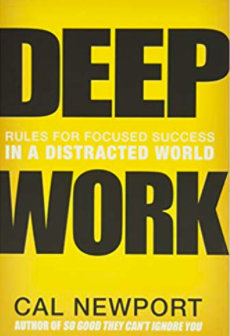
Cal Newport’s book (Deep Work), got me thinking, and got me concentrating in ways I haven’t done in a long time. Sometimes it feels like I am flitting from one activity to another, from one app’s ping to another. I have a big stack of books I want to read, but my days are ripped into tiny shreds of focus & attention. The subtitle of Newport’s book is: Rules for focused success in a distracted world. I am not after success, but I am after being able to read a book without interruption, ideally for hours on end.

I was able to do some of that, having read through 60% of Newport’s book in one sitting, but then the distractions took over. And the distractions are everywhere: there is our renovation project, still not finished 22 weeks after the demolition of our G&T porch began the first week of July. It’s final touches time. My mind is filling in the gaps constantly, imagining things completed that aren’t yet, stuff to decide, to buy. Maybe this is fine when you work on a project (for success) but in my case it doesn’t do any good; it doesn’t speed things up, just makes me impatient. 

And then there are the constant pings; not just mine but Axel’s as well. We often have 5 devices within earshot. Axel had programmed his text alerts to sound like a French Horn but then our daughters changed it into the screeching of a Tyrannosaurus Rex. Both distract me.

And then there are the sources of news: newspapers strewn across the table – we haven’t finished the NYT from last weekend yet and the local newspaper and the daily from the next town over.  We tend not to use the TV much, a good thing because most of the news is dreadful, but we listen to the radio which cackles on while we try to have a conversation.

Many years ago, we did a program with our Quaker meeting about simple living during one of our retreats. We sat around and looked at various categories of stuff and then talked about what was enough. It was both hilarious and sad, because we had more than enough of so much: sources of news, shoes, clothes, books, music, everything. We were faced with ridiculous abundance, irrelevance, and oh yes, distractions.

Aside from read and unread newspapers, our dining room table is now also strewn with Quaker documents. As the newly appointed Clerk of our local Quaker Meeting, I am preparing for my first Meeting for Business this Sunday. I am immersing myself not only into the history, rules and procedures of Quaker practices, but also the written testimonies that go back as far as the mid 17th century. They give me pause because they are of a depth I am jealous of. They invite me into Newport’s Deep Work: reading attentively, reflecting and making notes.

And so, ahead of my New year’s resolutions, I have taken action to reduce my distractions:

  • All my apps notification sounds are turned off (which means immediate reactions are unlikely from now on – I’ll check for activities on those apps a few times a day instead of instantly).
  • I deleted my Facebook account
  • I deleted my Instagram account
  • I deleted my Twitter account
  • I am working on getting Axel’s pings to be reduced to essentials (not entirely my call)
  • I am advocating for leaving our landline disconnected as it has been for the last 5 months due to the renovation.  This has saved us from countless solicitations for money and unnecessary election reminders.

Despite all these disconnects, I feel very connected to those I care about because they know where to find me. And so this is how I plan to start my 70th year on this world, tomorrow.

Blue skies

Something shifted today. Something big. The clouds receded and we can see the blue sky again. The acknowledgement that Biden is indeed the incoming president and will now have full access to the government’s dealings and resources led to a huge sigh of relief, despite the fact that this acknowledgement did not come from our current president. The poor election officials in Pennsylvania are doing their 3rd recount in as many weeks.

Even though we are in a relatively good position (mostly retired, a heated comfortable home, a healthy nest egg and no small kids trying to be schooled), we have lived under constant stress the last four years, and especially this year with COVID to compound the antics of a pathological narcistic leader.  But such is the nature of constant stress: it fades into the background and becomes unnoticeable and one learns to live with it or ignore it. But stress claws itself into our bodies in ways that are not always obvious.

We had a few extra stresses this last year as well: there is the renovation (to facilitate ‘aging’ in place) that started in July and was supposed to be done by the end of September, with daily comings and goings of workmen and our downstairs living quarters a construction site.  And then there are the many tendon, joint, nerve and muscle issues of my lower extremities. As soon as my chiropractor has gotten one issue resolved, another takes its place. Axel deals with upper body issues, so together we have a fully functioning body, but only one, instead of two.

But with the Biden issue clearing up, so is the renovation, the end no longer in the far distant future. We have moved into our new bedroom, even though our master suite is not quite done with an unfinished bathroom that requires plumbers and electricians who are not showing up when we expect them.  It’s our private room during the night, but during the day we still share it with the workmen, so we have to be out and cover things with plastic before they arrive at 7 in the morning.

Our smart new bed was installed a couple of weeks ago. It is so smart that it can tell us all sorts of things about our bodies and sleep patterns if we care to know them: deep sleep and restless sleep, how often we wake up and exit the bed, heart and breathing rates and heart rate variability. Our heart variability rate (HRV) has been in the low range, explaining the low energy and sluggishness that we sometimes experience. 

I am wondering whether the good news about the release of funds and open the books to our incoming president will change some of the numbers.

Hope & possibility

Mary Oliver’s ageless poetic wisdom spoke to me this week: [“Still, what I want in my life/is to be willing/to be dazzled—/to cast aside the weight of facts/and maybe even/to float a little/above this difficult world….”]. I have been dazzled.

Inspired and full of hope I end this week of seeing possibilities, being encouraged by kindred spirits from all over the world. I feel very blessed to get that much support and energy when the affairs of state (MA, the USA and the world) deplete me.

I got some clarity about why, as my guru Judith E. Glaser said “9 out of 10 conversations miss the mark.” It’s because of vantage points and horizons. It’s all about where we stand and what we are looking at.

Matt Taylor clarified the idea of vantage points for me – conversations miss the mark when one is talking from a philosophical vantage point while another is busy engineering, already descended to logistics or a task vantage point. Either one can turn the other off, which usually happens when one doesn’t see where the other stands. 

Bill Sharpe clarified the notion of three horizons – what we are looking at. One is talking about the current horizon, another about his or her faraway aspirational 3rd horizon and then there are those who are focusing on the 2nd horizon where the present is being brought steps closer to the 3rd horizon via experimentation and innovation. In his book ‘Three Horizons, the pattering of hope,‘ Sharpe explores his intuition “that we have within us a far deeper capacity for shared life than we are using, and that we are suffering from an attempt to know our way into the future instead of live our way.”

And finally there is my current author compagnon,  Margaret Heffernan who is reading her book ‘Unchartered’ to me. She kicked over some beliefs I have held for a long time, retold the scenario stories (Shell, South Africa) I already knew and added may more, all seems to have an unlimited supply of stories about what is possible when one has passion, perseverance, patience, and fellow travelers. All stories create a sense of awe as people accomplished (together with many others)  things most people would have considered impossible. She writes, “you cannot solve social problems without social processes.” It seems intuitive.

We had our 4th New Moon gathering of our 7 months Upcreation! journey on Friday. Part of the day we joined with our European friends who unhooked when it was bedtime for them, while we, on both US coasts, in the middle, and in Canada, continued to meet for another half day until it was bedtime for me (to continue with the Asia/pacific folks after that and resuming with the Europeans the next day. For us east Coasters it is a full day on Zoom (10AM till 8 PM). It sounds horrible but this group is special and wonderful to be with for all the hours (we do break preiodically).

coWe are all trying to right something that is horribly wrong or call something into being that only exists in the mind’s eye. We ended the day with the creation of a model (Pre-Covid it would have been with atoms, but now with bytes) of the patterns we were seeing in our various stands, and finally a Haiku describing 6 months from now, 1 years from now, 5 years from now and far into the future. It was fun, validating and inspiring.

And then, to close this week about possibilities and hope, there was our usual Saturday morning ritual of Music & Imagery with my M&I sisters from near and far, that ironed out the moments of despair and the resulting knots in my stomach, caused by our angry president. I try not to listen to the news too much because it gives him way too much free airtime, poisoning the ether with his vitriol.


April 2026
M T W T F S S
 12345
6789101112
13141516171819
20212223242526
27282930  

Categories

Blog Stats

  • 140,541 hits

Recent Comments

Lucy's avatarLucy on Probabilities
Olya's avatarOlya on Cuts
Olya Duzey's avatarOlya Duzey on The surgeon’s helpers
svriesendorp's avatarsvriesendorp on Safe in my cocoon
Lucy Mize's avatarLucy Mize on Safe in my cocoon

Enter your email address to follow this blog and receive notifications of new posts by email.

Join 78 other subscribers