Archive for the 'Uncategorized' Category


In the clouds

We spent all day in the clouds. This should not be so surprising given that we are at 7000 feet or thereabouts. While still in Kabul we would every night see the BBC weather map of the subcontinent and noted that this part of it was usually in the clouds. And so it was today. We learned, in the Ghum railway museum, from no less a person than Mark Twain, who was here some time ago, that weeks can go by like this.

We got up at 4 AM to make the trek up Tiger Hill to see, as promised by our travel agent and most guide books, the most spectacular sunrise on earth. With a lot of luck we would see all the highest peaks of the Himalayas in cotton candy colors.

The trek was by motorcar. Before we left I had this image of us standing on a tall outcrop all by ourselves. As it turned out we made our way up Tiger Hill with about 200 other cars (each with at least 5 people), all jostling to get to the top first and take up the choice spots on the lookout place. That place was also not quite as I had expected, with several large and ugly cell phone antenna structures and an ugly three story building where one could, for 300 rupees, buy entrance to a heated third floor for more comfortable viewing. So instead of the rosy peaks we watched Indians being tourists in their own country while the clouds passed right through our midst leaving us cold and clammy.

When it was clear that the sun wouldn’t be able to pierce the thick cloud cover the predictable mayhem ensued. All 200 cars tried to leave at the same time, some facing uphill, others down, on what was basically a one lane partially paved track (‘jeepable’ it is called here) up the mountain.

Rather than wait inside the car until the traffic jam dissolved (I couldn’t imagine how it ever could without divine intervention, but it did rather quickly), we decided to walk down and let our driver fend for himself – walking freely like that is such a treat for us and the moist cloud cover felt wonderful on our dried out skin.

On our way back to the hotel, for breakfast, we visited a spectacular monastery and got some basic education about Buddhism from our Buddhist guide, turned several prayer wheels sending wishes for peace in Afghanistan into the clouds.

After a hearty English breakfast we took the famous ‘Toy train’ of the Darjeeling-Himalayan Railway up to the town of Ghum, chugging along at 9 km/hour, if that. Halfway up the mountain we had to fill up on water to continue to generate steam. A large black cloud of coal smoke accompanied our ride and drifted into open windows along the line and enveloped newly washed clothes dangling on clotheslines; people turned their heads and smiled at us while hiding their mouths and noses behind scarves, sarees and facemasks.

Then it was lunch time. We have an hotel arrangement that includes all meals so we seem to be sitting down to eat a lot. In between our guide takes us places. After lunch it was the Himalayan Mountaineering Institute which is tucked away in a corner of the Darjeeling zoo. In the west we learned that Sir Hillary was the first to make it to the top of Mt. Everest but here it is the Sherpa, Tenzsing Norgay, whose name comes always first. We visited his memorial tomb and his glass encases gloves, boots, socks, crampons, coats, glasses and whatnot.

On the way back through the zoo we passed an enormous Bengal tiger, safely tucked away behind a moat and thick metal wire while someone’s radio played Evita’s melancholy song.

Back at the hotel a real English tea, complete with watercress sandwiches and scones with jam and cream, awaited us in one of the sitting rooms that was heated by a cozy coal fire. A young woman in an authentic English maid costume, as if we had stepped right onto an Agatha Christie movie set, served us tea. Cross-stitching my sampler felt exactly the right thing to do.

Promptly at 6 the tea service was discontinued and the bar opened for GTs, accompanied by snacks until it was time for dinner, beef Wellington with bread pudding and custard for dessert.

Once again we have to get up early, even earlier than yesterday because there are problems at the West Bengal-Sikkim border. Our guide told us that if we don’t get there by 6 AM we will not be able to pass until after 6 PM; so much for sleeping in and not having to love by a rigid schedule. Unhappiness with the statusquo is following us all the way from Afghanistan. Still we feel miles away from the stress of our adopted home, happy even in the clouds.
Time warp

We spent another full day, 11 hours, to get from our New Delhi hotel to the Windamere hotel in Darjeeling. We first flew to the capital of Assam, then to Bagdogra. Once more we had something draped around our neck, this time the cream colored scarves that the Nepalese give to travellers, for good luck.

From Bagdogra we wound our way to Darjeeling over poorly maintained roads from 500 feet to 7000 ft along hair raising hairpins at a snail’s pace. Halfway through the trip we stopped at a tea house to have a cup of Darjeeling and some cheese pakoras.

During the final ascent we followed the narrow gauge tracks of the Darjeeling railway, passing the third highest railways station in the world. We shared the narrow and potholed road with the tracks that ran right in front of houses and shops. A W/L sign wherever the track crossed a village or town meant ‘Whistle and Listen’ and at each crossing there was a handpainted sign with the a child’s drawing of a locomotive and the words ‘stop, look and go.’

We were told that the 3 hour road trip, by train, would take about 9 hours. Unfortunately the main road (as well as the train tracks) have been blocked for over a year since a landslide and the West Bengal government has other urgent roadwork elsewhere in the state. That’s one of the reasons the Aswanese and Sikkimese want to secede.

We are now in Gorkhaland (or Gurkhaland) and the main language is essentially Nepalese even though we are in India. Our guide and driver are ghurkas. In Afghanistan we know the ghurkas as the folks who guard the American embassy and who I greet with a palm-pressing ‘namaste’ each time we enter the place. We flew back with many of them to Delhi, on home leave to Nepal.

Here at the Windamere hotel we found ourselves in a time warp. We had cocktails in what could have been a Victorian living room, with pictures of dead local and British folks, including the former (and last) king of Sikkim and his American bride, a marriage, we were told didn’t last long, with offspring, two kids, who have disappeared from sight, according to our guide.

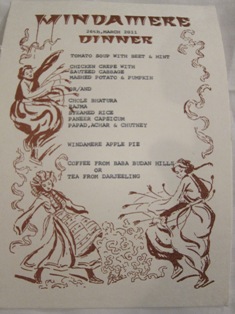
After our cocktails we had a pre-fixe dinner in the very Victorian dining room with music to match. We could have pretended we were in another era. White gloved turbaned waiters with wide cumberbands (in modern Afghanistan the Dari word for seatbelt is ‘kamrband.’) noiselessly served us our three-course dinner (non-veg) which we enhanced with a glass of wine.

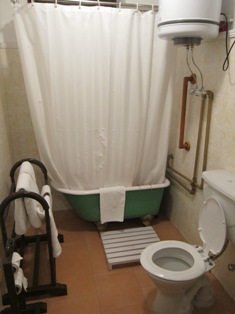
And now we are in our lovely room with flowery curtains, a fire in the fireplace, old wooden furniture and a tiny clawfooted bathtub in the old fashioned bathroom.
Outside our room are camellia bushes, potted English daisies, bright red geraniums, flowering lantennas and other signs of an English garden tradition. Because it is dark we haven’t seen the view but given how the chairs on the veranda are lined up we expect it to be spectacular. Our guide will come and pick us up at 4:30 AM to see the sunrise over the Himalayas.

Jailbreak

The flight from Kabul to Delhi is only one and a half hour but it took us 8 hours from door to door. At the entrance of the airport we met our friend Sabina, a reporter I met a year and a half ago in Herat when I spotted a western woman sitting alone at breakfast in the Nazary Hotel. Since then we have become friends, she visiting us more in Kabul than we her in Delhi. I had just written her an email that we were going to be in Delhi. She had not read it yet.

She returned from Kandahar where she met and interviewed all sorts of powerful people who hold the destinies of thousands of people in their hands, life, death and wealth; the latter through the contracts that the military are bringing into the country. I asked her whether she had not been afraid. Life goes on in Kandahar, she reminded us, much like it does in Kabul; in spite of the many acts of violence that are committed there. Places are always scarier from a distance.

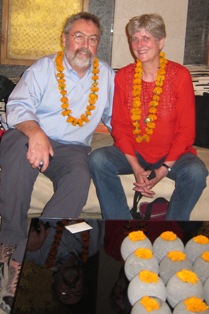
We were greeted at Delhi airport by the same young man who had first welcomed us to India in January. Now we are like old friends. He put marigold leis around our necks by way of welcome – we must have risen in status because last time we didn’t get those. Back in Manchester we plant marigolds around our vegetable garden to keep undesired animals out. They smell strongly and not particularly pleasant but they look very festive.

And now our fantasy vacation has really started. We ordered all sorts of Indian delicacies up to our room for a late supper before turning in. My sore throat and Axel’s respiratory problems have disappeared as by magic. Breaking out of Kabul is a good thing.

Sick

On the day before our departure I got sick: a sore throat, cold shivers and a bad cough. Halfway through the day, after having made many mistakes (a wrong bank transfer, a wrong accusation, a wrong turn) I accepted defeat and went home to try to sleep off whatever this is. My boss prescribed something to gargle and relieve my sore throat.

All through the winter I have been taking an ayurvedic immunity booster and stopped it last week thinking I could do without. All through the winter I have stayed healthy which is not easy in Kabul. A coincidence?

We checked the internet for the temperatures in our three destinations: Darjeeling (warm), Pemayangtse in West Sikkim (cold) and Gangtok in East Sikkim (in between).

We heard from Tessa that two of her old schoolmates will be teaching at the Gangtok school that is modeled after their secondary school in Beverly MA (and headed by one of Sita’s classmates). Now that Axel is in education (and has been offered the impressive sounding title of headmaster) our visit to the Gangtok is more than a nostalgia trip.

Good dips

Never in my 30 plus year career in international health have I seen such a direct effect of what we do on the saving of lives, especially the lives of babies and small children. It is actually the mission of MSH to do so but so far in my career the contributions are indirect and difficult to measure.

It is not because of clinical skills applied directly to individuals (that too of course) but because of a triage system that we have been helping to set up – a triage system that moves seriously ill kids to the front of the line, straight to the resuscitation room – a system for managing the material supplies and human skills that combine into timely and appropriate care of very sick children.

With the help of a many experts in emergency pediatric care, some of them colleagues from Malawi, WHO treatment guidelines, with pharmaceuticals, supplies and equipment provided through our project by the people of the United States, the emergency triage, assessment and treatment is operating reasonably well. Every week we have a meeting with the hospital director, the chiefs of the outpatient department, the emergency ward, the hospital pharmacy, the chief anesthesiologist plus the chief of the department in the ministry responsible for child health.

I try to attend these meetings as often as I can because, unlike many other meetings that depress me, these lift my spirits. The meeting always starts with stories about the children that didn’t die because they received prompt attention in a manner they would not have even a month ago.

We had arrived a little early and got to witness the triage in action. During a brief lull in his work the nurse, a new nurse, excitedly told us about how his triage work saved lives. There were more stories like that, all told in Dari so I only got the rough idea.

In all cases the essence was that at the end of the day the hospital did not have to send some parents home in great grief. Of course children still die and we are awaiting with great impatience the first chart that shows whether there was actually a dip in the 24-hour mortality statistics. I expect and hope for a dip, however small, as the dipping will probably be self-reinforcing

In the dark forest of ‘hard and difficult and messy’ it’s nice to have a few points of light.

Show and tell

The first day of our COO’s visit went without a hitch. The huge circus size tent stood on our volleyball field and had inside it tables covered with all the stuff our various projects had produced: slideshows, public education announcements, guidelines, pictorial guides for illiterate people, guide books, policies, training manuals, and promotional materials used on national awareness days such as TB Day, HIV/AIDS Day, etc.

Each project had their 10 minutes with the big chief while the rest of the people were busy taking pictures of one another, then in front of this table, then in back of that table. I clicked away myself as I know our 50th anniversary is 10 years away and by that time these old pictures will be priceless.

The current slideshow on which I have been working at least 15 hours was a success and worth all the time I spent on it simply by looking at the faces of those who have been with MSH for a long time. My intent was to make people smile and reminisce, and they did.

All the guesthouse cooks had been drummed up to prepare lunch for all the staff, a cast of over one hundred. The lawn not covered by the tent was covered with chairs and tables. It was a very festive scene.

Multilingual conversations

We celebrated New Year’s Day with an Afghan family. The invitation had come from one of my colleagues. We found ourselves in a small nuclear family, not what one would expect when thinking of Afghan families; two girls, one boy (all young adults) and educated parents, a mother who had studied in Germany and a father who had studied in the USSR.

When we first arrived we sat in the formal salon, sipping tea, eating various New Year’s delicacies and getting to know each other. The mother and I spoke in broken German, the children, except S whose English is quite good, spoke broken English with us and we spoke broken Dari with the father.

I could understand the mother’s German reasonably well but speaking was another thing altogether. The neural connections between the parts in my brain that know German and that are learning Dari intersected so much that I found myself searching frantically for German words and getting Dari replies instead.

The father and son are in politics and with Axel, trained as a Political Scientist, the threesome had a great time together talking about Afghanistan’s parliament. We came to the same conclusions as we always do: progress will be slow but less slow if education of the population becomes a priority, a massive investment in higher education here and abroad, jobs and career opportunities for young people so they want to come back home from study abroad and the strengthening of the judicial system so that consequences are attached to bad behavior. And of course there are the women, but that, everyone agreed, goes without saying.

We had a tour of the house which contained one large formal salon with western furniture, four rooms with tushaks (carpet covered mattresses) and balish (hard back pillows), and some miscellaneous rooms where various possessions were stored.
One major way in which Afghan houses are different from ours is that neither parents nor kids have their own bedroom. According to S at night everyone plops down on one of the tushaks in (I imagine the warmest) room and sleeps. Having a house with young people and none of the privacies our young people have (and expect) is hard to imagine.

We met the house kawk (fighting partridge) which was a mean bird, as one would expect, going after dad’s toes. He was quickly put back in his cage, not a petting kind of bird. Then we admired the hybrid roses which had just started to leaf out. We have to come back to see the result of dad’s green thumbs.

In the back of the house was a separate rental unit, a lovely three story house with a roof terrace that looked out on the narrow and exceedingly dirty Kabul River. In the distance S pointed out the bridge after which the area is called where junkies live.

While Axel played chess on a tiny chess board with S’s dad (and lost) I got to see the family photo albums, just like at M’s house some months ago. I marvel at pictures of these Afghan families, with parents our age, how they dressed and lived in the 70s. It was actually not that different from how we dressed and lived – no chadoors, exposed arms, necks and legs. Looking at these pictures one can see the extent of Afghanistan’s backslide, at least for the middle class. Watching the women now I can’t imagine how this is possible and I am reminded of Margaret Atwood’s ‘The Handmaiden,’ which is, hopefully, a fantasy, about such a backslide in the US.

What amazes me most is that the people who were young adults in the 70s and the parents of many of my colleagues now, have still not be able to regain their and their children’s (especially girls’) freedom from oppressive cultural, social and gender norms despite the fact that the Taliban have long gone.

Aside from the political discussions we also talked about the Holy Qu’ran, the Books of Psalms, the Torah and the Bible, all holy books and all, supposedly, required reading for good Muslims. All books were available in the house, including the King James Bible in English. This led to further conversations about the differences between the various holy books that I found very illuminating as it explained the Moslems low regard for the bible which, they claim, had probably strayed very far from the original stories and texts over the centuries with much lost or added in translation, something that cannot be said of the Holy Qu’ran which remains in its original Arabic.

After a simple but delicious lunch I found myself explaining Quaker traditions before we were treated to a fashion show by the two girls. We think we started the new year in the best possible way.

This slideshow requires JavaScript.

New Year’s Eve Afghan style

I am sitting here writing on the last day of the Afghan year with three and a half kilo of dried fruits and nuts next to me. The order was delivered in the early evening by the woman who runs the Afghan Pride Association. She hand delivered the traditional new year’s delicacy called Seven Fruits (hafta meyva) in seven 500 gram bags. We learned how to process the delicacy from Razia jan who brought us the finished product at just about the same time.

The traditional dish is made from a combination of fruits and nuts: pistachio, almonds, walnuts, dark and golden raisins, tiny dried apricots and something that looks like a different kind of apricot. The ingredients are skinned, washed and then submerged in boiling water to soak overnight. It’s the removing of the skins from the nuts that’s most tedious Razia told me.

M. explained to me that the traditions around the Afghan New Year date back to pre-Islamic time and came from the Zoroastrians in Persia. The celebrations are not universal in this country. There is a divide more or less along ethnic and north-south lines: there are those who welcome the new year with great abundance and those who see it as a heathen practice. The more conservative mullahs are preaching against the exuberant start of the Afghan New Year. The most exuberant of all the action is in Mazar in the north. People are streaming there from all parts of Afghanistan.

We are all told to stay home because there will be crowds everywhere and the rule is, stay away from crowds. We are not as constrained as the people in the US compound who are in lock down since today and until Tuesday evening. At least we can move around a little bit and were allowed to accept an invitation to celebrate the start of the Afghan New Year with S’s family tomorrow. Unfortunately we were not allowed to join the family later to one of the popular outdoor places like Lake Qargha or Babur Gardens where crowds are expected.

Working for the republic

I like to believe that there are more people working for the good of this republic, trying to get it into the 21st century and taking care of its citizens than those trying to cripple, destroy, destabilize it for their own benefit or some higher ideal that is at cross purposes of the former group. I was reminded of that this morning while being a fly on the on the wall at a meeting of one of the institutions of higher learning that prepares allied medical professionals (not doctors) for future jobs in health care.

The entire meeting was in Dari, including the agenda and I was grateful for my colleague who came along and helped me understand what was going on.

This observing of her bi-weekly meeting with her senior faculty is a first step in, what we hope, will be a longer process. We had been invited to assist the director in building a strong team that would be able to stand together and withstand the pressures from people with power and connections who are trying to circumvent the rules that apply to most other people. We don’t get many of such invitations and so it was worth sacrificing part of our day off for this purpose.

The director is a graduate from our leadership program, many years ago. It is refreshing to work with someone like that, someone who knows that leading and managing is not an automatic skill set that comes along with a promotion.

It occurred to me while listening to discussions about some of the faculty team’s challenges that in this country many good people are spending enormous amounts of mental and physical energy to counter attempts at circumventing transparent processes. There are so many places where interference happens: there is enrollment which is supposed to be only for students who qualify. There are the diplomas that should be only for people who pass the necessary tests, not for those who think they can buy them either from the professor or in the market.

The US and other government clamor for transparency all the time, rightly so, but I don’t think that people who are not directly involved in this ‘work for the republic’ have any idea what it takes, what courage, what sacrifice, to implement transparency. Like so many other things here it is easier said than done.

Eating out

This morning, side by side, Axel and I completed the 45 minute beginners’ yoga routine that we have on DVD. During weekdays I alternate this with half an hour on the elliptical and hope that between these two routines I will maintain some flexibility and stamina.

Axel picked me up after my usual Friday massage for lunch in the Bistro restaurant – a place around the corner from Chicken Street that used to serve wine but no longer does. It was a lovely sunny and warm spring day, just the kind of weather that demands a cool glass of white wine to accompany one’s lunch. We fondly remembered our vacation, exactly one year ago, in Lebanon where we had such fantasy lunches every day.

Instead we sipped our fresh fruit juices while watching Liz from the BBC at a table nearby looking at a map of Afghanistan and doing take after take of some background story that was, for once, not about angry Arab youth. We had gotten used to see her nightly on TV, then in Tunisia, then in Cairo and then in Libya, against the backdrop of Arab foment– seeing her in this lovely garden setting made Afghanistan look very peaceful and quiet.

Back home I spent another three hours on the photo memories of 40 years of MSH in Afghanistan, a job that will never be finished. I will ask Axel to print one copy to show to my colleagues. It may be a nice present for our founder who has Afghanistan close to his heart.

We had dinner in front of the TV, watching an old movie, The Thin Man. Since tomorrow is a work day for me I had to do my homework for language class which made me not pay as much attention to the movie as I should have in order to understand the unraveling of the mystery.

The mildewed plastic has been taken off the windows. As a result we have a clear view of our garden again. The outdoor table and chair set has been brought out, and cleaned. It is nice to have a guard who does this for us. We are ready for lunches and dinners outside.


March 2026
M T W T F S S
 1
2345678
9101112131415
16171819202122
23242526272829
3031  

Categories

Blog Stats

  • 140,198 hits

Recent Comments

Olya's avatarOlya on Cuts
Olya Duzey's avatarOlya Duzey on The surgeon’s helpers
svriesendorp's avatarsvriesendorp on Safe in my cocoon
Lucy Mize's avatarLucy Mize on Safe in my cocoon
Spoozhmay's avatarSpoozhmay on Transition

Enter your email address to follow this blog and receive notifications of new posts by email.

Join 78 other subscribers