Archive Page 32

System D

Système D stands for débrouillard. There is a long tradition in Africa of people making do with what they have. People have forever been making utilitarian goods out of things we usually discard such as tin cans, rubber tires, CDs and more.

Yet at the same time there is a persistent sense of hopelessness, victim hood and low confidence in the ability of the continent to pull itself out of the morass of poverty, illness and strife.

I see light points everywhere but they don’t seem to add up. There are people I know or have heard of who have been able to harness the innate talent at ingenuity.

My ICRC colleague A. in Bamako changed the outlook and attitude of the rehab center’s welder. He used to sit under a tree waiting for someone to bring him something to weld. When A. Told him “you can make a wheelchair” the welder rolled his eyes. But when A. showed up with a plan and materials he learned how to make a wheelchair. Since then he has made lots of frames. The director of the Centre was so proud of him that he took me over and they posed for a picture. The primitive storage room behind him was full of shiny frames. The director promised he would give him a proper workshop. Now it is a slab of concrete with a corrugated iron roof. No walls, looking more like an oil change station than a manufacturing workshop.

The possibilities are endless but it seems there always needs to be someone else from outside the system who is not paralyzed by the constraints. So too was the man who asked the artisanal shoe and slipper maker, sitting outside the museum on the sidewalk whether he would be interested in learning how to make orthopedic shoes. The shoemaker himself had a disability and could not walk. He said yes and rest is history. He is the only orthopedic shoemaker in the country and now training a young man to take over when he retired in a few years.

Bats

There are two things I remember vividly from my trip to Niamey 30 years ago. One is a very painful learning experience that has served me well, though I didn’t like it at the time. It had to do with facilitation and letting a group take control of the process. It was painful experiential learning.

The second I remember even more vividly. Every day, at the end of the work day, I would be sitting on the terrace of the Grand Hotel (it is still here). The same place Axel stayed before we changed roles, when he was the one traveling around West Africa. The terrace overlooks the river and the bridge across the Niger river. I would watch the camels either enter the city over the bridge, or leave it. Now I see, from the other side of the bridge, a gigantic traffic jam; the camels are gone.

As I would sit on the terrace, enjoying a ‘conjuncture’ (the local beer) and brochettes, I would watch the bats come out at dusk. I realized that I was a spectator in a ritual that was probably thousands if not millions year old. That has not changed of course, what is 30 years on a cosmic scale?

The terrace of my current hotel (the Gaweye) is not quite as spectacular but I can see the bats come out just the same. They come out about 6:45PM and disappear around 7:10PM. A few hundred of them come out of the enormous mango tree across from my room. There must be thousands of them swarming from everywhere in the city and across the river. The bats are the size of pigeons. They squeak when they leave their roosts in the trees and squeak when they return, but in between they are silent killing machines, eating all the hapless insects that are no match for their stealth.

Tonight I ate my mini brochettes while I watched the spectacle. I was wondering how long they’d be out. As if by some unseen signal or clock (it gets darker) they start to return, streaming towards the tree here or disappear over the roof of the hotel or in the distance. A few continue to flap around – they approach the tree and then they seem to change their mind and with a wide swoop fly out again. I imagine these are the adolescents, who love this daily outing. But eventually they too return to the roost and, after some settling in squeaks, night falls and everything is quiet again.

The returning home reminded me of summertime and playing out on the street in our neighborhood. I was among the younger ones and I wasn’t happy when my mom called me in, “ah,” mom, “can’t I stay just a little longer?” (in Dutch of course). I would have been one of those bats asking for one more trip around the block.

The stock of mosquitoes and other flying insects is, I assume, kept under control by the bats. For those insects that crawl, there is another danger, not at dusk but after dark. Then enormous toads come out. They are the size of an apple. They jump from one insect to the next, covering considerable distances on the swimming pool terrace.  I pulled up my legs to prevent being taken for an insect. They look fierce.

Protectors

I look right over the hotel garden, or at least what used to be the hotel garden but it is now the bivouac of the military, presumably to save us in case of a terrorist attack. Watching them at different times of the day gives me little confidence in their ability to do so. They live on and around two small huts: a concrete floor of about 3 meters across with a palm leaf roof and four metal pillars that hold up the roof. Two men sleep under one roof and a third under another, probably the highest in rank. The two small pavilions are about 7 meters apart and right under my window, and so I have a perfect view from the 4th floor.

When they wake up they remove their mosquito nets, fold their blankets and stow them someplace. Their beds are the plastic (no longer white) swimming pool lounge chairs, flattened. For mattresses they use the blue and white striped covers (rather faded) that used to be for the tourists but are now worse for the wear. They sweep their living space and then sit, which is what they do for the rest of the day. I can’t imagine they are in any condition to run or attack. They have a walkie-talkie by their side, or at least one does; they are all preoccupied, all day long, with their smart phones. I am told they are on FB all day long. Even when they get up and walk away, they seem to follow their smart phone.

I got to watch a supervisory visit, I assume, by a superior, who arrived with a rifle slung over his shoulder. Both soldiers spring to attention and pick up their rifles. They were laying on the ground, dark rifles camouflaged on the dark dirt of the neglected garden.  I can’t tell from the distance whether it is a call to duty, an admonition or a reprimand. Five minutes later the man leaves again. One of the soldiers dusts off his flak jacket, dons his red beret, slings his rifle over his shoulder and stands alert looking out over the river, on the edge of one of the pavilions and then starts to move to the outer perimeter (no, correction, it’s a call of nature). The other seems to be off duty and resumed his cell phone activities.

On the front of the hotel the situation is not that much better. There too the security guards have their eyes glued to the smart phone, interrupting their phone sessions only occasionally for a rather disinterested check with their wand, applied inconsistently to me, and presumably to others. The machine to check what’s in our bags is sometimes required and other times they wave me through. Even further away from the hotel, the guards who check the underside of cars at the entrance to the parking lot in front  of the hotel don’t feel the need to check the ICRC car that picks me up and drops me off. All ICRC cars have a sticker of a picture of a gun with a large red line across it. God help us if an ICRC car ever falls into the hands of people with other motives. My colleague here says that nearly happened when armed bandits commandeered an ICRC car in one of the wilder areas of Niger. The long negotiations were not about getting the car back, but rather about removing all ICRC logos.

How to be happy

During my tour of the tiny ‘Centre d’appareillage’ at Niamey’s central hospital I met Hawa. She had already greeted me enthusiastically, speaking in perfect French when I came in. I wasn’t sure whether she was staff or patient.  She was practicing walking, with one leg of her own and the other an artificial one that was produced at the centre.  After my rounds I returned to where we had met. She was taking a break. What she is doing, learning to walk again, is hard.Hawa1
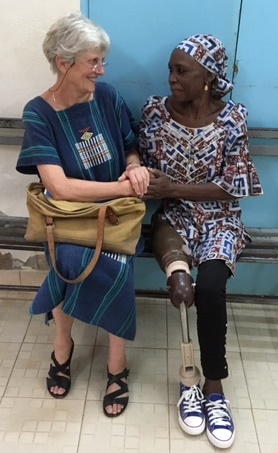
We sat for about an hour and chatted. I learned that she was from Agadiz, a city more or less in the center of the country, which also happens to be the meeting points of all the traffic routes: trafficking of drugs, weapons and those poor souls from all over Africa who spent fortunes to get to a very uncertain future in Europe, if they make it through the Sahara at all, and survive its various predators, heat, thirst and then the boat ride to Europe.

Hawa and her family were in a car when they were attacked. Here in the Sahel and Sahara, there is the equivalent of the Somali piracy practices. Most of the attacks are done by criminals who want cars and money, or maybe they are just high on drugs and have guns they like to shoot.  She was severely wounded and, her luck, picked up by ICRC and transported to the hospital. At the hospital her leg was amputated. After that she became a patient of the rehab center where I am spending this week. She is poster lady for CICR, for the rehab center and for the miracles that P&O (prosthetics and orthotics) professionals and physical therapists can perform.

Hawa is about 40 years old and has three children, divided between her ex-husband and herself.  Her French is so good that I suspect she was a school teacher but I haven’t asked. There are so many other things I want to ask her about her life before and after.

I noticed she had the name of a man tattooed on her arm, looking much like the numbers one sees on the arms of concentration camp survivors. I asked her what that was and why, wondering whether she was, at a young age – it was clearly an old tattoo – promised to a man who had already written his name on her. The ensuing conversation was a bit confused and I could tell she was not willing to share much with several men standing nearby. One of the attending therapists told me she had written it herself because she was in love with that man, at which she started to laugh. It’s hard to imagine a woman in this conservative country doing such a thing. Suffice to say she is no longer married, also unusual. Maybe hubby has taken a younger wife elsewhere – after all what good is a wife with only one leg.

There are other people I saw in the center and in the adjacent PT section, with what look like bullet wounds and/or amputations. Some told me their stories – attacks survived. North and Northeast of Niamey is like the Wild West, where there is only one law which is dictated by those who have the most guns, good transport and money that can buy loyalty from anyone hungry for money.

In the book A Force for Good that I am reading, about the Dalai Lama (and written by Daniel Goleman) he tells the story of someone who is asked to comment on people who are ultra rich. He responds by saying, incredulously, “but they only have one stomach?” I was wondering about these warlords and traffickers in the Sahara – they too have only one stomach; what can they do with all these riches they accumulate, while traversing the Sahara, over the bodies of all these hapless people, seeking a better life?  Maybe they drive around in a nice car, with air conditioning, a Rolex on their wrist and the latest Apple watch/phone. But they are in the Sahara where there is no electricity, no recharging stations, just heat and sand. Do they care what time it is and whether they had sufficiently REM sleep last night?  Are they happy? And then I think of Hawa and her smile and her positive energy to embrace whatever comes her way.

One generation later

My assignment in Mali ended on a high note, even if it didn’t always look like it would. At my last lunch with ICRC colleagues I met a fellow traveler who was also going to Niamey on the midnight flight – that makes waiting in airports a lot more pleasant.

After several debriefings at ICRC I returned to the hotel. I asked to see my bill and pay. As it turned out their credit card machine was broken. Luckily I had enough cash, though just barely, to pay the bill in a combination of CFA and dollars. That had been good intuition to bring dollars and get a lot of cash out of the Ecobank machine.

The Turkish Airlines flight from Bamako to Niamey was empty, although I managed to sit in one of the few rows that was filled. I suggested that the very tired 3 year old sit by the window but he chose to sit next to me. He flopped against me with his head and then with his feet. He was traveling with his mom to Istanbul and then Rome, a rather roundabout way, but I suppose the ticket was cheaper than Air France.

I helped mom put up her case in the overhead bin – something I can now do thanks to my daily swims. I few months ago I had to ask for help; now I can provide help. Even though I have only 3 tendons attached to my rotator cuff in my right shoulder, they are getting stronger by the day. The swimming has been a discovery for me. I didn’t think I liked it.

We arrived at 1:30 AM in Niamey, temperature 30 degrees! The ICRC car was waiting for us and dropped me off at a hotel that hadn’t even opened when I was here 30 years ago. Now it looks like it was 100 years old. I know plenty of old hotels that are nearing their centennial anniversary that look a whole lot better. The place has suffered from neglect, poor maintenance and probably poor quality building materials. Still, it is billed as the luxury hotel of Niamey.

I was too tired to care about which room they gave me, and tumbled into bed for a short sleep as my alarm was set for only 4 hours later. When I woke up I decided that the room I had, with a view onto a fly-over and thick dark curtains hiding a small dilapidated window, was too depressing for a 10 days stay. I requested a move to the back of the hotel that looked out on the pool, palm trees and the Niger River, the same river I had just left behind in Bamako.

The pool is twice as big as the one at my Bamako hotel, and also mostly unused, though it is not tucked away and out of sight of most hotel guests. Still the people here seem not to care about using it, whoever the guests are.

Next to the hotel is the Palais des Congres, where, the day of my arrival, the first ladies of West Africa came together to discuss genital mutilation, early marriage, domestic labor and other malpractices that hurt young girls. These practices used to be defended as ‘it’s our culture.’ I was happy to see that these issues have now reached the top. When I was here 30 years ago you would be hissed at, especially by men, if you raised any of these. Fran Hosken was an early activist against genital cutting in those heady days of the 70s. Her activism was dismissed as annoying American interference in age old rituals. She was ahead of her time. If she is still alive today she would be pleased. No one is arguing anymore that such practices are bad for everyone – and raising them is no longer political suicide.

A day in the life…

Yesterday was a rough day. I found myself totally depleted when I returned to my hotel room. What had depleted me are the challenges in my work here; the rampage in Las Vegas; the depressing and inane remarks from the gun lobby people; the misery in Puerto Rico, and the hidden misery of all the Caribbean islands that are no longer in the spotlight. And then there is the chaos I see in Bamako, a city and country that was so full of hope and visibly getting a handle on its development when I was last here more than a decade ago.  A coup in 2012 changed its course.

I had to call home to re-center and replenish. I managed to talk and Facetime with Axel, Tessa and then the Blisses. This helped, especially seeing Faro doing a Chinese bow and saying something else in Chinese that no one else understood, but it sounded very Chinese. He is learning a lot and seem to be enjoying it.

I don’t particularly like to travel by myself.  Meals in restaurants by oneself are boring and are just about food; and when the food is not so remarkable, meal time is not something I look forward to. I had such a large meal at my first dinner in this hotel that it served me for 3 more days, every day another chicken leg or wing. The little refrigerator in my room allowed me to have the leftovers packed up.

But the next day I found out that it is more of a freezer. I called the hotel technician who said he fixed it but he didn’t, and so I ate frozen (but cooked) chicken legs and wings for 3 nights in a row. The 4 dollar Pink lady apple I bought (imported from France) was crisp but I made the mistake of putting it in the fridge/freezer and so it froze and wasn’t as crisp anymore. These not so exciting meals were made palatable by fabulous local fruits: papaya, pineapple, bananas and melon. I bought a large Chinese knife to cut the fruits.  I will leave it behind for the woman who cleans my room

At lunch time I usually join with those ICRC colleagues who actually eat lunch. Many skip lunch altogether, and one even skips breakfast. No wonder some people have little energy during the day – it is not just the heat.

A couple of small restaurants are open only during work days for lunch – they serve the staff of ICRC,  UNESCO, Oxfam and other development agencies in the area. They serve only African food and the menu is limited and conveyed orally, and then served instantly for very little money.

During the weekend and after hours this part of Bamako is dead. There is construction of fancy apartment buildings but most are not yet inhabited. And so there are also no supermarkets nearby.  The closest is a store containing a jumble of kitchen and household stuff, run by people who look like Saudis (but I am told they are Malians) – this means of course also that they don’t sell wine – one of my few indulgences as I work on my computer in the evening, dealing with the never ending email stream.

Way back during my regular visits to Mali in the 90s I used to stay in a small guesthouse in the center of town. There were many places to eat. It feels like a different place now; and the people I used to know here are either gone or I can’t find them on social media.

Tonight is my last night in Mali – tomorrow I will conclude this visit and board a Turkish Airlines Plane that will drop me off in Niamey on its way back to Istanbul.

Chinese massage

When I travel I often have a massage because weekends are usually full of computer work and a massage is just what the body needs. And so I asked around at ICRC and a young Spanish-Chinese woman gave me the name of a Chinese masseuse/hairdresser who she frequents on weekends. I promised not to take her slot and made an appointment for Sunday morning. Here addresses don’t really exist – to find a place people use reference points such as hotels, or military barracks or large signs.  I was directed to look for a Chinese sign near a well-known supermarket named ‘La Fourmi’ (the ant).

I now consider I have a driver, Suleiman, who drives a taxi that is not held together with wire and tape. Despite his dirty carburetor he gets me places I want to go, including the search for a bathing suit. We easily found the place, next to the Chinese embassy and in a complex called ‘Cite Chinoise,’  which housed a supermarket that clearly caters to the many Chinese who live here. Next door was a small hair salon with two massage tables in the back. If it wasn’t for the recommendation I would not have entered as it looked all very sketchy. But then I was reminded of my masseuse in Kabul who had a set up that would have intimidated everyone: her bedroom in back of a kitchen in back of an office that sold large equipment such as bulldozers and military vehicles.  And so, I reasoned, why not try the Chinese lady.

I ended up getting a dry massage from a younger woman who, according to the one I had been recommended, was just as good, ‘also Chinese,’ as if that was as much as a recommendation one needed. I was given a satiny pajama top and bottom and laid down for what I thought was going to be a relaxing massage. Little did I know about dry Chinese massage: for a while the word ‘ferocious’ came to mind, as if my masseuse was both angry and impatience. Then I thought of ‘wild’ as she banged my muscles into submission. Now, over an hour later, I am still stunned and ready for a long nap.  I feel as if I have been engaged in serious exercise for a long time. But on my app that I use to ensure I exercise more, massage is not included in the categories. Maybe it should include Chinese Massage to count as a workout.

On the road again

For about two weeks I wasn’t sure whether I would travel or not on Monday September the 25th. The contract wasn’t signed until the 21st and my passport with the Mali and Niger visas didn’t arrive until the 23rd. Axel started to include me in his plans after the 25th, but then had to leave me out again, as the travel did start when planned; the ticket was purchased on Friday, the passport came on Saturday and I left on Monday.  It’s called JIT travel.

Before my trip we traveled to the far end of Long Island to enjoy a long weekend with good friends in beautiful North and South Fork, visiting wineries, swimming in the balmy waters of Long Island and eating great food. If Jose was still blowing on our way down, on our return on the ferry we enjoyed a 10+ day on the deck during the hour and a half crossing of Long Island Sound.

I was able to use Delta’s upgrade certificates for the crossing of the Atlantic which meant a good half night sleep before squeezing into coach for the remainder of the journey from France to Mali. I arrived early afternoon at the new airport (which already looked kind of old) but surely an improvement over the chaos at the old airport. Slowly all the old chaotic airports I remember from early in my career are disappearing. Senegal is about to open its brandnew airport in December.

The hotel I reserved turned out to be as far away from ICRC and where I would be working as possible. I was given a pricey studio with an ill equipped kitchenette, fancy barstools, large elephant furniture, an enormous flat TV screen. The windows were of the kind you find in bathrooms and cannot look through, which created a kind of prison feeling. The shower spouted in all directions and the breakfast wasn’t ready before I had to leave for the long trip across town. The only good thing it had going for it was a small gym and a lovely garden.

Discovering how long it took at rush hour to cut across town, while my employer had a hotel right next door, I moved and settled into a more standard hotel with a balcony overlooking a nice, unused except by me, pool, and windows that let the world in. All this also for half the price, and best of all, I can walk to ICRC as it is right next door.

To use the pool I had to buy a bathing suit as I had not packed mine. I usually don’t like to swim in front of a restaurant or with a terrace around – prude that I am – but here the pool is tucked away amidst foliage and birds and no one uses it, it is entirely mine.  I got a local taxi to help me find a bathing suit. Apparently the season had passed and only tiny bikinis were left. I told the sales lady that I was too old for a bikini, and too big for the one she showed me. I finally managed to construct a suit at a sport store, putting together an exercise top and bottom that would work fine. Ever since I have enjoyed my daily, very meditative swim.

New connections

It’s been two weeks since we have been back from Maine. I dove back into work after Labor Day, finalizing documents that need to be finished when the main project that has kept me busy closes on September 23.

I facilitated a two weeks virtual seminar on governance, Governing for Good, on LeaderNet,  MSH’s platform for learning and connecting, that closed on Friday. Getting people to post on such seminars is tricky – we don’t quite know why.  With some prodding we ended up hearing from some twenty people (10% of those registered) including two young men from Bhutan which I was thrilled about. They are studying in Thailand. I know their professor who encouraged them. This is really one of the best parts of my job, to establish relationships, even if they are only over the internet, with young people who have little access that all the resources that abound.

My connection with the Naresuan University in Thailand is fascinating. It started with a simple query we received. I followed up and before I knew it I was an associate or adjunct professor with my own email address at this faraway university. Since then I have befriended the director of a new international health systems management program (Masters and PhD) and his mentor, advisor to the Dean and ex Deputy Minister of Health of Thailand.  Since teaching is really my vocation and passion, I am thrilled at these new connections.

I am preparing for a trip under a new contract with ICRC, that allows me to keep working with ICRC colleagues and their rehab center counterparts in Mali and Niger. The trip is supposed to start a week from Monday, if the paperwork gets taken care of. It has been a bit stressful since getting visas for these two countries takes a bit of time. I may not get my passport back until the day I leave.

I have also entered, after hours, into the last three months of getting certified as a Conversational Intelligence™ certified coach. This too is connecting me with people all over the world who have, if not similar professions, at least a passion for helping people find their strengths.  Although the program is a bit pricy I decided to go for it, as I am seeing potentially the end of my long run at MSH, if no other source of funding comes through.  I will move into coaching as a profession rather than as a hobby.

Writing project

Aside from the reading and doing nothing I actually had one particular goal I had set for myself. It was to finish writing the children’s book (it needed only a closing page) about a retired school bus that goes to Africa. It’s a project that I started with Sita nearly a decade ago. The story had already written itself in my head and Sita would illustrate it. She gave me two books about writing and illustrating children’s stories one Christmas as well as a watercolor pencil set and note book to make the thumbnail sketches.

Fulfilling a promise to myself I did finish the first book, and then I was on a roll. The early mornings in the cottage we rent are full of inspiration, especially when I am the only one up and the sun comes in over the water and through the pine trees.

The next books, which I had not even planned on, tumbled out of my head onto the screen without any effort. And so I wrote book number two, three and four. Now it is a series. In book one the school bus is retired and rather than ending up on the scrap heap, is sold to an outfit in Africa. I had seen old American school busses in West Africa which had inspired me to write the story. I had always wondered how these busses got there.

In book two the school bus takes children on a field trip to the source of a big river. My inspiration for this was my own field trip into the Guinean Highlands – the Fouta Djallon – where I saw the initial trickle that eventually becomes the Niger River. This river baffled explorers for the longest time because it flows away, eastwards, from the Atlantic and into the desert (where there was once a big lake).  It goes underground in the desert and make a big  turn south eastwards near Timbuktu. From there, having lost much water, it flows towards the Bay of Benin, collecting water from tributaries and forming the Niger Delta. This was a deadly place for many explorers when the cause of malaria was not known.

In book three the bus gets sold to a person associated with a district hospital. The bus serves both as an ambulance, carrying a very sick woman to the regional hospital, and taking fieldworkers on a vaccination campaign. In the final book, when the bus breaks down a few too many times, it is retired again. The bus finds its final resting place (not a grave) on a hill overlooking the Atlantic. In my mind this is the place where the French garrison is stationed just north of Dakar on Cape Vert, a  place off limits to normal mortals like me but not to an imaginary school bus. The bus is converted into a home for an old lady who paints during the day, inspired by the ocean and the creatures around her. This is where Maine has slipped in, and Faro’s experience of nature and Axel’s art.

I tested the first two stories on Faro. He liked it. Kids of 5 who are about to go to real school tend to be fascinated with school busses, as I was when first coming to the US. This confirmed to me that the book may be for the 5 to 7 age group.

Sita explained to me that illustrating a children’s book is not entirely the same as scribing a conference about such lofty things as public health, environmental issues, early childhood development or topics for graduate students. She asked me to make the thumbnails so she knows what images are in my mind. This made me think I should take a drawing course. The images I drew were awful; I can’t even draw the school bus. And so I started to describe the scenes while wondering how to perfect my drawing skills in another way.


April 2026
M T W T F S S
 12345
6789101112
13141516171819
20212223242526
27282930  

Categories

Blog Stats

  • 140,555 hits

Recent Comments

Lucy's avatarLucy on Probabilities
Olya's avatarOlya on Cuts
Olya Duzey's avatarOlya Duzey on The surgeon’s helpers
svriesendorp's avatarsvriesendorp on Safe in my cocoon
Lucy Mize's avatarLucy Mize on Safe in my cocoon

Enter your email address to follow this blog and receive notifications of new posts by email.

Join 78 other subscribers