Archive Page 48

Smoke and mirrors

We picked the worst time of the year to come to this part of the world, according to our AirBNB hosts (but we picked the nicest place and host). He recommends October and November. At that time it might even be cold up north. People wear coats and hats.

We had another kind of Pho breakfast before going to the Temple of Literature which is one of the oldest universities in the region, founded by Confucius. It is a beautiful arrangement of buildings, portals, courtyards and water reservoirs. It is graduation time here and this is clearly the place to go and have your class pictures taken. We saw hundreds of slender young Vietnamese, the women in their long silk and satin dresses with the split on the site and the pants underneath and the men in white shirts and dark creased trousers, graduation robes and caps slung over their arms or dumped on the ground, much too to wear.

Schoolkids also made the trip to the temple, with their white blouses and red handkerchiefs around their necks, reminding me of the Komsomol youth I saw when traveling around the USSR in 1974. They said their prayers and burned josh sticks. Two boys with offerings places them next to the large than life size statues of the Chinese educator and his disciples: cans of Fanta and beer, dragon fruit and Choco Pies. Here too the ancestors like Choco Pies, just like in Mongolia.

Nearly every statue in the compound sat on a turtle, symbol of longevity I learned. I was reminded of there being turtles all the way down.

Afterwards we went to the Hi Chi Minh mausoleum. We were whistled from underneath the covered walkway which was, we assumed, reserved for party officials – of whom we saw none. That too reminded me of my travels behind  the Iron Curtain back in the 70s. The whole area is destined for parades and shows of force and cohesion and didn’t do much for me. The inside was unfortunately closed for the day. I would have liked to see pictures ‘from the other side.’

We escaped to the Hanoi Social Club to take a break from the unbearable heat and humidty. It is a hangout and workplace for hipsters and trekkers. When we traveled eastward from Lebanon, nearly 30 years ago, we didn’t have to worry about power sources (there was nothing in our small luggage that ever needed charging), or internet connections. We were informed by old guidebooks and word of mouth. Now the amount of information about where to go and stay can take days to sort through.

We had a lovely (vegan) lunch and set out for the Vietnam Women’s Museum. Downstairs we learned about the social and cultural life of the women of the various ethnic groups in Vietnam while upstairs we learned about their role in the two colonial wars, first with France and then with the US. Pictures of radiant and beautiful young women, some barely out of their teenage years, holding their klashnikovs or wading through muck and mud. They weredetermined to mow down the enemy and the tally below their pictures showed they had dne so indeed. Few survived.  Display cases held artifacts and pictures from their short lives; handkerchiefs, diaries, and stuff they hid secret documents in. There were pictures of the underground tunnels and lives that went on: babies born, midwives at work, kindergarten, women selling pots and pans.

During downtimes I am reading the backstory of the beginning of the American role in Vietnam in Seymour Hirsh’s ‘Dark side of Camelot.’ It is maddening to see how much of the suffering was caused simply by selfish men (the rules of society did not apply to Jack and Bobby) with too much testosterone for their and our good. I am nearly at the end of the book and this is the only conclusion I can draw; gone up in thin air the ones I thought heroes and statemen. It was all smoke and mirrors.
In search of wants

We had breakfast at a recommended Pho place. No one spoke English and there were no foreigners in sight. So we simply said ‘pho’ and got a wonderful meal. We are not in the part of the old town where the tourists hang out, as we discovered later which makes conversation difficult. It also means English menus are missing – here people know what they want and say so. We will point at what looks good and experiement.

In our neighborhood the coffee houses are local. The people who work there don’t know what and expresso is. They serve Vietnamese coffee which Axel didn’t dare to try given his reaction to any coffee that isn’t brewed in the expresso way.

We searched on our phones for our kind of coffee place and discovered the Bialetti Café. Mr. Bialetti, recently deceased, invented the octogenal moca maker which we possess in 4 sizes. We figured we could get the right kind of coffee there. But both Google maps and Waze pointed us to a place that was not the Bialetti Café, even though the address corresponded to our search results. All hot and sweaty we asked our phones to point us to the closest Starbucks where the coffee was right and the airco on extra high.

We have tried to use Uber but with taxis costing about a dollar and being in abundance, Uber (if you want a car rather than a moto) turns out to be a royal pain; try to spot your car in between 100s of motos. We tried twice and then canceled. The Uber moto appeals to me but Axel has no interest in this kind of transportation.

At Starbucks we arranged for a pedicure. I had expected to find mani-pedi places on each street corner here but we are either in the wrong part of town or all the mani-pedicurists have moved to the US.  We had another wild goose chase to find the place of our appointment which turned out to have branches, each with a different name. The treatment was disappointing – I have had better – and this in what I thought was the center of the mani-pedi universe. Axel basically had his nails cut and mine were varnished in addition-nothing more.

We treated ourselves to delicious but exorbitantly priced lunch in a French-Vietnamese fusion restaurant; no regrets but for that amount of money we could have eaten street food for the next 5 meals. In the evening we did just that, although the food was served inside and not on the street. It was a specialized one dish restaurant: pieces of fried fish with a mountain of dill and scallions cooked in a small frying pan at our table, then poured over a bowl of cold noodles, peanuts, a lime/fish sauce, chilies and fresh mint and other herbs we couldn’t name. It is fast and cheap and with high turnover of customers, clearly a money maker. Madam, the owner we supposed, was sitting at a table next to us counting her money – stacks of it.

After dinner we walked around the lake accompanied by thousands of motos, locals and tourists. This place swings at night, even with the heat and humidity that doesn’t let up. We are here during the wrong season we learned.

We are still trying to figure out what to do from Sunday on. The choices are legion and there are tourist traps everywhere. With internet access we are heeding the ‘Buyer Beware’ but it is a lot of homework that we probably should have done weeks ago.

Departure day

The hotel’s breakfast buffet was overpriced and not too good looking. We didn’t feel like shark fins or birds’ nests this early and chose instead to break our fast at Starbucks with their version of an Egg McMuffin and a latte. The American food and drink establishments are the new melting pots – we eat and drink and behave the same way: overpriced coffees, calorie-loaded foods and Wifi so we can consult our devices. We did so too in order to find out whether the museum would be open on Coronation Day which, in Holland, is Memorial Day and my brother’s birthday. It was.

We were only able to see part of the museum. It was simply too hot and humid, even in the air-conditioned display rooms but especially in the temples. Like in other parts of the world all treasures are religious art. It makes you contemplate how much money and energy went into producing artifacts to placate the gods. Actually it still does, considering the extravagant temples and prayer houses we have seen on this trip, both in Malaysia and Thailand.

The most striking room was the Javanese collection, dominated by a towering granite Ganesha. This turned out to be a ‘gift’ from the Dutch Governor-Genneral of Indonesia to King Rama V at the end of the 19th century.  According to the description King Rama V was visiting Indonesia’s famous Borobudur Temple and indicated he wanted some parts of it for his collection. He sent his people up to inspect the pieces he wanted and then had them marked and eventually cut out and shipped to his palace in Siam. He was generous and didn’t take the best and most perfect parts of the temple, leaving those for the local worshippers. He did have to ask permission from the Dutch Governor-General who apparently had no trouble giving away things that didn’t belong to him or his country in the first place. I think we have evolved since then.

There were countless Buddha statues, from different eras and regions, from Nepal to Sri Lanka and from western India to Japan. None were of the big bellied variety that is so familiar to us. Some of the tall stone Hindu statues, representing the many armed Shiva, reminded me of Assyrian and Mesopotamian statues I have seen in that part of the world. We realized that we didn’t know enough of the stories of Hinduism and Buddhism to fully grasp what we were looking at, just as one has to know the Christian stories to understand the art from centuries back in our musea.

We left the museum after two hours. It was enough for one museum sitting. We had a nice dim sum lunch across the street from our hotel and then took a taxi to the airport express train which took us in no time over the endless traffic jams to the airport. Vietnam, here we come!

Foodies on foot

Our hotel, an old Chinese opera house converted into a boutique hotel, is smack in the middle of Bangkok’s Chinatown’s most intense eating street. We had already noticed the many restaurants but at night the number is extended by 100s of street vendors with their pop up restaurants that consist of kitchen on wheels, plastic stools and foldout tables on the pavement and in front of closed store fronts. All cooking is done in plain view and the intense fires guarantee that any unwanted creatures in the food would be killed instantly. In fact the cooking fires are so intense that the woks are no longer round.

We randomly selected one of the many restaurants near the hotel for lunch. Many of them advertise their shark fin and bird nest dishes, foods that we thought were outlawed, but clearly not here. We choose one that featured other dishes and ate Singapore shrimp noodles and pork-fried rice. After halal Malaysia, the Chinese obsession with pork is rather striking.

After lunch we retreated to our cool room as the heat and humidity were intense. We considered various ideas of what we could or should do and then we looked at our watches and realized it was getting rather late for tourist excursions and the museum had closed.

The hotel has a spa and a massage seemed just the right thing to do. Because there was a staff party (a masquerade ball no less) in the evening there was only one slot left for the day, just before the cocktail hour. We took it and had a most wonderful and relaxing massage, at least I did – Axel always has masseuses work on one muscle group or another that is tight, so his massages are satisfying in another kind of way.

It was the cocktail hour after that and we gave up all ambitions ‘to do’ something by sitting at a street side bar sipping a G&T and a Dr. Beam on the rocks. And then it was time for food again. The hotel provided us with a foodie foot tour in the hotel’s environs, each stop describing what was offered there in terms that made us want to eat right there. We followed the trail until we lost it and also had gotten too hot and sweaty to go on. We finally settled down on wobbly plastic stools in a side alley from where 100s of food stalls and pop up restaurants could be seen in all directions. We ordered two different prawn dishes and a vegetable one with strands of greens that looked a bit like what’s left after weeding the garden. Stir-fried with garlic, chilies, lime juice and fish sauce it became a yummy dish that gave me some ideas. All the while the water and beer we were drinking came straight out of our pores; the humidity did not let up after dark.

We topped off our meal with durian ice cream – Axel had only gotten whiffs of durian but never tasted it. In Melaka we noticed it is called durian belanda (dutch durian), a combination that I don’t quite get. We weren’t quite ready to eat the real thing as they were sold in packages too big to eat in one sitting. I don’t think he will have it again. I bought a kilo of mangosteens knowing he would certainly like them with their citrusy flavor. He did.

Sleepers

We have arrived in Bangkok. I am now past the regrets and can actually appreciate this adventure that I thought we were too old for. We are reminded of our hippy trek days – we are the age of the parents of the young trekkers with their backpacks and bronzed faces, those who are of European, American, or Australian stock. The locals are more in our age category, at least some of them.

With all the boxes and cases stowed it started to get kind of cozy. Our seats already had a table put up between them with the meals we ordered back in Malaysia and two cups of tea. Axel had his remaining beer and we placed the full and empty can in the handy bottle rack until the steward told us that alcohol was forbidden. There was indeed a large sign that we had not seen. He quickly grasped the empties and squeezed them until the labels were no longer readable. The full one was pushed out of sight. A sign, next to the alcohol sign, said that inappropriate behavior would not be tolerated. We were happy about that.

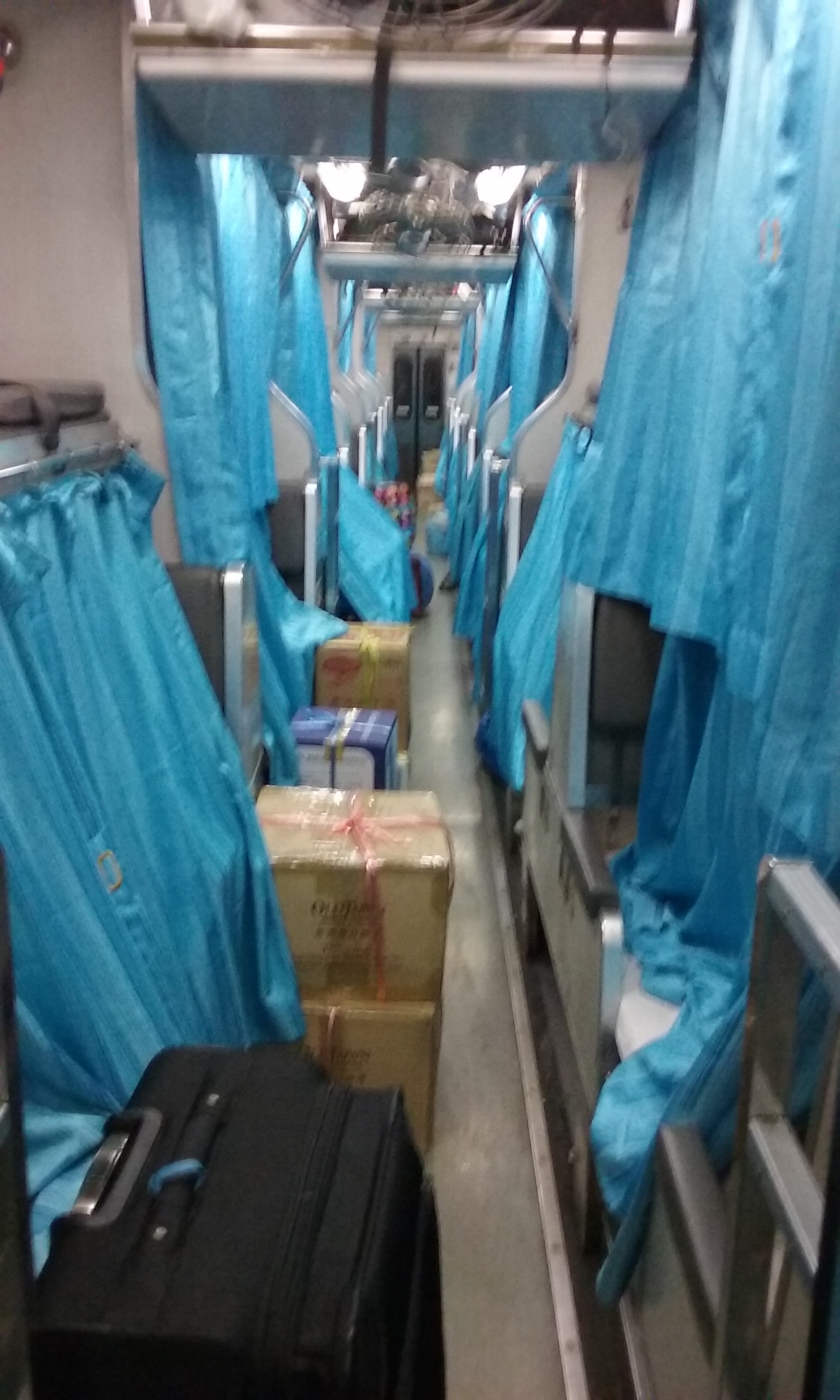
Around 9:00 PM the sleepers were prepared by the steward who moved fast through our car, lowering the upper berths and making the beds with the bedding hidden behind the folded up top berth. Each sleeper bed had a turquoise curtain for privacy. The number of each seat was embroidered in the middle of the curtain reminding us to creep into the right berth after a visit to the toilet.

At first things were a little noisy – mobile phones went off and kept ringing when the owner had already fallen asleep. A few small children played electronic games with the most annoying sounds, but eventually everything went quiet as we thundered through the narrow landmass between the Malaysian border and Bangkok.

We stopped a few times, some people got off but no one got on, except for hawkers feeding the few sleepless travelers and knowing exactly when it was time to get off the train. Cars were added or taken off judging from the loud maneuvering bumps up and down the train.

The toilets were old but stayed cleaner than the toilets on Emirates’ Dubai-Dhaka flight. There were sinks for brushing teeth and washing up and a restaurant car that served meals and (non-alcoholic) drinks. A tiny galley produced food for those who didn’t want it from the hawkers.

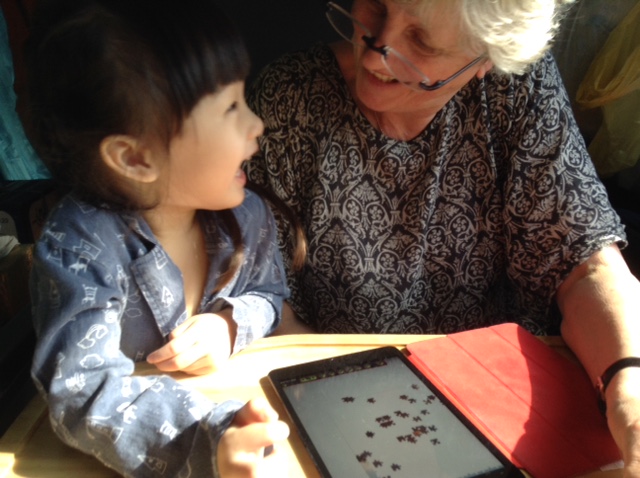
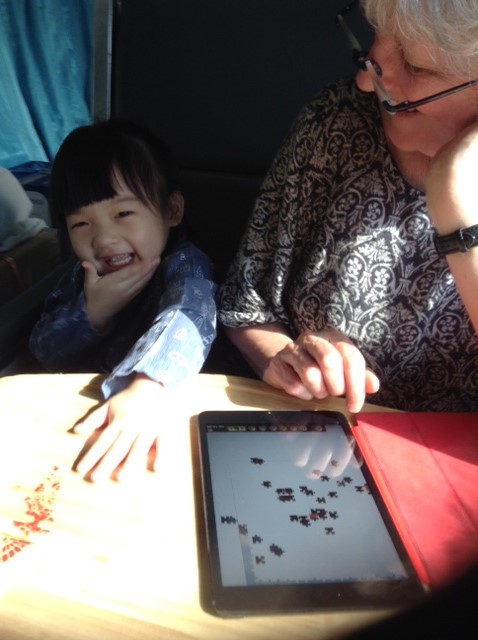
Everyone slept late – by 8:30 AM most curtains were still closed. We waited in vain for our paid breakfast and bought it again from the restaurant car when that transaction seemed not to have registered: a sandwich made from soft white bread with mystery stuff inside, two tiny bottles of over sweetened Tang and a cup of tea. A little Thai or Chinese girl entertained us for a while waiting for her grandparents to wake up. We rehearsed colors in English and she helped me with my iPad puzzle – moving the pieces with her finger to her great delight. She babbled on and we talked back in English, smiling and getting smiles.

I concluded that it had indeed been a great adventure. We had spent a very comfortable night, more comfortable than business class in a plane – all this in 2nd class. And now we are in Chinatown in Bangkok in the Shanghai Mansion boutique hotel, ready to have a great meal.

Penang-BKK-train3 Penang-BKK-train3a Penang-BKK-train3b Penang-BKK-train5 Penang-BKK-train6

From MIC to LIC

There were more moments I came to regret not taking the plane from Penang to Bangkok – we left Georgetown at the end of the morning to get to the station in time for a 1h15 PM departure. This turned out to be 2PM. Our train to Bangkok was number 36 and looked more like a commuter train. It was a local (no facilities) to the border which was 3 hours away. We stopped at small stations and at places in between. The airco system chugged along with some effort and not very effectively.

There were more regrets when we got to the border. The border crossing was easy; no stern immigration and custom officers here. We were greated by a friendly overweight man in a uniform that didn’t close. There was some sort of a trajectory through immigration and customs but when you were done you where exactly where you started and everyone passed freely between the two countries. The numbere of passengers was small; everyone recognized everyone else quickly. If you didn’t need a stamp in your passport you could have slipped easily from Malaysia into Thailand or the other way around.

I had had some naïve idea that a spiffy night train with the sleepers we had ordered would be waiting for us at the border crossing. It was not to be and I realized that this is the difference between a middle income country (our train from KL to Butterworth was very spiffy with an electronic display of the speed at all times and Harry Potter playing on a screen next to it).

Here in borderland it was very hot and very humid, and when we realized our train was still making its way from Bangkok the heat and humidity increased significantly.  We killed the time eating in the upstairs eating establishment until we realized that heat rises.

We had obtained the tickets through a byzantine process that involved multiple emails, a middleman and a courier carrying our ticket from Bangkok to Butterworth (our starting point). It was a trust fall if ever there was one. The courier, carrying a green apron, delivered our tickets and presented us with dinner options: chicken, beef or vegetarian, tea or coffee and a sandwich for breakfast. We ordered four beers; all this for 20 dollars. (Later we learned alcohol was forbidden on the train and the breakfast sandwich never materialized).

When the train was delayed he brought us the 4 cold beers on the customs inspection tables which we briefly had to evacuate for the passengers coming from Bangkok. It was a good sign because it meant our train was there, it just needed to change track and move its locomotive to the front.

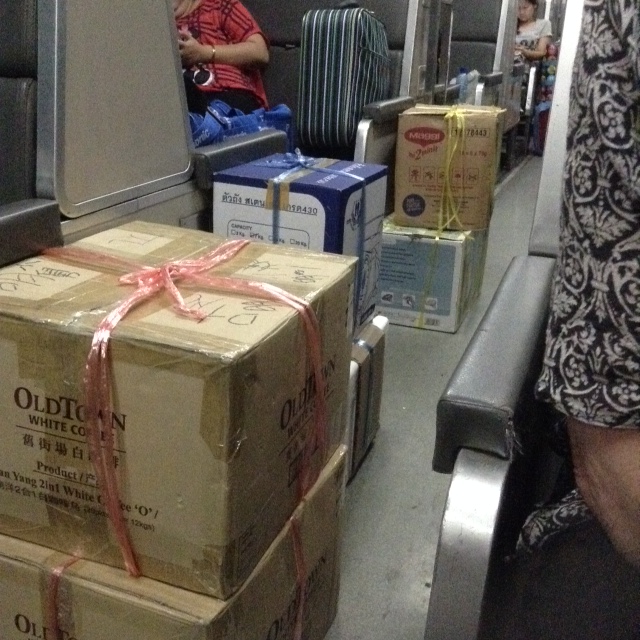
We found our places in car number 9 and discovered that there was not much room for luggage. With our two small pieces we managed but the family that came after us had a challenge with its 6 boxes, two giant suitcases, and countless assorted bags. There were other people with luggage like that.. The suitcases and boxes, not fitting anywhere else, were piled up in the narrow corridor between the seats. I thought of the flight attendants at the end of a flight warning us to keep blankets from blocking egress. Blankets now seemed harmless compared to these boxes upon boxes. A quick escape in case of an accident would be very challenging.

As we realized quickly the train was of a different type than the one in Malaysia. It reminded me of the sleeper trains I took in my youth on vacations to Switzerland and Austria, an old workhorse, well-worn, with little inkling about the coming electronic era, internet, and electronic gadgets that need constant charging.

Up and around Penang-2

We now regret a bit that we didn’t decide to fly from Penang to Bangkok and instead are taking the night train which takes about 20 hours. We wouldn’t have minded to stay here a bit longer. The old town is full of beautiful old buildings and coffee houses, a combination Axel cannot resist: sip his cappuccino and sketch. That is how we started our second day in Georgetown.

Last night we had a late night one hour foot massage, expertly (and for Axel painfully) done by two giant Burmese men who had learned the art of reflexology. While Axel let out whimpers of pain now and then, they pointed out that they were working on our spleens, hearts, lungs, digestive system and more. Despite the pain Axel made an appointment for the next evening; there was something very right about what they did. I whimpered only once.

We are both reading the same book: the Gift of Rain, which is a story about the years before WWII on this island and the Japanese occupation of Malaysia. It is a terrifying and beautiful tale of cruelty, love, divided loyalties, co-existence and duty with the beautiful island as a backdrop.

On the recommendation of a Trip Advisor traveler we hired Mogan to take us around the island which turned out to be a great move. Mogan, like Regi and Ravi, is also a third generation Tamil. He showed us the places I was reading about in my book. He took us to the lovely small museum, showed the island’s beautiful architecture and its extravagant temples. Mogan told us many tales about the island where Buddhuism as he called it, Hinduism, Christendom and Islam live side by side, sometimes in harmony, sometime snot, and have been doing so for centuries.

Although third generation, Tamil is still his first language, as it is for his children who learn Malay, English at school and Chinese or Hindi on the side.

We picked a bad day to go up to Penang Hill because of the May 1 holiday. Thousands of people lined up to get into the little mountain train that takes only a 100 people at a time. We bought the fastlane ticket for 10 dollars more which got us to the front of the line. It would have taken us all day to get up and then down again otherwise.

Up on the hill the view is breath taking if you can for a moment forget about the 1000s of other people around you, taking selfies and dragging tired and screaming children along. It’s a bit of a Disney Park up there until you get about 50 meters away from the beaten path. We sat under colorful prayer flags on the empty lawn of the Bellevue Hotel that has been taken over by the government and has fallen into disrepair. I could imagine the pre WWII gardens and the parties held here in the cool air above the stifling Georgetown heat; it was now a badly overgrown garden full of untamed and diseased plants and bushes.

We ended our trip at the old E&O Hotel, a bit like the Majestic in KL, right on the ocean, with a G&T as one should in such places. After a work related call for me we returned to the foot massage place down the street and enjoyed andother hourlong foot massage until after midnight. It made for a good night sleep.

Up and around Penang

We got up early on May (1) day to catch the train to Butterworth, a four hour ride north from KL. The train was modern, airco-ed with assigned seats and not too crowded even though it was a long holiday weekend. I suspect most people had already left on Saturday. While waiting at the KL central station we made friends with a palm oil marketing director whose daughter goes to school in Manchester NH. We wondered how she managed the cold, much as she probably wonders how we manage the hot and humid climate of the Malaysian west coast.

We were a bit disappointed in the food available on the train and noticed most people brought their own. They knew. For coffee there was only 3-in-1 or 2-in-1, both instant packages with sugar and milk powder or only sugar.

We had underestimated the schlepp (especially given the heat and humidity) from the train station to the ferry and from there to our hotel.  We vowed we’d take the road back on Tuesday once we discovered there is a bridge that connects Penang Island with the mainland.

The island looked like Manhattan, from the ferry – tall skyscrapers as far as the eye can see in both directions. This is not quite what we had expected. Luckily we are residing in the low part of town, the old Indian and Chinese quarters with their bustling commercial activities and mixtures of scents of curries and incense.

We were rewarded with a wonderful warm welcome by the innkeepers of the Ren-i-Tang Heritage Inn, a beautifully restored Chinese merchant home in the center of Georgetown’s India town.

The inn has a lovely café open to the street, serving wonderful food. I tried a local dish that let’s you wrap tiny pieces of shrimp, ginger, onion, cucumber, calamansi (small limes) and chillies in a fresh leave from something that grows below our balcony. The assembly concludes or starts with a sweet soy paste and is then popped into one’s mouth.

Everything is very low key. It’s not quite like the Majestic, more homey and very comfortable in a backpackers kind of way – guests greeting each other and exchanging tips, and at a price that is more manageable.  We picked another Heritage house for dinner and are largely making up for the not so great dinners of our Best Western days and its mediocre culinary neighborhood.

Holiday two

We had hired Ravi, a friend of  Regi, a third generation Indian who took Axel around KL one morning while I was still working. Ravi  is also of the third generation, but he ancestors came from Sri Lanka. Ravi took us to Melaka, a place I insisted on seeing even though it is now a tourist trap. Melaka is tied up closely with Dutch history. I had read about my forefathers (and a few unlucky foremothers) who traveled to this part of the world from 1600 onwards. Many died young, in the prime of their life or in childbirth, as did many of their children. This wasn’t an easy climate for the Dutch and they had little resistance to the diseases common here.

We looked at their enormous tombstones which had been lifted from the church floor and stood side by side against the remaining walls of the original Portuguese church.  “hier leyt…” said many, describing the person who was remembered. Later in the museum (the old ‘Stadthuys’ which means town hall in Dutch), we looked at the painted scenes that described how Melaka went from a small village inhabited by forest peoples who lived from the land, the sea and piracy, to the current modern city that lives for a good part from the tourist trade, oil and the technology industry.

Downstairs life size bronze statues represented the various conquerors in front of their flags. Upstairs the various eras (Portuguese, Belanda (=Dutch), British and, Japanese) had their own room with artifacts from that time.  Judging from what I saw in Melaka and what I known from history taught to Dutch school children in the 50s (I was 5 when Malaysia became independent), this has always been a place of great suffering. A suffering that was born out of greed and intolerance. Now it seems peaceful although we figured from Ravi’s explanations that there are dangerous undercurrents here. The surface tolerance between the ethnic and religious groups is paper thin. Below it are the same drgaons of greed and intolerance that are ready to rear their ugly heads.

Ravi took us to the water’s edge so that I could wade my kakies (=feet in Malay, a word that has crept into the Dutch language) in the (in)famous Malaccan Straits waters.  A lovely mosquee was built on stilts and open to visitors, even to foreign Christian women as long as they put on long satiny gown with pink and blue flowers and a baby blue stretchy kind of tube to put one’ head through, leaving only the front of our face visible. All nylong and polyester, the gear left me sweating profusely, but it allowed me to wander around the sacred space, anonymously.

An entire section of town near the old docks had been remodeled and expanded with fancy condos, but them something happened. Nobody lives there and the buildings are falling into disrepair. The large billboards with pictures of beautiful smiling couples clinking their champagne glasses and reclining on fancy furniture are the only remnants of the developers’ visions. The Muslim Malay  (and foreigners, read: Arabs) were not able to pull off the development without the Chinese who refused to be part of this in a subordinate position.  We learned all this from Ravi whose opinions are colored by his own prejudices that were dripping into the conversations. As a Sri Lankan he can never be a ‘bumiputra’ Malay (derived from Sanskrit meaning ‘sons of the soil’.) He will always be a second class citizen. It is a bit like townies in Manchester, except in Manchester we have the same rights – this is not the case here. At any rate, the stalled and mildewy developments reminded me of a similar failed dream on the outskirts of Karachi – that one stalled when the housing prices in Dubai hit rock bottom and people lost a lot of money.

The roundtrip KL-Melaka took nearly 6 hours which meant that we missed both the high tea and the cocktail hour when we came back to our fancy hotel. We were too tired to go out and spent an extravagant amount on dinner because we didn’t understand the arrangement with wines that came out of a machine. Beware of wines that come out of a machine!

Holiday one

We celebrated the end of our assignment in the Buku Bintang area of KL. First we went to the whiskey bar. We ordered samplers of several half ounce glasses (I tried the Japanese collection) and then walked to Alor street to sample KL street food:  durian, sweet yellow and spicy green mango, crayfish and other fish and meat on bamboo skewers, fresh coconut milk, coconut ice cream and much more.

At breakfast we said goodbye to T. who should have landed in Sri Lanka by now. We packed up, did a rather stupid walk at the hottest part of the day in a rather tepid park, took a cab to our new digs, the majestic Majestic Hotel. We splurged by buying the upgrade special for 75 dollars a night which put us in the original Majestic building, feeling like we landed in the days of the Raj. the British left their fingerprints all over the place. The upgrade came with breakfast (apparently quite a spread), an English tea at 5, cocktails at 6, free laundry, free minibar contents and our own butler. After a week of mediocrity and too many Chinese for company in the Best Western, we felt like royalty. We have now a 2 room suite with plenty of horizontal surfaces to spread our belongings; it’s a relief after our dormitary style Best Western roomlet with its tiny desk and twin beds, and hardly any space to manoeuver.

We visited the nearby Textile museum, Axel for the second time, and learned about the many inventive ways that the Malay have adorned their bodies and heads with the most amazing textiles and hats. I don’t understand how these textile techniques work, let alone how they were invented, but for Axel the silk painter, it was all very illuminating.

Tomorrow we will sample the breakfast buffet which will no doubt be an improvement on our breakfast experience of the last few days. At 9 a driver will pick us up to go tho Malaka, a place of great historical interest, some two hours south of KL.


April 2026
M T W T F S S
 12345
6789101112
13141516171819
20212223242526
27282930  

Categories

Blog Stats

  • 140,563 hits

Recent Comments

Lucy's avatarLucy on Probabilities
Olya's avatarOlya on Cuts
Olya Duzey's avatarOlya Duzey on The surgeon’s helpers
svriesendorp's avatarsvriesendorp on Safe in my cocoon
Lucy Mize's avatarLucy Mize on Safe in my cocoon

Enter your email address to follow this blog and receive notifications of new posts by email.

Join 78 other subscribers