Archive Page 50

Opportunity, luck and perseverance

About 10 years ago I met Elias – we cannot quite remember how, maybe via an acquaintance on Facebook, while I was on an assignment in Nairobi. What we had in common was a love of flying, but not much else.

When we met he had just found out that his arrangement to go to flying school in Australia had been canceled due to economic hardships of his benefactor. He was looking hard and praying hard. He wanted to be a pilot. I was so impressed with the power of his vision, a thing we teach about when we run our leadership development programs, and how far it had already gotten him, that I have often mentioned him as an example. I gave him the book I co-authored: Managers Who Lead, because he was such a good example of the kind of mindset and approach to life that we think makes for good leaders. He told me today with a big smile he still has it and uses it.

Back in 2007 or 2008 I tried to raise some funds to send him to Australia through my flight school in Beverly without any success. I felt I had let him down. But he didn’t see it that way, citing that the encouragement and enthusiasm of others helped him.

And while I was not being very successful in supporting him, and at times forgot all about him, he kept his eye on the prize and didn’t sit still. He took advantage of a requirement in the new constitution that reserved a percentage of every government tender for young people with no experience. He and 3 other young men created a company and applied. They have done well since. Now they are no longer in the youth category but they have established credibility and a reputation for good work. With the earnings from this work he was able to resume his pilot training here in Nairobi. He got his private pilot license, then his commercial license, and negotiated left and right to accumulate flying hours. His next prize is to be employed by an airline company.

Starting in a very poor orphanage, no shoes, and perpetually hungry, he has done well for himself. He now serves as an inspiring role model for the young kids in the orphanage. He belongs to a tribe of young people I have met from various countries who have overcome obstacles that would have paralyzed others. One thing they all have in common: they are constantly scanning for opportunities, they have a mindset that nothing is impossible; they are very good at establishing relationships quickly with total strangers (like me) and they have their eye on the prize, all the time.

Through his relationships with county officials (as a result of his company’s work), he has brought other benefactors and well-wishers to the Kapchesewes Children’s Home that is associated by the Africa Inland Church. A website of their own is his next venture. Now they only appear on other people’s blogs. The country has since connected them to the grid, making yet others things possible. This will continue the positive cycle of opportunity, luck and perseverance.

A lucky bid

Within 24 hours of our departure from Laos we heard that our bid for a business class seat on the 8 hour Kenya Airways flight from Bangkok to Nairobi had been accepted. I had never heard about bidding for business class seats. Checking for my seat on the Kenya Airways website there was a tab ‘bid on a business class seat’ that caught my attention. For amounts between 150 and 795 dollars one can place a bid for a B-class seat. I had originally placed a bid for 300 dollars, which according to a ‘chance’ meter indicated I had a slightly below average chance. My colleague upped her bid above mine. Then I got word that our taxes were done and we owed the US Government about 4000 dollars (Axel is drawing social security for the first time).  I immediately downgraded my bid to the minimum (chance meter said ‘very poor.’), expecting it would not be accepted. But it was, and so I had my first ride in a Dreamliner in style, sleeping a good part of the turbulent trip across the Indian Ocean fully horizontal in seat 1A. My colleague also got the upgrade but paid a bit more. It’s a chance game.

Companions in my cabin were few – most of them Congolese traders returning from Guangzhou where there is a thriving Congolese community that is doing very well buying Chinese wares cheaply and selling them for a bit more in the DRC. I had just read about them in the book ‘Congo’ by David van Reybrouck, who dedicated a whole chapter to this trade route. The flight originated there.

Because of our delayed departure from Bangkok we hit Nairobi exactly at the morning rush hour. It took two hours to get to our hotel.

On April 1 we met some of the faculty for this training of trainers, the people who wrote the curriculum and with whom I had communicated by email and on Skype during the long preparation phase of this first pilot of the TOT. Meeting them felt like meeting old acquaintances and we fell into easy conversation right away. And now the other trainers and participants are trickling in, while we are finishing the preparations.

We are using Uber to travel around town. It’s a great invention – we need no cash and we have a record of our trips. So far the drivers have been as prompt as can be expected giving the horrendous traffic jams here, and very courteous.

Multivariables

I usually join our wheelchair training team when the practical clinical and technical work is done. Together we then teach the managers or supervisors of the participants in the just completed training how to run the wheelchair service in a way that supports the new skill set of their staff so they can start practicing right away. We cover everything from demand generation, organization and patient flow, finances, fundraising, monitoring and evaluation, managing change and staffing, while also helping them to understand the big picture of wheelchair service delivery.

We don’t always get the right people in the room. I had been forewarned about how hard it was to engage people and get them to speak out. Sometimes it seems that the only inducement to come to this kind of training is the per diem – the daily allowances that serve as a nice complement to, probably very low salaries.  It makes little sense for people who are already at their usual workplace but they demand it anyways. We follow strict US government guidelines, but people try to wrangle more out of us. This is what my colleague M has to deal with, over and over.

It is the per diem curse that haunts many of us and that has contaminated what we would consider a drive to learn. Like in other places, I assume this drive is there, with curiosity as its signpost. But there are only a few that show this.

It is complicated to teach the management course: there is a script that I find hard to stick to as it is a PowerPoint lecture-based set up. Especially on the first day there were many blank stares and people getting hopelessly tangled up in very basic math. Add to this that the slides we project are in Lao script and the tangle of wires and ear buds and mics for the simultaneous translation, teaching these classes can be quite unnerving in the beginning, even when one knows the topic very well.

And then there is the culture: a communist party culture superimposed on a highly stratified society and the trauma of the Vietnam War. Altogether it makes for a challenging teaching experience. It takes me about two days to get the hang of it and establish the kind of relationships that allow us all to relax and enjoy the opportunity of working towards something all of us deeply care about.

Then, after the management training was done we had a stakeholder meeting, bringing together key movers and shakers who are invested in pushing the wheelchair agenda forward, as part of a broader commitment to implement the UN Convention of the rights of people with disabilities.

Usually we have two days for this event but this time we were given only one day. For this meeting there is a script too but I never follow it as these kinds of meeting are too contextual to allow for a cookie cutter approach. I do have developed a kind of formula and then riff on that: where are we now? Where do we want to go? How did we get from here to there? Who is leading and coordinating efforts after today?

The complications of how to do small group exercises when the set-up is for simultaneous translation is something I had not fully grasped during the design phase. We managed anyways, reminding me that ‘where there is a will, there is a way.’

Haunted memories

Other than our short daily drive to work, I didn’t get to see much of the city. In the tourist brochures I saw pictures of all the beautiful things I could or should have seen – I suppose it requires going here as a tourist. I also learned, a little late, that I had pronounced the name of the capital all wrong. It sounds more Chinese than French (wiet chan).

The one tourist stop I did see was the COPE museum of the Vietnam War’s sad legacy of unexploded ordinance (UXO) and mines. The museum receives a constant stream of tourists which we saw passing by our training room, located in a large complex dedicated to people with disabilities. The rehabilitation center also receives a constant stream of requests for artificial limbs and wheelchairs for people who were mostly (or currently are) innocent bystanders of this devastating war.

One of our participants is from the northern part of the country, from the Hmong tribe which is present in a wide band below China. Thousands of Hmong were recruited by the CIA to fight the communists in Indochina during its ‘Secret War.’ As a result they were persecuted and many fled to Thailand and other places further away, like Minnesota. Anne Fadiman wrote a beautiful book (and intensely sad) about the latter group and the resulting culture clashes between two medical world views.

The young gentleman told me that his father recounted to him the horror stories, experienced while he (the father) was still a child. That generation was severely traumatized by memories of bombs falling, killing squads in the jungle and the dangerous Mekong crossing. His grandfather didn’t survive. He does have relatives in Minnesota and his uncle wrote a book about crossing the river. When I googled this I came across more nightmare memories. The Vietnam War is still very much alive here.


Bodyworks

The part of Vientiane where we are lodged is awash with small restaurants and massage places. At the end of the road, snaking along the Mekong River, is the daily night market (6-10PM). It is a poor cousin of Bangkok’s weekend market, full of cheap Chinese wares and some local handicraft.

During one of our evening strolls looking for a restaurant we found a boutique hotel (Ansara) that we should have stayed in. Its lovely French restaurant offered set menus and good wine for a reasonable price. Across the hotel we discovered (with some help from Trip Advisor) a very professionally run spa. We started to visit it daily. Upon entering one receives a thick menu book with choices. I tried the one hour leg and foot massage which ended with a neck and shoulder massage, thrown in as a bonus. I would have liked to propose to the diminutive masseuse to come home with me.  I had my body scrubbed for an hour with the promise of a sense of (cell) rejuvenation – one of the few options available after dinner. The chief masseuse was very strict about ‘no whole body massages (nor sauna) directly after dinner.’

And for our last day I chose the sports massage which was delivered with more force than seemed possible given the size of the masseuse. Now, more than24 hours later my muscles are still wondering what happened to them. That was it for massages in the short time I was there.


Indochine

As we landed in Laos, I couldn’t help but think what would have happened had I not divorced P in 1979. Just before he died last year he became consul for Laos in the Netherlands; he had lived some years here.  How different things would have been: no Sita, no Tessa, no Faro, no Saffi. I would not have gone here on a business trip, but I would have known this place.  I wouldn’t have minded living here for a bit, but there are no regrets.

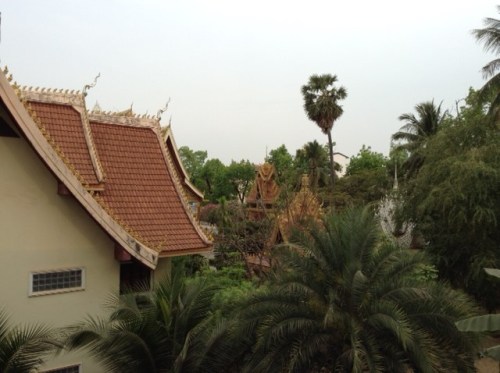
I was whisked away from the tiny airport in an elegant van to our boutique hotel. I look out over a temple complex with fantastical roofs.IMG_1842

I joined my colleagues who have already spent 2 weeks here, training staff of rehab centers how to properly prescribe and fit wheelchairs: a physical therapist from the Philippines, a colleague from our Arlington office who looks after the very complicated logistics and an occupational therapist from Israel. The latter is now on her way home, her job done. The three of us will stay. We have done this training and aligning of wheelchair stakeholders together before: twice in the Philippines, in Mongolia and in Cambodia.

It was a nice reunion which we celebrated at a French café. We had quiches and ‘pain de mie’ with Norwegian salmon.  Vientiane is very French; we are in the old French ‘Indochine,’ after all. Government buildings have their Latin script names in French.

Our departing team member got to choose the venue for our farewell dinner. She picked a restaurant already tested and approved, especially for its frozen chili margaritas. It is a social enterprise restaurant, where unlucky kids turned lucky served us a most wonderful meal.

New year, old ramblings

We celebrated the Iranian/Afghan New Year, nawruz, at the Museum of Fine Arts, followed by a lovely dinner at Ariana, an Afghan restaurant on the outskirts of Boston, with our longtime friends and ex-colleagues. We have Afghanistan in common, among many other things. They are preparing for a trip to Holland and so we put all the celebrations together, spring, travel, happy retirement (they, not me), new year, crocuses and daffodils.

For the first time in months I pedaled to Quaker Meeting – with all the travel I miss a lot of Sundays and when I am home for a change we go to NH or Easthampton to see our kids and grand kids. Our silent worship was tested by a gentleman with a giant vacuum cleaner or polishing machine, which led to some interesting thoughts and messages about sucking sounds and what polishing (both of these) can do for our psyche.

Spring, a day early because of leap year, started with a snowstorm. It was a gentle one, at least for someone who didn’t need to get on the road. It left, possibly for the last time, everything around our house soft, white, round and silent. But it was all gone within days. The earth is warming, spring is coming.

I worked hard and fast on reviewing facilitation guides that badly needed some changes. It’s not my kind of work – attention to detail that stresses me out, but I had made the commitment both to myself and to others who had to deal with would-be facilitators being flummoxed. It’s done now and I rest my case.

Resting is what I need very badly right now, after only an hour of sleep on the plane ride to Japan. Still, I can’t complain – I was able to cash in one of my four upgrade certificates – Delta’s thank you for my frequent flying. I killed the time by listening to Joyce’s Ulysses while trying to master knitting two socks at the same time, and starting at the toes.  The two combined required serious concentration. The socks are practice socks, bright yellow cotton, just about Saffi’s size. Ulysses is read by a formidable actor which makes it worth my while, even though I couldn’t possibly say anything coherent about what I listened to for the last five hours.

Ulysses was the favorite book, and Joyce the favorite author, of one of my classmates in 11th grade. He was way too mature for us 16 year olds, talking about Joyce in a way I will never able to do. Both he and his sister became authors – the germs planted then, between the classics, read in their original languages, and the 100 year old willow tree that we circled around, talking about deep stuff, during our recess. Walking in ‘the hortus’ was a privilege for the older kids in our Latin School (Gymnasium), the younger ones circled around and around on what was essentially a parking lot.

It was under that tree that I was first exposed to someone rambling about Joyce. Reading (or listening to) Ulysses was on my bucket list. Now I understand the rambling, but still not what Ulysses is all about.

Flaming red

Right now the sun shines red through the second flowering stem of the Amaryllis, blood red. We are told to brace for another snowstorm, after this raw and rainy week, but right now it feels like spring.

I have completed my morning ritual of nearly 18 different exercises to regain strength in my left shoulder. I have decided to bring along the right shoulder which has never quite recovered from having lost one tendon in our accident now nearly 10 years ago. I can lift two pound weights during most exercises without triggering a tendinitis. It is about time because the left shoulder surgery was a year ago. I can put away stemware and plates from the dishwasher on shelves over my head, with less and less recourse to my right arm as a support. I am gaining strength. Even the defective right shoulder is benefiting from the special attention, within the limits of its 3-tendon arrangement.

I finished reading Anita Diamant’s Boston Girl which made me think of my in-laws, both gone now, who grew up in more or less the same places (Boston, Cape Ann) in the same time period (early 1900s and through the depression, 2nd world war). Such narratives are a reminder of the new immigrant struggles and how far their descendants have come.

For contrast, The dark side of Camelot (Hersh) keeps providing me with a stark counterpoint; a reality test of sorts (is this stuff really still going on?). Yes, says the Big Short movie we watched last night.

The 2nd blood-red Amaryllis bloom exudes energy and possibility. The old stem with its faded flower and yellowing stem is gone; it gave up (or gave in, to entropy). Today is a flaming hot red day!

Connections

As we left  the museum Tessa and Steve’s new old car failed to start. Before we could even get to them a fellow New Hampshire citizen stopped and helped them to jump start the car. People are friendly and helpful here, which is not usually the first thing that comes to mind when reading NH’s motto on the number plates (Live free or die). We left NH Manchester for MA Manchester in the sun.

Tessa invested her meager business resources into a trip to DC to lobby for implementation of the Small Business Administration support for small and women-owned businesses. She falls into that category and hopes it will get her more business. She is learning about the laws and letting her voice be heard. I bought her lobbying clothes; not that she needs those with her one-meter long red rasta hairdo and her straight posture – she is an impressive presence. Even if she doesn’t always feel that confidence inside, she surely looks like she has it. I gather she came back with some more.

Here in Massachusetts we suffered a week of dreary weather, which is traditional during Saint Patrick’s week. I suppose it is good for the vegetation but for us humans it is dreadful and soul sucking. At work I ploughed through 500 pages, reviewing our flagship leadership program guides. This kind of detail oriented work is also dreadful and soul sucking for me as there is nothing creative about it. But it needs to be done and I think few others could do it. There’s more review work before I take off on another wheelchair adventure next week. But those adventures (never mind the long plane rides) are energizing, inspiring and soul-nourishing and compensate for a lot.

There was more soul nourishing this week. I am reconnecting with people I see rarely or lost touch with. I immediately forward connected them to other people in my network. As a result I am in an expansive mood. When I hear what people are doing and see how it overlaps with what others are doing, I become nearly manic with possibilities. The older I get the more I see the importance of weavings these connected threads together.

Changing light

We had a busy weekend – much too busy for the beautiful day that beckoned yard work. First we visited an old friend of Axel, a widower, and his new wife who brought their (his) grandkids to Lobster Cove – reminding me that there are always new friends to make, no matter at which stage one is in one’s live.

Then we went to a lecture at the Cape Ann Museum, about the Folly Cove Designers, a collaborative of women of Cape Ann who made extraordinary art between the 1940s and late 1960s. At the time it was considered craft, not art, but now we recognize it as art. It was a lecture about the social history of Cape Ann that was heavily influenced by its immigrant Finnish population, who came to Cape Ann with their predilection for communal action, misrepresented, at the time, as socialism, and abhorred by the American establishment.

From there we drove to New Hampshire to spent this night that is one hour shorter than other nights as we shift to daylight savings at Tessa’s. She had arranged for us to have Sunday brunch at the Currier museum in Manchester (NH) and a visit to the exhibit on high heels.

By the time we came back to Manchester (MA) there was enough daylight time left to clean the asparagus bed, the flowerbed and get ready for the burning season.


April 2026
M T W T F S S
 12345
6789101112
13141516171819
20212223242526
27282930  

Categories

Blog Stats

  • 140,564 hits

Recent Comments

Lucy's avatarLucy on Probabilities
Olya's avatarOlya on Cuts
Olya Duzey's avatarOlya Duzey on The surgeon’s helpers
svriesendorp's avatarsvriesendorp on Safe in my cocoon
Lucy Mize's avatarLucy Mize on Safe in my cocoon

Enter your email address to follow this blog and receive notifications of new posts by email.

Join 78 other subscribers