Posts Tagged 'Afghanistan'


A sense of service

This morning was all devoted to drugs, of the legal kind. As our drug management team is transferring from one project to another later this year, the two project leaders and affected staff came together to demystify the transition, deal with rumors and put everyone at ease.

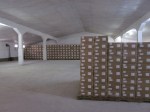
Afterward I joined the warehouse management team for a tour of the facility where all the bulk drugs are stored and then repacked for distribution to the NGOs. It is a very complex logistical challenge. I know that from the emails about procurement, shipments and clearance on which I am cc-ed. But now I finally got to see the result of all the work: boxes piled on top of boxes with the medicines that appear on the approved drug list for health centers and hospitals and are shipped to Kabul with the compliments of the American people.

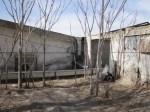
The warehouse consists of several large buildings. They were rebuilt from the debris that the Mujahedeen had left behind, which was little when it concerned the traditional mudbrick structures, or dented and pockmarked with bullet holes when it concerned the building put up by the Russians with indestructible and thick cement walls.

The storage is secured, temperature controlled, pest controlled (all the traps have been empty since a food storage place was established nearby) and closely monitored by staff whose offices are dwarfed in the corners of the gigantic spaces. It is not a comfortable work environment in the winter – these spaces are heated only as much as is needed to keep things from freezing – but then, in the summer everything stays naturally cool.

The inventory check that is done quarterly, a yeoman’s job of counting every box, has consistently surfaced numbers that are within the tiniest fractions of allowed discrepancies from what is expected to be there. When you see the number of boxes you realize the accomplishment. I am told that people coming from outside the country, and who are familiar with pharmaceutical logistics systems are awed by it all. It is one of those accomplishments that is invisible because it is not newsworthy. Only a negative event, theft, fire, would make it newsworthy which is too bad.

The next challenge for the combined project teams is how to transfer the responsibility and running of all this to the government. It will be a slow process that will take years but less so because of the strong foundation on which the system is built.
In the evening I tumbled unknowingly into a meeting of the Pakistan District Rotary Club Kabul; complete with banners and District Governors (a Rotary governance title I learned) from Lahore (male) and two from the UK (one male one female), the latter two wearing their red Rotary blazers.

There were many ceremonies that included speeches and gifts: the traditional Afghan gray silk-turban/skullcap combinations for the men and a chador that looked like a fringed American flag without the stars for the lady. This was preceded and followed by many speeches about Service over Self, upcoming events (Lahore and New Orleans), projects, some history and some posing for the obligatory gift receiving pictures.

Razia jan who was hosting the meeting showed a wonderful new documentary about her Zabuli school for girls that her foundation (and Rotary) supports. It included an interview with Khaled Husseini of Kite Runner fame.

I learned that Zabuli was a wealthy Afghan banker responsible for the introduction of checkbooks and other banking novelties, who left all his money for the betterment of Afghanistan. Razia jan’s school got windows and walls and named the school after him in return.
White

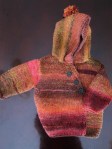
My reservoir of patience has filled up as hoped. I spent the day reading documents that had been languishing in my inbox, waiting for comments, or for my edification. All the while I am putting the finishing touches on a knitted ensemble for Liz who is going to have a baby in spring: jacket, booties and mittens, for next winter.

We watched the analyses and reviews of Obama’s speech while listening to the roar and thunder of helicopters overhead, loaded airships, just in case the people who did not get a seat in parliament were going to cause problems during the official inauguration that had given us a day off (white city the UN calls it – sequestered at home as during a white-out).

In the evening I joined my MSH colleagues from around the world for our quarterly staff meetings. Technology makes it possible to listen to presentations given in Boston, Seattle and Port-au Prince, to ask questions and hear them answered. It is truly amazing to be together like that.

We channel surfed between BBC, Al Jezeera and EuroNews to find out more about what is happening in Egypt, my destination in a few days. Someone said that if Tunisia sneezes the whole Middle East catches a cold. We hope that Egypt’s cold won’t turn into something nastier. Such irony; after over a year of trying to get all the moving pieces of getting Afghans to Egypt fit together, the trip may be cancelled after all. I am crossing my fingers for a good outcome.

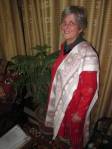
Photos: the new dress made from the material M gave me for my birthday, in front of our thriving Christmas tree that Hadji Kazem lovingly tended during our absence. And the sweater for Liz’s baby.

Car problems

I concluded today that I have been tasked to cross extremely difficult terrain in a car with defective steering, four flat tires and dirty oil. Last week I kicked that car and it came apart. The car got mended and today I lost my temper and kicked it on the other side, leaving a big dent. We’ll see what falls apart next. This is the story of my work here. I don’t think I can get from here to there in the vehicle made available to me. I mean ‘vehicle’ figuratively of course.

There’s more that is not right. I love to teach and I am very good at it but there is little room for me to teach the things I am passionate about. For many what I want to teach is secondary, or fluff. I want to help people design better meetings, teach how to manage power dynamics. It’s partially self interest (or, as they say here ‘cooking my own kebab.’)

I have a very low tolerance for sitting in badly conceived and facilitated meetings that waste every one’s time. I walked out of such a meeting today and threw my hands up. My preventive work as it relates to design and facilitation doesn’t appear to be very effective. Sometimes I get to correct course in midstream of a meeting, when there is a crisis and people notice that the meeting is about to derail or has already done so; when a few people dominate the meeting and influence the outcome in a less than democratic way.
But these are retrofitting or emergency operations that I prefer to avoid because they are awkward and never really coherent, and if they fail I have egg on my face.

So I am spending most of my days managing my own teams and their staff, and being part of the senior management team. I am extremely busy with internal project management tasks and other things that are not really my area of expertise or passion. I have a team under me that manages millions of dollars of pharmaceuticals, calculating, ordering, shipping, negotiating exemptions and other bureaucratic hurdles, custom clearing, distributing, monitoring and fixing problems. I know nothing about any of this. Luckily I have a good team and they do fine with or without me. I am called in when there are morale problems but even those are mostly managed without my interventions, Afghan style.

I have another team that has advisers who work on technical issues I also know little about: child health, public relations, environmental health and my third team is not a team, but a one-man show, an all-eggs-in-one-basket kind of thing.

Tomorrow the parliament will open and our area is already swarming with armed men in pickup trucks. The main access road to our office will be blocked off. As a precautionary measure we are told to stay home. This is a good thing so I can fill up my depleted patience reservoir.

Mud

Things are a bit muddled in my head, as if the ideas I have cannot find the right words to convey to others who operate from a different metaphor. I suddenly have a strong urge to go back to school and work within the confines of academic rigor and discipline and express myself in a better way.

We spent the entire day in one of our smaller conference rooms. Small means warm, there is no central heating; but small also means stuffy as we were packed tightly around the conference table on our bulky chairs. We scrutinized every program manager’s plan for this year and explored what we can finish when we are beginning to wind down, in June, and what needs more time and what, if we get another year, we should add or continue.

The conversations were spirited at times, aggressive at others, skeptical or muddled as when we were using the same words but talking about different things. It is then that I felt the disconnect between what I was told to focus on, what I was able to do (and more importantly not do) and how others see those tasks.

Sometimes I felt like I was operating from one bubble trying to communicate with others in their own bubbles. There are those who insist on everything being measurable and precise which leads to deleting all that cannot be made precise. It is the age old dilemma for social scientists struggling to make their science resemble the physical sciences. How do you measure capacity building in management and leadership or process awareness? And if it can’t be precise, how can you know whether you have achieved or not.

Two of Don Schon’s quotes came to mind as I am trying to sort through my muddled thoughts about today:

“It’s as though the teacher said something like this: “I can tell you that there’s something you need to know and I can tell you that with my help you can probably learn it. But I cannot tell you what it is in a way that you can now understand. You must be willing therefore, to undergo certain experiences as I direct you to undergo them, so that you can learn what it is you need to know and what I mean by the words I use. Then and only then can you make an informed choice about whether you wish to learn this new competence. If you are unwilling to step into this new experience without knowing ahead of time what it will be like, then I cannot help you. You must trust me.” (Address at Queen’s University in Australia)

“In the varied topography of professional practice, there is a high, hard ground overlooking a swamp. On the high ground, manageable problems lend themselves to solutions through the application of research-based theory and technique. In the swampy lowland, messy, confusing problems defy technical solution. The irony of this situation is that the problems of the high ground tend to be relatively unimportant to individuals or society at large, however great their technical interest may be, while in the swamp lie the problems of greatest human concern. The practitioner must choose. Shall he remain on the high ground where we can solve relatively unimportant problems according to prevailing standards of rigor, or shall he descend to the swamp of important problems and non rigorous inquiry?” (The Reflective Practitioner)

I ask these questions about measurability myself to students in our leadership program yet I find Schon’s words comforting but I don’t have his authority to use them in the way he does.

The measurability focus is both good and bad: good when it forces people to articulate their ‘theories of change,’ and bad when it leads to dropping anything that is too complicated to measure.

My mantra today was, ‘that’s why I am here, that’s why I am here.’ But seeping underneath came that same old question again, ‘can I bring about some of the changes I set out to make?’

Rapids

I am reading Antony and Cleopatra and am struck by the similarities between Afghanistan now and Rome of that time. They say that those who don’t study history will be condemned to repeat it. Afghans would only have to look at Berlusconi to be horrified about what all these wars produced a few thousand years later.

Last week’s crisis seems to have resolved itself with a recognition of the existence of, respectively one’s shadow, reptilian brain, or an overdose of stress, depending on how one looks at it. The reptilian brain language is mine, by the way.

Today felt like I was entering the rapids, and the rest of the week will remain that way. Still hoping to join the trip to Egypt (though no sign of my visa-stamped passport yet), we are squishing much activity in this week which, for government officials is nearly at the halfway point. There are all sorts of team missioning, visioning and/or planning events that I had hoped for since I arrived here and suddenly they all happen in the same few days.

The opening (or not) of the parliament later this week leaves us with much uncertainty about whether we can even move around at all on Wednesday as the parliament is in our neighborhood, just down the street. We are waiting with baited breath. Will it be calm, will there be demonstrations? Will the cauldron boil over?

Breathless

My two birthday presents, one from M and the other from our housekeeper, were converted into Punjabi (tunic/loose pants/scarf) outfits. We picked them up at my new tailor, in between the satin-dressed bridal mannequins, apparently the tailor’s main business (photos to follow).

We met up with M who had just come back from a snow hike in Salang. It is hard to imagine that people go skiing and hiking in the winter, a little further north. There are foreigners (and Afghans) who go out every weekend to enjoy the breath taking beauty of the Afghan mountains that we only know from memory (and not in winter) or from pictures. They celebrated their successful ascent with French cheese and wine, she told us. Imagine that, here in Afghanistan. You can do these things when you don’t have a security chief, when you are on your own, or an Afghan, or may be more adventuresome than we are.

We joined her and another friend at the Rumi restaurant, a first time for us even though it has been around for several years. It is an Afghan restaurant in a lovely old house with a nice garden that will see us back when the temperature rises again in a couple of months. We feasted on various comfort/winter dishes before hurrying back to my Dari class. Axel is still in recovery mode and decided to skip classes and have a nap instead.

I am halfway through a chapter book about the history of Afghanistan. Reading Dari is difficult, not only because most vowels are not written but also because it is not clear where one word ends the the next begins; a space can either be a sign that a new word starts or simply be a space after a letter that never connects to the next (a,r,d,w).

Furthermore, unlike English, there is very little punctuation, no capital letters and sentences that go on for half a page with endless clauses and sub-clauses and passive tense verbs. By the time I get to the end of a sentence I have forgotten how it started. Reading and understanding is a very slow process require endless practice.

This is also the advice I give to my students who study English. They too have to read out aloud and I correct their pronunciation and help explain words that are not known just like my teacher does in my Dari class. My students, all Dari speakers, are used to long sentences and unaccustomed to punctuation. Not understanding many of the words, like me in their language, they too drone on.

But one thing is different; while I scan the Dari text for (non existing) periods and commas and places to take a breath, they ignore the countless periods and commas, and read on breathlessly, one sentence after another, until the paragraph is completed or I stop them.

Hand-i-work

Three of us entered through the unassuming metal blue door, into the massage place that looks nothing like it from the outside. In fact, its location between gray blast walls and barbed wire makes the business that gets conducted inside rather unlikely. I wonder what the men who walk from the highly protected US embassy to the highly protected military base, through highly protected streets, not accessible to anyone else, thought of us, three ladies, who slipped through that blue door.

M and I got our massages while P had her eyebrows done. While I was away in Holland and India Lisa fell on or against the woodburning stove and burned her arm badly. The German clinic took care of her and she is back in business with the ghastly burn still looking fresh. The massage, a relay kind of massage with different people working different parts of the body, was, as usual, blissful. M is coming back for more in a couple of days. I stick to my one-a-week routine.

We had planned to go for a long walk in Bagh-e-Bala but Axel is still sick and we canceled our plans. While he napped I took another stab at the complex sampler embroidery, doing and redoing the stitches over and over, counting the tiny threads until my eyes were all red and painful. At the massage place one of the girls is doing the traditional Afghan embroidery on regular fabric, picking up two threads that are tiny compared to the ones I try to pick up. She does it so fast and so perfect that I felt rather clumsy.

I stitched and knitted (babies are still being born everywhere) most of the afternoon, finished Anna Karenina (it gets a little boring towards the end) and starting Antony and Cleopatra – good for another couple of months of exercising and knitting.

I interrupted the craft work for a moment to prepare a presentation that is expected of our Afghan delegation to Egypt, a trip that is to start next week. I will come along if my visa-stamped passport comes back in time; otherwise I will stay behind.

M and P joined us for a wonderful dinner, coming with goodies for us and leaving with health related goodies for them. In between the coming and going we discussed hours worth of serious and not so serious topics including a good dose of gossip. We haven’t seen each other for a long time and there was much to catch up on.

Poetry in the depths

Today was one of those days when I wondered about the contributions I can make. It is so very difficult to work here, not just the work itself but the human relations part of the work. Sometimes that realization energizes me but today it depleted me. The emotions that were dancing below the surface in our interactions were stark and strong, like the ‘khakbad,’ the dust-filled winds that fill one’s lungs with unwanted particles of God knows what.

It was good that today was also SOLA teaching day as my interactions with the girls sweep the dust away and make me feel hopeful again. Today 6 girls showed up; I never know who will show up and at what level their English is. We had two newcomers, one a very young girl who has only been studying English for a few months. Although her English was far beyond my Dari at three months, we are reading a book that is way over her head. Still, at the end, she said she enjoyed the lesson.

I have them pick random chapters and then have these read out loud, everyone gets to read about half a page. Today’s chapter contained a love making scene, an illicit one between two unmarried people who have fallen in love but the fighting between the mujahedeen tears them apart as one of the families escapes to Pakistan. The love match is not to be because of family obligations – a constant refrain in this part of the world.

Reading Khaled Hosseini with the girls has made me realize how poetic his language is. When I read the book back in the US some years ago (in the summer after the crash), I read fast like a high speed train, not taking in the beauty of the landscape as I hurried along in the book. Now we are as in a local train that stops every five minutes and I see the beauty of every paragraph. It is a very different experience.

I explained about metaphors and had them pick them out from the text; every page has at least two. It has become a game, ‘who can find the metaphor?’ One of my students is far ahead of the others. She serves as my talking dictionary and stood in for me while I was away. She could be easily bored, having the most extensive vocabulary and having read the book already (in a record 3 days) but she is very engaged. She is the first to find the metaphors.

The first snow had fallen while we were away. I didn’t stay. Today the second snow fell. When I left the office the sky was white with flakes gently falling down. It is a lovely sight which is why I could never live for long in the tropics. I love winter for that reason. But when I came home the snow had stopped and our terrace was like a skating rink. That’s when I like winter a little less.

Adding value

I spent half an hour explaining to Axel the complexity of today’s events at work. There is the complexity of work in my own organization and the tenfold complexity of working with the ministry.

I visited a department that is in the process of being upgraded into something with more authority and power. The formal transition has not been made and may not be made for some time but informally the process for the change in status is, albeit somewhat hesitantly, underway.

I asked whether the transformation was generally seen as a good thing and if not, who were the nay-sayers. The first response was that everyone was in favor as there had been a formal meeting with one of the top leaders and no one spoke out against the decision for the upgrade, very much favored by the chair of the meeting. But the second response was that after the meeting, in the hall ways there had been much disagreement.

Just like any other organization, here too there are two sides of an organization: the formal one with its rules and regulations, its organogram, its pyramid of relationships and nested units. And then there is the other side that is made up of alliances and relationships, debts owned and accounts that need to be settled. Those links cut through the hierarchy like veins in blue cheese; they bypass the hierarchy and everyone knows it. That’s what the talk in the hallways is about.

Sometimes I wonder how things can ever become more straightforward and transparent and whether I can contribute at all, especially in this culture where family networks trump everything. Abolishing the shadow and opaque side of an organization (whether public or private) is ultimately what leadership and good governance assistance is supposed to accomplish. It is a tall order and rather elusive, remaining a distant vision for most people I have worked with.

Today I accepted that simply asking questions that make people think about what they are trying to accomplish may be the best I can do at this time.

On poetry and double whammies

The gender thing reared its ugly head again today, once more in a way I had not anticipated. Now, looking back, I can see how gender was just one element in a soup made from form not following function, issues of authority and power, a calling to account for under performance, self management and such things as pride and self esteem. I am dealing with the double whammy of gender and culture which made for giant bubbles that can pop easily. Today one did.

The whole affair had caught me by surprise. I had some inklings that something was brewing and stewing but I didn’t realize what the main sticking points were (oh, this should have been a poem with so many metaphors). It will take some time to digest and calm down before we can look at the facts and come up with solutions. They will have to take into account this very particular context that led me to make decisions about who reports to who that would seem irrational anyplace else.

Later in the morning I was, like yesterday, called on short notice to the ministry, this time for a meeting of an ad hoc committee that I had actually volunteered for in a moment of great optimism about the committee’s task. With 7 people sitting around a table we tried to revise a strategy for one ministerial department. None of us really knew about the subject matter, which has a common sense side and a technical side, but all of us had opinions, except maybe the one person representing the department.

After one and a half hour of doing and undoing track changes in a word document projected on a screen, and grappling with the definitions of such words as goals, objectives, interventions and approaches, we had made little progress. Still, I thought it was time well spent as we explored and clarified what the department’s work is and what belongs elsewhere in the ministry. Sometimes such work is done by outside experts who fly in and out. It may be more efficient and of better quality, but no one owns the consultant’s deliverables after he or she flies home again.

On the way home from the ministry I pulled out a book of poetry for children that S. had given me. I listened to the Dari (or rather Farsi) recitation by a colleague and then learned the meaning of the couplets. The poems are lovely, quite evocative, and very hard to translate literally into English with words such as ‘a singing to oneself that comes from the source.’ I am determined to learn the first short poem about a kite that escapes and spins like the earth to become as small as a butterfly. There may be much wrong with the way Afghans are educated, but this early exposure to such lovely poems can only be good and I hope this tradition will be kept up.

After the work day had ended we settled around the boss’ conference table for our biweekly phone call with our Boston-based team – the beginning of their day and the end of ours. By 6:30 PM some of us were released while other continued to talk about operational issues that I don’t need to worry about. I headed out to the supermarket to get Axel his cold medicine – he had spent half the day in bed, sneezing and coughing. It’s flu time here as well.

During our vacation our cook interned with the master cook who works in another guesthouse. We are now treated daily to new dishes that are a great improvement upon his usual fare: pizza with a sand pie crust, baked cheesy cauliflower (we now think that the ‘caul’ in cauliflower comes from here (Gul=flower)), and for dessert a marriage between carrot cake and pecan pie.


February 2026
M T W T F S S
 1
2345678
9101112131415
16171819202122
232425262728  

Categories

Blog Stats

  • 139,792 hits

Enter your email address to follow this blog and receive notifications of new posts by email.

Join 76 other subscribers