Posts Tagged 'Afghanistan'


Cheap thrills

I rushed to the ministry this morning to find out that I was, mistakenly, called to a meeting of a committee I am not a part of. Given that a ride to the ministry and back takes at least one and a half hours I lost a good chunk of the morning, a morning during which I was supposed to clean out my mailbox and review tons of attachments. The only thing that made this not a total loss was the Dari practice I got from my colleagues during the shuttle ride as they helped me read a children’s poem about a kite.

A thrilling thing is happening: after initiating our visa renewal process on November 23 our two passports have finally been taken to the Ministry of Interior Affairs for our new multiple entry visa stamps. With lots of luck I get mine back in time to secure a visa for Egypt. A study visit to Aswan is in the works, with a departure planned for January 29. Oh the suspense!

Another extraordinary thing happened: I received very honest and pertinent feedback from two of my staff about the symbolic meaning of what I do and don’t do. One of my teams, I now realize, is not getting enough of my attention. That is because they are so good – the team’s program manager works hard and gets his work done without making much noise. I also don’t know much about their work as it is outside my sphere of expertise. I came to realize that I was paying mostly attention to those staff members who are in charge of activities I know something about and where I can add value; they also happen to be in closer proximity to my office.

The more I think about it the more I am thrilled that I was actually told about my shortcomings in my face rather than being ‘reviewed’ behind my back. Critiquing your boss is risky and rather countercultural here even though we all encourage people to be frank and open and to ignore the hierarchical divides. A colleague once told me he prefers working for a foreigner because he can be more forthright and honest because the cultural constraints about social interactions are not operating in that relationship the way they do in relationships between Afghans.

The experience of hearing about my shortcomings reminded me that there is much we miss in this culture so different from our own; that some people may never get such feedback. I suppose that there is probably much talking about us foreigners, in a language we don’t understand and when we are not around; about and our right, wrong and odd way of managing our work and our teams.

Easing in

It is now quite cold at night and in the early morning. The bed warmers we bought in Holland are worth every one of the 2900 euro pennies we paid for them. We plug them in an hour before bedtime and then find a warm cocoon waiting for us. I can’t think of anything more luxurious and decadent!

Today I tried to catch up on things and succeeded only partially, not having much chance to clean out my inbox. The entire morning was spent in a meeting with all our program manager – first the usual reports and then a more in depth discussion about what we can/should and cannot complete before the close out phase of our project start in July.

At lunch time I made a quick trip to meet friends at the Afghan Midwives Board meeting, in their brand new offices. I met them again for dinner later at the Safi Landmark hotel which presents a luxurious face of Afghanistan that few people outside the country know of: glass-walled elevators moving noiselessly up and down a giant atrium with a coffee bar at the bottom and fancy boutiques selling luxury goods on the ground and first floors. It could have been Dubai.

These visits with the midwives lift my spirits like little else here. There is so much energy and commitment that it is hard not to be optimistic. At the same I am acutely aware what these young ladies are up against, how fragile the status of women is, and thus how much they can realistically accomplish.

All through the day I was confronted with some deep divides about philosophies about development and how we go about our business. These discussions are always full of emotion as the frames we use are so much a part of our professional identity. It is also what makes work here so very interesting.

Return to Kabul

We left our lovely Delhi ‘boutique’ hotel early in the morning. We learned from one of the managers that the hotel is actually owned by an Indian OB/GYN and his Indonesian wife. All the exquisite art work, fabrics, paintings and photographs turned out to be from Bali. They also own a series of shops that sell beautiful home decoration fabrics. It will be our favorite place in Delhi whenever we come back again.

Moving through Delhi Airport was a breeze this time. Our entire brief experience of Incredible !ndia was nothing like those first few hours in helly Delhi on January 4. We will come back when the next leave comes up.

We flew back with 20 Afghan young men who are employed in the civil aviation sector. They returned from a two-week training in Singapore on aviation management. We sat next to one of them, a young traffic controller who, in my view, made a much better career choice than all those people who want to become a doctor. He had received an FAA scholarship to finetune his training in Oklahoma City and then got to go to Singapore.

He is another one of those Afghans who grew up in a refugee camp, learned Urdu, Hindi and English in the process and opted for a technical training rather than the highly overrated medical education.

As one of only two Afghan traffic controllers, more are being trained right now, he is employed by both the Afghan government and ISAF (Kabul airspace is being controlled by ISAF at this time). His future looks very bright, a lot brighter than many of the newly graduated docs.

We flew over the magnificent snow covered Hindukush mountains. So far Kabul has remained without snow; an unusual situation this deep into winter.

Back at our house we found the dining room and bathroom of our house pleasantly warmed by the two bucharis we still trust (the other three are now permanently off after the two misfirings that covered the house in black soot).
The rest of the house was exactly what you would expect of cement in zero 5 degrees.

We unpacked, distributed the goodies we brought back across the house and to the guards and then enjoyed the meal left by our cook. I had given him a German cooking show DVD dubbed in Persian. Tonight’s meal showed that this had been a good move.

And then we caught up on the news which we had ignored during our trip to both Holland and India. We noticed that things had shifted: Ivory Coast had made way for Tunisia as the news star. I was once again reminded of the saying, “everything will work out in the end. If it hasn’t worked out it is because you haven’t come to the end yet.” That was certainly true for our trip which started so poorly. It will work out that way for Tunisia too.

We are not celebrating MLK day here in Afghanistan (in spite of his message being very appropriate for this place) and so tomorrow I will be back at work. First order of business is getting our new visa for Afghanistan; the old one expires tomorrow. The immigration officer noticed that we got in just in time.

Helly Delhi

I had been telling Axel stories about travelling through Delhi airport, on transit from Nepal some four years ago and what an arcane and tedious process it had been; how the functionaries at the airport had no sense of ‘customer service,’ and instantly made travelers angry. This anger then triggered their anger and with the functionaries angry you were really in trouble.

Now, with the new airport, I assumed all would be smooth and computerized, but I was wrong. The environment was modern and new but the business processes had not been adjusted.

But the first hassle started long before we arrived in Delhi. The station manager of Air India in Kabul (a punishment post for Indians?) would not let us take our roll-ons onto the plane – a safety measure we had taken because luggage on Air India tend to get lost according to a notice given to US Embassy personnel.

As I was trying to argue with the station manager I remembered my colleague Doug’s exhortation never to argue with Indian government employees because it would spoil India. And so I relented and we each got a sketchy tag with our KLM flight number handwritten on it in exchange for our bags that we may never see again. We crossed our fingers.

At the end of the jetway at Delhi airport all the transit passengers were told to step aside; once the plane had emptied we all walked in single file behind two officials. I had expected that the transit process would no longer require that our names be written in longhand on folio sheets with carbon paper, like in the old airport but I was wrong.

It was a confusing process with officials doing the carbon routine amidst a jumble of passports and e-ticket printouts. It was good I paid attention because some other traveler, who was not paying attention, had walked away with our tickets. And here, especially here, if you don’t have your piece of paper with you, you are a nobody and should not be at the airport. No one will help you.

After the papers were filled in (in duplo) we were herded into a waiting area, just like four years ago and asked to wait until some official came looking for you. The waiting area has no shops, no banks, no restaurants, not place to buy phone cards. Now I wished I owned a Blackberry, a wish I have never ever had before.

Earlier than expected an official with our folio sheets found us and took us to a young man with a KLM lanyard around his neck. He informed us that our seats were gone and we had been booked on Lufthansa that wouldn’t leave until 3 AM. The KLM plane had been overbooked and the airline had, supposedly, sent us an email to that effect (when? We wondered – not true, we discovered later after we had established connectivity). Ah, if only we had checked in from our computers at home.

I tried to use the broken record technique (we have confirmed seats, look! Take us to your supervisor – on endless repetition) in a futile attempt to reclaim our seats. Not being able to get past the peon I tried to call the Delta elite desk (I have traveled 1.5 million miles on Delta), an 800 number in the US that quickly used up all the credit of my Dutch Vodaphone account. I got disconnected just when I got through to a real person.

I tried to get to a person one hierarchy rung above the polite young man with the lanyard but the lanyard boy was well trained and politely explained that it was no use talking to his supervisor as he had already tried and his supervisor was actually angry. There it was again, this strange phenomenon I remember from the former Soviet Union and France, where the customer is easily intimidated by angry officialdom.

A plot to check in and reclaim our seats using the backdoor of the internet also failed because the wireless service required payment that could only be done via an Indian cell phone number; but how to get that within the confines of the transit space?

Finally, a nice official whose task was to pacify irate travelers showed up and mobilized all sorts of resources to help ease the collective pain of those of us stranded In Transit. He gave us his phone number so we could buy internet access, talk to Delta to find out how inevitable things were (they were, KLM had downgraded to a smaller plane), change our breakfast plans, our rental car pick up and such.

Having adjusted to our new reality (not leaving until 3 AM and not arriving until noon) we settled in for a long stay In Transit, drinking sweetened machine cappuccino, eating Cliff bars and chatting with other stranded passengers and local officials. Now that we had surrendered ourselves to the new timetable, heard from the nice Delta lady that we did have confirmed seats on the Lufthansa flight, we stopped being angry and were able to have more humane interactions with the locals.

With our itinerary totally out of order we did start to worry a bit more about our bags and whether we would ever see them again. I tried to think of the things inside it that I would mind losing very much.

And then suddenly some other young lanyard man showed up to tell us that there weren’t enough seats on the Lufthansa flight and he had found us seats after all on the KLM flight. He mumbled something about too many upsets at the desk and now things had calmed down. We will never quite know what led to what, maybe it was the nice Delta lady who reclaimed our seats? We also got a voucher for the business lounge. Within a matter of minutes we went from limbo in transit to luxury in lounge.

Surrender is a good thing. [Nine hours later the two suitcases did show up in Amsterdam, all contents as packed]
Progress in millimeters

Today was our quarterly reporting to ourselves. We call it the During Action Review, or the DAR for short. It is a quarterly review ritual that is done, obviously, every three months, in the first week of the new quarter. The format and the dates are known. Yet my team scrambled to put it together the night before as if it totally surprised them. What do they not know about quarterly? I wondered in desperation as I watched several mediocre slide shows.

I have been quite tolerant of poor performance – there are always many excuses and there is much that is not under our control, but this was. I decided not to accept any excuses this time and called the poor performance for what it was. I like to be the nice boss but today I don’t think I was. My staff are probably saying, good thing she is going on leave for two weeks. I agree.

Axel came back from his language class and found me in a jubilant ‘holiday mood,’ with an adult beverage in front of me and a mana’ish (Lebanese wild thyme pizza) in the oven, producing a most wonderful aroma that wafted from the cold kitchen into the rest of the house.

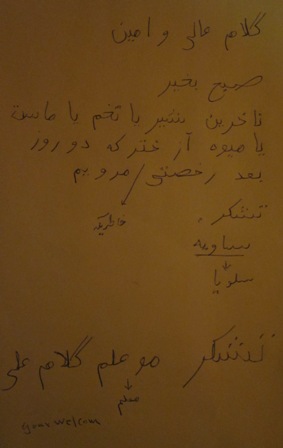
We told the cook to stop buying things that would spoil. I wrote the note entirely in Dari, in the handwriting of a second grader. I got it back with some corrections. I wrote back on the notice, this morning, thank you teachers, and made yet another mistake in the spelling of ‘teacher.’ I can go on forever saying ‘thank you teacher.’ And so, even though some spoilables did get purchased, there is some progress, on all sides, even if it is only measured in millimeters.

I said goodbye to M and her two little boys in their kodakistan (daycare center). They will have left for Egypt by the time I come back. I asked them to keep a journal (I think it is a good habit that cannot start too early) and to write about their trip to Egypt and draw pictures of what they see and learn.

The oldest child gave me a bear hug, his younger brother was less interested in my lecture. I don’t think he quite realizes the adventure he is about to embark on. I would have killed to go to Egypt when I was a little girl. My father went to Egypt when I was about that age. I remember the picture of him on a camel in front of one of the great pyramids, with a fez on his head. It stood for years in its silver frame on a chest in our living room. One of those childhood treasures.

Hustling and bustling

All the to-dos and meetings are now being compressed in the few remaining work hours; right now, one full work day to be exact. There was one last hurried trip to the ministry for a meeting about the various top-level health strategy events, and then the whittling down of what must be done by me and no one else in the next 24 hours.

Our office email system has been severely crippled by an inordinate amount of spam and malicious emails. It is a mystery to me how IT folks can solve this problem without blocking out the good mails along with the bad stuff. As we can see from our ‘undeliverable’ notices, they don’t always succeed. Everyone expects, even here, that emails arrive instantly; so when they don’t we are in big trouble. I am starting to use my gmail and educating people to send emails to both addresses but it may be a little too late.

For reasons I never understand the traffic has been jammed all day and everywhere. The driver took a very roundabout way to the ministry. I passed through neighborhoods that I am not familiar way and watched the hustle and bustle of commerce and trade.

If this was all you got to see of Afghanistan you’d see an industriousness that most people could not imagine. Carts with bags of cement, cans of tomato paste, stacked too high and sacks filled with flour and rice where heaped on rickety ‘karachis’ (the wooden planked two wheeler cards usually pulled by donkeys and sometimes by men) or in wheelbarrows. Spindly little boys or sinewy men pushed carts we wouldn’t even entrust to a donkey or horse. Small and big change is earned there every day.

Axel went to see his four students who are off to various US High Schools, beneficiaries of the US government-sponsored YES program. One is going to be living with a family in Alabama that owns the Polka Dot Café, another will be in the far western part of Massachusetts, near North Adams, the third in Maine and the fourth is still waiting for his host family to turn up, someplace in the US.

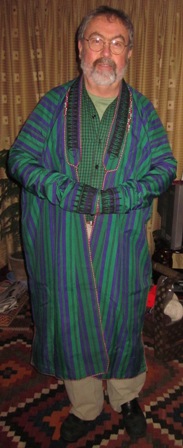
I missed the send off party because it was too early in the day. Axel received a chappan (the green/blue Karzai coat with the very long skinny sleeves) and then there was much speechifying, regrets from the YES program alumns, things they should have done but didn’t, plenty of good advice and a SOLA cake, as there always is, the good cake from the Iranian bakery near our house.

I was told this morning by our expeditor that it was time to hand in our passports to get a new visa. This is a process that I initiated about 6 weeks ago but it was too late now. We can’t risk having our passports on someone’s desk waiting to be stamped when our departure is less than 48 hours away. We are supposed to arrive back here the day before our visas expire and keep our fingers crossed that the renewal will be a matter of days.

Holding hands

I got up before 2011 had arrived back home in the US. For Afghans it was an ordinary day. Still, a few people wished me happy New Year. I spent the first morning of the new year with the senior staff of one of the preventive medicine directorates. Throughout the morning I was reminded once more how much hand holding is needed and how institutional development needs a lot of sitting around the table.

On my way in to the ministry compound I ran into an Afghan advisor to one of the other general directorates who is on the European Union payroll. He reminded me that the follow up of an intervention we did some months ago had not happened, stressing the word ‘you’ to remind me that it is my, not his job to keep things moving. That is how the Europeans and the Americans are working in parallel. Sometimes I wonder if the follow up of interventions is anyone’s job.

It is rare to see champions emerge who keep things moving after the workshop or the event has ended. It tells me something about how we external agents go about our business and how we design interventions. Follow up action appears too much associated with having another workshop, another action plan created, which always requires an external agency that provides the goodies.

As I am getting more ‘hands-on’ involved in things that I had previous let my staff to do, with the countdown of our project ticking in front of our eyes, I am acutely aware that the hand holding I need to do has to be more constant and more intense. The events are all done in the local language and so I can kill two birds with one stones: my staff translates and in doing so learn how to work with groups in a flexible and focused way as I model the way. May be I should have started doing this a year ago, but then I didn’t know what is possible and what is not, and I certainly could not follow anything of the conversations in Dari.

After lunch I picked up my friend M to meet her tailor and drop off various pieces of fabric I had received for my birthday, to turn them into panjabis, the comfortable tunic and loose pants outfits so popular in this part of the region.

From there we went to see Ibrahim off Chicken Street to pick out the spectacular woven fabrics for M’s sitting cushions and pillows. I picked up a treasure Steve had bought some time ago, a piece of an old Torah scroll that came from Uzbekistan. Axel and I unwrapped the delicate piece from its cloth covering to take a look at the scroll and its Hebrew letters written on soft sheepskin leather and marveled about the hidden history of this artifact. It completes the rest of the scroll already in Steve’s possession.

On the way home I stopped at a widows’ embroidery cooperative. The manager gifted me a bracelet for the New Year and, in celebration of the same, dropped enough off his ordinary prices that I left with a bag full of stuff. My special treatment, he claimed, was also because I reminded him of his grandmother who lives in Washington (and aren’t we are all related through Adam and Eve anyways? said his wife).

My final stop on my afternoon shopping expedition was the supermarket that caters to foreigners. We had pizza on the menu and Axel wished to top it with pork sausage. At the supermarket I found my way to the unmarked pork freezer that was loaded with enormous slabs of bacon, sliced ham, bangers and other forbidden foods, all of it in packages too big for a household of two. So I got something that only looked like pepperoni.

Cookies on an ordinary day

I took Chris to the massage place to receive her Christmas present: a one hour massage. We squeezed into the tiny bedroom, me on the bed, Chris on the table, and had ourselves oiled and kneaded until we both glowed. Afterward the car dropped me off at Mary’s house where Axel had gone earlier to help with the Democrats Abroad Christmas cookie baking project.

We baked and frosted brownies, cupcakes, fudge, chocolate chip cookies and whoopee pies, put them in plastic baggies and delivered them to the troops at Camp Eggers, until we ran out.

It was a civic responsibility project organized by Mary who had her extended network of family and friends in the US contribute to Christmas packages that she handed out last week, and the baking ingredients for today’s project.

We may not agree with the military approach to rebuilding Afghanistan and the overwhelming militarization of this project we know what it is like to be away from family and friends over the holidays and we feel sorry for people who have to eat the kind of food they serve in military canteens. We hope that what we did was a tiny little spark of light in an otherwise dreary and, we are told, mostly boring set of routines.

Mary is the chair of the Democrats Abroad Afghanistan chapter and she is also working to protect wildlife in Afghanistan. Confiscated rugs and coats, made from bearskin, wolf hides and even sealskin (mostly from Russia) were stashed in her house to serve as examples what not to buy. I imagine that it will take a lot of effort and public education to stop this trade.

A few others showed up in Mary’s lovely old house in a pleasant and very low key part of town where I would have chosen to live if we’d had the choice. For lunch we walked over to the Flower Street Café next door. The place was empty as most of the foreigners who frequent the place had left Kabul for the holidays.

We abandoned our plans to organize a board game night because we don’t know any board game players and besides it is a school night – I will be working with the Environmental Health team to start on something that could be called a new beginning. It seems the right thing to do on the first day of the new year, even though for Afghans it is just an ordinary day.

Leading change

In a couple of months we hope to showcase some of the health facility teams that have graduated from our leadership program. We are in the process of selecting the best teams, those that have taken leadership to heart and have improved one or another of the ministry’s priority health services: deliveries with skilled birth attendants (in health facilities), TB detection, antenatal visits, etc.

Most of the teams sent us documentation in Dari. In a tedious process of line-by-line translations I finally got a glimpse of what is happening in these third or fourth generation leadership programs that are taught by people who were taught by people who were at some point taught by me.

The language barrier had kept me from following these later generations and the results of their leadership attempts. But the time had come to pay closer attention.

I was pleasantly surprised about the work of the first team we reviewed – there were some things that needed further investigation, explanation, more precision but all in all their analysis was not bad and the result of their work led to actions and interventions that benefited women who would otherwise have delivered without skilled care.

Diving

Today was a day of diving; diving below the surface of superficial reasoning, asking people about their ‘theories of change,’ and first having to explain what that was in words that made them realize they already had them. There are countless assumptions about positive change contained in activities that are not being articulated and so can never be tested. In the meantime the activities continue, as if….

This is not just an Afghan thing; the theories of change behind US interventions here, military or otherwise, are loaded with assumptions of the ‘if this…then that’ kind. The election process is one of those where many of these assumptions fell flat on their faces.

It kills me to think how much money was spent on the elections by my and other governments to end up with a result that doesn’t come close to the original intent: building trust in government by the people and for the people, or something like that. The assumptions were all wrong. At least we know that now, but how many more elections do we have to go through before acknowledging that the assumptions were all wrong and that a change in course is needed? Sometimes it feels as if we prefer to continue doing the wrong things before admitting that we don’t know the right things to do.

I was also diving today into tasks that shouldn’t me mine but had become mine because others are not doing what they should be doing because it never occurred to them that they were supposed to have been doing something.

I keep telling myself that this is why I am here; that if the capacity building was easy it would already have been accomplished in the last 9 years and that if all was done as I think it should be done, my presence here would be superfluous. Thus, the diving is both frustrating and satisfying at the same time.

I came home early and put my jammies on ready for an early dinner and early to bed. But Axel had invited one of his students over for a last review of his (US) school application essay before he heads out to the US later this week.

The boy was one of the successful applicants to the YES program that puts Afghan students for a year in a US High School. But the visas didn’t come through in time and so he and some other boys missed half the year. But they are going now for the 2nd semester.

Axel spent the afternoon saying his goodbyes and wishing them godspeed, an emotional experience because he has gotten very fond of his students.

As a good woman would in this place, I retired upstairs to the bedroom and left the menfolk downstairs. If or when I get bored I will get dressed again and join them.


February 2026
M T W T F S S
 1
2345678
9101112131415
16171819202122
232425262728  

Categories

Blog Stats

  • 139,793 hits

Enter your email address to follow this blog and receive notifications of new posts by email.

Join 76 other subscribers