Posts Tagged 'Afghanistan'


Home alone

Axel’s has left for Dubai and his doctor’s appointment. When else did we have to travel that far to see a doctor?

I had my longest day ever, with too many meetings and too many hours in traffic. For desserts a cocktail party at the Dutch embassy where I saw new and old friends, including the head of the police training team, a founding father of the Dutch Afghanistan Committee, a friend of my friend Miho all the while enjoying the luxury of a few glasses of South African wine.

It is amazing how bad the image is of the Americans in the conversations with my compatriots. There is hardly a positive word uttered (arrogant, unilateral). I take it with a grain of salt, as Dutch people tend consider themselves better than the Americans and most anybody else in the world but still, being a half American, it hurts a little bit and I wonder, does it have to be this way? Can this stereotype not be changed?

And now I am watching the depressing news coming through from the US about the elections. There are no surprises. Still, no matter the outcome, the US election process is a few hairs better than the one over here where the losers are bad losers and take to the streets protesting the the process that did not elect them. At least our president is graceful about the new reality.

Risky business

I spent most of the day at the ministry. Only one of the three meetings I had planned to attend actually materialized. So much for getting things clarified, straightened out and organized before I go off for a fortnight. Still, it is good to hang out at the ministry because you meet people and hear things one would not back at our office.

In the morning I attended a presentation by the private sector (for profit) office that has sketched out a plan for bringing them on board to work alongside the ministry towards better health services and products for Afghans.

It is a complicated undertaking because (1) there is a general mistrust of the private-for-profit sector’s motives (perceived as ‘make as much money as you can, no matter what the quality of the product or service is’), and (2) the for profit health sector is not organized making it hard to invite ‘representatives’ to the table.

The plan was a heroic attempt to bring some order in all this, and a strategy for action. Yet how this is going to be funded is unclear. This was also true for the next presentation about Afghanistan’s mental health strategy; maybe an even more complex and more costly undertaking.

Everyone agrees there is a huge problem but the boundaries of what constitute ‘illness’ and what is the result of cultural practices that some of us would call domestic abuse are fluid.

The strategy development process was long and arduous and full of disagreements and conflict. The proponents of the need for action fought many battles and lost often to primary health care advocates. All sides claimed that their investments pay off. But the investments will have to come from outside as the government cannot pull this cart on its own. Someone is calculating the cost. It will stun people no doubt.

That women are anxious, throw themselves in wells, burn themselves or are seriously depressed is not because they are mentally ill (although one could argue they become that way – ill from worry). Afghanistan, especially the rural areas, is not a healthy place for women.

One of today’s ANSO reports (the organization that reports faithfully on the multiple ‘security incidents’ each day) illustrates this all too well: the bodies of two women were brought to the capital city of Helmand province this morning. They were, allegedly, members of a women’s tailoring cooperative – funded through the US government which made them, in the eyes of the insurgents, ‘collaborators,’ a death sentence that was swiftly executed. Or may be it was simply a family feud – such reckoning goes mostly unpunished.

There are safe houses for women who escape, but they are well hidden and thus not easy to find. The women who make it there need psycho social support yet there are few professionals who are trained to provide this and no government services or legal recourse to help them. The mental health strategy tries to insert some services so that women who come to the health center can find an attentive ear rather than a man to escort them back to their tormentors (husbands, brothers, uncles as well as mothers-in-law).

One of the people who spent much energy on this mental health strategy is Inge Missmahl. She attended the meeting as one of the architects of the strategy. She and her ministry counterpart must have been very happy to hear the words ‘strategy accepted,’ at the conclusion of the meeting, coming out of the mouth of a senior government official.

My friend Charles had sent this link that shows Inge speaking on TED. I felt privileged to meet her in person.

Bad omens

We talked about life and death in a way that would be unthinkable in the US. We had Ted over for dinner. Much of the evening we brooded over whether his school for young girls and boys can survive – with survival also referring to people living rather than dying, or to be more precise, being shot by angry fathers, uncles or brothers.

Two of what we refer to as ‘his girls’ have first names that mean ‘bad omen.’ How’s that for a vision of your baby girl? Yet both of these bad omens are now in the US studying to become the Afghan intelligentsia. But with the Taliban talking to Karzai and maybe even with the Americans, what good will that do to girls? Most of Afghanistan’s male and female intelligentsia is now living someplace else. They know on which side their bread is buttered.

Having Ted for dinner is an emotional roller coaster ride. On the one hand there are the stories of the blossoming of female talent and self-confidence, which I have witnessed myself, and on the other hand the threats, the abrupt ending of promising school careers for (forced) marriage, and always, always the possibility of an angry man with a gun storming into his home and wrecking havoc.

Over a delicious leg of lamb dinner accompanied by a bottle of Mateus Rose that Ted brought us, we pondered the future of the SOLA school. Ted’s is beginning to come to the conclusion that investing in brick and mortar in this place is increasingly unattractive as the situation in Afghanistan (though not quite in Kabul) deteriorates. Could the school be someplace else?

Axel and I invoked the Quaker belief that one day ‘way will open,’ even if that opening is right now obscured from view. Ted’s trip to the US may help open the way, or it may not. We will add some of our connections to the ones he already has. After all that is how the world works, even, or especially, for these young Afghan girls and boys whose families have placed all their hopes in a better education for them, even for the two bad omens.

Appearances

My biggest regret today was that I don’t understand Dari as well as I should to follow the conversations during this morning’s alignment meeting with several of the Midwives’ Association’s stakeholders. It is hard to coach people when you don’t understand exactly who is saying what. The only thing I could do was reacting to signs of derailment and requesting a quick whisper translation before intervening.

M. facilitated several pieces of today’s agenda. She was nervous, and had probably been sweating all through the weekend, but she performed just fine and none of the nervousness showed. It is always like that – nervousness is mostly noticeable inside, not on the outside. I am pleased with the results of our gentle pushing – we are all one experience wiser. We will do an after action review later this week, before I leave. There were many teachable moments, even after the fact.

I continue to see the consequences of the awkward dynamics between men and women, especially older men and younger women. The longer I am in this country the more I believe that Afghanistan’s troubles partially stem from the unequal and uncomfortable relations men and women have with each other outside the home. The inability of professional women, especially young ones, to tactfully challenge their male colleagues means there is nothing to put the brakes on their behavior except the man’s own willingness to observe what he is doing or ask for someone else to do that. Luckily A. is like that.

It also means there is little room for women to experiment as a way to learn how to facilitate conversations with dominant men in the room. I learned the trade by challenging (or gentle confrontation) and then I noticed the response and compared it to the effect I had intended. Over time this is how one learns and expands one’s repertoire. The main thing is that I, as a woman, can do this sort of experimenting without risking life and limb. It’s not clear how that could happen here.

The pattern I have observed is that when men violate agreements, dismiss or belittle women as full partners, the women, unable to confront this, exit behind their chadoors and into their private spaces where they talk with their sisters, increasing the upset through mutual reinforcement.

A few young women in this country have dared to challenge men in public, older and powerful men, but the consequences have been deadly. And so there is little incentive to change the situation. As a result the vicious circle is reinforced over and over, unbreakable it seems: the women remain unable to engage directly with the men who they criticize (at best) and despise (at worst). I sometimes joke that this is a 1000 year project. But for Afghan women this is no joke.

My grey hair comes in handy, as does my (birth) nationality and the fact that I am a creature that doesn’t fit into any of the clearly delineated gender roles. I am direct, sometimes very direct. I don’t know really how that goes over except that it doesn’t appear to have damaged my relationships. I say ‘appear’ because the indirectness makes it impossible to gauge the impact of one’s behavior on others.

And since appearances are so important here, I treat ‘what appears’ as ‘what is.’ I don’t know how else I could do my job.

Parallel universe

This morning at about 7:20 AM my colleague Dr. H and I walked into a parallel universe – the universe of ISAF, just east of the Kabul airport. It had been hard to get instructions on how to get there because the military either don’t leave the base or they don’t drive through Kabul, or both. As a result, they couldn’t explain how to get there. I was told to ‘take highway 7 east and then go to Abbey gate.’ No ordinary Kabuli would know where that is as no one uses these terms. It is military-map-speak. There was also no Dari speaker anywhere near to explain to the driver where the hell the place was. But we found it.

The entrance to the base is a process, not a door or gate. We worked our way along meter-high blast walls that looked they could withstand an earthquake, wires and endless check posts, eyes cans, whole body scans and long lines of Afghan workers showing up for duty. Along the way I spotted a truck from Feenstra Vleesgroep BV from Dokkum (Friesland) – what was it doing there and how had it gotten there?

On the narrow path, paved with large chunks of stone (no high heels allowed), we encountered men wrapped up in so much gear that they looked and walked like zombies. I think they could easily walk through active warzones with all that protection and come out unscathed.

Once we passed all the checks, following the young female German lieutenant, she pointed us to an old Volkswagen truck. She apologized. The back was filled with old newspapers and the front was full of gear. She had to climb in through the passenger side because, as she had already said, it was old, from the time the Germans had populated this base by themselves.

We drove over beautifully paved roads with white stripes in the middle, like one would in Europe, and everywhere signs of the Germans. On the other side of the wires and walls we saw orchards and maize fields and Afghans living in mud brick houses; no asphalt roads with white stripes on that side; no roads at all. I wondered what it would be like to live so close to America (or
Germany) and yet have no access.

The base, which houses all the operational units (the planning people are closer to town) is home to several thousand people, a veritable city on the edge of Kabul. Many people never find out about Afghanistan, or even Kabul. It is self contained. There is the Marouf store and gemstone center – a glassy storefront that would be right at home in a tourist center. We learned there was a Thai restaurant (a three-course meal for 17.50 Euro, with tropical drinks without alcohol), a bazaar, a Moneygram store and a travel service and streets with exotic names, and then the barracks. And everywhere, as far as they eye could see containers and generators.

People were lounging outside in the sun, most in uniform, sitting at picnic tables in front of their two-story barracks. I got to check out the bathroom in the French hospital, now taken over by the Americans which was obvious because of the Haloween display, a hunched over person in camouflage with hospital gloves and a facemask.

The conference was interesting mostly because we were the only people who are actually living in Afghanistan, the other universe that most attendants don’t know. The presentation was well received though with few questions. I imagined that our picture of life outside the wire will take some digesting.

Of the 100 or so people in the room only 6 or 7 were civilians, including us. There were probably about 10 women. I still have a hard time looking at women who wear camouflage jackets and holsters and guns – call me old fashioned but to me fighting wars is something that men do. I did notice one woman sitting in a back row thumbing through a stack of family pictures as if they were baseball cards – I noticed the wistful expression on her face. It confirmed to me that women have no business here.

I learned today that each country has its own formulation of what camouflage looks like. The US, the Croates, the New Zealanders and the Afghans have pixalated camouflage clothes (some with large and some with small pixels); the French, Brits and Australians have organic blobs, like amoebes, splashed on their jackets. The colors are grey, tan, and dark green in various combinations. Only the Afghan military has the color of bright green, the happy color of new life, in their camouflage. I liked that. But they also have the accented red of the Afghan flag which contrasts with the bright green – it’s a Christmas contrast but also the juxtaposition of life and death in this bloody place.

The organizer liked the distinction we made between needs and wants (the army wants everything and has the resources to satisfy them) and the notion of creating feedback loops between the various actors. This included of course a feedback loop with the foreign and national armies, hence our presence.

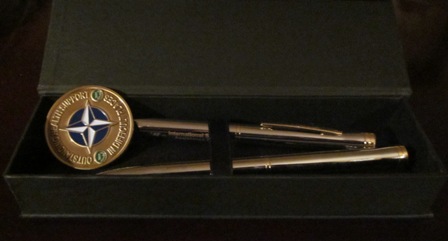
By way of thank you for our efforts we received a medal and an engraved pen and pencil set. I imagine my great grand children looking at the medal (‘Outstanding Health Support in Difficult Places’) and making up stories about what great grandma did to get it and missing the real reason (a powerpoint!).
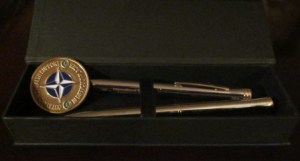
We left just when the smells of fried chicken and the fumes of frying fat from the adjacent cafeteria became unbearable. I stuffed myself with Dunkin Donuts type (giant) croissants and brownies to make up for the missed lunch.

On the way back we were escorted by two Croates. During the ten minute ride we discussed the origin of the necktie (cravat, from Croate) and what it had been like to live in Yugoslavia when it exploded. They are in Afghanistan to repay their debt to the international community and my Afghan colleague Dr. H. thanked them.

Even though it was my day off the workday wasn’t over. We rushed back to the ministry and met with the minister to present the areas where we can’t move without her support. She re-iterated the priorities of the ministry for the next five years which match our organization’s strengths quite nicely.

From there I barely made it in time to my Dari class. I finished the Iranian story about the lady of the thousand stories and then we talked using all the new words I had learned.

As if the day wasn’t long enough, in the evening we rallied to Restore Sanity. The Kabul rally didn’t quite match the Washington rally but it is the thought that counts. It was also nice to feel part of something big. Some twenty of us Dems Abroad came together in the basement bar of a Chinese restaurant. By night the streets of Kabul are too cold and too dangerous for such a show of support for our embattled president. Blindfolded we pinned American teabags on pictures of the Tea Party leadership. I won a bag of pork rinds, contraband in this place.
Bloody mess and eraser cheese

Janneke had the top of her middle toe sliced by the not so very experienced pedicurist at the spa. Luckily it was after the massage so she was very relaxed and had at least had one good experience. But I think it was the last pedicure we will have there. I had been a little concerned about the razor gizmo that was used to remove calluses – luckily I had the more experienced member of the staff and emerged intact.

It was messy because the blood kept squirting out and the stupefied girl was clueless as how to stop it. Everyone got involved and soon there were wads of bloody cotton balls, gauze and what not; until Lisa came upstairs and took over. We drove off to the clinic where she got a proper bandage and a tetanus shot. All is well again.

I left her with Lisa at the clinic and had a drawn out lunch with our boss from Headquarters who is visiting us for a week. We had our lunch at the Galleria so that he could squeeze in some quality shopping time while we waited for the car to come and get us.

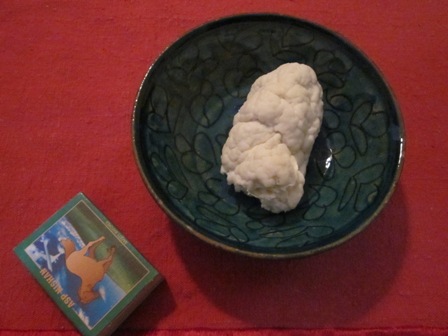
Back home I used up all our fresh milk to try to make mozzarella. It was like one of these fairy tales where something good gets exchanged for something less good all the way to nothing. Out of one gallon of the most delicious creamy milk I created a piece of cheese that had the size and taste of an eraser.

M. showed up for another knitting lesson. The 2 meter long scarf for her boyfriend was completed and I helped her put on the final touches and got her started on a matching hat. The wool is so authentic that it is a little scratchy but we hope that the Woolite will help soften it a bit and take the sheep smell out.

And now it is time to finish my preparations for the military conference tomorrow. I still don’t know where I am supposed to show up. The lieutenant commander wrote me, in answer to my query, “Ma’am, unfortunately I do not have a map that would point you into the right direction [he will ask someone else].We will be prepared to meet you at the gate at 07:30.” I am halfway through Obama’s Wars and so was not too surprised about this answer. I guess we will ask around when we get closer to the base, to find out at which of the many gates the gentleman will be waiting for us.

Stories

My colleague S’s little girl is very sick. She is only five years old but suffering from something no doctor in Afghanistan or Peshawar has been able to diagnose. The family has made several trips with the little girl to Peshawar, delivered blood to a Karachi laboratory. Still, the girl cries at night from pain and has large welts, bumps and bruises on her legs no one can explain.

He was going to deliver a presentation at a quarterly conference of military doctors on Saturday but today he realized that his priorities are rearranged. Family always comes first – as it should be. He was away from the office trying to get a visa to fly with the little patient to Islamabad, to a hospital that is among the best in the region. Something needs to be done; the family has not slept in days.

And so I get to go to the military-medics conference on Saturday to replace him. Our powerpoint story needed to be sent in today. When you work with the military everything needs to be checked and thus submitted in time. In some ways it is a good thing as all is now fixed – hard for me who always wants to make endless changes until the bitter end. Not possible now.

Today was my weekly SOLA class. I shared my hour with the coordinator of the Afghan Women Writers Project who explained the girls how they could become part of this very exciting project. We listened to one of the girls who has already published on the AWWP site as she read to us her essay to get into colleague in the US. I used a series of questions to guide the response of her classmates about powerful images, feelings and the message she tried to convey.

The essay triggered several stories, most very disturbing: the young girl, mother of a small boy, who had sneaked out to attend high school, 10th grade, and was beheaded by her husband upon return from school; her mother was too. The sin: wanting to be educated. She was the classmate of one of my students who will bring her photo next class.

Or the 13-year old married off to a 45-year old poppy grower as his 3rd wife, a relative of Sofia. “Even though she was younger than most of her step-children, she seemed to agree with her life, accepting it as her destiny and a practice of her culture,” wrote Sofia. “She did not protest – it was expected, something to be endured.”

And then there was the young girl in Kandahar killed by a passing motorbike rider, right in front of Sofia’s eyes. She described her reactions as “my […] senses had stopped working for a while and I could do nothing except like a statue staring [at] her.”

I watch the faces of the girls as each one tells her story. They could all easily become one of these stories themselves, and they know it. I am glad that they are just as outraged as I am. One could expect them to be rather inured to such horrors that surround them.

After just a few classes it is clear that I never have to worry about not having enough material for my conversation class. We just started to talk about the rule of law versus moneyed power when our time was up. We are now having a waiting list of conversation topics: will educating the young girls and women make any difference if the men are not educated? How can the rule of law be enforced when the enforcers themselves are wealthy and powerful? Does God pick your husband?
Since we are leaving for Dubai next week the girls will have several weeks off. Their homework is to interview a woman they admire and then report on the interview in class four weeks from now.

Celebrations and small victories

Today was Sita’s thirtieth birthday – imagine that, having a daughter of 30! I remember having vague images of Sita turning 30 when she was still very little though it was mostly unimaginable in the same way that imagining the death of one’s parents is so very difficult.

I am sitting here contemplating Sita’s 30 years while listening to the music of her birth place, Senegal. The music pulls at my heart strings like any music with sweet associations does. I miss the warmth, colors, rhythm and freedom of Senegal, sitting here in our cold concrete house that a small stove is trying to heat. Outside it is getting cold and dark, there is no rhythm at the moment and people are dressed in variations of tan and grey, the national uniform for men, or black and blue, the national uniform for women. Yet I know that one day I will listen to Afghan music and be nostalgic in the same way. I will not think of the bad stuff then, only the good things.

Bad news came today from the girl we are trying to get to her school in Connecticut next school year. A terse email indicated that the family had changed its mind once again, now also forbidding email use. We brought her the Kindle and started fantasizing about her trip to the US in August, only 10 months from now. The school in CT must be roller-coastering along with her. They get excited about their new schoolmate and then hopes are dashed all around. I wonder how it feels like to be on this roller coaster while not living here. It is very much part of our experience here, but in CT it probably is not. How we deal with disappointment says much about our circumstances.

Disappointment is the stuff of everyday life here – as is the ecstasy of small victories.

Warmer and colder

I took M along to an awards ceremony for media that had increased awareness about HIV/AIDS in Afghanistan. There were prizes for TV, radio and print press, distributed after many speeches by high level officials from the ministry of health, of culture, the independent media, and the university.

Between speakers the mistress of ceremonies recited poems about HIV/AIDS and, I assume, healthy living. I don’t think I have attended any ceremony that did not have poems in between speeches. I asked M whether these poems were written for the occasion and by whom; did project or department staff write these? Can anyone in Afghanistan write poetry just like that? It seems that poetry is in the cells of most Afghans. I was impressed. I try to write poetry myself during bouts of inspiration (marked by long periods of silence). M told me that sometimes students of literature are asked to write such poems. What a concept!

I took advantage of the down time that being part of an audience granted me by knotting the fringe of the scarf that matches my new outfit. It would unravel without the knots. I let the Dari words of the speeches wash over me and enter my ears (and occasionally my brain when I recognized a word). This is how one learns a language, by immersion: listening to speeches and finding the recurrent words (culture, awareness, important work) and then looking them up or asking someone. It is a bit like deciphering the Rosetta stone, except here people already have the key.

The small stoves in our house have been filled with fuel and the one in the bathroom and in the living room are lit. This required airing the house for a while, letting more cold in. It had the opposite effect of what a stove is supposed to do, leaving us more chilled. It’s a temporary thing; until the fumes have dissipated.

Tomorrow I am going to request a different heating source for my office and our guesthouse. Now that we are on the municipal grid, I am told, we can heat electrically – odor- and fume-less, such a luxury.

Cold

I tried out my new Punjabi (tunic and baggy pants) outfit made by M’s tailor from the cloth I bought at the agfair some weeks ago. It is beautifully tailored and very comfortable even though the tailor thought little about the quality of the material. My housemates liked it too. Unfortunately the weather is a little too cool for this spring dress.

Today was the first day I needed a heater in my small concrete office. Our yard was covered with a thin layer of frost this morning. All across the compound and in the guesthouses the diesel stoves (‘bucharis’) are fitted back into their winter spots requiring much moving of furniture.

I had to remove an entire bookcase. I pulled out dusty books that I had forgotten about – reading I thought a year ago that I might need but didn’t. It reminded me of how little the work I did before I came here I am actually doing nowadays.

I am preparing an event that draws on my somewhat rusty design and facilitation skills – a visioning workshop with one large urban hospital that has been limping along from one crisis to another. There must be a way to turn it around, like one can even an oil tanker – slowly and in a wide circle with all hands on deck. That’s what I hope we can do next month, when all important hands are back from abroad, even Axel and myself.

Axel went to the Kabul International Fair that is being held in the Loya Jirga tent, the one provided by the Germans for the first Loya Jirga way back in the early 2000s and then used for the Peace Jirga in July; the same one that had rockets shot at it – out of the media limelight all is quiet there now.

He came back with a bottle of locally made extra virgin olive oil, pressed using age old methods with the technical assistance from the Italians (of course), two plastic bags of fresh full-fat milk (a forgotten delicacy for us used to UHT milk) and a local pasteurized cheese (we are discouraged to buy the unpasteurized cheeses that are sold down the street, displayed on pushcarts on bright green fake grass sheets).

We are wondering if some of the new local enterprises that owe their success to technical and financial assistance from development organizations will soon find themselves without that support. The removal of the private security companies is turning into a big crisis. There is much rhetoric about this move by Karzai. Everyone appears to be painting themselves into a corner that will be hard to get out of.


February 2026
M T W T F S S
 1
2345678
9101112131415
16171819202122
232425262728  

Categories

Blog Stats

  • 139,796 hits

Enter your email address to follow this blog and receive notifications of new posts by email.

Join 76 other subscribers