Posts Tagged 'Afghanistan'


Rumi in our cells

Tonight was the second time that we saw Ahmad Sham’s Sufi ensemble. It was at the American Institute of Afghan Studies where the Fullbright and Humphrey fellows and scholars have their clubhouse. One of our Afghan friends is a Fullbright scholar and she had passed on the invitation.

What we saw there was a world that is light years away (ahead) from the fighters and mullahs whose minds are still in the Stone Age. The room was full of bright, enthusiastic and articulate English speaking Afghans who had studied in the US. If only they could wiggle loose from all that constrains young people here and be let loose on ministries, businesses and parliament, then Afghanistan would be in good hands I imagine. Some are already loose, running businesses, making policies – they even created an association for policy advisors.

There were few women in the audience – Ankie and I, a few escapees from the US embassy and USAID and, later in the evening two of the students from the school where we teach. We asked the Fullbright fellows where the women were. ‘They married,’ was the answer. In this country that means for most that they are ‘out of the game.’ Couldn’t they talk with the husbands and let them come to the alumni program night? I asked. ‘A good idea,’ they said politely but I could tell they thought it was a rather stupid idea.

The music was stupendous; a Rumi song that takes about 15 minutes with a cadence that gets into your very cells and moves you from the inside out. It has become my favorite. Just when our driver showed up there was a tabla solo by a young men that left us transfixed and unable to move. His fingers moved so fast over the drum’s surface that you couldn’t see them, just wisps of air. He mimicked one horse, then a whole bunch galloping by, then a train, coming and going and finally a variety of notes up and down the scale. Never have I heard anyone playing drums like that.

This evening came on top of a day with several encouraging developments, accomplishments, and a good though small class in the after school program. It was one of these days where Axel and felt like pinching ourselves to make sure that we were really in Afghanistan. A good day indeed.
Readiness

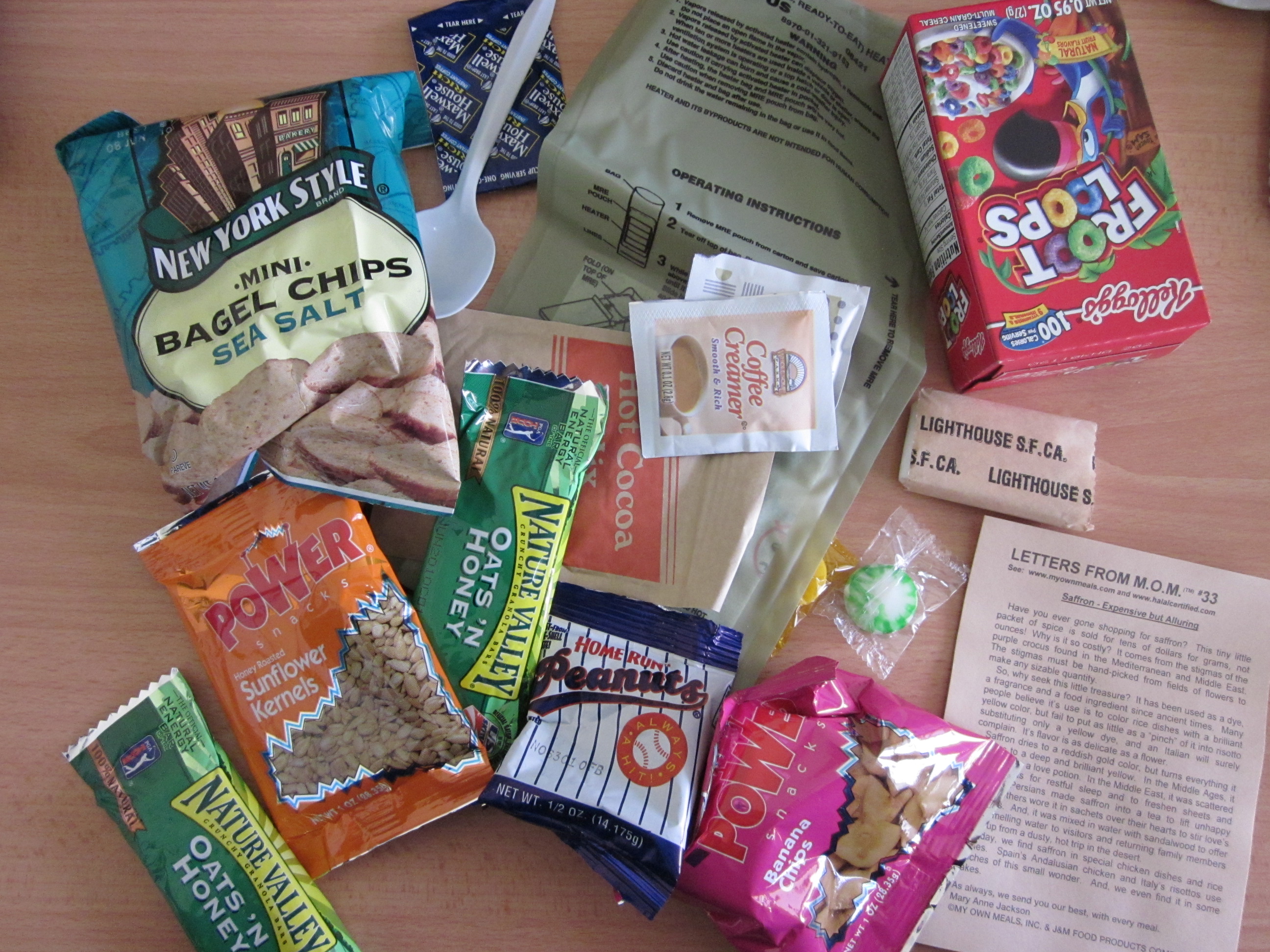
One of my colleague who manages to live on MREs (Meals-Ready-to-Eat, military fare that has fallen of the truck) had promised me a snack pack for taking notes at a meeting yesterday. This morning he delivered the promised snack pack. It included 2 hard candies, a one serving box of Fruit Loops (but what about the milk? Was I supposed to mix the coffee creamer with water and pour it into the box that had scored lines to turn it into a bowl?).

There was a Nature Valley bar, a bag of Power banana chips, a small pack of sunflower seeds, New York bagel chips, cocoa powder ready to mix, one serving of Maxwell instant coffee, domino sugar, pepper and salt (for what?), a plastic sleeve with a heating element, presumably to heat water for my cocoa or coffee, Red Sox label peanuts and a letter from M.O.M (My Own Meals, the company that packages these) about saffron, including a website in case I want to learn more about saffron.

My colleague lives on these and has bought a year’s worth of snack packs and complete meal packs. He does not participate in the Afghan food economy. It’s very cheap he told me; a year’s worth of supplies is what we spent in two weeks on groceries. But what about these juicy apricots, the pomegranates, the kebabs, I wonder. I suppose it works if food is nothing more than a physical necessity and not high on your list of priorities.

Today we started a two-day partially in-house partially out-of-house training using the leadership development approach that I had wanted to introduce about a year ago to all our colleagues. But then everyone was too busy. Now people want the training. It goes to show that for everything there is a right time and a wrong time.

We did a few attempts last May but it went nowhere. Now we have four teams actively participating: two community health teams, one drug management team, a university team and a few hangers on.

The program is done in Dari. I sit, once again, in the back. I know the program and the daily agenda inside out and can follow some of the discussions. Still, I have a long way to go. And when they switch to Pashto I am lost.

I was proud to see the local facilitators teach the program as a team and with great confidence. One of them is a young woman who has recently been promoted out of a poorly paid and dead-end consultancy job to a UN-financed program manager position in one of the ministry’s directorates. I have seen her grow in just a short two years into a formidable facilitator without any accompanying increase in her ego. It makes all the troubles here vanish – change is possible, even here; especially here.

Women as human beings

Today, our local newspaper told us,that the number of women drivers in Herat has increased by 60%. Of course it probably started from very little, but still. The title of the article was Afghan Road Rage but it was about men’s reactions to women driving. The woman who was featured in the article had a dented Suzuki, the dents coming from young men who didn’t think women should be driving, and a scarf tightly wrapped around her head.

The article ended with a quote from a young male student, “I see women as human beings deserving of all human rights.” Now there is enlightenment! Other people interviewed for the article didn’t think women should ever be behind the wheel. Their mullahs told them so, and that, here, is truth!

I attended the opening of a conference about the pressing problem of not having enough or good people to manage the pharmacies in private and public health facilities. The entire event was in Dari and so I treated it as a Dari class. With my dictionary I tried to translate the words on the banner and discovered the Dari translation was quite different from the English text.

Then, when the slides came on I tried to look up the words but by the time I had found the meaning the next slide was on. Still, I learned one new word per slide, words like assessment, framework, goals, graduates, etc.

A distinguished gentleman sat next to me who turned out to be a professor at the university. He was trained in France in the 60s and so we spoke French, a language that I rarely speak anymore as it is associated with a generation that has mostly disappeared through death and emigration.

Good vibes and bad chemicals

All morning we listened to our program managers presenting their accomplishments, the reasons for non accomplishment of activities, risks and challenges they foresee for our last project year and how we plan to deal with those. These presentations are collectively referred to as ‘the DAR,’ or the During-Action-Review. I am not sure where the term comes from. Whoever came up with the idea had some foresight about how different teams can come together and reflect on what we did the last 3 months.

Exactly one year ago I attended my first DAR; today was my fifth. The improvements in both the quality of the presentations and the thinking behind it was quite remarkable. From the powerpoints and notes taken during the discussions we will produce the annual report of the last year – a deliverable but also an opportunity for stock taking.

Our house guest Vince has left and Ankie has moved in. Over dinner Axel reported on the activities in house 33 during the day: one of our administrative staff has been assigned to check on dust in the houses. She showed up and checked the tops of doors and windowsills with a Kleenex.

Someone must have alerted our staff because the Kleenex remained clean and everyone rejoiced. Spotless window sills is no mean accomplishment here.
Now that Axel is home more he discovers the use of household chemicals.

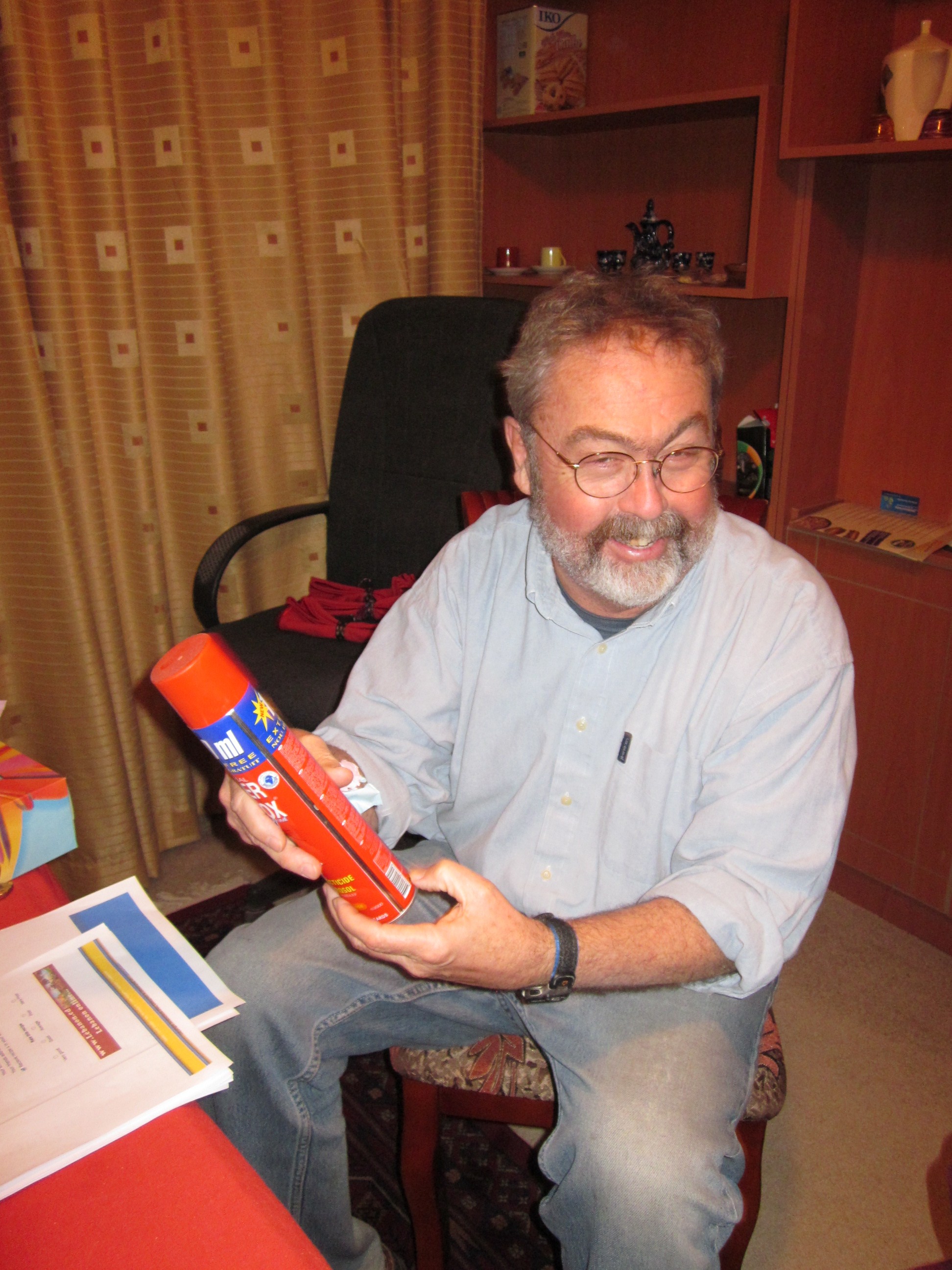
We discovered (from purchase requests) that our household staff uses 6 cans of Russian insecticide spray per month. The cook sprays the kitchen more than is good for us as well as unnecessary (there are few bugs in this high and dry climate). The instructions on the can are indecipherable (Russian and very small English print), besides, the cook cannot read English (or Russian for that matter). Axel explained that the spray does not only kill the bugs that are portrayed in small circles with an X drawn through them but is also bad for humans. Ankie proposed to take a picture of the cook himself and paste it below the bugs with an X through it as well.

We wonder if all our coughing and sputtering when we sit in our living room in the evening has something to do with this abuse of chemicals.

Unfair

The uplifting weekend came crashing down at the beginning of this new workweek with today’s reporting on the killing of Linda from one of our sister organizations. She was part of our community, living on the outer more difficult edges, far from where we are allowed to go. Although we did not personally know her, we remembered her at the beginning of our weekly program managers meeting.

There are some difficult dynamics that I noticed around the office and also with Axel at home wondering what’s next. I absorb these vibes like a sponge. Ninety five percent of my work here is about managing relationships and all the psychological baggage that is wrapped up in them; five percent is what some refer to as ‘technical.’

We are reviewing our accomplishments for the year that started with my arrival here in 2009. There are lots of small activities, some very big ones, some that add up and some that do not. We are asked to also write about risks and challenges we see in the future, this next year that started last week, and the actions we propose to minimize or tackle them. Decreasing security is always one of them.

We have to report each month the number of security incidents that involve health facilities in the provinces that are supported by American tax dollars. I sent Axel the graph that accompanied the report. The bars are low and more or less similar in height until my arrival last year and then they steadily increase in length, from less than 25 incidents in March 2008 till 250 last month, a tenfold increase.

On dark days like this I wonder whether we can do anything useful here at all. Linda’s murder makes everything look suddenly very futile.

Fair

The main event for the day was our visit to the Kabul International Agricultural Fair. It isn’t quite the Topsfield Fair and there weren’t any animals or mega pumpkins. Still, it was a very impressive show of what Afghans could do if this place would simply come to its senses and return to trade and agriculture, as it used to do in between its many wars. Everyone was beaming proudly – it was surely a show of possibilities.

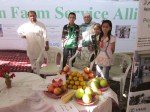
There were booths manned and womanned by members of agricultural cooperatives who produce dairy products, grains and nuts, fresh and dried fruit, honey, compressed rice hulls for woodburning stoves, and more.

A graphic design and printing firm handed out bags with beautiful posters and everywhere there were brochures with the familiar USAID logo.

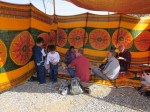
M and her family came along. They were waiting for us with a hot meal, kebabs and rice, sitting cross-legged on a colorful ground cover under a gaily colored tent that made me feel like royalty on a picnic outing.

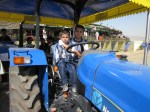
I took M’s little boys for a walk when they got tired of sitting with the slow eating adults. As boys would, they were drawn to the large shiny tractors from the New Holland company that were within our view. The salesman helped us with the photo opportunity by putting them in the driver’s seat.

There weren’t many foreigners and so we were the odd people out. This meant that instead of us taking pictures of the Afghans, they took pictures of us standing next to the occupants of the booths. Young men practiced their English with us. Just when Vince and I had complimented them on their fine English (we could understand their questions and they our answers) an Afghan American passerby tossed a less friendly comment in the middle of our conversation by saying ‘work on your English first.’

I was thrilled to find a supplier of lamb wool and even cashmere (beautiful but very pricey). He and his spinning wheel ladies live close to our neighborhood. He told me he would be happy to come and deliver goods to my house or office. I am assured of a full knitting winter season! We also found a supplier of tofu who needs just 24 hours notice to provide us with a batch.

After the fair we went to Chicken Street, my first visit after Steve had left, now more than 3 months ago, and Vince’s first visit. We joined Peter who was already knee-high into carpets and served as Vince’s advisor, which then led to a sale. One hallway, one baby room and one living room in Namibia will be graced with Afghan carpets next week.

Vince and I cooked a TV dinner (gazpacho, cold chicken and fries). We used the cheap French fries cutter that bit the dust halfway through the cutting operation. This is a common occurrence with cheap Chinese goods. It went into the dustbin. Throwing things away does not have the finality it has back in the US. Someone will go through our garbage next week, take the defective cutter and, recycle it, making a little money along the way.

Over and after dinner we watched an Inspector Lewis (former sidekick of Mahler loving Inspector Morse who has come into his own) movie which was so complicated that we had to rewind many scenes to get the clues we had missed. Maybe this is the new reality of getting older – you need several people to piece together the plot. In our case even the brains of three people weren’t not enough to get it.

Grains, greed and dramas

We have a saying in Dutch, ‘een graantje meepikken (help oneself to a few grains).’ It is about helping oneself to food that is being spread around, though not necessarily intended for the one who is serving him or herself. On a large scale there is much of this going on in this country – not just a few grains, but whole silos. It’s of course also happening on a very small and petty scale. Workshops are great occasions for picking up some grains; not just here, but everywhere I have worked.

The other day, during the last day of our workshop, Mustafa, our admin assistant came to talk with me about the secretary of the hospital director who had reserved the room for the workshop, a few key strokes on her computer. She claimed that she should receive transport money. Her argument: she had facilitated that our meeting could be in the hospital. And, to bolster her argument, she said that the two cleaners assigned to keeping the room tidy, serving us at tea break and lunch, had been given transport money and a free (and fancy= much meat) lunch. So what about her?

The fact that my colleague would even contemplate her request is indicative of the degree to which the workshop culture has distorted things, like doing the work one is paid to do without expecting supplementary payments; payments masquerading as ‘transport money’ or ‘facilitator fees’ or simply a reimbursement for effort expended on doing something like reserving a room.

Of course the salaries of these people are nothing to write about, barely covering a month’s rent. I don’t know about the secretary, she may have as a husband a corrupt government official, a lowly clerk, a war victim or she may be the mother of a fighter or a kid who died young of a preventable disease. I don’t really want to know, because it messes up principles, rules, policies about paying people extra for things they are supposed to be doing anyways.

All this context, especially the human dramas we don’t see in our everyday interactions, makes standard operating procedures so very desirable, so very necessary and also very unfair.

Uptalk downtalk

We were like the black crow and the white pigeon from my recently completed Dari book, sitting across the table from each other. He, an adviser paid by a competing donor, an Afghan doctor (male) saying: “Everything is dirty, broken, polluted. Everyone is corrupt. No one cares. Nothing will come of this,” and then followed a list of problems without end.

He described a dark, dirty and debris-filled pool from which polluted rivers flowed. The pool represents senior leadership, an interesting image for me that tells something about what leadership means here: a reservoir from which flows death rather than life. I suppose it is an apt metaphor for Afghanistan. His question: “how can the people lower down, drinking from the polluted rivers, clean up the mess produced upstream?” The images from last night’s news about the toxic mud spill in Hungary flashed in front of my mind. He is right of course – he talks about how things are, not how they could be.

I interrupted him, “could you tell me about something that is good, that is working, people who care and who are honest?” It was as if I had not interrupted his list of problems, he picked it right up where he had left off and continued, until I interrupted him again, saying the same, and then it was his turn to say the same; two broken records.

It was as if we were each talking in our own little bubble, me with my ‘uptalk’ and he with his ‘downtalk,’ miles apart from each other. I couldn’t stand any longer to sit with him because every comment of despair and pessimism drained energy from the reservoir I have that allows me to be an optimist.

I tried to explain the impact his ‘downtalk’ had on me. He smiled and indicated he would try this ‘uptalk.’ But his next sentence started with, “you know, this is our problem…” I put my hand on his arm and told him, ‘no thank you, your problems are well advertised by a whole army of ‘downtalkers.’ This country is too full of them.

My colleague Ali is not like that. He is an ‘uptalker’ and he sees reasons for ‘uptalk’ everywhere. He takes the words out of my mouth and says them in Dari before I realize that he did. I contrast his approach to organizational change with that of the advisor who in essence does not seem to think change is possible. I try to imagine his advising but come up blank. Gripe sessions?

Toner

Because most of the training workshops are in the local language, and there are so many I couldn’t attend all, I have been rather disconnected from that what gives me life: helping people reflect on and better understand how their own behavior contributes to the status quo.

Being in this workshop for four days is reconnecting me to the core of what I am about. Even though my efforts to learn the language aren’t enough to let me follow the subtleties of the comments or questions from participants I can watch for the non verbal cues to tell me what is happening in the group and observe the kind of behavior that will get in the way of change.

There is much talk about ownership in my line of business, and in particular now in Afghanistan with the US Government’s policy of ‘Afghan First.’ But I see very little behavior, of participants and facilitators alike, in these kinds of workshops that will help develop a sense of ownership.

If you join a group to work on issue ‘x’ because you happened to be number 4 and the issue is discussed in group 4 then what responsibility do you have after you have delivered your workgroup’s flipchart with findings, suggestions, recommendations, or even an action plan? Instead of taking responsibility, as a number 4, I focus on being a good student and deliver a piece of work as per the teacher’s instructions, with the hope that the teacher will say that group #4 was the best.

This kind of group work is part of a workshop ritual that makes people proudly say their workshop is ‘participatory,’ an odd commentary on the concept of a workshop that comes from a tradition of lecturing. It’s self-delusional because the organizing team, the teachers or facilitators maintain responsibility for everything. When the participants go home and back to work the organizers/trainers/facilitators return to their office with rolls of flipcharts that will be typed up in due course (if they are at all) and, in the best of circumstances, appear as an annex to the workshop report that is produced – sometimes months later, if at all – because it is a deliverable. It’s my jaundiced view on workshops that comes from 30 plus years of workshopping or being workshopped.

This morning I saw and heard the reluctance of the participants to join a break-out group based on their expertise and/or enthusiasm for the four topics that had emerged as priorities. They ignored the lead facilitator’s prodding to do so and requested him to assign everyone to a group. This prompted me to talk about energy as our most precious resource and that it is their energy that will have to drive the change processes they say they want – not the production of a plan to please the facilitator (or me, the foreigner on the side).

I love to challenge people with the shocking statement that money is not our most precious resource. I always get a rise out of some of them when I say that. One rebutted me, saying, ‘but what about if I need to make copies and there is no toner?’ implying that the absence of toner would stop all efforts to improve on the status quo.

This time I did not have to engage with him on this very self-limiting view about resources; several other people came to my rescue with stories and arguments that showed how it is not the copy machine or the toner that will bring about change in Afghanistan.

On the sidelines

Today we started a four-day workshop with one of the general directorates. The purpose is to align everyone around a common understanding of where they need to focus their attention so that the entire team becomes more cohesive, more productive, and more together. The result we expect is a limited number of initiatives that will improve the general directorate’s performance.

All but one of the directors, each with two of their staff, showed up for this collective self-assessment that is spread out over four days. The event is done in Dari and I am sitting on the sidelines to make sure that our facilitators do a good job. I am looking at the level of energy, confusion, collaboration and the proportion of time that participants are actively engaged in solving their own problems. When something looks or feels different I ask for a translation to understand what is going one.

I quickly learned that there are sensitivities about speaking one’s mind. Some brave souls do it because they have been doing it for some time and discovered that their speaking out has a positive effect and did not get them fired. But many are not willing to speak out. There is an ex leader and a new leader (neither present) and much fear to offend one or the other when saying that something is deficient, missing or incorrect.

The subtleties in speech about these sorts of things escape me of course because everything is said in the local language. My colleague Ali is handling things well though. When I make a suggestion about something to say he tells me he already said it. And so I sat there at the sidelines marveling how my Afghan colleagues are running the show pretty much on their own.

During group work I studied flip charts with norms and expectations. This is the next frontier in my study of Dari: to be able to read handwriting. Later, back with my Dari teacher I started my first chapter book – a sort of graduation. It is a book about peace and in the first chapter I learned about all the bad things that happen when there is no peace. Beautiful watercolor paintings of devastation, hunger, poverty and illness accompany the text – I am after all still reading children’s books with lots of illustrations.

When I got home Vince had arrived from South Africa but his luggage had not. I first met Vince some 10 years ago when MSH had a project in South Africa’s Eastern Cape. We lived through some pretty intense group dynamics of his ministry team – then he was on the inside and I on the outside – now things are more or less reversed. He is our house guest for the next 10 days.


February 2026
M T W T F S S
 1
2345678
9101112131415
16171819202122
232425262728  

Categories

Blog Stats

  • 139,796 hits

Enter your email address to follow this blog and receive notifications of new posts by email.

Join 76 other subscribers